A bright red apple, a blue sky, a yellow sun, and green grass can make color learning feel natural for kids. Children see colors in toys, food, clothes, books, crayons, animals, flowers, and the world outside, so color words are easy to connect with real life.
Color names help kids describe what they see, sort objects, read simple sentences, and build early vocabulary. These words are useful for preschool, kindergarten, ESL lessons, flashcards, worksheets, coloring pages, classroom games, and everyday speaking practice.
Color Names Kids Learn First
Young children usually learn the colors they see most often at home, in books, on toys, in food, and outside. These first color words are short, familiar, and easy to match with real objects.
- Red
- Blue
- Yellow
- Green
- Orange
- Pink
- Purple
- Black
- White
- Brown
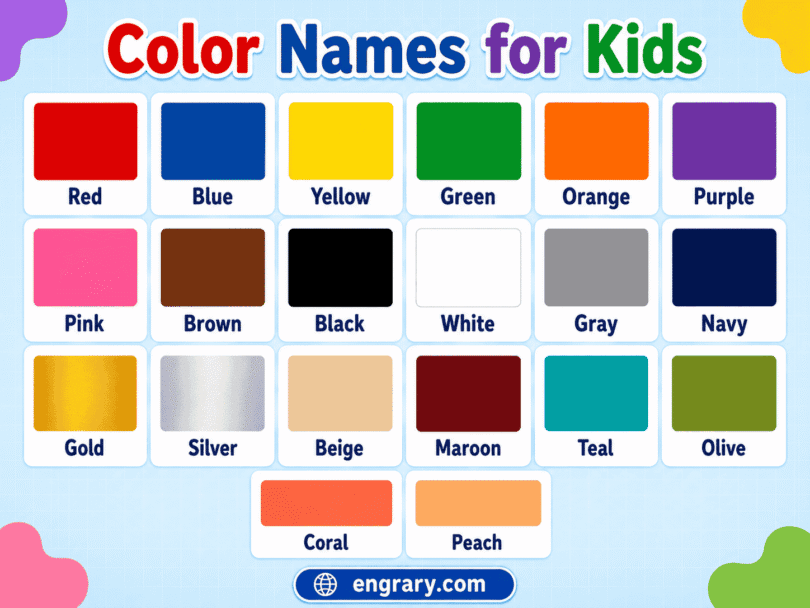
Basic Color Names for Kids
Basic color names are the main color words children use in early speaking, reading, and picture matching. Each color becomes easier when kids connect it with a familiar object.
- Red — the color of apples, strawberries, roses, and fire trucks.
- Blue — the color of the sky, ocean, blueberries, and many toy cars.
- Yellow — the color of the sun, bananas, lemons, and school buses.
- Green — the color of grass, leaves, frogs, and cucumbers.
- Orange — the color of carrots, pumpkins, oranges, and traffic cones.
- Purple — the color of grapes, plums, eggplants, and some flowers.
- Pink — the color of many flowers, cotton candy, ribbons, and dresses.
- Brown — the color of wood, soil, chocolate, and teddy bears.
- Black — a very dark color seen in shoes, tires, bats, and cats.
- White — the color of snow, clouds, milk, and paper.
- Gray — a color between black and white, seen in stones, elephants, and clouds.

Color Names with Real Object Examples
Real object examples help children connect color words with things they already know. Use clear objects that children can recognize in pictures, books, classrooms, or daily life.
- Red apple
- Red strawberry
- Red rose
- Red fire truck
- Blue sky
- Blue balloon
- Blue whale
- Blue crayon
- Yellow sun
- Yellow banana
- Yellow lemon
- Yellow school bus
- Green leaf
- Green frog
- Green grass
- Green cucumber
- Orange carrot
- Orange pumpkin
- Orange fruit
- Orange traffic cone
- Purple grapes
- Purple flower
- Purple plum
- Purple eggplant
- Pink rose
- Pink dress
- Pink ribbon
- Pink cotton candy
- Brown teddy bear
- Brown tree trunk
- Brown chocolate
- Brown basket
- Black shoes
- Black cat
- Black tire
- Black hat
- White cloud
- White snow
- White paper
- White milk
- Gray stone
- Gray elephant
- Gray cloud
- Gray pencil
More Object Examples for Extra Color Names
Extra color names become easier when children see them with simple objects. These examples work well for older preschoolers, kindergarten learners, and picture vocabulary cards.
- Gold crown
- Gold coin
- Gold trophy
- Silver spoon
- Silver bell
- Silver key
- Beige sand
- Beige basket
- Cream candle
- Cream blanket
- Navy backpack
- Navy shirt
- Teal cup
- Teal crayon
- Turquoise bracelet
- Turquoise bead
- Lavender flower
- Lavender ribbon
- Violet flower
- Violet crayon
- Maroon bag
- Maroon sweater
- Magenta marker
- Magenta flower
- Peach dress
- Peach crayon
- Mint leaf
- Mint notebook
- Coral shell
- Coral flower

Primary and Secondary Colors for Kids
Primary and secondary colors are useful in simple art lessons, coloring pages, and classroom sorting.
| Color Group | Color Names | Easy Examples |
|---|---|---|
| Primary colors | Red, Blue, Yellow | red apple, blue sky, yellow sun |
| Secondary colors | Orange, Green, Purple | orange carrot, green leaf, purple grapes |
Rainbow Color Names
Rainbow colors are useful for songs, posters, coloring pages, and early science activities. Children often learn them in the same order.
- Red
- Orange
- Yellow
- Green
- Blue
- Indigo
- Violet
Color Names vs Shade Names
A color name is the main color word. A shade name tells what kind of color it is, such as light, dark, bright, soft, pale, deep, or baby.
| Color Name | Shade Names |
| Blue | light blue, dark blue, sky blue, navy blue, baby blue |
| Green | light green, dark green, mint green, forest green, lime green |
| Pink | light pink, baby pink, hot pink, rose pink |
| Yellow | pale yellow, bright yellow, golden yellow, lemon yellow |
| Red | dark red, bright red, cherry red, maroon |
| Purple | light purple, deep purple, lavender, violet, plum |
| Brown | light brown, dark brown, tan, chocolate brown |
| Gray | light gray, dark gray, soft gray, charcoal gray |
| Orange | light orange, bright orange, peach, coral |
More Color Names Kids Can Use
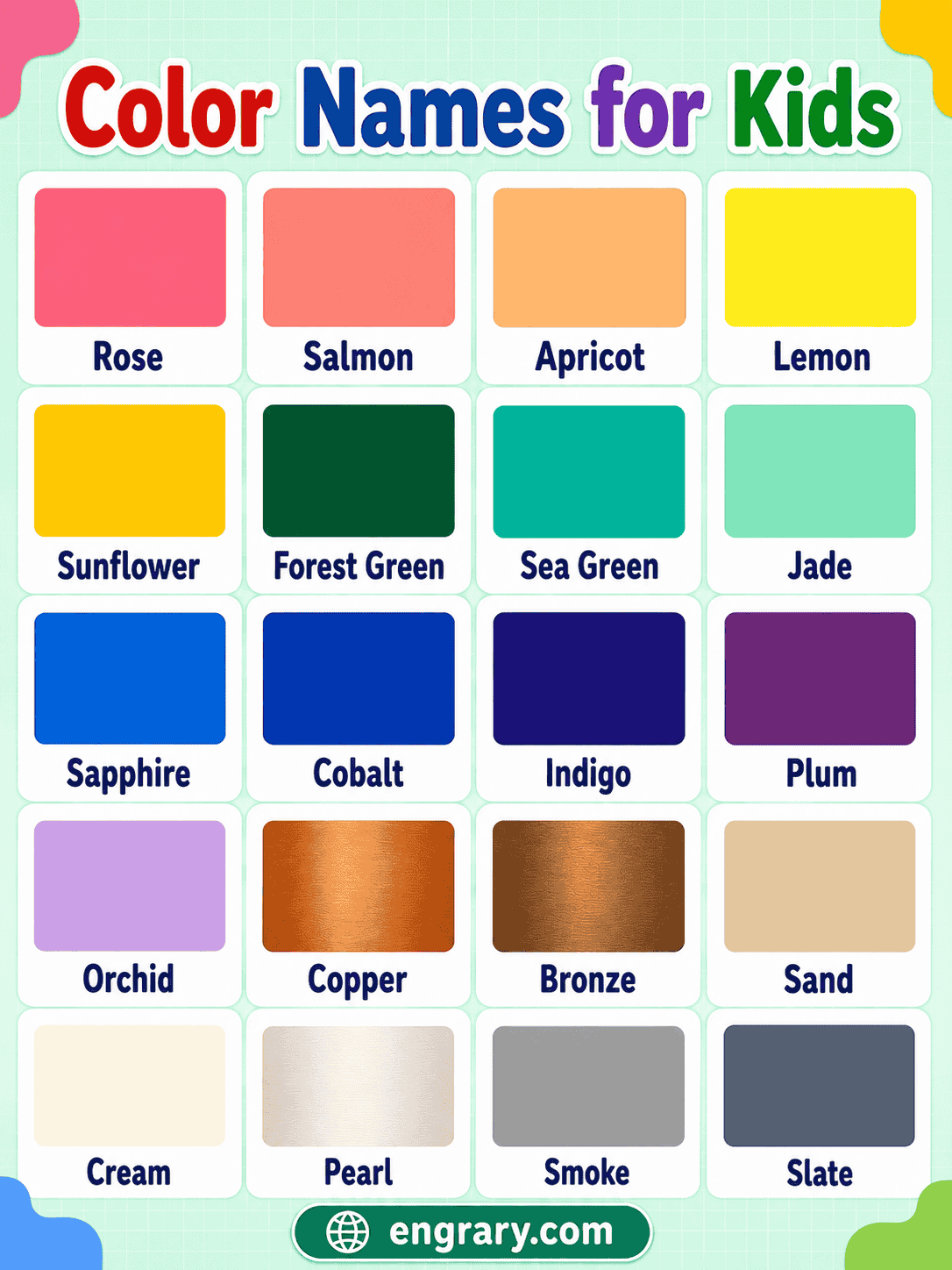
After children learn the basic colors, they can learn more color names that appear in books, crayons, clothes, posters, and classroom materials. Keep these words useful and child-friendly instead of using very rare color names.
- Gold — shiny yellow color.
- Silver — shiny gray color.
- Beige — light brown color.
- Cream — soft white-yellow color.
- Navy — very dark blue.
- Teal — blue-green color.
- Turquoise — bright blue-green color.
- Lavender — light purple color.
- Violet — purple-blue color.
- Indigo — deep blue-purple color.
- Maroon — dark red color.
- Magenta — bright pink-purple color.
- Peach — soft orange-pink color.
- Mint — light green color.
- Aqua — light blue-green color.
- Coral — pink-orange color.
- Ivory — warm white color.
- Olive — dark yellow-green color.
- Tan — light brown color.
- Sky blue — light blue like the sky.
- Lime green — bright green color.
- Forest green — dark natural green.
- Plum — dark purple color.
- Rose — soft pink-red color.
- Charcoal — very dark gray color.
Warm and Cool Color Words for Kids
Warm and cool color words are useful for simple sorting, art activities, and classroom posters. Keep this idea simple for children.
| Color Group | Color Words |
| Warm colors | red, orange, yellow, pink, coral, peach |
| Cool colors | blue, green, purple, teal, turquoise, lavender |
| Neutral colors | black, white, gray, brown, beige, cream |
Color Words for Sorting and Matching
Sorting and matching help children remember color names through play, movement, and picture practice. These tasks work well with crayons, toys, blocks, buttons, classroom cards, and printed worksheets.
| Activity | What Kids Do |
| Color sorting | Put red, blue, yellow, and green objects into groups. |
| Picture matching | Match a color word with a picture, such as red with apple. |
| Crayon matching | Match each crayon to its color name. |
| Toy sorting | Sort blocks, cars, balls, or buttons by color. |
| Light and dark sorting | Group colors into light and dark shades. |
| Rainbow order | Arrange colors as red, orange, yellow, green, blue, indigo, violet. |
| Clothes sorting | Sort shirts, socks, hats, or shoes by color. |
| Nature sorting | Sort leaves, flowers, stones, and sky pictures by color. |
Color Names for Preschool Kids
Preschool color words should be short, familiar, and easy to match with toys, clothes, food, and picture cards. The best preschool color words are the ones children can point to quickly.
- Red
- Blue
- Yellow
- Green
- Orange
- Pink
- Purple
- Black
- White
- Brown

Color Names for Kindergarten Kids
Kindergarten children can learn basic colors, shade words, and a few stronger color names for reading, sorting, and spelling.
- Gray
- Gold
- Silver
- Beige
- Cream
- Navy
- Teal
- Turquoise
- Lavender
- Violet
- Indigo
- Maroon
- Magenta
- Light blue
- Dark green
- Pale yellow
- Baby pink
- Bright orange
- Deep purple
- Soft gray
- Sky blue
- Lime green
- Forest green
- Chocolate brown
- Charcoal gray
Color Names Pronunciation Guide
Pronunciation support helps children and ESL learners say harder color names more clearly. Use it only for selected color words so the article stays clean and easy to read.
- 🔊 Orange — /ˈɔːr.ɪndʒ/
- 🔊 Purple — /ˈpɝː.pəl/
- 🔊 Yellow — /ˈjel.oʊ/
- 🔊 Turquoise — /ˈtɝː.kwɔɪz/
- 🔊 Lavender — /ˈlæv.ən.dɚ/
- 🔊 Violet — /ˈvaɪ.ə.lət/
- 🔊 Indigo — /ˈɪn.dɪ.goʊ/
- 🔊 Magenta — /məˈdʒen.tə/
- 🔊 Beige — /beɪʒ/
- 🔊 Maroon — /məˈruːn/
Simple “I See…” Color Sentences for Kids
Simple sentences help children use color names in real speech. These sentences are useful for reading practice, picture cards, and classroom speaking.
- I see a red apple.
- I see a blue ball.
- I see a yellow sun.
- I see a green leaf.
- I see an orange carrot.
- I see purple grapes.
- I see a pink flower.
- I see a brown bear.
- I see a black cat.
- I see a white cloud.
- I see a gray stone.
- I see a gold crown.
- I see a silver spoon.
- I see a navy backpack.
- I see a lavender ribbon.
- I see a teal shirt.
- I see a turquoise bracelet.
- I see a maroon bag.
- I see a magenta marker.
- I see a sky blue kite.
Sentence frames:
- I see a _____.
- The ball is _____.
- My shirt is _____.
- The flower is _____.
- The sky is _____.
- This crayon is _____.
- My bag is _____.
- The toy car is _____.

Color Names Quiz for Kids
Try this short color names quiz.
1. What color is the sky on a clear day?
A. Blue
B. Brown
C. Pink
Answer: A. Blue
2. What color is a banana?
A. Purple
B. Yellow
C. Black
Answer: B. Yellow
3. Which color is very dark?
A. Black
B. White
C. Yellow
Answer: A. Black
FAQs
Kids should learn familiar color names first, such as red, blue, yellow, green, orange, pink, purple, black, white, and brown. These colors are easy to find in toys, food, clothes, and picture books.
The basic color names for kids are red, blue, yellow, green, orange, purple, pink, brown, black, white, and gray. These colors help children describe everyday objects.
Primary colors are red, blue, and yellow. Secondary colors are orange, green, and purple. These color groups are useful in simple art lessons and color-sorting activities.
Use clear picture cards with familiar objects, such as a red apple, blue sky, yellow sun, green leaf, and orange carrot. Children can point to the picture, say the color, and match it with the correct word.
Good kindergarten color words include gray, gold, silver, beige, navy, teal, turquoise, lavender, violet, indigo, maroon, and magenta. These words help children move beyond basic color names.
You May Also Like