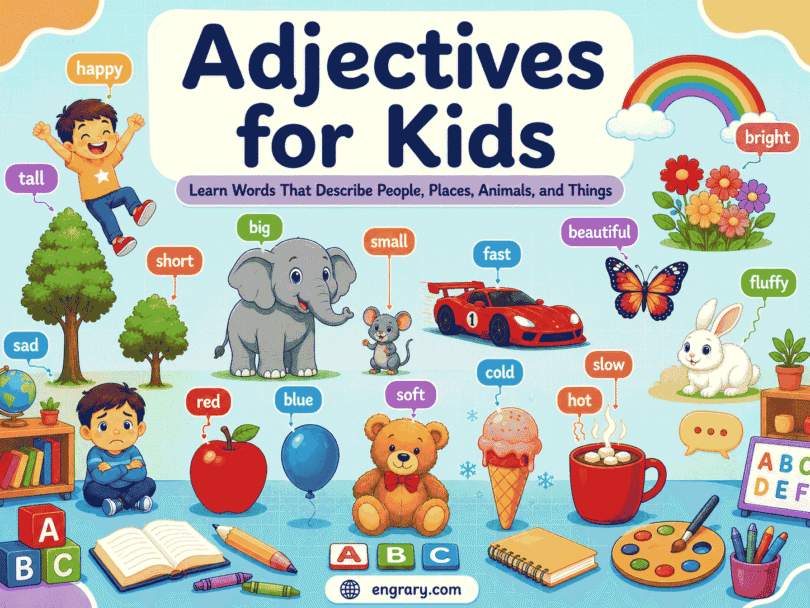
Adjectives make sentences clearer, more interesting, and more exact. Instead of saying, “I saw a dog,” a child can say, “I saw a small, playful dog.” Those extra words help the reader picture the dog more clearly.
Children use adjectives whenever they describe people, animals, places, objects, feelings, and experiences. By learning how adjectives work, students can identify them in sentences, compare things correctly, avoid common grammar mistakes, and choose stronger words in their own writing.
What Is an Adjective?
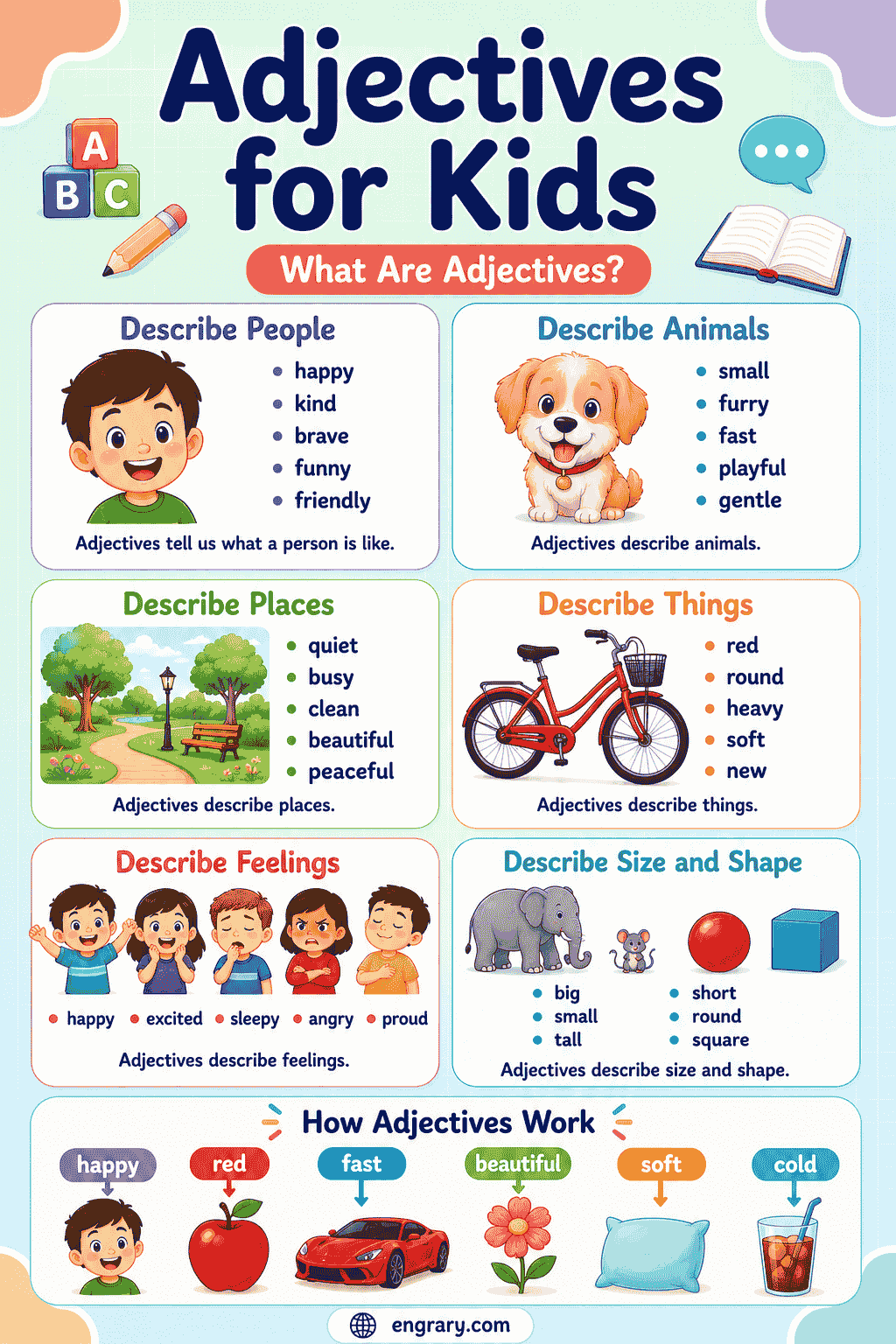
An adjective is a word that gives information about a noun or pronoun. It may describe what someone or something is like, show which one is meant, tell how many there are, or indicate ownership.
Consider these examples:
- a blue backpack
- three small kittens
- that house
- my pencil
- The soup is hot.
- They seem excited.
In each example, the bold word adds information. Some adjectives describe qualities, while others point out, count, or identify nouns.
What Do Adjectives Describe?
Adjectives most often describe nouns. A noun names a person, place, animal, thing, or idea.
- a helpful teacher
- a busy city
- a striped tiger
- a wooden table
- a brilliant idea
However, adjectives can also describe pronouns after linking verbs.
- She is kind.
- He looks tired.
- They are ready.
- It feels soft.
In these sentences, the adjectives describe she, he, they, and it. The linking verbs connect each pronoun with its description.
Questions Adjectives Answer
Adjectives often answer one of several useful questions.
| Question | Example | Word Giving Information |
|---|---|---|
| What kind? | We found a smooth rock. | smooth |
| Which one? | That bicycle is mine. | that |
| How many? | I packed four sandwiches. | four |
| How much? | We have enough water. | enough |
| Whose? | Mia’s notebook is open. | Mia’s |
In the last example, Mia’s is a possessive noun. It works like an adjective because it modifies notebook and tells whose notebook it is.
Many elementary grammar programs teach words such as this, my, several, and which as adjectives. Other grammar systems call some of them determiners or quantifiers. For young learners, the most important skill is understanding what information each word gives and how it works in the sentence.
How to Find Adjectives in Sentences
A reliable way to find an adjective is to locate the noun first. After that, look for a word that describes, counts, points to, or shows ownership of that noun.
Consider this sentence:
The cheerful child carried a heavy box.
The nouns are child and box. The word cheerful describes the child, while heavy describes the box. Therefore, both words are adjectives.
Find the Noun First
Children can use this simple process:
- Find the person, place, animal, thing, or idea.
- Look for a word that gives information about that noun.
- Ask what kind, which one, how many, how much, or whose.
- Check the word’s job in the sentence.
For example:
Two noisy birds landed on the old fence.
The nouns are birds and fence. The word two tells how many birds, while noisy tells what kind. Meanwhile, old describes the fence.
The adjectives are two, noisy, and old.
Adjectives Before Nouns
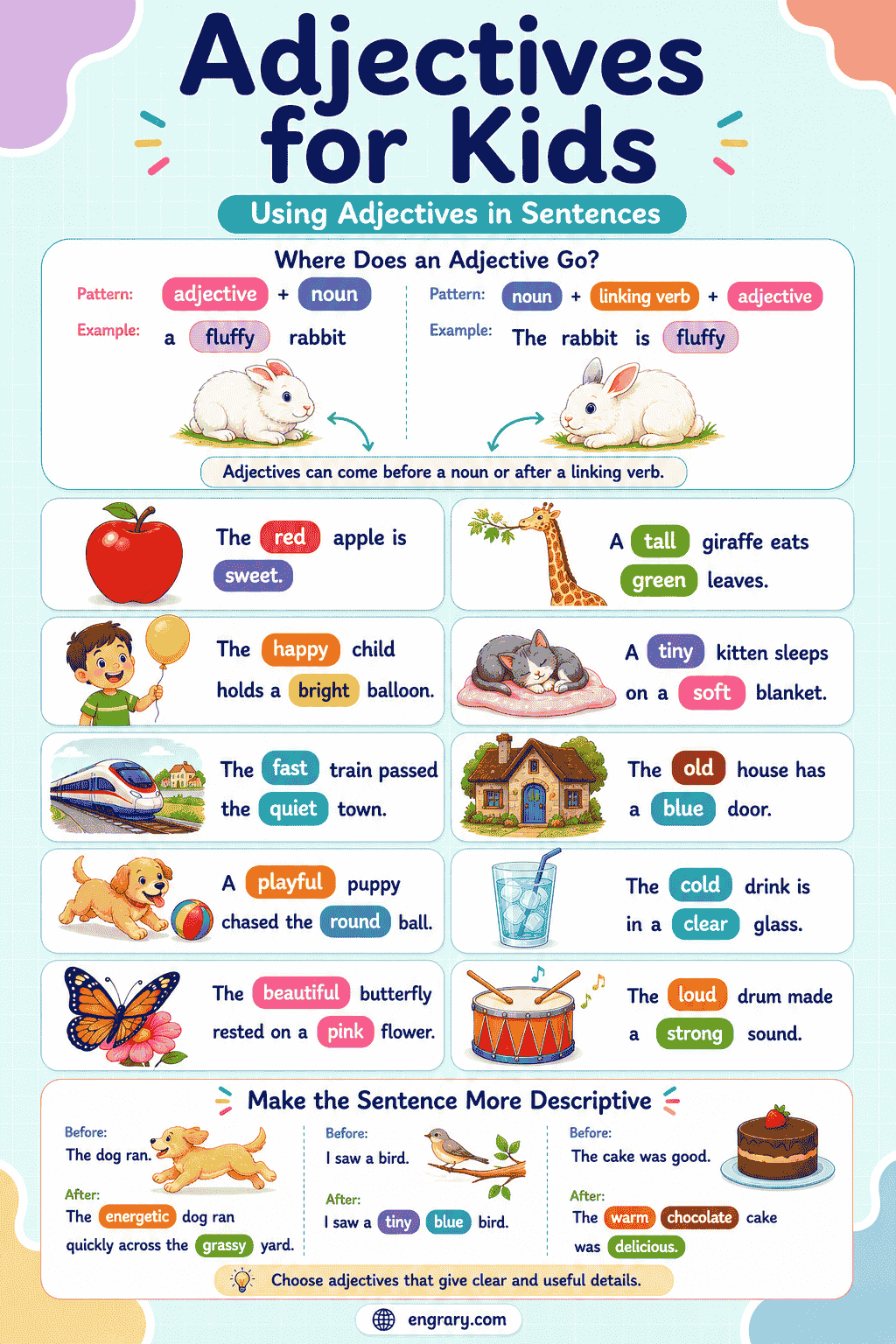
Adjectives frequently appear directly before the nouns they modify.
- a bright light
- an interesting book
- the green door
- several tiny insects
- her favorite song
Sometimes, more than one adjective appears before a noun.
- a small red wagon
- a soft woolen blanket
- three ripe yellow bananas
- an old wooden bridge
Although this position is common, adjectives do not always come before nouns. They may also appear later in the sentence after linking verbs.
Adjectives After Linking Verbs
A linking verb connects the subject with a word that describes or identifies it. Common linking verbs include:
- am
- is
- are
- was
- were
- seem
- look
- feel
- smell
- taste
- become
Examples:
- The sky is cloudy.
- The children seem quiet.
- This fabric feels rough.
- The cookies smell delicious.
- The leaves became dry.
In each sentence, the adjective describes the subject rather than the verb.
Compare these examples:
| Adjective After a Linking Verb | Adverb After an Action Verb |
|---|---|
| The turtle is slow. | The turtle moves slowly. |
| The singer sounds beautiful. | The singer performs beautifully. |
| The children are quiet. | The children entered quietly. |
In the first column, the bold words describe nouns or pronouns. In contrast, the bold words in the second column describe actions.
Descriptive Adjectives for Kids
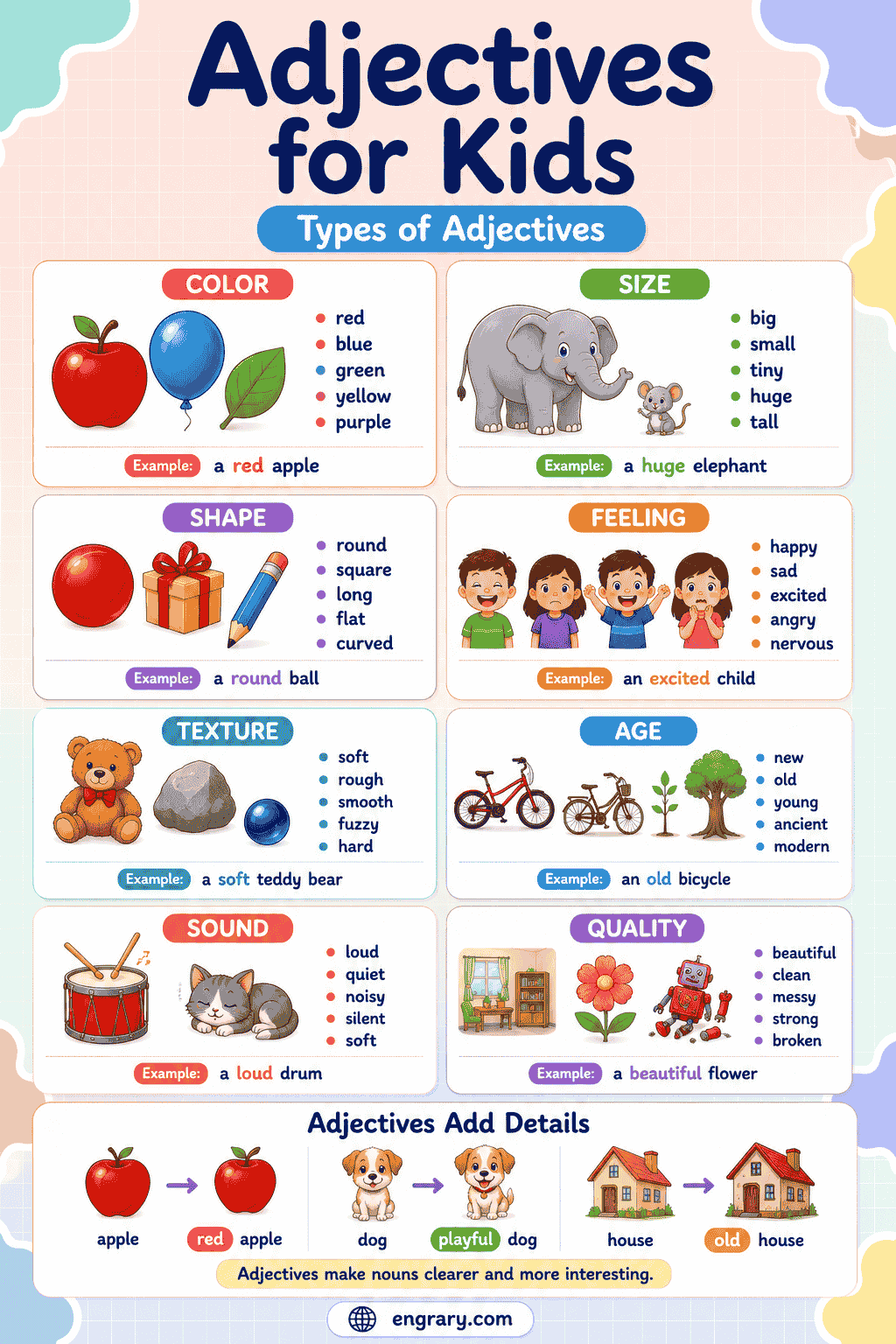
Descriptive adjectives tell what a person, animal, place, object, or idea is like. They may describe appearance, size, shape, texture, sound, taste, smell, age, condition, feeling, or quality.
Examples include:
- a brave firefighter
- a narrow road
- a gentle horse
- a difficult puzzle
- a peaceful afternoon
These adjectives help readers imagine people, places, and things more clearly. However, a good writer chooses details carefully instead of adding many unnecessary words.
Color, Size, and Shape Adjectives
Color adjectives describe appearance.
- a purple scarf
- a silver spoon
- a brown rabbit
- a white cloud
Size adjectives show how large, small, tall, short, wide, or narrow something is.
- a huge elephant
- a tiny seed
- a wide river
- a short ladder
Shape adjectives describe form.
- a round plate
- a square window
- a curved path
- a triangular sign
Descriptions can depend on context. For instance, a small dog may still be larger than a large rabbit. Therefore, adjective meanings often depend on what is being described.
Texture, Sound, Taste, and Smell Adjectives
Texture adjectives describe how something feels.
- a smooth pebble
- a rough wall
- a sticky note
- a fluffy pillow
Sound adjectives describe what something sounds like.
- a loud alarm
- a quiet whisper
- a musical voice
- a crackling fire
Taste adjectives explain flavor.
- a sweet peach
- a sour lemon
- a salty cracker
- a spicy sauce
Smell adjectives describe scent.
- fresh bread
- a fragrant flower
- a smoky room
- a stinky sock
Because these adjectives describe information received through the senses, they are especially useful in descriptive writing.
Feeling, Condition, and Quality Adjectives
Feeling adjectives describe emotions or physical states.
- a happy child
- a nervous speaker
- an angry customer
- a sleepy puppy
Condition adjectives show the state of someone or something.
- a broken chair
- a clean room
- a wet jacket
- a closed gate
Quality adjectives describe character, usefulness, or value.
- an honest friend
- a useful tool
- a creative solution
- a careful driver
Similar adjectives may express different levels of meaning. For example, nervous, worried, and terrified all describe uncomfortable feelings, but terrified is much stronger.
Common Types of Adjectives
Elementary grammar lessons often organize adjectives by the kind of information they provide. These categories help children understand how words modify nouns.
Quantity and Number Adjectives
Number adjectives tell exactly how many or indicate order.
- one apple
- six chairs
- the second chapter
- her first goal
Quantity adjectives give a general amount instead of an exact number.
- many visitors
- several questions
- enough food
- little time
- some juice
Many elementary lessons call these words number or quantity adjectives. Other grammar systems may classify some of them as determiners or quantifiers. Either way, they answer questions such as how many or how much.
Demonstrative Adjectives
Demonstrative adjectives point to particular nouns.
The four common demonstrative adjectives are:
- this
- that
- these
- those
Examples:
- This book is funny.
- That building is tall.
- These cookies are warm.
- Those birds are noisy.
A demonstrative word acts adjectivally when it comes before a noun.
Compare:
| Before a Noun | Used Alone |
|---|---|
| Those shoes are wet. | Those are wet. |
| This book is mine. | This is mine. |
In the first column, the demonstrative word modifies a noun. In the second, it stands alone as a pronoun.
Possessive Adjectives
Possessive adjectives show ownership or relationship.
Common possessive adjectives include:
- my
- your
- his
- her
- its
- our
- their
Examples:
- My backpack is heavy.
- Your answer is correct.
- Her bicycle is new.
- Our class planted flowers.
- Their dog loves water.
Possessive adjectives appear before nouns. By contrast, possessive pronouns such as mine, yours, hers, ours, and theirs stand alone.
| Possessive Adjective | Possessive Pronoun |
|---|---|
| This is my pencil. | This pencil is mine. |
| That is their dog. | That dog is theirs. |
The meaning is similar, but the sentence job is different.
Interrogative Adjectives
Interrogative adjectives help form questions about nouns.
The most common ones are:
- which
- what
- whose
Examples:
- Which movie should we watch?
- What color do you prefer?
- Whose jacket is on the chair?
Each interrogative word comes before a noun. However, the same word may act as a pronoun when it stands alone.
- Which book belongs to you?
- Which belongs to you?
How Adjective Types Can Overlap
Adjective categories are not always completely separate. One word may provide more than one kind of information.
For example:
- three is a number adjective and also expresses quantity;
- those points to particular nouns and limits which ones are meant;
- cold may describe weather, food, water, or a person’s physical feeling.
As a result, children should not focus only on memorizing labels. Instead, they should examine the word’s job and meaning in the sentence.
Comparative and Superlative Adjectives
Adjectives can compare people, animals, places, or things. The three comparison forms are called positive, comparative, and superlative.
Positive, Comparative, and Superlative Forms
The positive form describes someone or something without making a comparison.
- Mia is tall.
The comparative form compares two.
- Mia is taller than Ava.
The superlative form compares three or more.
- Mia is the tallest student in the group.
| Form | Purpose | Example |
|---|---|---|
| Positive | describes without comparing | fast |
| Comparative | compares two | faster |
| Superlative | compares three or more | fastest |
Comparatives often appear with than, while superlatives commonly appear with the.
- This road is narrower than that one.
- This is the narrowest road in town.
Adding -er and -est
Many short adjectives form comparisons by adding -er and -est.
| Positive | Comparative | Superlative |
|---|---|---|
| tall | taller | tallest |
| short | shorter | shortest |
| fast | faster | fastest |
| cold | colder | coldest |
When an adjective already ends in e, add only -r or -st.
- large → larger → largest
- nice → nicer → nicest
- safe → safer → safest
Some short adjectives double the final consonant.
- big → bigger → biggest
- hot → hotter → hottest
- thin → thinner → thinnest
When an adjective ends in a consonant followed by y, change y to i.
- happy → happier → happiest
- busy → busier → busiest
- funny → funnier → funniest
Using More and Most
Longer adjectives usually form comparisons with more and most.
- careful → more careful → most careful
- interesting → more interesting → most interesting
- beautiful → more beautiful → most beautiful
- expensive → more expensive → most expensive
Do not combine more with an adjective that already ends in -er. Likewise, avoid using most with an -est form.
| Incorrect | Correct |
|---|---|
| more taller | taller |
| more faster | faster |
| more happier | happier |
| most tallest | tallest |
| most fastest | fastest |
Irregular Comparative and Superlative Adjectives
Some adjectives do not follow the usual spelling patterns.
| Positive | Comparative | Superlative |
|---|---|---|
| good | better | best |
| bad | worse | worst |
| many | more | most |
| much | more | most |
| little | less | least |
| far | farther or further | farthest or furthest |
Examples:
- This book is better than the last one.
- That was the best game of the season.
- Today’s weather is worse than yesterday’s.
- This is the least expensive option.
These forms must be learned because regular endings would produce incorrect words.
Farther often refers to physical distance, while further commonly means additional or more advanced. However, real usage sometimes overlaps.
Using More Than One Adjective
A noun can have more than one adjective.
- a small red ball
- a cheerful young teacher
- two ripe yellow bananas
- an old wooden bridge
Nevertheless, adjectives usually follow a natural order in English.
Basic Adjective Order
A simplified pattern for young learners is:
opinion + size + age + color + material + noun
Examples:
- a lovely small garden
- a funny little puppy
- an old red wagon
- a beautiful wooden table
- a large brown leather bag
Not every phrase needs every kind of adjective. In fact, too many details can make a sentence crowded.
Overloaded:
- We saw a beautiful enormous old brown furry friendly dog.
Clearer:
- We saw a huge, friendly brown dog.
Repeated reading and speaking help children develop a natural sense of adjective order. Therefore, young learners do not need to memorize every advanced ordering category.
Commas Between Adjectives
Use a comma when two adjectives describe a noun equally.
- a cold, windy morning
- a bright, cheerful room
- a long, difficult journey
One useful test is to place and between the adjectives.
- a cold and windy morning
- a bright and cheerful room
- a long and difficult journey
Because these versions sound natural, commas are appropriate.
Do not normally add a comma when one adjective is more closely connected to the noun.
- three blue balloons
- a small wooden box
- two round tables
- an old brick wall
The phrase three and blue balloons would sound incorrect. Consequently, no comma belongs between three and blue.
Adjectives Compared With Other Words
A word’s job in a sentence determines its part of speech. Therefore, children should not assume that a word always belongs to one category.
Adjectives and Adverbs
An adjective describes a noun or pronoun. An adverb often describes a verb.
| Adjective | Adverb |
|---|---|
| The rabbit is quick. | The rabbit runs quickly. |
| The singer sounds beautiful. | The singer performs beautifully. |
| The children are quiet. | The children entered quietly. |
| The driver is careful. | The driver turns carefully. |
After a linking verb, use an adjective to describe the subject.
- The soup smells good.
- The blanket feels soft.
- The sky looks dark.
After an action verb, an adverb may explain how the action happens.
- The chef cooked well.
- The child spoke softly.
- The athlete ran quickly.
The word well can also function as an adjective when it refers to health.
- I feel well today.
Adjectives and Nouns
Some words can act as either nouns or adjectives.
- Orange is my favorite color.
- She wore an orange sweater.
In the first sentence, orange names a color, so it is a noun. In the second, it modifies sweater, so it acts as an adjective.
Another example shows the same change:
- The necklace is made of gold.
- She wore a gold necklace.
Children should identify the part of speech by examining the word’s job, not by memorizing only one label.
Adjectives After Pronouns and Linking Verbs
Adjectives can describe pronouns when a linking verb connects the pronoun with its description.
- She is generous.
- He seems confused.
- They look prepared.
- It became dangerous.
The adjective does not appear directly before the pronoun. Instead, the linking verb joins the pronoun to the describing word.
Choosing Stronger Adjectives
Strong writing does not require the longest or most unusual adjective. Instead, it requires the word that communicates the exact meaning.
| General Adjective | More Precise Choices |
|---|---|
| nice | friendly, pleasant, helpful |
| good | useful, delicious, excellent |
| bad | harmful, unfair, unpleasant |
| big | huge, enormous, wide |
| small | tiny, narrow, miniature |
| happy | cheerful, delighted, excited |
| sad | disappointed, lonely, miserable |
Compare:
- We had a nice day.
- We had a relaxing day.
The second sentence gives more specific information.
Similarly:
- The dog made a bad noise.
- The dog made a harsh growl.
Precise adjectives make writing vivid. However, writers should avoid adding details that do not help the reader.
Weak:
- The tall, nice, good, friendly teacher smiled.
Stronger:
- The friendly teacher smiled warmly.
Common Adjective Mistakes
Children often make predictable mistakes when using adjectives. The following table shows several common problems and their corrections.
| Mistake | Correct Form | Reason |
|---|---|---|
| two reds balloons | two red balloons | Adjectives usually do not become plural. |
| more smaller | smaller | Do not make a double comparative. |
| most tallest | tallest | Do not make a double superlative. |
| The bird sings beautiful. | The bird sings beautifully. | The word describes how the bird sings. |
| Of five towers, this one is taller. | Of five towers, this one is the tallest. | Use a superlative for three or more. |
| a red small wagon | a small red wagon | Size usually comes before color. |
| a cold windy morning | a cold, windy morning | Equal adjectives need a comma. |
| The cookies smell wonderfully. | The cookies smell wonderful. | A linking verb takes an adjective here. |
Another common problem is repeating vague adjectives.
Weak:
- We had a nice picnic in a nice park beside a nice lake.
Improved:
- We had a peaceful picnic in a shady park beside a sparkling lake.
Adjective Practice for Kids
Complete the activities before checking the answer key.
Identify and Sort Adjectives
A. Find the adjectives
Identify the adjective or adjectives in each sentence.
- The playful puppy chased a yellow ball.
- Three ducks crossed the narrow road.
- My new backpack has two large pockets.
- The soup smells delicious.
- Those noisy students entered the quiet library.
- A tired hiker rested beside a shady tree.
- The round table has a smooth surface.
- Her cheerful brother carried several heavy bags.
B. Sort the adjectives
Place each word in the correct group.
Word bank: round, sour, tiny, cheerful, rough, purple, loud, broken
| Color | Size | Shape | Texture | Sound | Taste | Feeling | Condition |
|---|
Choose and Form Adjectives
A. Choose the correct word
- The baby slept (peaceful / peacefully) in the crib.
- The baby looked (peaceful / peacefully).
- This box is (heavy / heavily).
- Noah lifted the box (careful / carefully).
- The flowers smell (sweet / sweetly).
- The children spoke (quiet / quietly).
- Ava feels (well / goodly) today.
- The musician played (beautiful / beautifully).
B. Complete the comparisons
- tall → ______ → ______
- large → ______ → ______
- big → ______ → ______
- happy → ______ → ______
- careful → ______ → ______
- good → ______ → ______
- bad → ______ → ______
- interesting → ______ → ______
Fix Adjective Errors
Rewrite each sentence correctly.
- I found two greens marbles.
- This rope is more longer than that one.
- Mia is the most fastest runner on the team.
- The dog barked loud.
- Of the five buildings, this one is taller.
- We walked into a cold windy room.
- Leo carried a blue small suitcase.
- The cookies smell wonderfully.
Expand and Write Sentences
A. Put the adjectives in a natural order
- a / red / small / wagon
- an / old / wooden / bridge
- a / lovely / small / garden
- three / yellow / ripe / bananas
- a / leather / large / brown / bag
B. Expand each sentence
Add at least two suitable adjectives.
- The cat slept.
- We visited a park.
- A bird landed on the fence.
- The child opened the box.
C. Write your own sentences
Write:
- one sentence with a descriptive adjective;
- one sentence with a possessive adjective;
- one sentence with a demonstrative adjective;
- one sentence with a comparative adjective;
- one sentence with a superlative adjective.
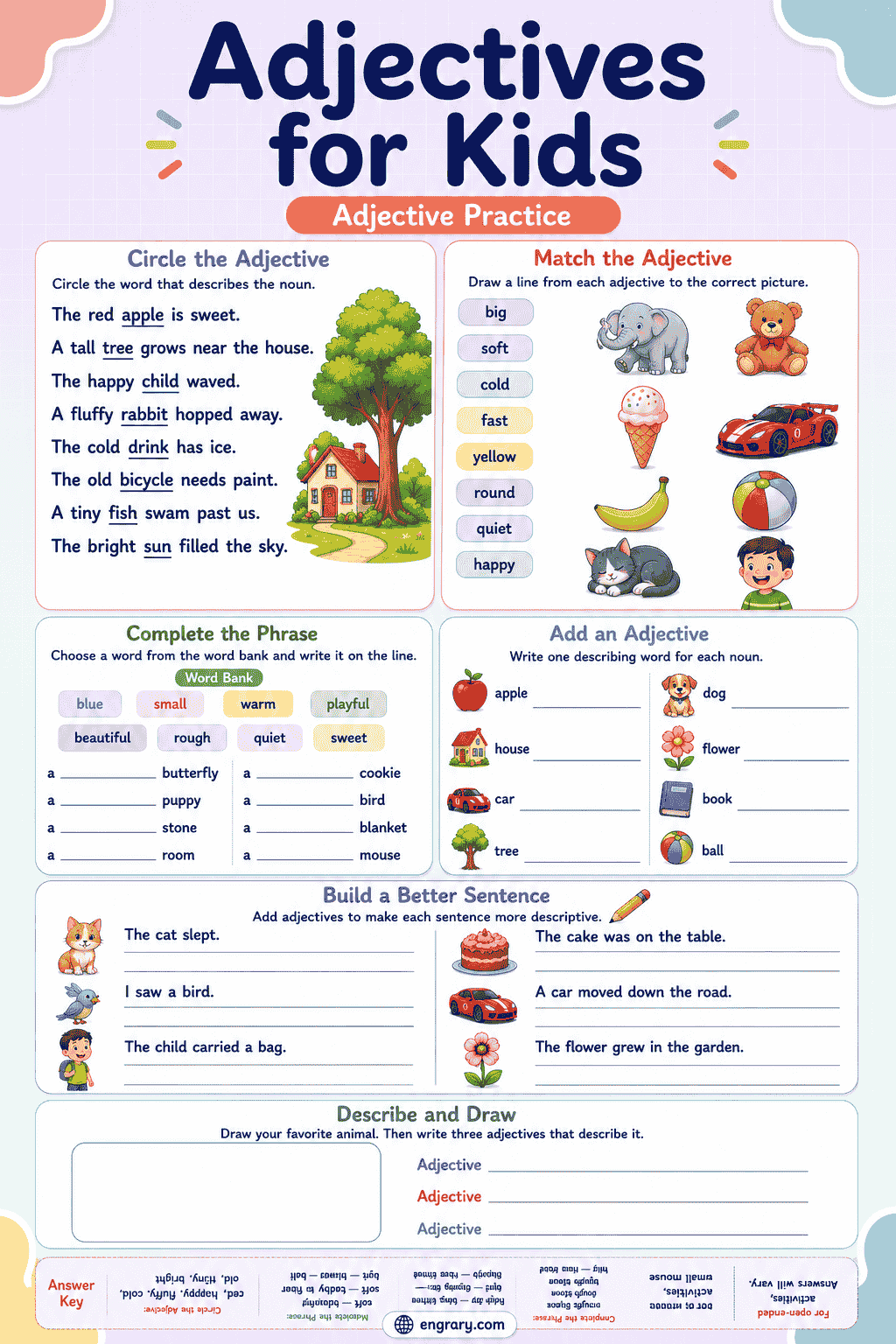
Adjective Practice Answer Key
Identify and Sort Adjectives
A. Find the adjectives
- playful, yellow
- three, narrow
- my, new, two, large
- delicious
- those, noisy, quiet
- tired, shady
- round, smooth
- her, cheerful, several, heavy
B. Sort the adjectives
| Group | Answer |
|---|---|
| Color | purple |
| Size | tiny |
| Shape | round |
| Texture | rough |
| Sound | loud |
| Taste | sour |
| Feeling | cheerful |
| Condition | broken |
Choose and Form Adjectives
A. Choose the correct word
- peacefully
- peaceful
- heavy
- carefully
- sweet
- quietly
- well
- beautifully
B. Complete the comparisons
- tall → taller → tallest
- large → larger → largest
- big → bigger → biggest
- happy → happier → happiest
- careful → more careful → most careful
- good → better → best
- bad → worse → worst
- interesting → more interesting → most interesting
Fix Adjective Errors
- I found two green marbles.
- This rope is longer than that one.
- Mia is the fastest runner on the team.
- The dog barked loudly.
- Of the five buildings, this one is the tallest.
- We walked into a cold, windy room.
- Leo carried a small blue suitcase.
- The cookies smell wonderful.
Expand and Write Sentences
A. Natural adjective order
- a small red wagon
- an old wooden bridge
- a lovely small garden
- three ripe yellow bananas
- a large brown leather bag
B. Sample answers
- The sleepy gray cat slept.
- We visited a large, peaceful park.
- A small blue bird landed on the fence.
- The curious young child opened the box.
Other answers are acceptable when the adjectives fit the nouns and the sentences remain grammatically correct.
C. Sample answers
- The fluffy rabbit ate a carrot.
- My lunchbox is on the table.
- Those flowers are beautiful.
- This puzzle is easier than the last one.
- Ava chose the brightest flashlight.
FAQs
An adjective is a word that gives information about a noun or pronoun. It may describe what something is like, which one is meant, how many there are, or who owns it.
Yes. A sentence may contain several adjectives, and one noun can also have more than one adjective, as in a small red ball.
Adjectives often appear before nouns or after linking verbs. For example, a soft blanket and the blanket feels soft both contain adjectives.
An adjective describes a noun or pronoun, while an adverb often describes a verb. In the quick rabbit, quick is an adjective. In the rabbit runs quickly, quickly is an adverb.
A comparative adjective compares two people or things, while a superlative adjective usually compares three or more. For example, taller is comparative, and tallest is superlative.
You May Also Like