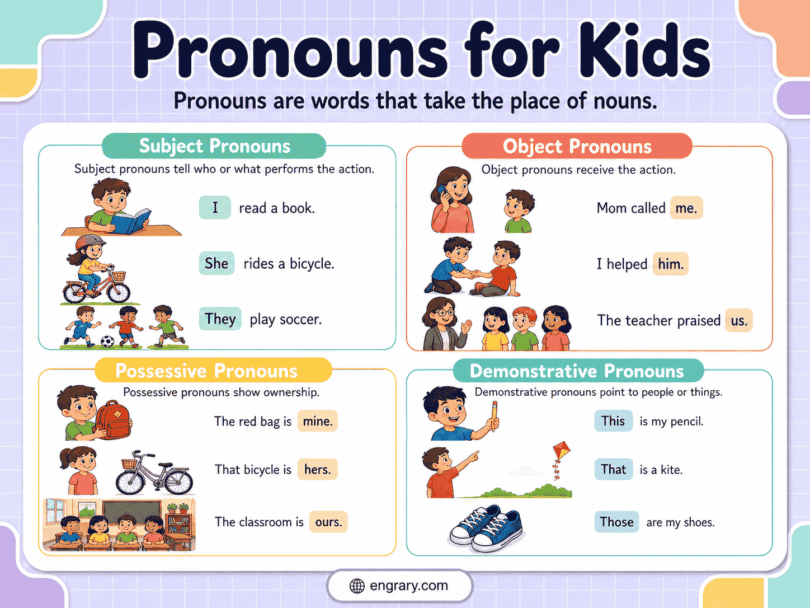
Pronouns help sentences sound clear and natural because they let us refer to people, animals, places, things, and ideas without repeating the same nouns again and again. Words such as I, she, it, they, mine, this, who, and someone are all pronouns.
This guide explains the main types of pronouns, shows how pronouns connect to antecedents, and teaches children how to choose the correct form. It also covers agreement, clear reference, common mistakes, and practical exercises with answers.
What Is a Pronoun?
A pronoun is a word that replaces a noun or refers to a person, animal, place, thing, or idea without naming it directly.
Read this repetitive sentence:
Maya found Maya’s backpack, and Maya placed Maya’s backpack on the chair.
Now compare it with the improved version:
Maya found her backpack, and she placed it on the chair.
The pronouns make the sentence shorter and smoother.
- Her shows that the backpack belongs to Maya.
- She refers to Maya.
- It refers to the backpack.
Pronouns do more than replace nouns already mentioned. Some ask questions, point to objects, or refer generally to people and things.
Who called?
This is mine.
Someone left a notebook.
Pronouns and Antecedents
A pronoun often refers to a noun or noun phrase called its antecedent. The antecedent tells readers who or what the pronoun means.
Elena found the puppy. She carried it home.
| Pronoun | Antecedent |
|---|---|
| she | Elena |
| it | puppy |
Pronouns should connect clearly to their antecedents.
The students finished their projects and displayed them in the hallway.
In this sentence, their refers to the students, while them refers to the projects.
Not every pronoun has a stated antecedent.
Someone knocked at the door.
The pronoun someone refers to an unknown person rather than a previously named noun.
Personal Pronouns
Personal pronouns refer to particular people, animals, things, or groups. Their forms change according to person, number, and sentence function.
| Person | Subject pronoun | Object pronoun |
|---|---|---|
| First-person singular | I | me |
| First-person plural | we | us |
| Second person | you | you |
| Third-person singular | he, she, it | him, her, it |
| Third-person plural | they | them |
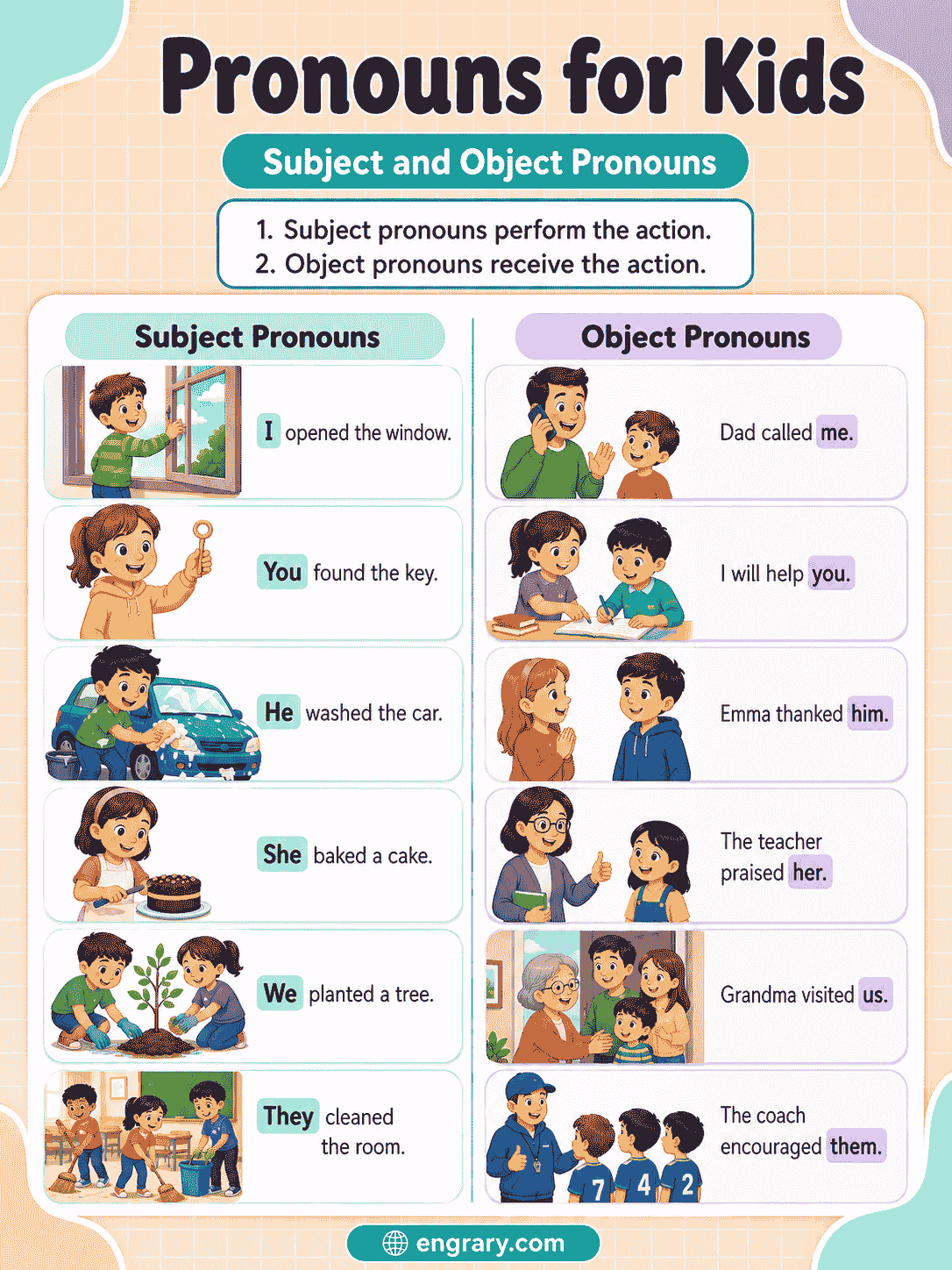
Subject and Object Pronouns
Subject pronouns perform the action or act as the main subject of a sentence.
Common subject pronouns include:
- I;
- you;
- he;
- she;
- it;
- we;
- they.
She opened the window.
They completed the project.
Object pronouns receive an action or follow a preposition.
Common object pronouns include:
- me;
- you;
- him;
- her;
- it;
- us;
- them.
The teacher praised him.
Ava invited us.
The package was for them.
Compare the forms:
| Subject form | Object form |
|---|---|
| I | me |
| you | you |
| he | him |
| she | her |
| it | it |
| we | us |
| they | them |
The pronoun’s job determines which form is correct.
They helped us.
They performs the action, while us receives it.
Choosing Between I and Me
Children often confuse I and me when another person’s name appears in the sentence.
Incorrect:
Ava and me went to the library.
Remove Ava and:
Me went to the library.
Because that sentence sounds wrong, use I:
Ava and I went to the library.
Now consider this sentence:
The teacher spoke to Noah and I.
Remove Noah and:
The teacher spoke to I.
The correct object form is me:
The teacher spoke to Noah and me.
A useful test is:
Remove the other person’s name and read the sentence with the pronoun alone.
In standard English, another person’s name usually comes before I or me.
Noah and I visited the library.
The teacher spoke to Maya and me.
First, Second, and Third Person
Personal pronouns also show who is speaking, who is being addressed, or who is being discussed.
| Point of view | Common pronouns | Example |
|---|---|---|
| First person | I, me, we, us | I opened the gate. |
| Second person | you | You should turn left. |
| Third person | he, she, it, they | They opened the gate. |
First person refers to the speaker or writer.
We visited the aquarium.
Second person speaks directly to the reader or listener.
You should bring a jacket.
Third person refers to another person, animal, thing, or group.
She found the missing key.
These forms also help readers identify the point of view in a story.
Singular They
The pronoun they can refer to one person when the person is unknown, when gender is not important, or when someone uses they/them pronouns.
Someone left their notebook.
A student should ask for help if they are confused.
Jordan said they would arrive soon.
Singular they is common in modern English and often sounds more natural than repeating he or she.
It still takes plural-form verbs:
They are ready.
Not:
They is ready.

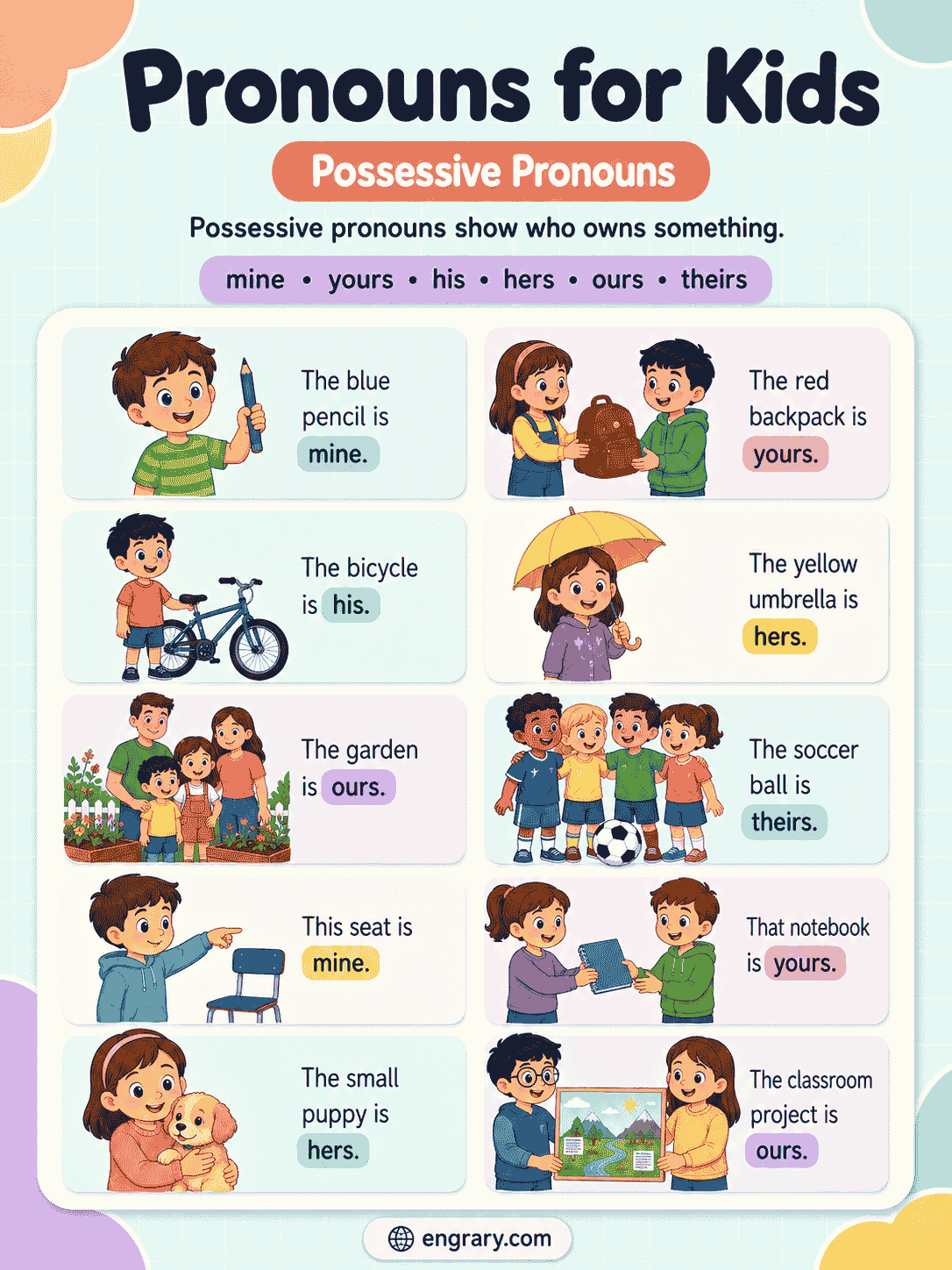
Possessive Pronouns and Determiners
Possessive forms show ownership or belonging. Some appear before nouns, while others stand alone.
Possessive determiners come directly before nouns.
| Possessive determiner | Example |
|---|---|
| my | my notebook |
| your | your coat |
| his | his desk |
| her | her pencil |
| its | its tail |
| our | our classroom |
| their | their project |
This is my notebook.
The dog wagged its tail.
Many school materials call these words possessive adjectives, although possessive determiners is the more precise term.
Possessive pronouns stand without a noun after them.
| Possessive pronoun | Example |
|---|---|
| mine | The notebook is mine. |
| yours | The coat is yours. |
| his | The desk is his. |
| hers | The pencil is hers. |
| ours | The classroom is ours. |
| theirs | The project is theirs. |
Compare the two forms:
| Before a noun | Stands alone |
|---|---|
| my book | the book is mine |
| your coat | the coat is yours |
| her pencil | the pencil is hers |
| our room | the room is ours |
| their project | the project is theirs |
English does not normally use a standalone possessive pronoun matching its.
Possessive pronouns also do not use apostrophes.
Correct:
- hers;
- ours;
- yours;
- theirs.
Incorrect:
- her’s;
- our’s;
- your’s;
- their’s.
Reflexive and Intensive Pronouns
Reflexive and intensive pronouns use forms ending in -self or -selves, but they perform different jobs.
| Personal pronoun | Reflexive or intensive form |
|---|---|
| I | myself |
| you | yourself / yourselves |
| he | himself |
| she | herself |
| it | itself |
| we | ourselves |
| they | themselves |
A reflexive pronoun is used when the subject and object refer to the same person or thing.
I taught myself to juggle.
The cat cleaned itself.
The students prepared themselves.
In each sentence, the action returns to the subject.
An intensive pronoun uses the same form but adds emphasis.
The principal herself opened the event.
We ourselves painted the room.
A simple test can help: remove the intensive pronoun.
The principal opened the event.
The sentence still works, so herself adds emphasis rather than receiving the action.
Reciprocal Pronouns
Reciprocal pronouns show a shared action or relationship between people.
The two reciprocal forms are:
- each other;
- one another.
The two friends helped each other.
The team members encouraged one another.
Compare reflexive and reciprocal meanings:
The students introduced themselves.
Each student introduced himself, herself, or themselves.
The students introduced one another.
Each student introduced another person in the group.
Avoid nonstandard forms such as hisself and theirselves in formal writing.
Demonstrative Pronouns
Demonstrative pronouns point to specific people or things.
| Number and distance | Pronoun |
|---|---|
| Singular and near | this |
| Singular and farther away | that |
| Plural and near | these |
| Plural and farther away | those |
This is delicious.
That belongs to Noah.
These are ready.
Those need washing.
The same words can also appear before nouns. In that position, they act as determiners rather than pronouns.
Pronoun:
These are fresh.
Determiner:
These apples are fresh.
A demonstrative pronoun stands alone, while a demonstrative determiner comes before a noun.
Interrogative and Relative Pronouns
Interrogative and relative pronouns share several forms, but they perform different jobs.
| Interrogative use | Relative use |
|---|---|
| asks a question | connects information to a noun |
| Who called? | The student who called is absent. |
| Which do you prefer? | The book which I borrowed is new. |
| Whose is this? | The artist whose work won is here. |
Not every interrogative pronoun is also used as a relative pronoun.
Interrogative Pronouns
Interrogative pronouns ask about unknown people, things, ownership, or choices.
Common forms include:
- who;
- whom;
- whose;
- which;
- what.
Who opened the window?
Which do you want?
Whose is this?
What happened?
Whom is mainly used as an object in formal English.
Whom did you invite?
In everyday speech, many people use who instead.
Relative Pronouns
Relative pronouns connect extra information to a noun.
Common forms include:
- who;
- whom;
- whose;
- which;
- that.
The student who won the contest thanked her teacher.
The bicycle that has the red seat belongs to Noah.
The author whose book we read visited the school.
In general:
- who refers to people;
- which refers to things;
- whose shows possession;
- that can refer to people or things in many sentences.
Indefinite Pronouns
Indefinite pronouns refer to people, things, or amounts without naming a specific one.
| Meaning | Examples |
|---|---|
| Unspecified person | someone, anyone, everyone, nobody |
| Unspecified thing | something, anything, everything, nothing |
| Amount or number | all, some, many, few, several, none |
| Individual choice | each, either, neither |
Someone left a notebook.
Everything is ready.
Several volunteered to help.
Neither was available.
Some indefinite pronouns are treated as singular.
Everyone brought their lunch.
Here, singular they provides a natural way to refer to each person without specifying gender.
Other indefinite pronouns are plural.
Several brought their notebooks.
Words such as all, some, and none can be singular or plural depending on what they refer to.
Some of the water is gone.
Some of the books are missing.
Context determines the correct verb and pronoun form.
Pronoun-Antecedent Agreement
A pronoun should match its antecedent in number and meaning.
Correct:
The puppies wagged their tails.
Incorrect:
The puppies wagged its tails.
The plural antecedent puppies requires the plural possessive form their.
A singular antecedent usually needs a singular form.
The dog wagged its tail.
Singular they can agree with one person when gender is unknown, not important, or specified that way.
Each student should check their work.
Although they has the same form used for plural groups, its meaning here is singular.
Clear Pronoun Reference
A grammatically correct pronoun can still confuse readers if its antecedent is unclear.
Unclear:
When Maya spoke to Emma, she was upset.
The reader cannot tell whether she refers to Maya or Emma.
Clear:
Maya was upset when she spoke to Emma.
Another clear version is:
Emma was upset when Maya spoke to her.
Consider another example:
Liam placed the book beside the tablet, but it was broken.
The word it could refer to either object.
Clear:
Liam placed the book beside the broken tablet.
A clear pronoun should point to only one reasonable antecedent.
Common Pronoun Mistakes
Pronoun errors usually involve choosing the wrong form, showing possession incorrectly, or leaving the reference unclear.
Using the Wrong Personal Pronoun
Incorrect:
Me and Noah finished first.
Correct:
Noah and I finished first.
Incorrect:
The teacher called she.
Correct:
The teacher called her.
Use subject pronouns as sentence subjects. Use object pronouns when they receive an action or follow a preposition.
Using Myself Instead of Me
Incorrect:
Please send the form to Ava or myself.
Correct:
Please send the form to Ava or me.
Use myself when the subject is I and the action returns to the speaker.
I reminded myself about the meeting.
It can also add emphasis.
I myself checked the answer.
Adding Apostrophes to Possessive Pronouns
Incorrect:
The blue backpack is her’s.
Correct:
The blue backpack is hers.
Possessive pronouns already show ownership, so they do not need apostrophes.
Confusing Its and It’s
These forms have different meanings.
- Its shows possession.
- It’s means it is or it has.
The bird spread its wings.
It’s ready to fly.
A useful test is to replace it’s with it is. If the sentence still makes sense, the contraction is correct.
Confusing Their, There, and They’re
These words sound alike but have different jobs.
- Their shows ownership.
- There refers to a place.
- They’re means they are.
They’re placing their bags over there.
Making a Pronoun Ambiguous
Unclear:
Ava told Mia that she had won.
Who won—Ava or Mia?
Clear:
Ava told Mia that Mia had won.
Another possible meaning is:
Ava told Mia that Ava had won.
Repeat the noun when a pronoun could point to more than one person.
Using a Pronoun That Does Not Match
Incorrect:
The dogs wagged its tails.
Correct:
The dogs wagged their tails.
The plural antecedent dogs requires the plural possessive form their.
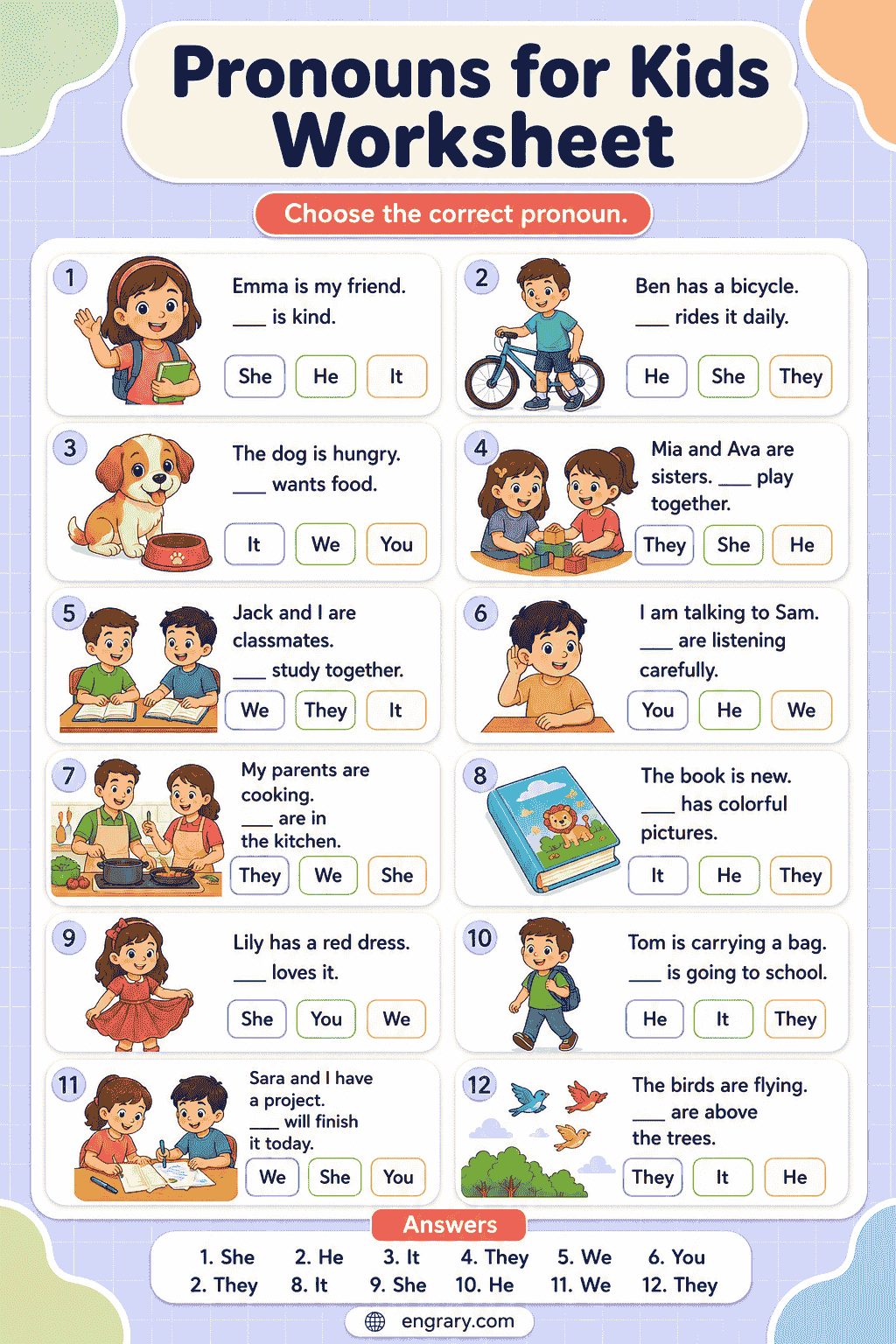
Pronoun Practice with Answers
Practice helps children connect pronoun forms with their jobs in complete sentences.
Replace the Repeated Nouns
Rewrite each sentence using suitable pronouns.
- Sofia found Sofia’s coat.
- Marcus picked up the keys and placed the keys on the desk.
- Ava and Mia finished Ava and Mia’s project.
- The dog saw the ball and chased the ball.
- Noah called Noah’s brother.
Identify the Pronoun and Antecedent
Find the pronoun and name its antecedent. If the reference is unclear, say so.
- Liam found the book and returned it.
- Elena called Mia because she needed help.
- The players packed the uniforms and carried them outside.
- The kitten saw the toy and chased it.
- The students finished the posters and displayed them.
Choose a Subject or Object Pronoun
- ___ opened the window. (she/her)
- The teacher called ___. (he/him)
- ___ invited us. (they/them)
- The gift was for ___. (we/us)
- ___ completed the task. (I/me)
Choose the Correct Possessive Form
- This is my / mine notebook.
- The notebook is my / mine.
- Their / theirs project won.
- The winning project was their / theirs.
- That coat is her / hers.
Complete the Reflexive Pronoun
- I made the card by __________.
- The cat cleaned __________.
- We prepared __________ for the game.
- She taught __________ to play chess.
- The children introduced __________.
Identify the Pronoun Type
Identify the type of each bold pronoun.
Choose from:
personal · possessive · reflexive · demonstrative · interrogative · relative · indefinite · reciprocal
- Who called?
- Someone left a notebook.
- The students helped one another.
- Those belong to Ava.
- The dog cleaned itself.
- The bicycle that has a red seat belongs to Noah.
- They arrived early.
- The red backpack is hers.
Identify the Point of View
Choose from first person, second person, and third person.
- I opened the door.
- You should read the instructions.
- They walked toward the bridge.
- We finished the project.
- She found the missing key.
Choose the Pronoun That Agrees
- The dogs wagged its / their tails.
- The dog carried its / their toy.
- The players brought his / their own uniforms.
- The girls finished her / their own project.
- Each student checked their / its work.
Correct the Pronoun Mistake
- Me and Emma finished first.
- The teacher spoke to Noah and I.
- The blue notebook is her’s.
- The bird spread it’s wings.
- Their leaving they’re bags over there.
- Please send the message to Maya or myself.
- The dogs wagged its tails.
Make the Reference Clear
Rewrite each sentence so the pronoun has one clear antecedent. More than one answer may be possible.
- When Ava spoke to Mia, she was laughing.
- Liam placed the book beside the tablet, but it was broken.
- Noah told Ethan that he had won.
- Emma called Sofia after she finished dinner.
- The teacher spoke to the student near the door because she was worried.
Answer Key
Replace the repeated nouns
- Sofia found her coat.
- Marcus picked up the keys and placed them on the desk.
- Ava and Mia finished their project.
- The dog saw the ball and chased it.
- Noah called his brother.
Identify the pronoun and antecedent
- Pronoun: it; antecedent: book
- Pronoun: she; antecedent: unclear
- Pronoun: them; antecedent: uniforms
- Pronoun: it; antecedent: toy
- Pronoun: them; antecedent: posters
Choose a subject or object pronoun
- she
- him
- they
- us
- I
Choose the correct possessive form
- my
- mine
- their
- theirs
- hers
Complete the reflexive pronoun
- myself
- itself
- ourselves
- herself
- themselves
Identify the pronoun type
- interrogative
- indefinite
- reciprocal
- demonstrative
- reflexive
- relative
- personal
- possessive
Identify the point of view
- first person
- second person
- third person
- first person
- third person
Choose the pronoun that agrees
- their
- its
- their
- their
- their
Correct the pronoun mistake
- Emma and I finished first.
- The teacher spoke to Noah and me.
- The blue notebook is hers.
- The bird spread its wings.
- They’re leaving their bags over there.
- Please send the message to Maya or me.
- The dogs wagged their tails.
Make the reference clear: possible answers
- Ava was laughing when she spoke to Mia.
Or: Mia was laughing when Ava spoke to her. - Liam placed the book beside the broken tablet.
Or: Liam placed the damaged book beside the tablet. - Noah told Ethan that Ethan had won.
Or: Noah told Ethan that Noah had won. - After Emma finished dinner, she called Sofia.
Or: Emma called Sofia after Sofia finished dinner. - Because the teacher was worried, she spoke to the student near the door.
Or: The teacher spoke to the worried student near the door.
FAQs
A pronoun is a word that replaces a noun or refers to a person, animal, place, thing, or idea without naming it directly.
The main types include personal, possessive, reflexive, demonstrative, interrogative, relative, indefinite, and reciprocal pronouns.
An antecedent is the noun or noun phrase that a pronoun refers to, such as puppy in “The puppy barked because it was excited.”
Use I as a subject and me as an object. Removing another person’s name from the sentence can help reveal the correct form.
Agreement helps readers understand whether a pronoun refers to one person or thing or to more than one. It also keeps the sentence clear and grammatically consistent.
You May Also Like