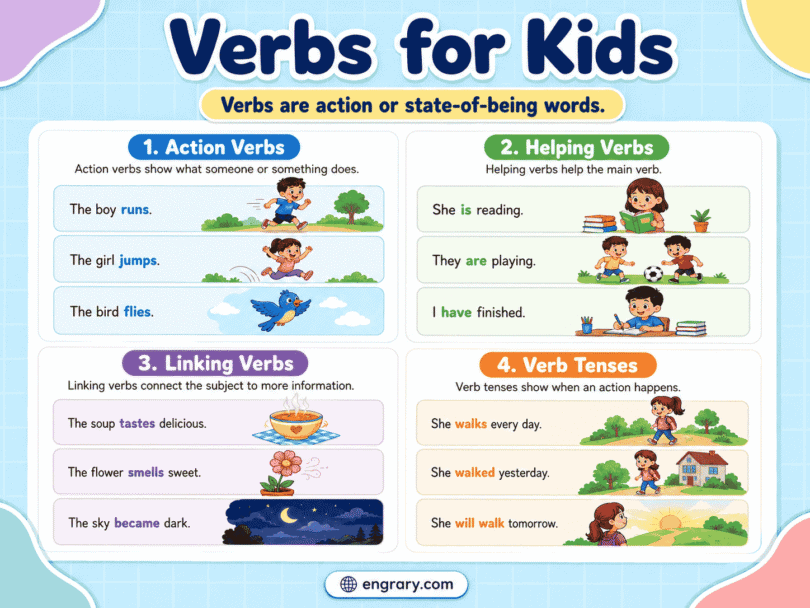
Verbs sit at the center of sentences because they tell us what a person, animal, place, thing, or idea does, is, feels, has, or experiences. Words such as run, think, is, became, has, and will can all work as verbs.
This guide explains how children can find verbs, identify their main types, recognize complete verb phrases, and choose correct forms for tense and subject-verb agreement. It also covers regular and irregular verbs, commonly confused forms, frequent mistakes, and practice activities with a full answer key.
What Is a Verb?
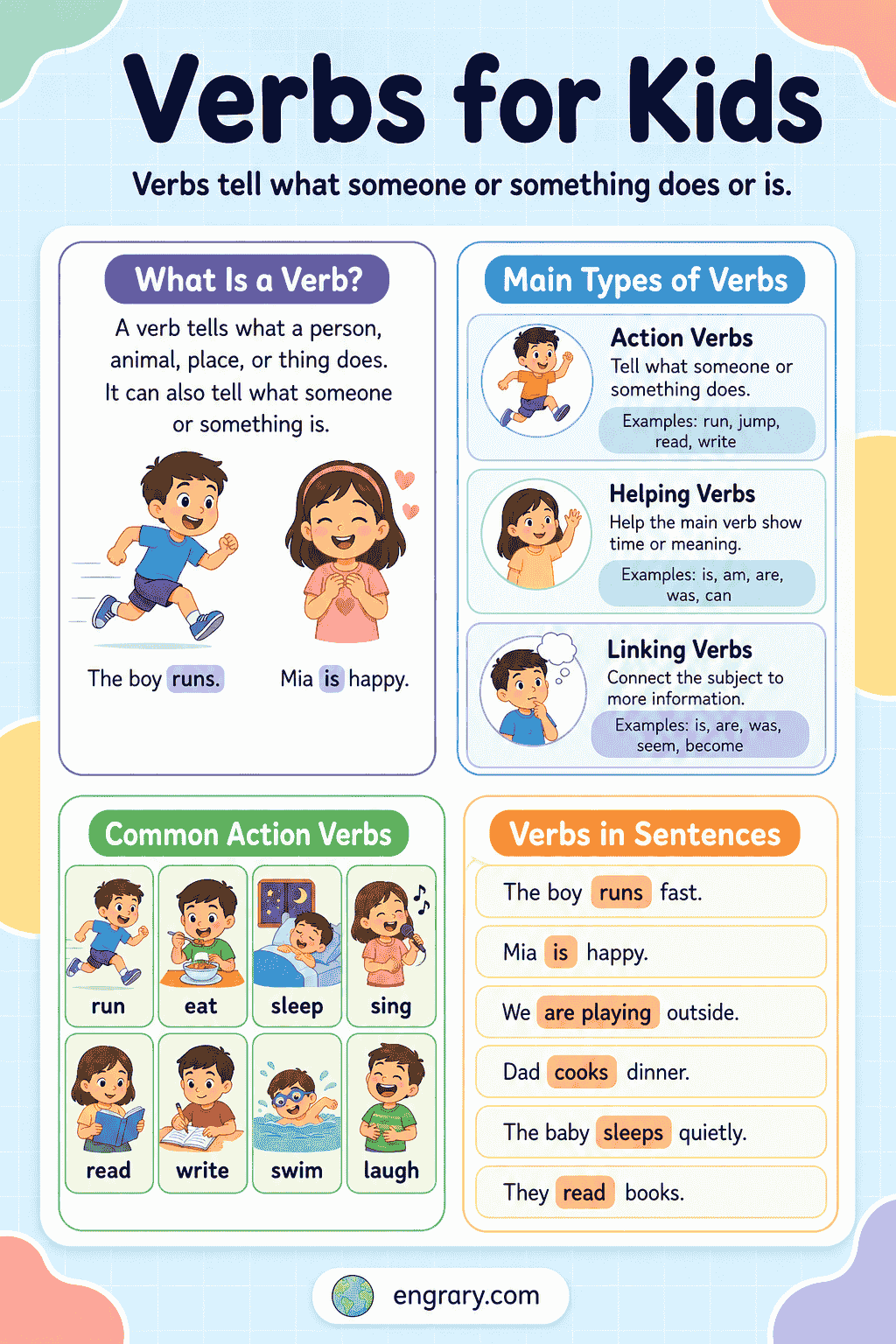
A verb is a word that shows an action, state, feeling, event, possession, or existence.
Some verbs show visible actions:
The dog runs.
Ava opened the window.
Other verbs show mental actions that cannot be seen:
Noah remembers the answer.
Mia understands the lesson.
A verb can also show what someone or something is, feels, or has.
The sky is cloudy.
The soup smells delicious.
Liam has a new backpack.
Verbs are sometimes called action words, but that definition is incomplete. Words such as is, seems, knows, wants, belongs, and has are also verbs even though they may not show visible movement.
A complete clause usually needs a subject and a verb.
Incomplete:
The puppy under the table.
Complete:
The puppy slept under the table.
The verb slept tells readers what the puppy did.
Compare these examples:
| Subject | Verb | Complete sentence |
|---|---|---|
| Birds | fly | Birds fly. |
| Ava | smiled | Ava smiled. |
| The soup | smells | The soup smells delicious. |
| Noah | has | Noah has a bicycle. |
Finding Verbs in Sentences
Children can find verbs more accurately by looking for actions, states, and complete verb phrases rather than searching only for movement words.
Use these steps:
- Find the subject.
- Ask what the subject does, is, feels, has, or experiences.
- Look for helping verbs before the main verb.
- Read the complete verb phrase.
- Check how the verb functions in that sentence.
Example:
Mia has been practicing every afternoon.
- Subject: Mia
- Helping verbs: has, been
- Main verb: practicing
- Complete verb phrase: has been practicing
Another example:
The soup smells delicious.
- Subject: soup
- Verb: smells
- Information about the subject: delicious
Here, smells does not show the soup performing an action. Instead, it connects the subject to a description.
Sometimes a sentence contains more than one verb.
Ava opened the book and began reading.
The verbs opened and began show two actions performed by Ava.
A sentence may also contain a verb inside another phrase or clause.
The student who won the contest smiled proudly.
The sentence contains:
- won, which belongs to the clause who won the contest;
- smiled, which is the main verb of the full sentence.
Main Types of Verbs
Three verb types are especially important for elementary learners.
| Verb type | Main job | Example |
|---|---|---|
| Action verb | shows what the subject does or thinks | Mia climbed the ladder. |
| Linking verb | connects the subject to a description or identity | Mia is tired. |
| Helping verb | supports the main verb | Mia is climbing. |
These categories describe how a verb works in a sentence. Other labels, such as regular, irregular, transitive, and intransitive, describe different features of verbs.
For example, jumped is:
- an action verb;
- a regular past-tense verb;
- intransitive in “Ava jumped.”
One verb can therefore belong to more than one grammar category.
Action Verbs
Action verbs show what a person, animal, thing, or idea does.
Noah threw the ball.
The baby laughed.
Mia solved the puzzle.
Action verbs may describe physical activity or mental activity.
Physical and Mental Action Verbs
Physical action verbs show movements or activities that can often be seen.
Common examples include:
- build;
- carry;
- climb;
- dance;
- draw;
- jump;
- kick;
- paint;
- run;
- throw;
- write.
Ava painted a picture.
The children climbed the hill.
Noah carried the boxes.
Mental action verbs describe thinking, understanding, remembering, or deciding.
Common examples include:
- believe;
- decide;
- imagine;
- know;
- remember;
- solve;
- think;
- understand;
- wonder.
Mia remembered the answer.
Liam imagined a different ending.
The students understood the instructions.
Mental actions may not be visible, but the words still act as verbs.
Strong and Precise Action Verbs
Precise verbs help readers picture an action more clearly.
| General verb | More precise choices |
|---|---|
| went | hurried, marched, wandered |
| looked | glanced, stared, peeked |
| moved | crawled, dashed, slid |
| ate | nibbled, chewed, devoured |
| spoke | whispered, shouted, replied |
General:
The dog went across the yard.
More precise:
The dog raced across the yard.
General:
Ava looked through the window.
More precise:
Ava peeked through the window.
A more unusual verb is not automatically better. The strongest choice is the verb that matches the action accurately and naturally.

Linking Verbs
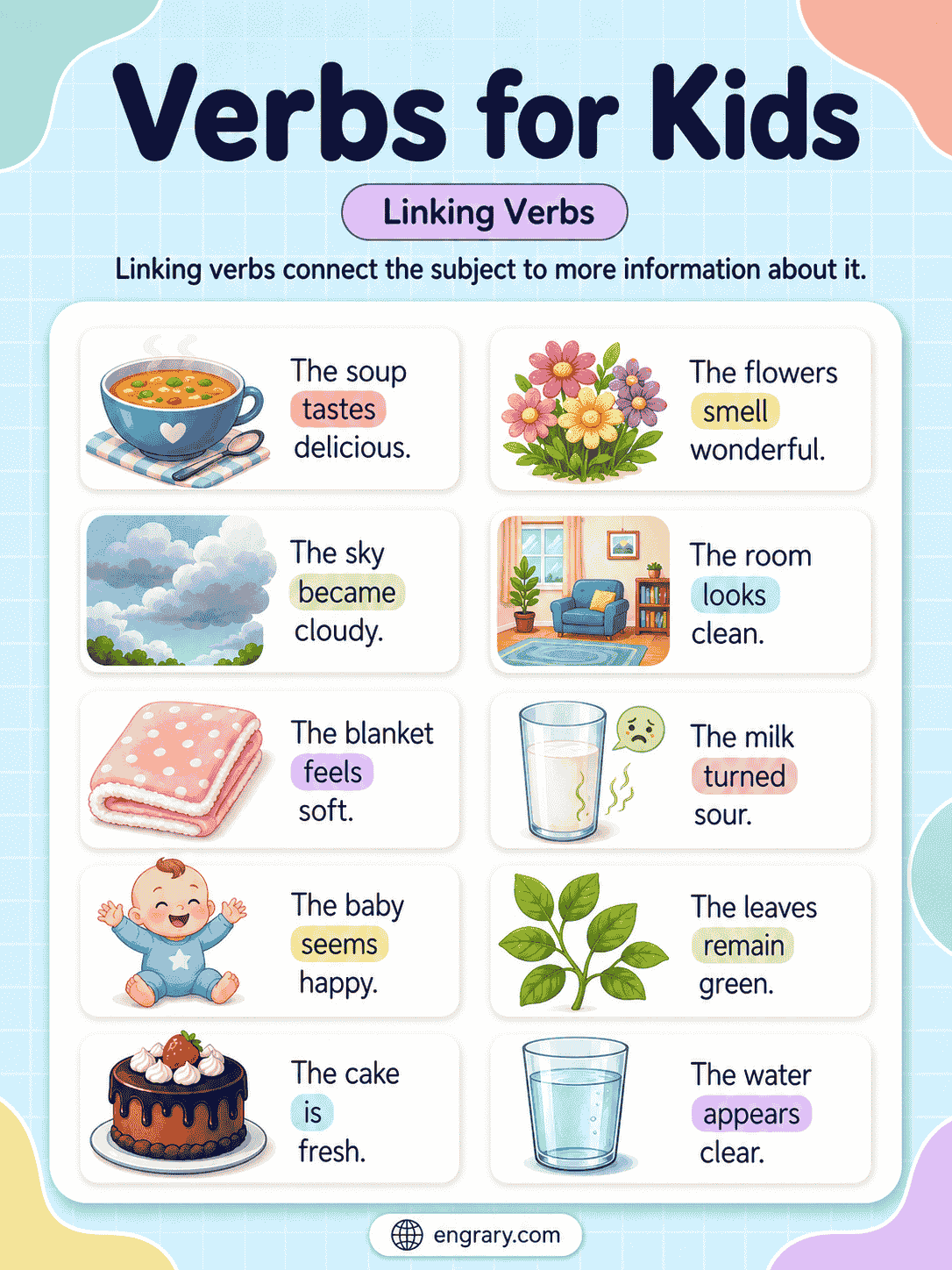
Linking verbs connect the subject to a word or phrase that identifies or describes it.
The sky is blue.
Noah became tired.
The soup smells delicious.
The words blue, tired, and delicious describe the subjects. The linking verbs connect each subject to that information.
Common linking verbs include:
- am;
- is;
- are;
- was;
- were;
- be;
- become;
- seem;
- appear;
- feel;
- look;
- smell;
- sound;
- taste.
A linking verb does not show an action passing to an object. Instead, it tells what the subject is like or what it becomes.
The children seem excited.
The music sounds peaceful.
The leaves became yellow.
A helpful test is to ask whether the word after the verb describes or identifies the subject.
The flowers smell sweet.
The word sweet describes flowers, so smell works as a linking verb.
Verbs That Can Be Action or Linking Verbs
Several verbs can perform different jobs depending on the sentence.
| Action use | Linking use |
|---|---|
| Mia smelled the flower. | The flower smelled sweet. |
| Noah tasted the soup. | The soup tasted salty. |
| Ava looked at the map. | Ava looked worried. |
| The child felt the fabric. | The fabric felt soft. |
| The gardener grew tomatoes. | The sky grew dark. |
In the action sentence:
Mia smelled the flower.
Mia performs the action of smelling.
In the linking sentence:
The flower smelled sweet.
The verb connects flower to the description sweet.
Children should therefore check the verb’s job in the sentence rather than classify a word from memory alone.
Helping Verbs and Main Verbs
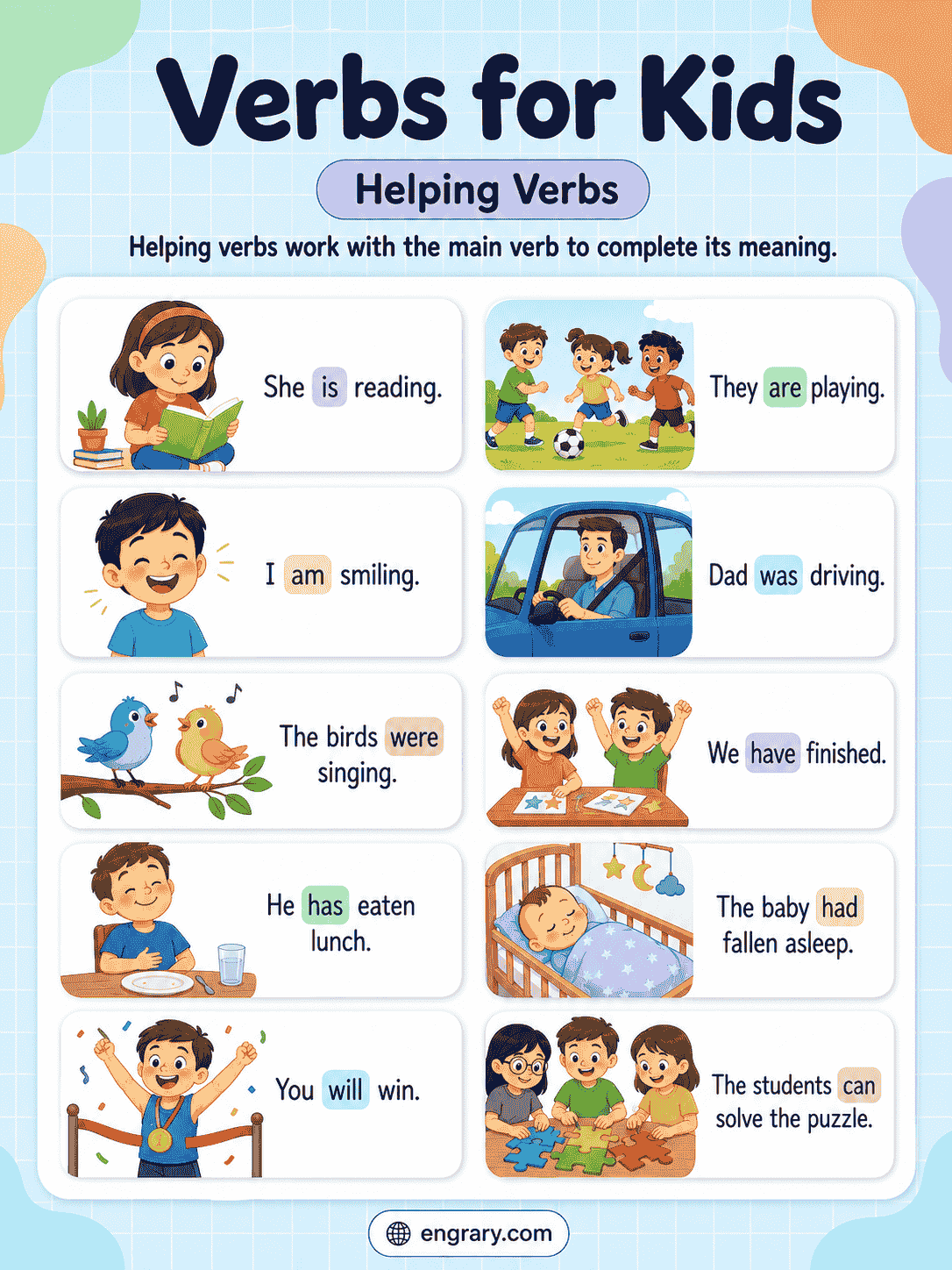
A helping verb supports a main verb. Together, they form a complete verb phrase.
Ava is running.
- Helping verb: is
- Main verb: running
- Complete verb phrase: is running
Primary helping verbs are forms of:
- be;
- have;
- do.
Examples:
We are studying.
Mia has finished.
Noah did complete the task.
Helping verbs can add information about:
- time;
- completion;
- emphasis;
- possibility;
- necessity;
- continuous action.
The students were working quietly.
The helping verb were helps show that the action was in progress in the past.
Ava has completed the project.
The helping verb has helps show that the action is complete.
Be, Have, and Do as Main or Helping Verbs
The verbs be, have, and do may work alone as main verbs or support another verb.
| Main-verb use | Helping-verb use |
|---|---|
| Mia is happy. | Mia is reading. |
| Noah has a bicycle. | Noah has finished. |
| We did the work. | We did complete the work. |
In:
Mia is happy.
The verb is is the main verb because no other verb follows it.
In:
Mia is reading.
The word is helps the main verb reading.
The sentence structure determines the verb’s job.
Modal Helping Verbs
Modal helping verbs add meanings such as ability, possibility, permission, advice, necessity, or future intention.
| Modal | Common meaning | Example |
|---|---|---|
| can | ability | Ava can swim. |
| could | past ability or possibility | Noah could read early. |
| may | permission or possibility | You may leave. |
| might | possibility | It might rain. |
| must | necessity | We must listen. |
| should | advice | You should rest. |
| will | future intention | We will return. |
| would | imagined or polite meaning | I would help. |
A modal comes before the base form of the main verb.
Correct:
She can swim.
Incorrect:
She can swims.
Correct:
We should leave.
Incorrect:
We should left.
After a modal, use the base verb.
Verb Phrases
A verb phrase contains a main verb alone or a main verb with one or more helping verbs.
Examples include:
- laughed;
- is laughing;
- has laughed;
- will laugh;
- might have laughed.
| Sentence | Helping verb or verbs | Main verb | Complete verb phrase |
|---|---|---|---|
| Mia runs. | none | runs | runs |
| Mia is running. | is | running | is running |
| Mia has finished. | has | finished | has finished |
| Mia will arrive. | will | arrive | will arrive |
| Mia has been practicing. | has, been | practicing | has been practicing |
Children should identify the entire verb phrase rather than circling only the last word.
The players have been waiting for an hour.
The complete verb phrase is have been waiting, not only waiting.
Forms ending in -ing are not always complete verbs by themselves.
Ava is running.
Here, is running is the complete verb phrase.
Compare:
Running is fun.
In this sentence, running names an activity and acts like a noun.
Another comparison:
Mia was painting.
The complete verb phrase is was painting.
Mia enjoys painting.
The main verb is enjoys. The word painting names the activity she enjoys.
Verb Tenses
Verb tense shows when an action, state, or event happens.
English verbs can refer broadly to present, past, or future time.
Present, Past, and Future Verbs
| Tense | Time | Example |
|---|---|---|
| Present | now, regularly, or generally | Ava walks to school. |
| Past | before now | Ava walked to school. |
| Future | after now | Ava will walk to school. |
Use the simple present for habits, routines, repeated actions, and general truths.
Noah reads every evening.
Water freezes at 32°F.
Use the simple past for completed actions before now.
Noah read the book yesterday.
Ava walked home.
The simple future often uses will plus the base form.
Noah will read tomorrow.
Ava will walk home.
A sentence may also include a time word that helps clarify the tense.
We played yesterday.
We play every Saturday.
We will play tomorrow.
Simple and Progressive Forms
Simple forms often show habits, completed actions, facts, or future events. Progressive forms show actions in progress.
| Form | Example | Main meaning |
|---|---|---|
| Simple present | Ava reads. | habit or general fact |
| Present progressive | Ava is reading. | happening now |
| Simple past | Ava read. | completed past action |
| Past progressive | Ava was reading. | happening during a past period |
| Simple future | Ava will read. | future action |
| Future progressive | Ava will be reading. | action in progress in the future |
Compare:
Noah writes after school.
This shows a routine.
Noah is writing now.
This shows an action currently in progress.
Noah was writing when the phone rang.
The writing was already in progress at a past time.

Regular and Irregular Verbs
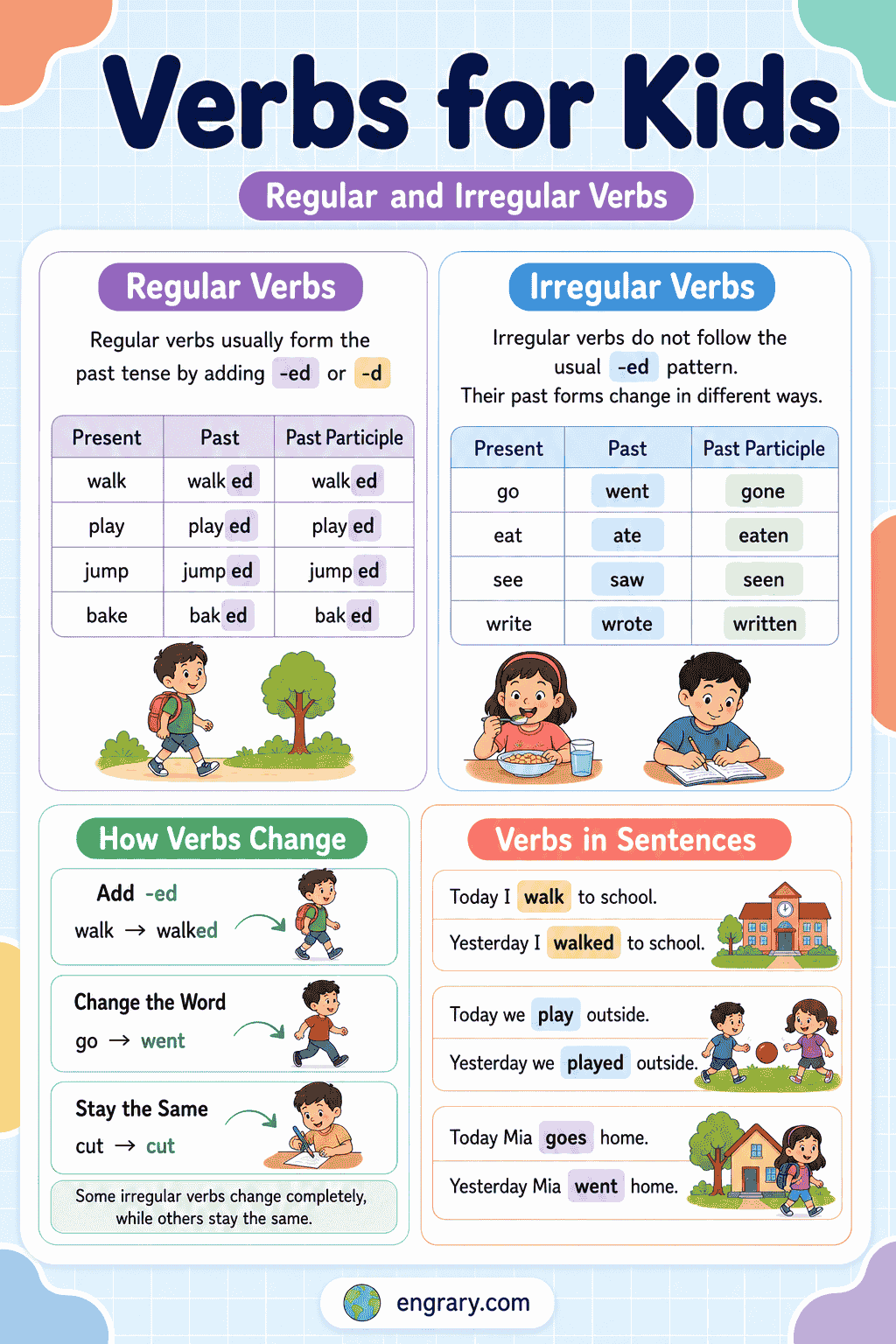
Regular verbs generally form the simple past by adding -ed or -d.
Irregular verbs change in other ways and must be learned individually.
| Base verb | Past tense | Type |
|---|---|---|
| jump | jumped | regular |
| play | played | regular |
| live | lived | regular |
| carry | carried | regular |
| go | went | irregular |
| see | saw | irregular |
| take | took | irregular |
| bring | brought | irregular |
Spelling Regular Past-Tense Verbs
Most regular verbs follow a few common spelling patterns.
| Pattern | Example |
|---|---|
| add -ed | jump → jumped |
| add -d after final e | live → lived |
| change consonant + y to i | carry → carried |
| double the final consonant in some short verbs | stop → stopped |
Examples:
play → played
smile → smiled
try → tried
plan → planned
Not every final consonant doubles. However, short one-syllable verbs ending in one vowel followed by one consonant often double that consonant before -ed.
hop → hopped
stop → stopped
Common Irregular Verbs
Irregular verbs do not form the past by adding -ed.
| Base form | Past form |
|---|---|
| begin | began |
| break | broke |
| bring | brought |
| buy | bought |
| come | came |
| do | did |
| eat | ate |
| find | found |
| give | gave |
| go | went |
| have | had |
| make | made |
| run | ran |
| see | saw |
| take | took |
| write | wrote |
Examples:
We went to the museum.
Ava brought her notebook.
Noah wrote a story.
Incorrect:
Noah goed home.
Correct:
Noah went home.
Because irregular forms do not follow one shared spelling rule, children learn them through repeated reading, speaking, and practice.
Subject-Verb Agreement
A verb should match its subject in number and person.
In the simple present, most verbs use the base form with I, you, we, and they. The third-person singular form usually ends in -s or -es.
| Subject | Verb |
|---|---|
| I | walk |
| you | walk |
| he, she, it | walks |
| we | walk |
| they | walk |
Examples:
The dog runs.
The dogs run.
She watches television.
They watch television.
Children sometimes find this pattern confusing because plural nouns often end in -s, while singular present-tense verbs also frequently end in -s.
Agreement with Be
The verb be changes more than most English verbs.
| Subject | Present form | Past form |
|---|---|---|
| I | am | was |
| you | are | were |
| he, she, it | is | was |
| we | are | were |
| they | are | were |
Examples:
I am ready.
She is ready.
They are ready.
We were early.
The puppy was sleepy.
Common Subject-Verb Agreement Rules
Singular and Plural Subjects
A singular subject usually takes a singular verb.
The bird sings.
A plural subject usually takes a plural verb.
The birds sing.
Subjects Joined by And
Two subjects joined by and are usually plural.
Ava and Mia are ready.
The dog and the cat play together.
Words Between the Subject and Verb
Extra words between the subject and verb do not change the subject.
The box of pencils is heavy.
The subject is box, not pencils.
The students in the classroom are quiet.
The subject is students.
Everyone and Similar Words
Words such as everyone, someone, each, and nobody are grammatically singular.
Everyone is ready.
Each student has a notebook.
A later pronoun may naturally use singular they.
Everyone brought their notebook.
There Is and There Are
In standard edited English, the verb should match the noun that follows.
There is one book on the desk.
There are three books on the desk.
Transitive and Intransitive Verbs
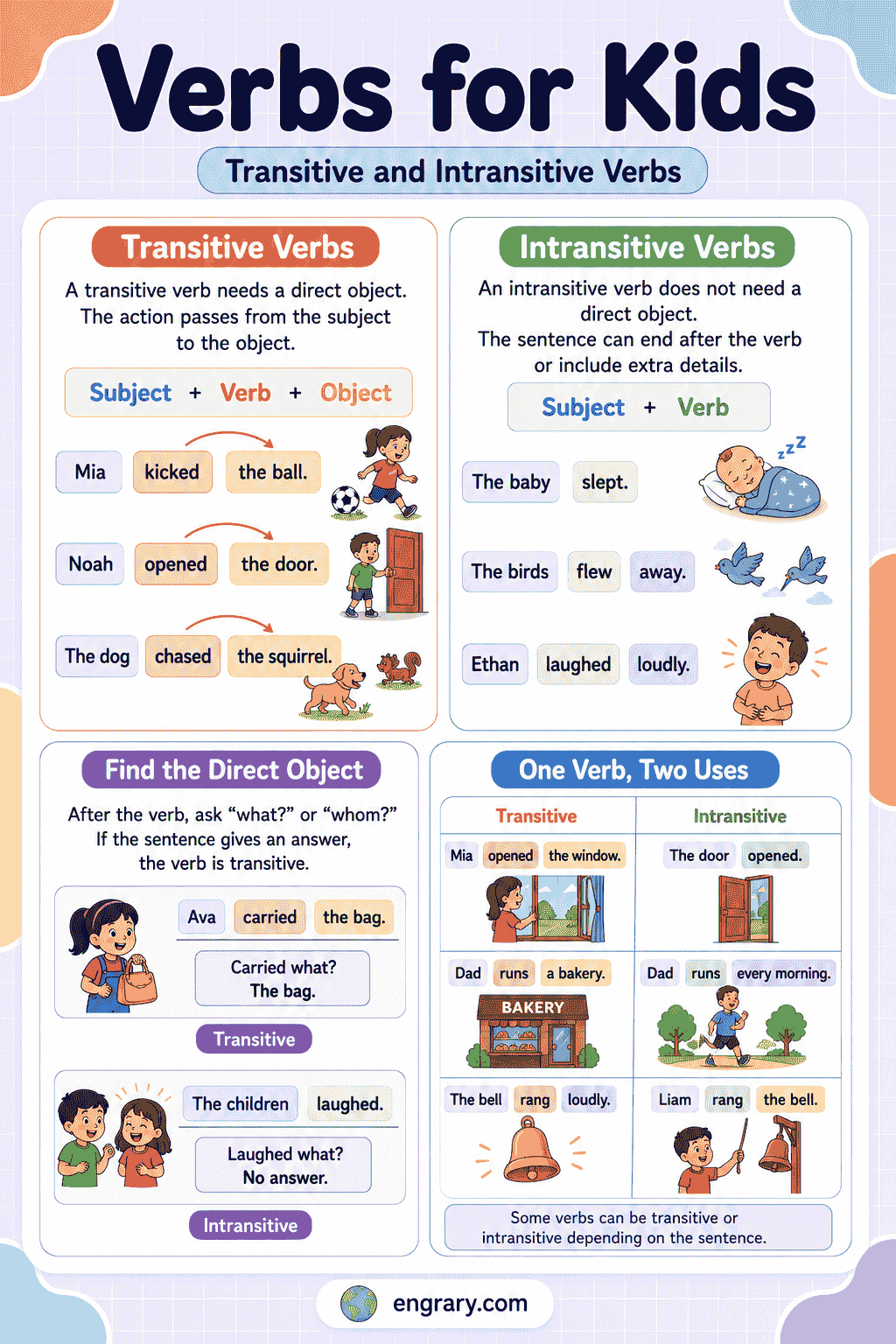
A transitive verb takes a direct object. An intransitive verb does not.
| Type | Example | Direct object |
|---|---|---|
| Transitive | Ava opened the door. | door |
| Intransitive | The baby cried. | none |
A direct object receives the action of the verb.
Noah kicked the ball.
The noun ball receives the action of kicked.
Some verbs can be transitive in one sentence and intransitive in another.
Mia reads every evening.
No direct object appears.
Mia reads books every evening.
The noun books is the direct object.
Another comparison:
The door opened.
Here, opened is intransitive.
Ava opened the door.
In this sentence, opened is transitive because it has the direct object door.
An indirect object may also appear with some transitive verbs.
Mia gave Noah a pencil.
- Verb: gave
- Indirect object: Noah
- Direct object: pencil
The indirect object tells who receives the direct object.
Commonly Confused Verbs
Some verb pairs look similar but perform different jobs.
Lie and Lay
| Verb | Meaning | Example |
|---|---|---|
| lie | rest or recline | I lie on the couch. |
| lay | place something down | I lay the book on the desk. |
The verb lay needs an object.
Lay the blanket on the bed.
The verb lie does not take an object.
Lie on the bed.
The past forms can be confusing:
- lie → lay;
- lay → laid.
Present:
I lie down each afternoon.
Past:
Yesterday, I lay down for an hour.
Present:
I lay the book on the table.
Past:
I laid the book on the table.
Rise and Raise
| Verb | Meaning | Example |
|---|---|---|
| rise | move upward by itself | The sun rises. |
| raise | lift something | Raise your hand. |
The verb raise takes an object.
Ava raised the flag.
The verb rise does not need one.
The balloon rose.
Sit and Set
| Verb | Meaning | Example |
|---|---|---|
| sit | take a seated position | Sit on the chair. |
| set | place something | Set the cup on the table. |
Use sit when a person or animal takes a seated position.
The child sat near the window.
Use set when someone places an object somewhere.
The child set the book on the desk.
Saw and Seen
| Form | Use | Example |
|---|---|---|
| saw | simple past | I saw the movie. |
| seen | past participle with a helping verb | I have seen the movie. |
Correct:
We saw the bird yesterday.
Correct:
We have seen that bird before.
Incorrect:
We seen the bird yesterday.
The form seen normally needs a helping verb such as have, has, or had.
Common Verb Mistakes
Verb mistakes often involve missing helpers, incorrect irregular forms, tense shifts, or disagreement between the subject and verb.
Leaving Out a Helping Verb
Incorrect:
Ava running across the field.
Correct:
Ava is running across the field.
The -ing form needs a helping verb when it functions as part of a progressive verb phrase.
Using the Wrong Irregular Form
Incorrect:
Noah goed home.
Correct:
Noah went home.
Incorrect:
Mia buyed a notebook.
Correct:
Mia bought a notebook.
Irregular verbs do not follow the regular -ed pattern.
Using a Past Participle Without a Helper
Incorrect:
I seen the movie.
Correct:
I saw the movie.
Or:
I have seen the movie.
Incorrect:
She written the letter.
Correct:
She wrote the letter.
Or:
She has written the letter.
Making the Subject and Verb Disagree
Incorrect:
The dog run quickly.
Correct:
The dog runs quickly.
Incorrect:
The students is ready.
Correct:
The students are ready.
Incorrect:
He walk to school.
Correct:
He walks to school.
Changing Tense Without a Reason
Incorrect:
Ava opened the door and walks inside.
Correct:
Ava opened the door and walked inside.
Both actions happened in the past, so both verbs should remain in the past tense.
A tense change may be correct when the time changes.
Ava opened the letter yesterday and is reading it again now.
Using Two Past-Tense Markers
Incorrect:
Did you went?
Correct:
Did you go?
Incorrect:
She did not finished.
Correct:
She did not finish.
After did, use the base form of the main verb.
Verb Practice with Answers
These activities help children identify verbs, classify verb types, find complete verb phrases, choose correct tense forms, and correct common errors.
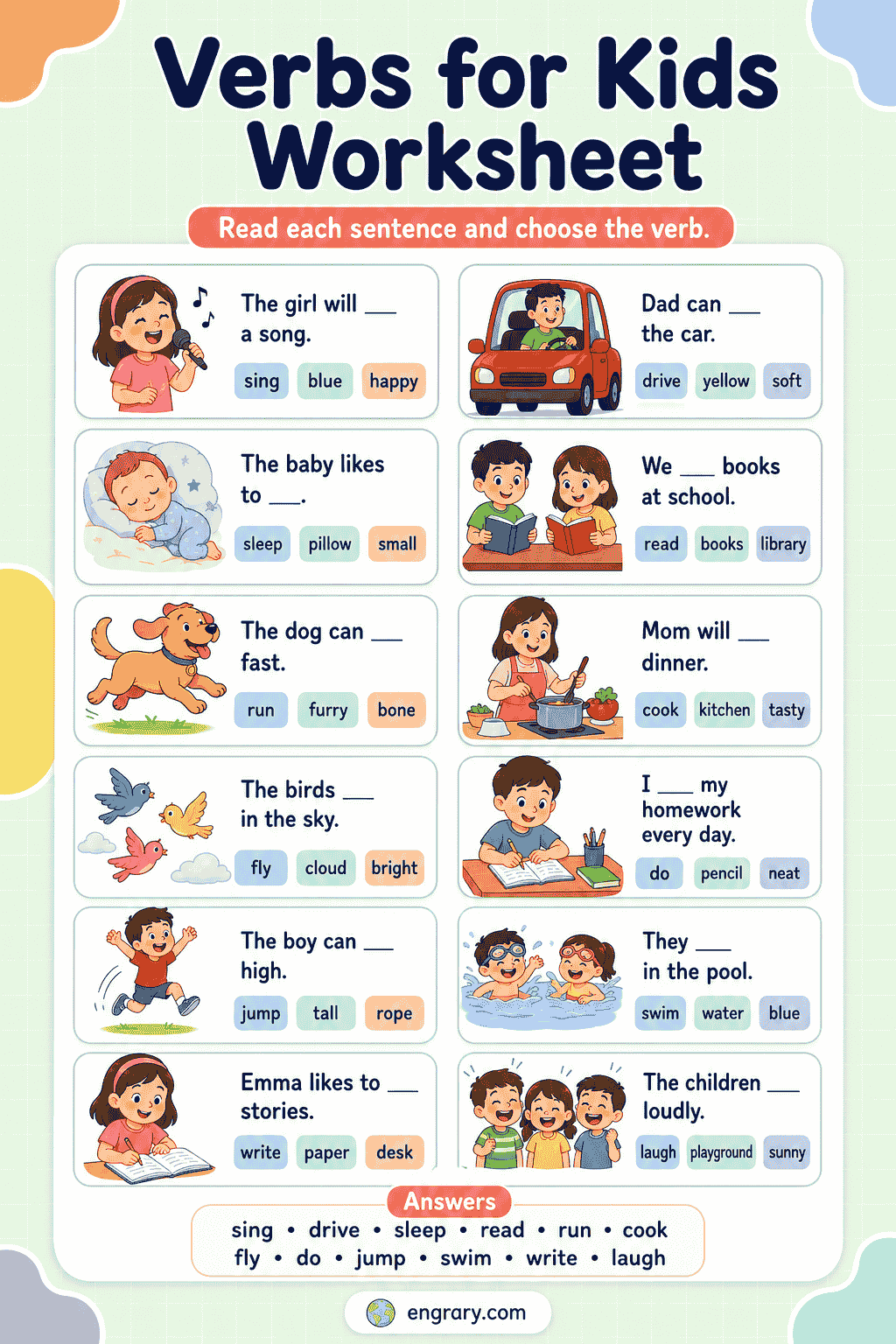
Identify the Verb
Find the verb or verbs in each sentence.
- The puppy barked loudly.
- Mia understands the lesson.
- The sky became dark.
- Noah has a new bicycle.
- Ava opened the book and smiled.
Find the Complete Verb Phrase
- The children are playing outside.
- Mia has finished her project.
- Noah will arrive soon.
- Ava can swim well.
- The team has been practicing daily.
Name the Verb Type
Choose from:
action · linking · helping
Identify the bold verb’s job.
- The dog chased the ball.
- The soup smells delicious.
- Ava is reading.
- Noah seems tired.
- Mia has finished.
- The students laughed loudly.
Identify Physical or Mental Action
Choose physical or mental.
- Noah climbed the ladder.
- Mia remembered the answer.
- Ava imagined a new story.
- The child threw the ball.
- The students understood the rule.
Choose Action or Linking Use
Identify the bold verb as action or linking.
- Mia smelled the flower.
- The flower smelled sweet.
- Noah looked at the map.
- Noah looked worried.
- The child felt the fabric.
- The fabric felt soft.
Identify Main and Helping Verbs
- Ava is running.
- Mia has finished.
- Noah will travel tomorrow.
- The children were laughing.
- The team has been practicing.
Choose the Correct Tense
- Ava walks / walked to school yesterday.
- Noah reads / will read the book tomorrow.
- The children play / played outside every Saturday.
- Mia is writing / wrote now.
- We visit / visited the museum last week.
Change Regular Verbs to the Past
- jump
- live
- carry
- stop
- smile
Complete the Irregular Past Form
- go → ______
- see → ______
- take → ______
- write → ______
- bring → ______
- buy → ______
Choose the Agreeing Verb
- The dog run / runs quickly.
- The dogs run / runs quickly.
- Ava and Mia is / are ready.
- The box of books is / are heavy.
- Everyone has / have a pencil.
- There is / are three chairs.
- The students was / were early.
Identify Transitive or Intransitive Use
- Ava opened the window.
- The baby cried.
- Noah reads every night.
- Noah reads stories every night.
- The door opened.
Correct the Verb Mistake
- Ava running across the field.
- Noah goed home.
- I seen the movie yesterday.
- The students is ready.
- Mia opened the door and walks inside.
- Did you went to the store?
- He walk to school every day.
- Lay down and rest.
Replace the General Verb
Replace the bold verb with a more precise action verb.
- The dog went across the yard.
- Ava looked through the window.
- Noah ate the sandwich.
- The child moved toward the door.
- Mia spoke to her friend.
Write Your Own Sentences
- Write a sentence with a physical action verb.
- Write a sentence with a mental action verb.
- Write a sentence with a linking verb.
- Write a sentence with a helping verb.
- Write a sentence with a modal verb.
- Write a sentence in the past tense.
Answer Key
Identify the verb
- barked
- understands
- became
- has
- opened, smiled
Find the complete verb phrase
- are playing
- has finished
- will arrive
- can swim
- has been practicing
Name the verb type
- action
- linking
- helping
- linking
- helping
- action
Identify physical or mental action
- physical
- mental
- mental
- physical
- mental
Choose action or linking use
- action
- linking
- action
- linking
- action
- linking
Identify main and helping verbs
- Helping: is; main: running
- Helping: has; main: finished
- Helping: will; main: travel
- Helping: were; main: laughing
- Helping: has, been; main: practicing
Choose the correct tense
- walked
- will read
- play
- is writing
- visited
Change regular verbs to the past
- jumped
- lived
- carried
- stopped
- smiled
Complete the irregular past form
- went
- saw
- took
- wrote
- brought
- bought
Choose the agreeing verb
- runs
- run
- are
- is
- has
- are
- were
Identify transitive or intransitive use
- transitive; object: window
- intransitive
- intransitive
- transitive; object: stories
- intransitive
Correct the verb mistake
- Ava is running across the field.
- Noah went home.
- I saw the movie yesterday.
- The students are ready.
- Mia opened the door and walked inside.
- Did you go to the store?
- He walks to school every day.
- Lie down and rest.
Replace the general verb: possible answers
- The dog raced across the yard.
- Ava peeked through the window.
- Noah devoured the sandwich.
- The child crept toward the door.
- Mia whispered to her friend.
Other accurate verbs may also work.
Write your own sentences: possible answers
- The children climbed the hill.
- Noah remembered the answer.
- The soup smells delicious.
- Ava is reading a story.
- Mia can solve the puzzle.
- We visited the museum yesterday.
FAQs
A verb is a word that shows an action, state, feeling, event, possession, or what someone or something is, has, or experiences.
The three main elementary verb types are action verbs, linking verbs, and helping verbs. Other labels, such as regular, irregular, transitive, and intransitive, describe additional verb features.
The main verb expresses the central action or state, while a helping verb supports it. In “Ava is running,” is is the helping verb and running is the main verb.
First find the main action or state. Then include any helping verbs directly before it, such as has been in “Mia has been practicing.”
Regular verbs usually add -ed or -d, but irregular verbs change in other ways. For example, go becomes went, and write becomes wrote.
You May Also Like