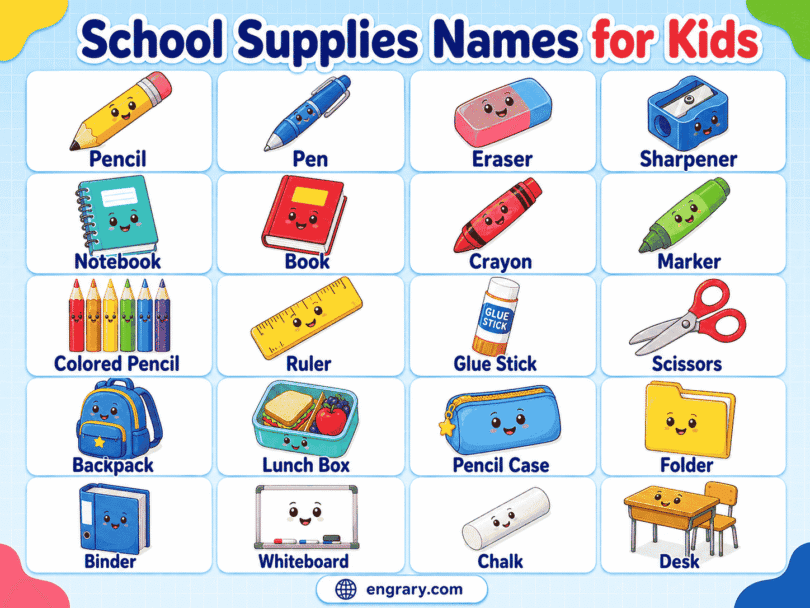
A child opens a school bag and finds the small things that make the school day easier: something to write with, something to erase with, something to read, something to keep papers neat, and something to carry lunch or water. These familiar items help children work, draw, color, cut, paste, organize, and learn.
Learning school supplies names helps children talk about the things they carry and use at school every day. Instead of memorizing a random list, kids can learn these words by packing a bag, opening a pencil case, using supplies during lessons, and putting each item back in the right place.
School Bag Items Kids Carry Every Day
A school bag carries the items children need for the school day. Some supplies help with lessons, while others support daily routines like lunch, water, and keeping things organized.
Common school bag items include:
- school bag
- pencil case
- pencil
- eraser
- sharpener
- ruler
- book
- notebook
- folder
- crayons
- glue
- scissors
- lunch box
- water bottle
A simple explanation for kids:
School supplies are the things students carry or use for reading, writing, drawing, cutting, pasting, organizing, and learning.
Useful examples:
- My notebook is in my school bag.
- My pencil case is inside my bag.
- I carry a water bottle.
- My folder keeps my papers neat.
Common School Supplies Children Learn First
Young learners should begin with supplies they see and use often. These words are easy to teach with real objects, picture cards, classroom practice, and simple sentences.
Important school supplies names include:
- pencil 🔊 /PEN-suhl/
- pen 🔊 /pen/
- eraser 🔊 /ih-RAY-ser/
- sharpener 🔊 /SHAR-puh-ner/
- ruler 🔊 /ROO-ler/
- notebook 🔊 /NOHT-book/
- book 🔊 /book/
- paper 🔊 /PAY-per/
- folder 🔊 /FOHL-der/
- pencil case 🔊 /PEN-suhl kays/
- crayons 🔊 /KRAY-onz/
- glue 🔊 /gloo/
- scissors 🔊 /SIZ-erz/
- school bag 🔊 /skool bag/
Easy meanings:
- Pencil is used for writing or drawing.
- Pen is used for writing with ink.
- Eraser removes pencil marks.
- Sharpener makes a pencil point sharp.
- Ruler helps draw straight lines.
- Notebook is used for writing schoolwork.
- Book is used for reading.
- Folder keeps papers together.
- Pencil case holds small writing supplies.
- School bag carries books and supplies.
School Supplies Inside a Child’s Bag
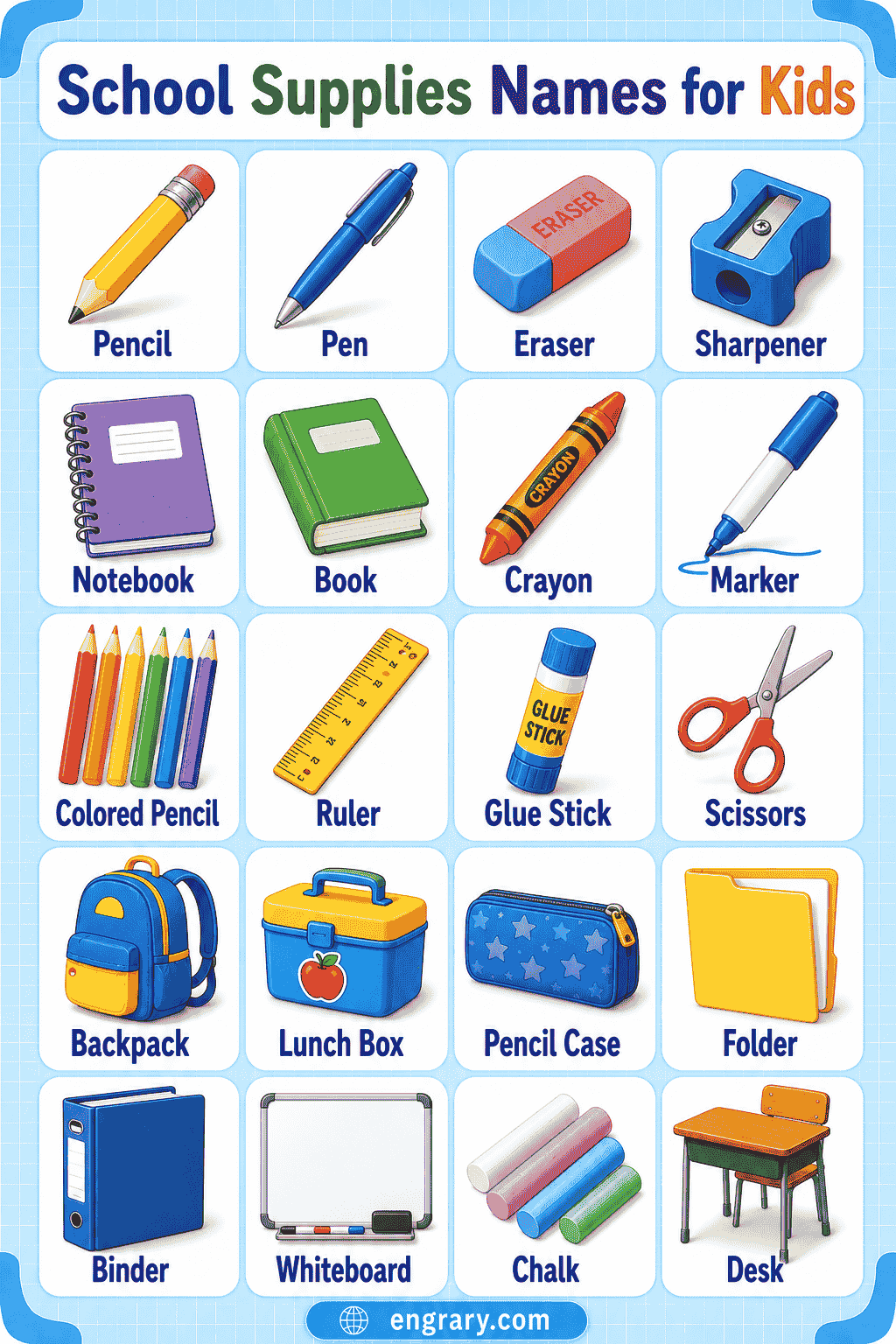
A child’s school bag usually has supplies for lessons, homework, reading, writing, art, and daily school needs. The bag may also have a lunch box or water bottle, but learning supplies should stay the main focus.
Useful supplies inside a school bag include:
- book
- notebook
- folder
- worksheet
- pencil case
- crayons
- glue stick
- scissors
- lunch box
- water bottle
Simple examples:
- My book is in my school bag.
- My folder is inside my bag.
- My worksheet is in the folder.
- My lunch box is in my bag.
- My water bottle is in the side pocket.
Children can use this sentence pattern:
My ________ is in my school bag.
Pencil Case Supplies for Kids
A pencil case keeps small supplies together. It helps children find what they need quickly during class.
Common pencil case supplies include:
- pencil
- pen
- eraser
- sharpener
- ruler
- crayons
- colored pencils
- marker
- highlighter
Simple examples:
- My pencil is in my pencil case.
- I keep an eraser in my pencil case.
- The ruler is long.
- My crayons are colorful.
- The sharpener is small.
Useful question:
What is in your pencil case?
Short answers:
- A pencil is in my pencil case.
- An eraser is in my pencil case.
- Crayons are in my pencil case.
Writing Supplies Kids Use in Class
Some school supplies help children write, fix mistakes, make lines, or mark important words. This use-based grouping is easier than learning a long list with no purpose.
Useful writing supplies include:
- pencil
- pen
- eraser
- sharpener
- ruler
- marker
- highlighter
How children use them:
- I write with a pencil.
- I write with a pen.
- I erase with an eraser.
- I sharpen my pencil.
- I draw a straight line with a ruler.
- I use a marker to write clearly.
- I use a highlighter to mark important words.
For young children, the most important first words are usually pencil, eraser, sharpener, and ruler.
Reading and Classwork Supplies
Some student supplies help children read, write class notes, complete worksheets, and keep papers together. These items often stay in a school bag, on a desk, or inside a folder.
Useful reading and classwork supplies include:
- book
- notebook
- paper
- worksheet
- folder
- storybook
- textbook
Easy meanings:
- Book is for reading.
- Notebook is for writing.
- Paper is used for writing, drawing, or printing.
- Worksheet is a practice paper.
- Folder keeps papers together.
- Storybook has stories to read.
- Textbook is used for school lessons.
Simple examples:
- I read a book.
- I write in my notebook.
- I draw on paper.
- My worksheet is in my folder.

Creative School Supplies for Activities
Children also use school supplies for drawing, coloring, cutting, pasting, and making class projects. These words are useful for art lessons and craft activities.
Creative school supplies include:
- crayons
- colored pencils
- markers
- paintbrush
- paint
- glue
- glue stick
- scissors
- paper
- tape
Simple examples:
- I color with crayons.
- I draw with colored pencils.
- I paint with a paintbrush.
- I paste paper with glue.
- I cut paper with scissors.
- I use tape to stick paper.
Children should use scissors, glue, and paint carefully, especially in younger classes.
School Supplies Kids Use Carefully
Some school items need careful hands. Children should learn the item name and the care word that goes with it.
Care words for school supplies:
- careful
- safe
- sharp
- cap
- close
- clean
- put away
- wash hands
Supplies that need care include:
- scissors
- sharpener
- glue
- marker
- paint
- tape
- stapler
Simple safety examples:
- Use scissors carefully.
- Do not run with scissors.
- Put the cap on the marker.
- Close the glue after using it.
- Keep the sharpener clean.
- Wash your hands after using paint or glue.
- Put supplies back in your pencil case.
Organizing School Supplies Neatly
Some supplies help children organize their schoolwork. These words are useful because students often need to put books, papers, pencils, and art items back in the right place.
Useful organizing supplies include:
- folder
- pencil case
- school bag
- box
- tray
- clip
- label
- book cover
Simple examples:
- A folder keeps papers together.
- A pencil case keeps pencils safe.
- A school bag carries books and supplies.
- A box can hold crayons.
- A label shows a name.
Sentence pattern:
I keep my ________ in my ________.
Examples:
- I keep my pencil in my pencil case.
- I keep my books in my school bag.
- I keep my papers in a folder.
Where School Supplies Belong
Children learn school supplies names better when they know where each item belongs. Some items are small enough for a pencil case, while others belong in a school bag, folder, box, or lunch pocket.
| Item | Where it usually goes |
|---|---|
| Pencil | pencil case |
| Eraser | pencil case |
| Sharpener | pencil case |
| Ruler | pencil case or school bag |
| Notebook | school bag |
| Book | school bag |
| Folder | school bag |
| Crayons | pencil case or box |
| Lunch box | school bag |
| Water bottle | side pocket or school bag |
Simple sentences:
- My pencil is in my pencil case.
- My notebook is in my school bag.
- My folder keeps my papers neat.
- My water bottle is in the side pocket.
School Supply Mix-Ups Kids Often Make
Some school supplies look similar or are used for related tasks. This table helps children understand the difference.
| Mix-up | Easy difference |
|---|---|
| Pen vs pencil | A pen uses ink. A pencil can be erased. |
| Eraser vs sharpener | An eraser removes pencil marks. A sharpener makes a pencil point sharp. |
| Book vs notebook | A book is for reading. A notebook is for writing. |
| Crayons vs colored pencils | Crayons are waxy and colorful. Colored pencils are pencil-shaped and used for coloring. |
| Glue vs tape | Glue sticks things together with paste. Tape sticks things with a sticky strip. |
| School bag vs pencil case | A school bag carries many items. A pencil case keeps small writing supplies. |
| Ruler vs eraser | A ruler measures or draws straight lines. An eraser removes pencil marks. |
| Scissors vs glue | Scissors cut paper. Glue sticks paper. |

School Supplies in Simple Sentences
Children learn school supplies names better when they use the words in real sentences. These examples are useful for speaking, reading, writing, and classroom practice.
Useful school supply sentences:
- I have a pencil.
- I write with a pen.
- I erase with an eraser.
- I sharpen my pencil.
- My ruler is long.
- My notebook is in my bag.
- I read a book.
- I draw with crayons.
- I cut paper with scissors.
- I paste with glue.
- My folder keeps papers neat.
- My pencil case is blue.
- My lunch box is in my school bag.
- I drink water from my water bottle.
- I put my supplies away after class.
Question practice:
- What do you write with?
- What removes pencil marks?
- What do you use to draw a straight line?
- Where do you keep your pencil?
- What do you use to cut paper?
Short answers:
- I write with a pencil.
- An eraser removes pencil marks.
- I use a ruler.
- I keep my pencil in my pencil case.
- I use scissors to cut paper.
School Supplies Picture Sorting Activities
School supplies are easy to practice with pictures and real objects. These activities work well at home or in class.
Pack-the-bag game
Place picture cards or real supplies on a table. Children choose what should go in a school bag: book, notebook, pencil case, folder, lunch box, and water bottle.
Pencil case hunt
Children open a pencil case and name each item: pencil, eraser, sharpener, ruler, pen, or crayons.
Supply-use matching
Match each item to its use: pencil — write, eraser — erase, ruler — measure, scissors — cut, glue — paste.
Bag or pencil case sorting
Sort items by where they belong: school bag, pencil case, folder, or lunch pocket.
Missing supply game
Show four supplies, hide one, and ask: “What is missing?”
Draw and label supplies
Children draw a school bag and label simple supplies such as pencil, book, eraser, ruler, and notebook.
School Supplies Names Practice Worksheet
Use this practice block for classwork, homework, or quick revision.
A. Circle the school supply
- pencil / apple / spoon
- eraser / pillow / shoe
- ruler / banana / sock
- notebook / plate / cup
- glue / chair / ball
B. Match the supply
- Pencil — ________
- Eraser — ________
- Sharpener — ________
- Ruler — ________
- Glue — ________
Word bank: sticks paper, writes or draws, makes a pencil sharp, removes pencil marks, draws straight lines
C. Complete the sentences
- I write with a ________.
- I erase with an ________.
- I keep my pencil in a ________.
- I cut paper with ________.
- My books are in my ________.
D. Write school bag, pencil case, writing supply, or creative supply
- Pencil — ________
- Crayons — ________
- Lunch box — ________
- Eraser — ________
- Notebook — ________
Answer key:
- A1: pencil
- A2: eraser
- A3: ruler
- A4: notebook
- A5: glue
- B1: writes or draws
- B2: removes pencil marks
- B3: makes a pencil sharp
- B4: draws straight lines
- B5: sticks paper
- C1: pencil / pen
- C2: eraser
- C3: pencil case
- C4: scissors
- C5: school bag
- D1: writing supply
- D2: creative supply
- D3: school bag
- D4: pencil case / writing supply
- D5: school bag / writing supply
School Supplies Names Quiz for Kids
Try the questions first, then check the answers below.
- What do you use to write or draw?
- What removes pencil marks?
- What makes a pencil point sharp?
- What helps draw a straight line?
- Where can you keep pencils and erasers?
- What do you use to cut paper?
- What do you use to paste paper?
- What carries books and supplies?
- What do you drink water from at school?
- Name one school supply you use every day.
Answers:
- Pencil / pen
- Eraser
- Sharpener
- Ruler
- Pencil case
- Scissors
- Glue
- School bag
- Water bottle
- Pencil, eraser, notebook, book, ruler, pen, crayons, or another school supply
FAQs
School supplies names are words for items students carry or use at school, such as pencil, pen, eraser, ruler, notebook, book, school bag, pencil case, glue, and scissors.
Children can start with common supplies like pencil, eraser, sharpener, ruler, notebook, book, pencil case, school bag, crayons, glue, and scissors.
Not exactly. School supplies are items students carry or use, such as pencils, notebooks, and glue. Classroom objects include larger things in the room, such as desks, chairs, boards, clocks, doors, and shelves.
A pencil case can hold small supplies such as a pencil, pen, eraser, sharpener, ruler, crayons, and colored pencils.
Kids can learn school supplies names by packing a school bag, opening a pencil case, matching supplies to pictures, sorting items by use, and making simple sentences like “I write with a pencil.”
You May Also Like