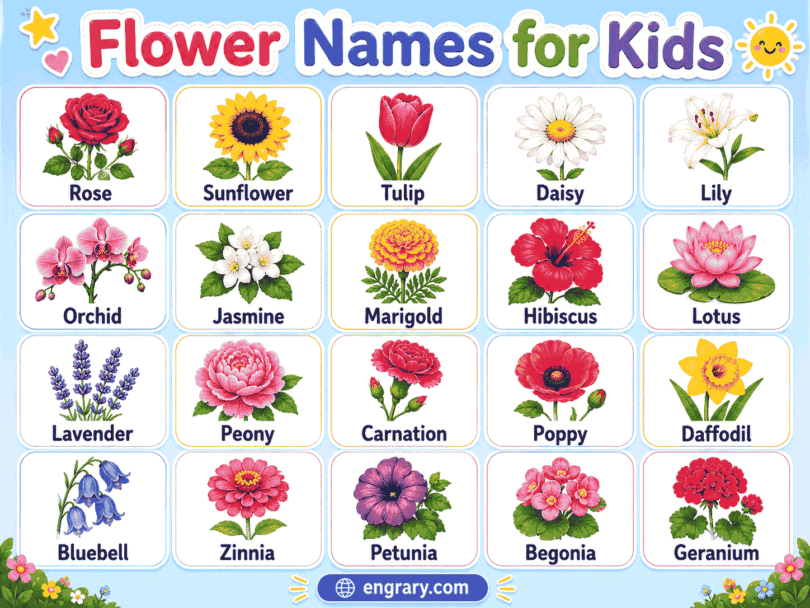
A child may notice a flower before they know its name. A bright yellow sunflower, a red rose, a small daisy, or a sweet-smelling jasmine can quickly catch a child’s attention because flowers are colorful, soft, and easy to see in everyday life.
Learning flower names for kids helps children talk about gardens, parks, homes, birthdays, drawings, nature walks, and classroom pictures. Instead of only memorizing a long list, children learn flower names better when they connect each flower with color, smell, shape, place, and real-life use.
Why Flowers Catch Children’s Attention
Flowers are often one of the first parts of nature children notice. They can be bright, soft, sweet-smelling, tiny, tall, round, or cup-shaped. Some grow in gardens, some bloom in pots, and some appear in ponds or parks.
Children usually remember flowers through simple clues:
- color, such as red, yellow, white, pink, purple, or orange
- smell, such as sweet, fresh, or light
- shape, such as round, open, wide, or cup-shaped
- place, such as garden, vase, pond, park, or flower pot
- use, such as decoration, drawing, gifts, or classroom charts
A simple way to explain flowers is:
A flower is the colorful part of some plants. Flower names help us tell one flower from another.
Flower Names Children Should Learn First
Young learners should begin with flower names they are likely to see in pictures, gardens, books, classrooms, homes, or parks. These names are familiar enough for beginner vocabulary lessons.
Good first flower names include:
- Rose
- Sunflower
- Lotus
- Marigold
- Jasmine
- Daisy
- Lily
- Tulip
- Hibiscus
- Orchid
Short meanings:
- Rose is a common flower with soft colorful petals.
- Sunflower is a tall yellow flower with a large round head.
- Lotus is a flower that grows in water.
- Marigold is a bright yellow or orange flower.
- Jasmine is a small flower that can smell sweet.
- Daisy is a simple flower with white petals and a yellow center.
- Lily is a flower with large beautiful petals.
- Tulip is a cup-shaped flower.
- Hibiscus is a bright flower with large petals.
- Orchid is a delicate flower with a special shape.
These flower names give children a strong starting point before they learn less familiar names.
Flowers Children See in Daily Life
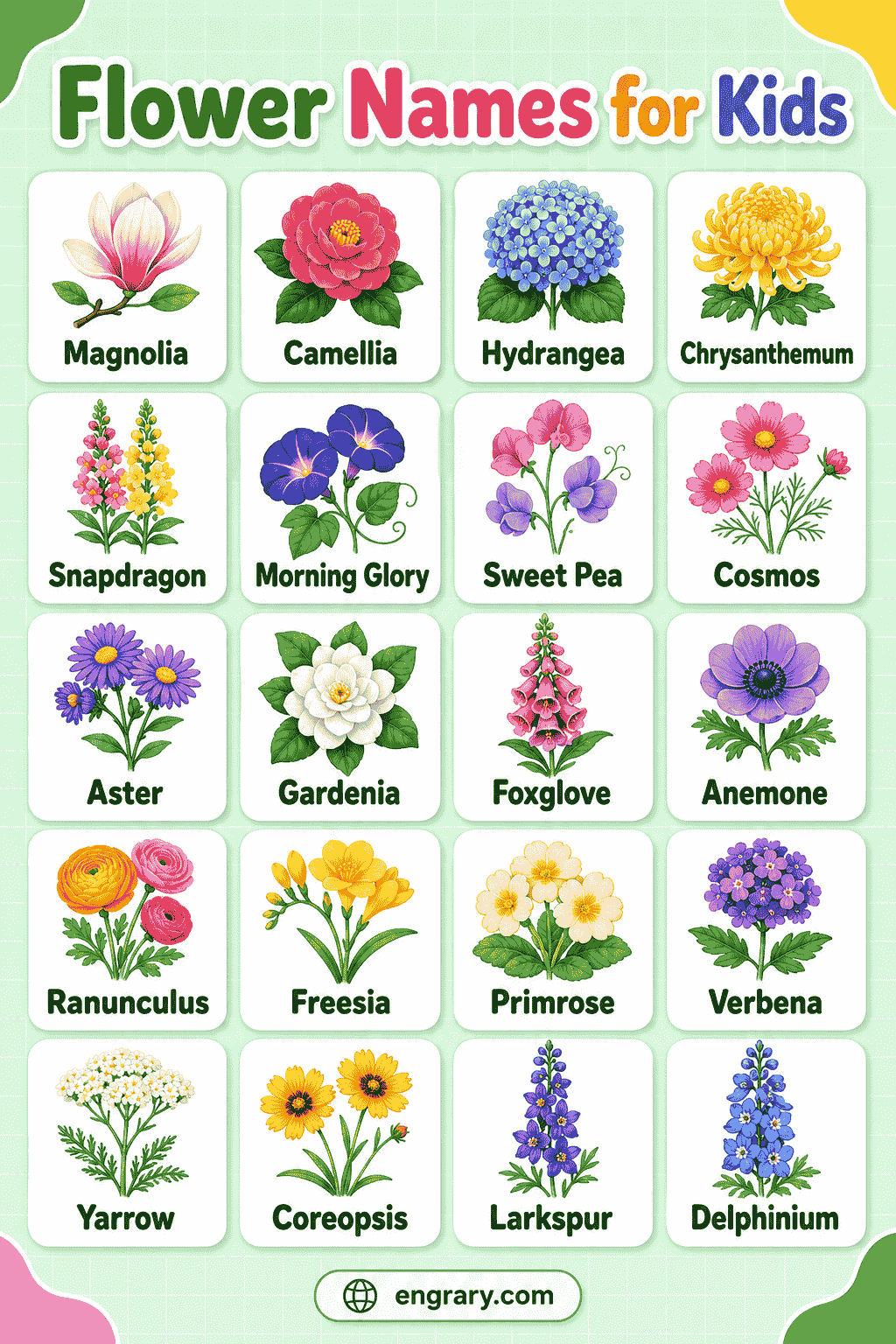
Children may see flowers in many everyday places. A rose may grow near a home. Marigolds may appear in gardens. Flowers may sit in a vase, decorate a classroom, or grow in a park.
Common places where children may see flowers include:
- garden
- park
- home
- school
- classroom
- flower pot
- vase
- field
- pond
- picture book
Examples:
- A rose can grow in a garden.
- A lotus can grow in a pond.
- Flowers can be kept in a vase.
- A park may have many colorful flowers.
- A classroom may have a flower chart.
Children can use this sentence:
I saw a flower at the ________.
Flower Names by Color
Color is one of the easiest ways for children to remember flower names. Many children first say, “red flower” or “yellow flower” before they learn the exact name.
Common flower color examples:
| Color | Flower Examples |
|---|---|
| Red | rose, hibiscus |
| Yellow | sunflower, marigold, daisy |
| White | jasmine, lily, daisy |
| Pink | lotus, rose, tulip |
| Purple | orchid, lavender |
| Orange | marigold, tulip |
Useful sentences:
- A rose can be red.
- A sunflower is often yellow.
- A jasmine flower is often white.
- A lotus can be pink.
- An orchid can be purple.
- A marigold can be orange or yellow.
Color practice question:
What color is this flower?
Flowers Children Remember by Smell
Some flowers are easy to remember because of their smell. Children may smell them in gardens, homes, parks, or decorations.
Sweet-smelling flower names include:
- Jasmine
- Rose
- Lily
- Lavender
- Gardenia
- Tuberose
Not every flower has a strong smell. Some flowers are known more for color, while others are remembered for fragrance. Children should smell real flowers only with adult guidance, especially if the flower is unfamiliar.
Examples:
- Jasmine can smell sweet.
- A rose may have a soft smell.
- Lavender has a fresh smell.
- A lily can have a strong smell.
- Some flowers have little or no smell.
Safe question for children:
Does this flower smell sweet, or does it only look colorful?
Flowers Children Like to Draw
Flower drawing is a natural way for children to learn flower names. Many children enjoy drawing a simple flower with petals, a stem, leaves, and bright colors.
Easy flowers to draw:
- Daisy
- Sunflower
- Tulip
- Rose
- Lotus
- Marigold
Why these flowers work well:
- Daisy has a simple round center and petals.
- Sunflower is large, bright, and easy to color yellow.
- Tulip has a simple cup shape.
- Lotus can be drawn with layered petals.
- Marigold can be shown as a round bright flower.
Drawing sentences:
- I drew a sunflower.
- My flower is yellow.
- This is a red rose.
- The lotus has pink petals.
- My favorite flower is daisy.
A simple drawing prompt:
Draw your favorite flower and write its name under it.
Flowers Used for Gifts and Decorations
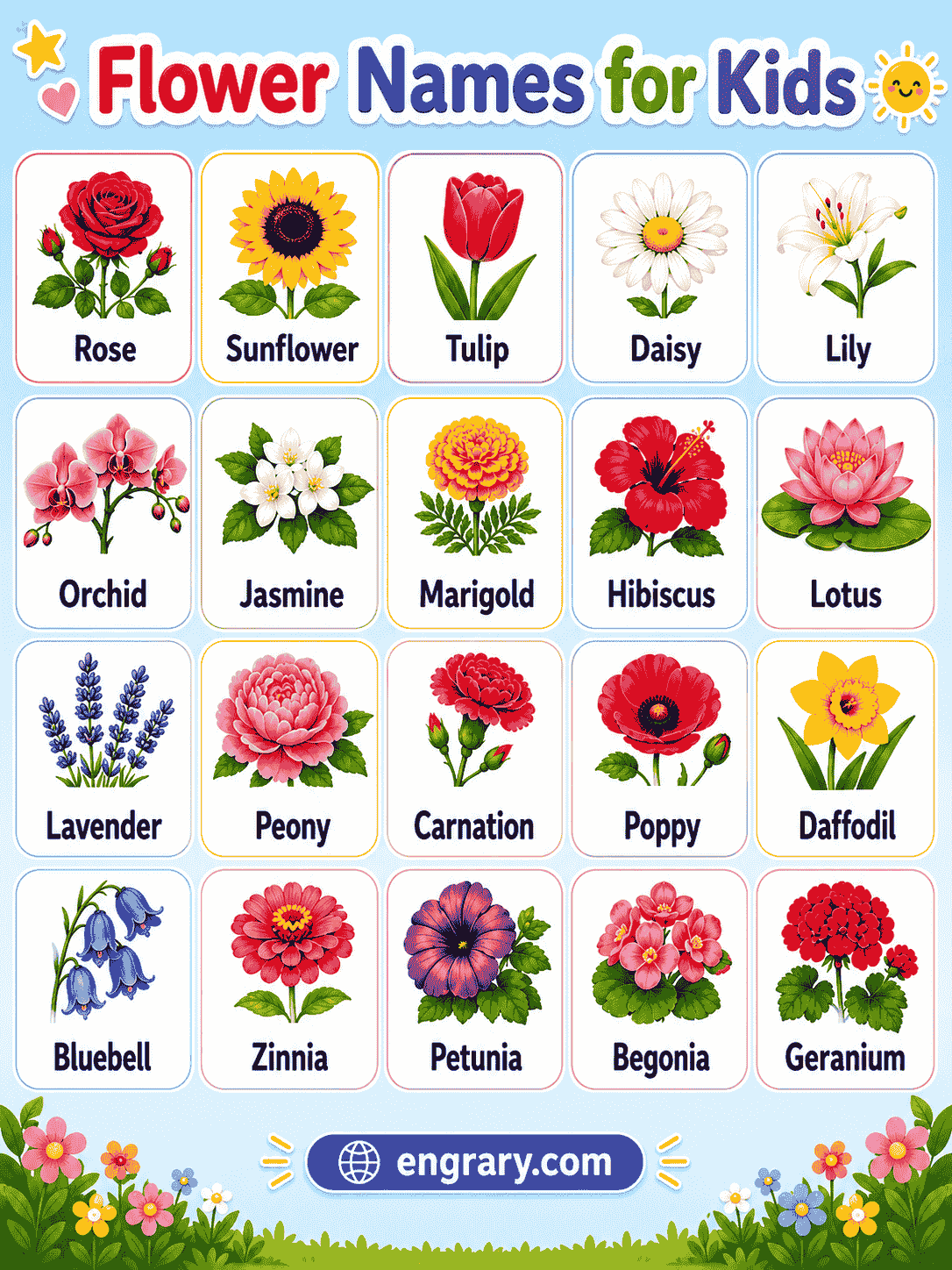
Children often see flowers at birthdays, family visits, school events, festivals, and special days. This makes flower names easier to connect with real life.
Common flowers used for gifts or decoration include:
- rose
- marigold
- jasmine
- lily
- orchid
- tulip
Simple examples:
- A rose can be given as a gift.
- Marigolds are often used for decoration.
- Jasmine flowers may be used in garlands.
- Lilies can be placed in a vase.
- Orchids are often used for decoration.
Children can complete this sentence:
I can give a ________ to someone.
Flowers in Gardens, Parks, and Pots
Some flowers grow in open gardens. Others grow in pots near homes, classrooms, windows, or doors. Children may see flowers in both places.
Garden flowers children may know:
- rose
- sunflower
- marigold
- daisy
- tulip
- hibiscus
Potted flowers children may see:
- rose plant
- marigold
- petunia
- pansy
- orchid
- geranium
Examples:
- A rose can grow in a garden.
- A marigold can grow in a pot.
- A sunflower can grow tall in open space.
- An orchid can be kept indoors.
- A hibiscus flower can grow on a bush.
Picture question:
Is this flower growing in a garden, a pot, or water?
Flowers That Grow in Water
Some flowers grow in water or near water. These flowers are interesting for children because they look different from many garden flowers.
Two useful water flower names for kids are:
- Lotus
- Water lily
A lotus grows in water and often has large beautiful petals. A water lily also grows in water and may float on the surface with round leaves.
Examples:
- A lotus grows in water.
- A water lily can float on water.
- Lotus flowers can be pink or white.
- Water lilies are often seen in ponds.
Water flowers are best taught with pictures because many children may not see them every day.
Flower Shapes Children Can Notice
Children can learn flower names by looking at shape as well as color. Shape words make flower vocabulary richer and more useful.
Flower shape words include:
- round
- wide
- small
- large
- cup-shaped
- star-shaped
- layered
- delicate
Examples:
- A sunflower is large and round.
- A tulip is cup-shaped.
- A daisy looks simple and round.
- A rose has layered petals.
- An orchid has a special shape.
- A hibiscus has wide petals.
Children can use this pattern:
The ________ looks ________.
Examples:
- The sunflower looks round.
- The tulip looks cup-shaped.
- The rose looks soft.
Flower Name or Flower Part?
Children may confuse flower names with flower parts. This is normal because words like petal, stem, and leaf are often taught near flower names.
A flower name tells what the flower is called. A flower part tells one piece of the flower or plant.
| Flower Name | Flower or Plant Part |
|---|---|
| rose | petal |
| sunflower | stem |
| lotus | leaf |
| daisy | seed |
| tulip | root |
| jasmine | branch |
Clear examples:
- Rose is a flower name.
- Petal is a flower part.
- Sunflower is a flower name.
- Stem is a plant part.
- Lotus is a flower name.
- Leaf is a plant part.
A simple teaching line:
A flower name tells the flower. A flower part tells one piece of the flower or plant.
Flower and Plant: Simple Difference for Kids
A plant is the whole living thing. A flower is the colorful part that grows on some plants.
For example, a rose plant has roots, stems, leaves, and flowers. The rose flower is one part of the rose plant. Children do not need a long science lesson here; they only need the simple difference.
| Word | Simple Meaning | Example |
|---|---|---|
| Plant | The whole living thing | rose plant |
| Flower | The colorful part of some plants | rose flower |
| Flower name | The name of a flower | rose, lotus, daisy |
Useful examples:
- A rose is a flower name.
- A rose plant is the whole plant.
- A leaf is not a flower name.
- A stem is a plant part.
- A sunflower is a flower name.
Common Flower Names with Simple Meanings
This chart gives quick meanings for common flower names. It works well for revision, classroom display, or picture-card practice.
| Flower Name | Simple Meaning |
|---|---|
| Rose | A common flower with soft colorful petals |
| Sunflower | A tall yellow flower with a large round head |
| Lotus | A flower that grows in water |
| Marigold | A bright yellow or orange flower |
| Jasmine | A small flower that can smell sweet |
| Daisy | A simple flower with white petals and a yellow center |
| Lily | A flower with large beautiful petals |
| Tulip | A cup-shaped flower |
| Hibiscus | A large bright flower often seen in warm places |
| Orchid | A delicate flower with a special shape |
| Lavender | A purple flower known for its fresh smell |
| Pansy | A small colorful garden flower |

Easy Sentences with Flower Names
Children learn flower names better when they use them in real sentences. These sentences help with speaking, reading, and writing practice.
Useful flower sentences:
- A rose is red.
- A sunflower is yellow.
- A lotus grows in water.
- Jasmine can smell sweet.
- A marigold is bright.
- A daisy has white petals.
- A tulip is cup-shaped.
- A hibiscus flower is large.
- An orchid has a special shape.
- Lavender can smell fresh.
Question practice:
- What is your favorite flower?
- What color is the rose?
- Which flower grows in water?
- Which flower is tall and yellow?
- Which flower can smell sweet?
Short answers:
- My favorite flower is rose.
- The rose is red.
- The lotus grows in water.
- The sunflower is tall.
- Jasmine can smell sweet.
Flower Mix-Ups Children Often Make
Some flower words can confuse children because they connect to plants, colors, smells, or flower parts.
| Mix-Up | Simple Difference |
|---|---|
| Flower vs Plant | A plant is the whole living thing. A flower is one colorful part of some plants. |
| Flower Name vs Flower Part | Rose is a flower name. Petal is a flower part. |
| Rose vs Tulip | A rose often has layered petals. A tulip usually has a cup-like shape. |
| Lotus vs Water Lily | Both grow in water, but they are different flowers. |
| Sunflower vs Marigold | Both can be yellow, but a sunflower is usually much taller. |
| Jasmine vs Lily | Both can smell sweet, but they are different flowers. |
Quick correction examples:
- A petal is not a flower name.
- A sunflower is a flower name.
- A lotus grows in water.
- A rose and a tulip do not have the same shape.
Flower Matching, Coloring, and Picture Games
Flower names are easier to learn with pictures, colors, and real examples. These activities work well at home or in class.
- Flower picture matching
Match flower names to pictures, such as rose, sunflower, lotus, marigold, and jasmine. - Color and name game
Show a flower picture and ask children to say the color and name: red rose, yellow sunflower, or orange marigold. - Flower or part sorting
Sort words like rose, petal, lotus, stem, jasmine, and leaf into flower names and flower parts. - Water flower picture talk
Show a lotus or water lily and ask, “Does this flower grow in water?” - Draw your favorite flower
Children draw one flower and say: “My favorite flower is ____.” - Safe smell observation
With adult guidance, children can compare flowers that smell sweet and flowers with little or no smell. - Find the flower in a picture
Use a garden image and ask children to point to flowers they can name.
Flower Names Practice Worksheet
Use this practice block for classwork, homework, or quick revision.
A. Circle the flower name
- rose / leaf / stem
- sunflower / root / seed
- lotus / water / soil
- jasmine / branch / leaf
- daisy / petal / stem
B. Match the flower
- Rose — ________
- Sunflower — ________
- Lotus — ________
- Jasmine — ________
- Marigold — ________
Word bank: sweet smell, red flower, yellow tall flower, water flower, bright orange flower
C. Complete the sentences
- A rose can be ________.
- A sunflower is often ________.
- A lotus grows in ________.
- Jasmine can smell ________.
- A marigold can be orange or ________.
D. Write flower name or flower part
- Tulip — ________
- Petal — ________
- Lily — ________
- Stem — ________
- Daisy — ________
Answer key:
- A1: rose
- A2: sunflower
- A3: lotus
- A4: jasmine
- A5: daisy
- B1: red flower
- B2: yellow tall flower
- B3: water flower
- B4: sweet smell
- B5: bright orange flower
- C1: red / pink / white
- C2: yellow
- C3: water
- C4: sweet
- C5: yellow
- D1: flower name
- D2: flower part
- D3: flower name
- D4: flower part
- D5: flower name
Flower Names Quiz for Kids
Try the questions first, then check the answers below.
- Which flower is often red and has soft petals?
- Which flower is tall and yellow?
- Which flower grows in water?
- Which flower can smell sweet?
- Is petal a flower name or a flower part?
- Which flower can be orange or yellow?
- Which flower has a cup-like shape?
- Is sunflower a flower name?
- What is the difference between a flower and a plant?
- Name one flower you may see in a garden.
Answers:
- Rose
- Sunflower
- Lotus
- Jasmine
- Flower part
- Marigold
- Tulip
- Yes
- A plant is the whole living thing, while a flower is one colorful part of some plants.
- Rose, sunflower, marigold, daisy, tulip, or another garden flower
FAQs
Flower names are words that name flowers children can recognize, such as rose, sunflower, lotus, marigold, jasmine, daisy, lily, and tulip.
Children can start with common flower names like rose, sunflower, lotus, marigold, jasmine, daisy, and lily because these are easy to see in pictures and gardens.
A plant is the whole living thing. A flower is the colorful part that grows on some plants.
No. A petal is a flower part, not a flower name. Rose, lotus, sunflower, and daisy are flower names.
Kids can learn flower names by looking at pictures, matching flower cards, coloring flowers, visiting gardens, drawing flowers, and using simple sentences like “A rose is red.”
You May Also Like