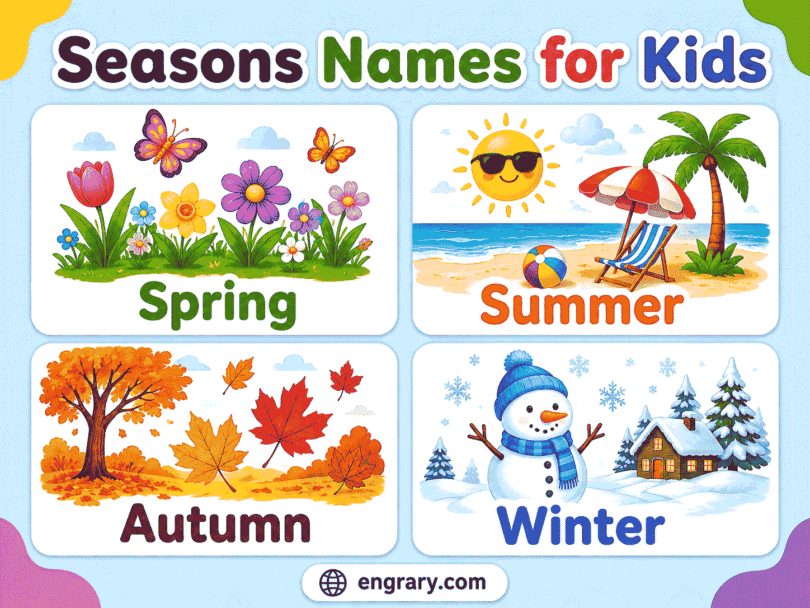
Children can feel the year changing before they know the word season. They may see flowers growing, sunshine getting stronger, leaves turning colorful, or warm coats coming out when the air becomes cold.
Learning seasons names for kids helps children name these changes in a simple way. Once they know spring, summer, autumn/fall, and winter, they can talk about weather, clothes, nature, outdoor play, and their favorite time of year.
What Children Notice When Seasons Change
A season is a part of the year when weather and nature often change. Many children learn four main seasons: spring, summer, autumn/fall, and winter.
Young learners usually understand seasons through things they can see, touch, and feel. They may notice warm sunshine, rainy days, fresh flowers, falling leaves, chilly wind, or snow in some places.
Common signs of seasonal change include:
- flowers blooming
- trees becoming green
- sunny outdoor days
- cooler wind
- leaves changing color
- warmer or thicker clothes
- rain, heat, cold, or snow
- different games and activities
A child-friendly explanation is:
Seasons are parts of the year that bring changes in weather, nature, clothes, and activities.
Four Season Names Kids Should Learn First
The four main season names are:
- Spring
- Summer
- Autumn/Fall
- Winter
Children may see both autumn and fall in books, videos, posters, and worksheets. Both words can name the same season.
| Season | Easy Pronunciation | Listen and Say |
|---|---|---|
| Spring | spring | 🔊 Spring |
| Summer | SUM-er | 🔊 Summer |
| Autumn | AW-tum | 🔊 Autumn |
| Fall | fall | 🔊 Fall |
| Winter | WIN-ter | 🔊 Winter |
Helpful pronunciation notes:
- Spring starts with the spr sound.
- Summer has two parts: sum-mer.
- Autumn sounds like AW-tum; the n is usually silent.
- Fall is short and easy to say.
- Winter has two parts: win-ter.
Clap the word parts:
- Spring: 1 clap
- Sum-mer: 2 claps
- Au-tumn: 2 claps
- Fall: 1 clap
- Win-ter: 2 claps
Spring: Flowers, Rain, and Fresh Green Plants
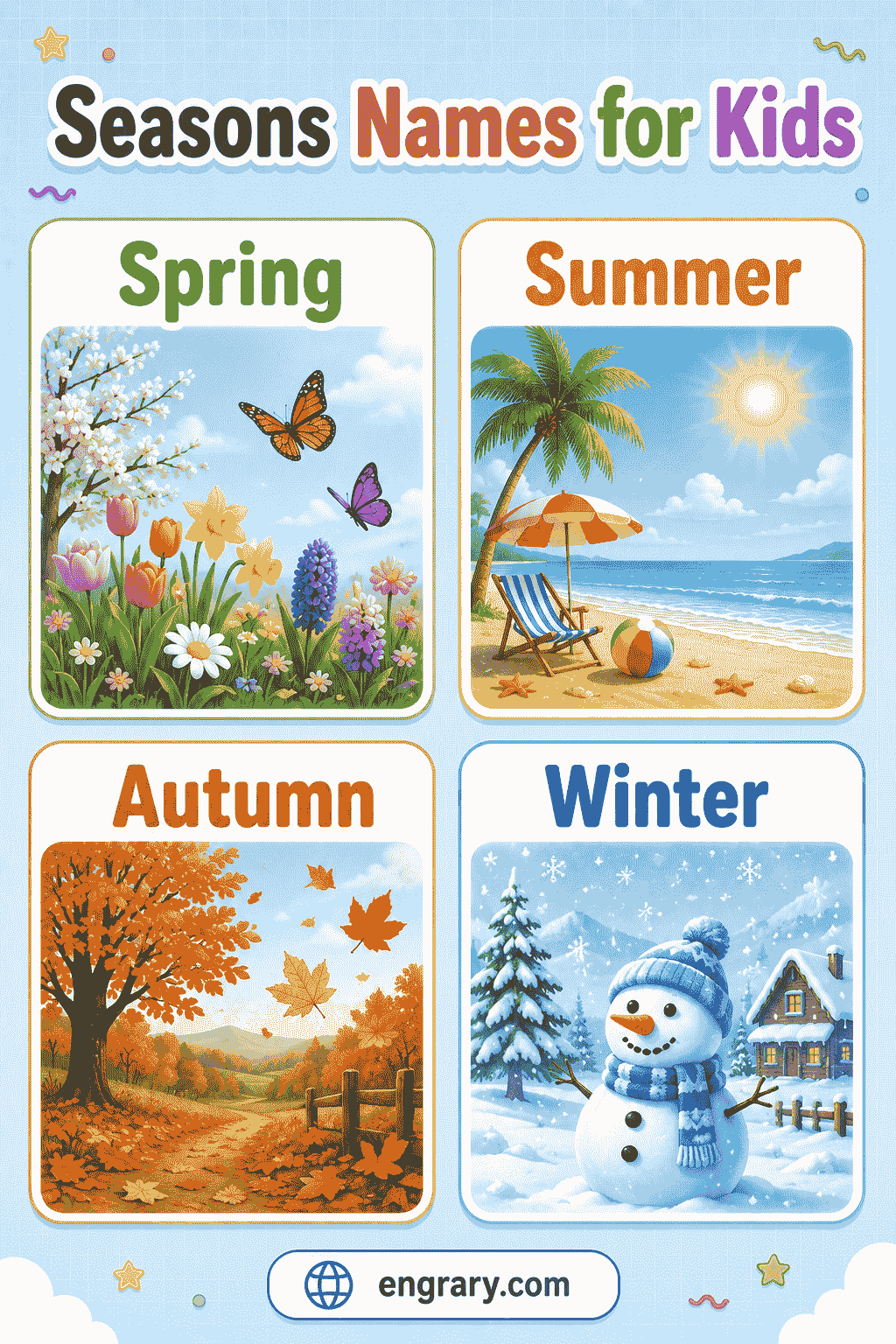
Spring is the season when many plants begin to grow again. In many places, the weather becomes warmer, flowers bloom, and trees grow new green leaves.
Children may see rain, puddles, birds, butterflies, grass, and small plants. Spring often feels fresh because nature starts looking brighter after colder days.
Spring signs kids may notice:
- flowers
- green leaves
- rainy days
- birds
- butterflies
- puddles
- light jackets
- rain boots
Simple spring sentences:
- Spring is a season.
- Flowers grow in spring.
- It can rain in spring.
- I see green leaves in spring.
- We can plant seeds in spring.
Summer: Hot Days, Sunshine, and Outdoor Play
Summer is often the hottest season in many places. Children may notice bright sunshine, warm air, cold drinks, light clothes, and more outdoor play.
Summer does not look the same everywhere. In some places, children swim and play outside often. In very hot places, families may rest indoors during the hottest part of the day.
Summer signs kids may notice:
- hot weather
- bright sun
- blue sky
- T-shirts
- shorts
- hats
- sunglasses
- water play
Simple summer sentences:
- Summer can be hot.
- The sun shines in summer.
- I wear shorts in summer.
- We drink cold water in summer.
- Summer comes after spring.
Autumn or Fall: Colorful Leaves and Cooler Air
Autumn or fall is the season after summer and before winter. In many places, the air becomes cooler, and leaves may change color or fall from trees.
Children may see red, yellow, orange, or brown leaves. They may also start wearing sweaters, jackets, or closed shoes when the weather becomes cooler.
Autumn/fall signs kids may notice:
- colorful leaves
- falling leaves
- cooler air
- windy days
- sweaters
- light jackets
- acorns
- nature walks
Simple autumn/fall sentences:
- Autumn comes after summer.
- Fall is another word for autumn.
- Leaves can change color in autumn.
- The weather gets cooler in fall.
- I wear a sweater in autumn.
Winter: Cold Weather, Warm Clothes, and Snowy Days
Winter is often the coldest season in many places. Children may notice cold air, warm coats, scarves, gloves, blankets, and shorter days. Some places have snow in winter, but not every place gets snow.
Use words like can, may, and in many places when teaching winter. This keeps the explanation accurate because winter looks different around the world.
Winter signs kids may notice:
- cold weather
- warm coats
- scarves
- gloves
- boots
- blankets
- snow in some places
- indoor games
Simple winter sentences:
- Winter can be cold.
- I wear a coat in winter.
- Some places have snow in winter.
- We use blankets in winter.
- Winter comes after autumn or fall.
Autumn vs Fall: Two Names for One Season
Children may feel confused when they see both autumn and fall. The simple answer is that both words can name the same season.
| Word | Simple Meaning |
|---|---|
| Autumn | The season after summer and before winter |
| Fall | Another word for autumn |
| Both words | They can mean the same season |
Fall is common in American English. Autumn is common in British English and many school materials. Children do not need to choose only one word, but they should know both.
Simple examples:
- Autumn comes after summer.
- Fall comes after summer.
- Autumn and fall can mean the same season.
- Leaves often fall in autumn.
- Leaves often fall in fall.
How the Seasons Go Around the Year
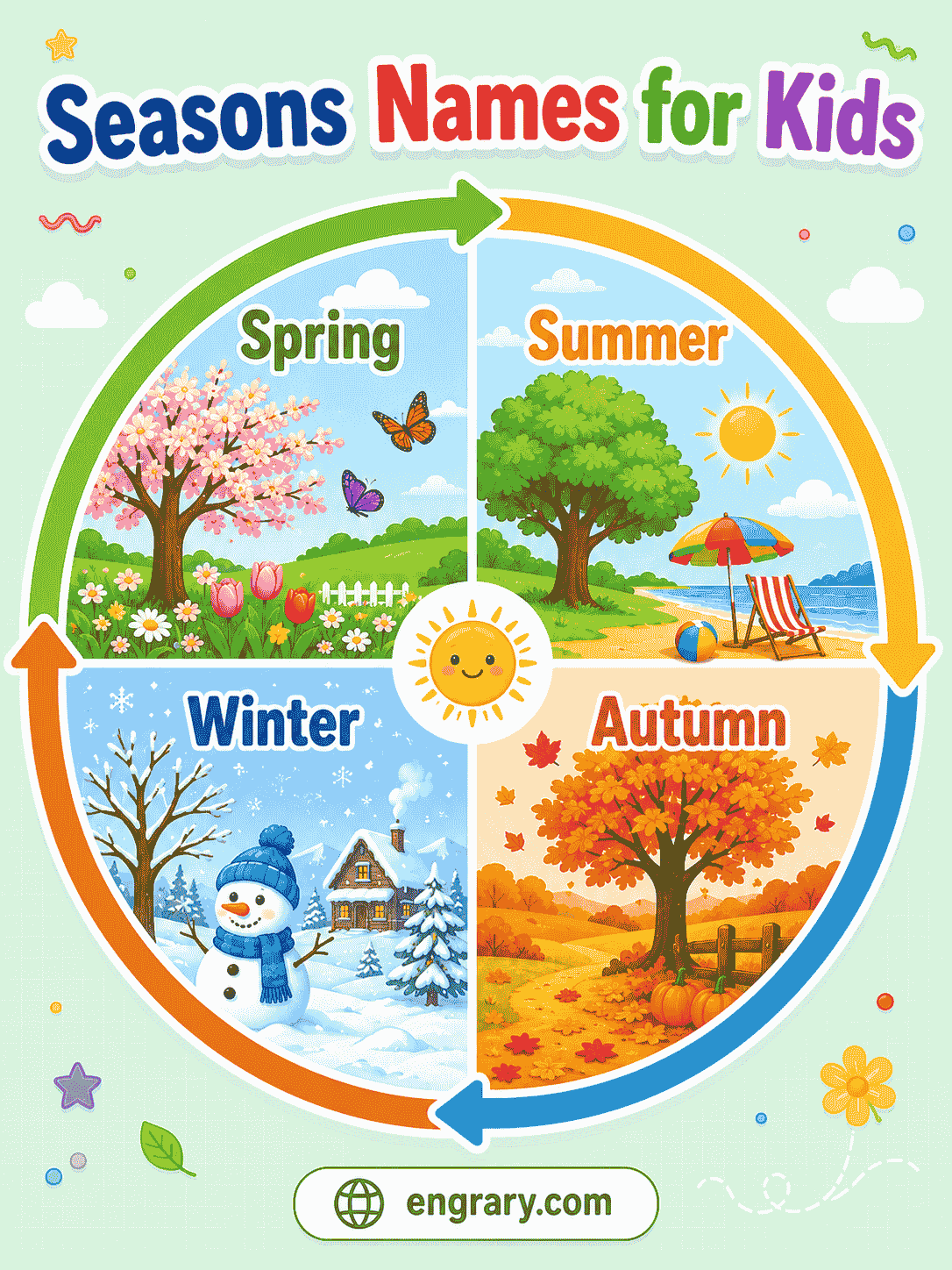
Seasons move in a repeating cycle. After the last season, the cycle starts again.
The common order is:
Spring → Summer → Autumn/Fall → Winter → Spring again
Children can think of the seasons like a circle. When winter ends, spring comes again. Then summer follows spring, and autumn or fall comes after summer. Finally, winter returns after autumn/fall.
Before-and-after examples:
- Summer comes after spring.
- Autumn/Fall comes after summer.
- Winter comes after autumn/fall.
- Spring comes after winter.
Try these practice questions:
| Question | Answer |
|---|---|
| What season comes after spring? | Summer |
| What season comes after summer? | Autumn/Fall |
| What season comes before winter? | Autumn/Fall |
| What season comes after winter? | Spring |
| What season comes before summer? | Spring |
For hands-on practice, place four season cards in a circle:
Spring → Summer → Autumn/Fall → Winter
Weather, Clothes, and Activities by Season
Children often remember season names faster when they connect each season with familiar weather, clothes, and activities. These examples may change by country, but they give children a simple starting point.
| Season | Quick Clues |
|---|---|
| Spring | warmer days, rain, flowers, light jackets |
| Summer | hot sun, T-shirts, hats, water play |
| Autumn/Fall | cooler air, colorful leaves, sweaters |
| Winter | cold weather, coats, scarves, snow in some places |
Simple matching examples:
- Spring — flowers
- Summer — sunshine
- Autumn/Fall — colorful leaves
- Winter — cold weather
- Spring — rain boots
- Summer — hat
- Autumn/Fall — sweater
- Winter — coat
Simple Sentences Children Can Say About Seasons
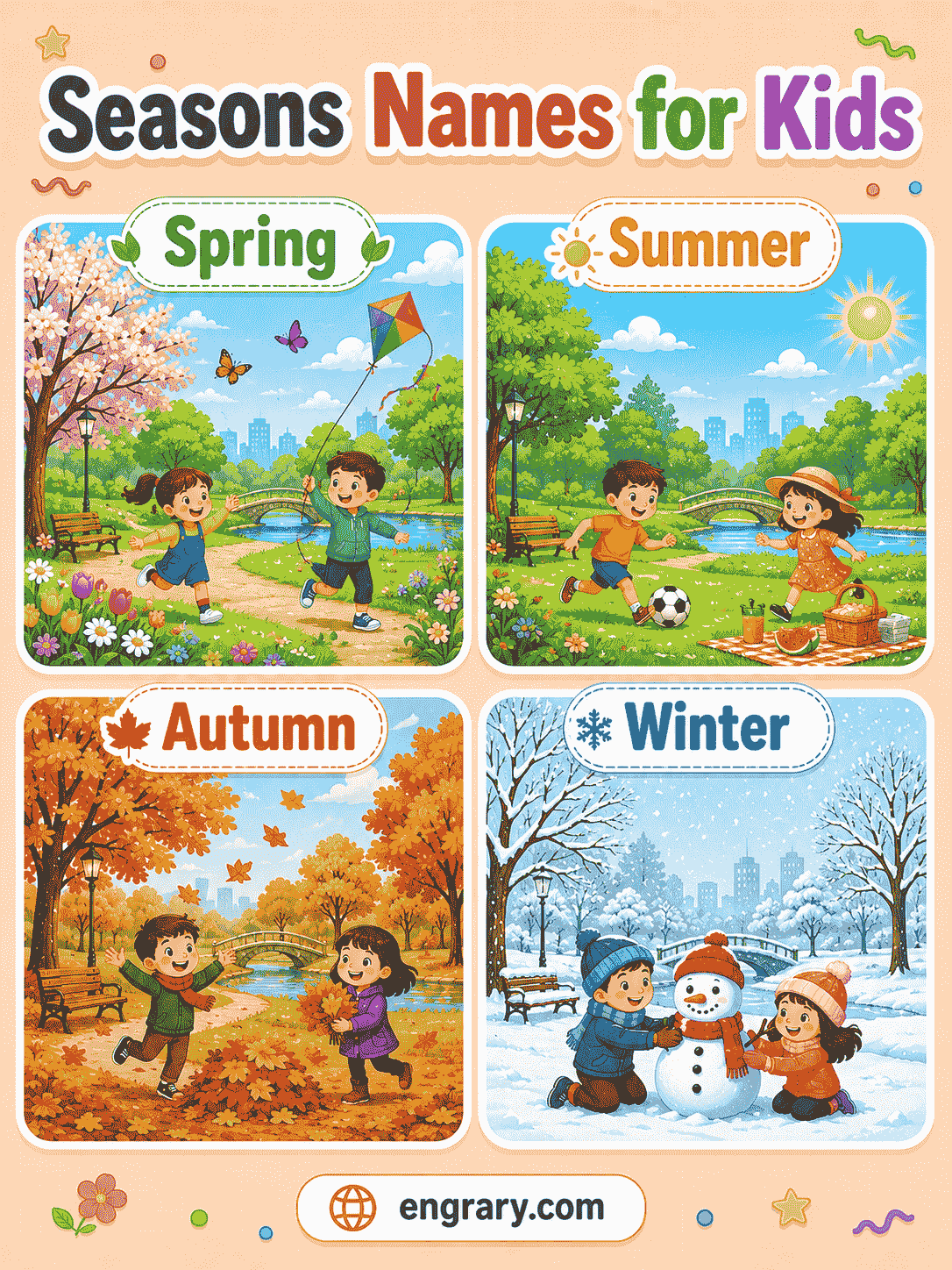
Children should use season names in real sentences, not only repeat them in a list. Sentence practice helps them speak, read, and write with more confidence.
Useful sentence patterns:
- Spring is a season.
- Summer comes after spring.
- Autumn comes after summer.
- Fall is another word for autumn.
- Winter comes after autumn.
- My favorite season is summer.
- I wear a coat in winter.
- Flowers grow in spring.
- Leaves fall in autumn.
- The weather is hot in summer.
Helpful questions:
- What is your favorite season?
- What season comes after winter?
- What can you see in spring?
- What do you wear in winter?
- Is fall another word for autumn?
Short answers kids can practice:
- My favorite season is spring.
- Spring comes after winter.
- I can see flowers in spring.
- I wear gloves in winter.
- Yes, fall is another word for autumn.
Season Sorting Games and Picture Practice
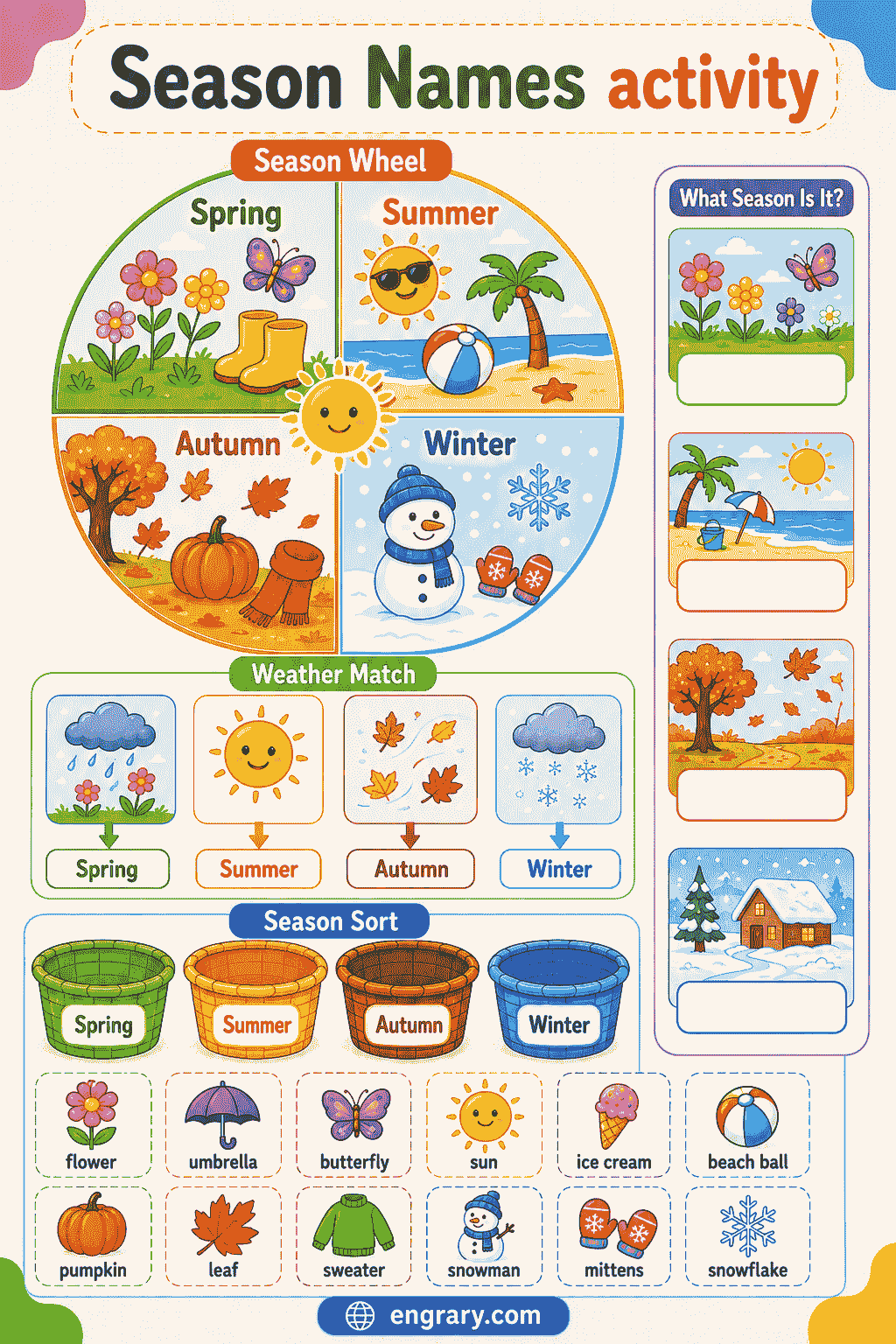
Season sorting is one of the easiest ways to teach season names. Children can match pictures, clothes, weather words, and activities to the correct season.
Try these simple practice ideas:
- Season picture sorting
Give children pictures of flowers, sun, leaves, coats, rain boots, sunglasses, scarves, and snowflakes. Ask them to place each picture under the correct season. - Weather word matching
Match simple weather words to seasons. For example, hot can go with summer, cold can go with winter, and rainy can go with spring. - Clothes basket game
Use picture cards for clothes such as coat, shorts, sweater, hat, gloves, and rain boots. Ask, “Which season does this match?” - Season order line
Place four cards in order: Spring → Summer → Autumn/Fall → Winter. Then mix them and let the child rebuild the order. - Favorite season drawing
Ask children to draw their favorite season. After drawing, they can say one sentence: “My favorite season is ____.” - Nature walk talk
Look outside and ask: Is it hot, cold, rainy, or windy? What season might it be? - Before-and-after cards
Hold up one season card and ask what comes before or after it. For example: “What comes after summer?”
Common Season Mix-Ups Kids Need Help With
Season names are easy to say, but children may still mix up meanings, order, and weather signs.
| Common Mix-Up | Better Teaching Tip |
|---|---|
| Thinking autumn and fall are different seasons | Explain that both words can mean the same season. |
| Saying every winter has snow | Say winter is cold in many places, but snow does not happen everywhere. |
| Mixing up the season order | Use four cards: spring, summer, autumn/fall, winter. |
| Confusing seasons with months | Explain that months are calendar names, while seasons describe weather and nature changes. |
| Calling every warm day summer | Show that spring can also have warm days. |
| Thinking seasons look the same everywhere | Use words like can, may, and in many places. |
Useful correction example:
“Yes, it is warm today. Warm days can happen in spring too.”
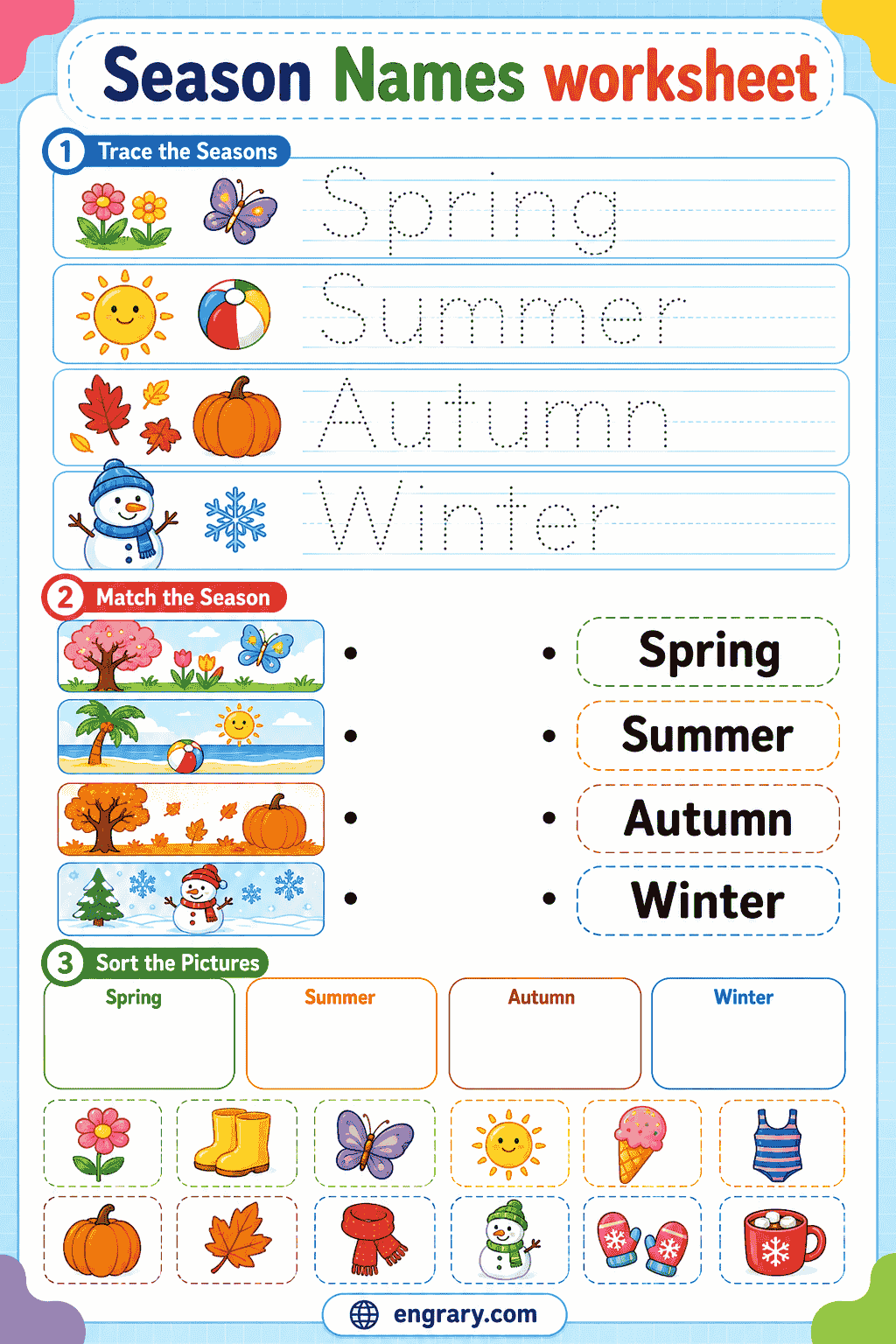
Season Names Practice Worksheet
Use this quick practice block for classwork, homework, or review.
A. Fill in the missing season
- Spring, Summer, ________, Winter
- Winter, Spring, ________
- Summer, Autumn/Fall, ________
- Autumn/Fall, Winter, ________
- Spring, ________, Autumn/Fall
B. Match the season
- Spring — ________
- Summer — ________
- Autumn/Fall — ________
- Winter — ________
Word bank: cold weather, flowers, hot sun, falling leaves
C. Circle the correct answer
- What season comes after spring?
Summer / Winter / Autumn - What season comes before winter?
Spring / Autumn/Fall / Summer - Which season can be hot and sunny?
Summer / Winter / Autumn - Which season can be cold?
Winter / Spring / Summer - Fall is another word for:
Autumn / Summer / Winter
D. Complete the sentences
- My favorite season is ________.
- Flowers grow in ________.
- I wear a coat in ________.
- Leaves can fall in ________.
- Summer comes after ________.
Answer key:
- A1: Autumn/Fall
- A2: Summer
- A3: Winter
- A4: Spring
- A5: Summer
- B1: flowers
- B2: hot sun
- B3: falling leaves
- B4: cold weather
- C1: Summer
- C2: Autumn/Fall
- C3: Summer
- C4: Winter
- C5: Autumn
Season Names Quiz for Kids
Try the questions first, then check the answers below.
- How many main seasons do many children learn?
- What season comes after spring?
- What season comes before winter?
- Which season can be hot and sunny?
- Which season can be cold?
- What is another word for autumn?
- What season comes after winter?
- In which season do flowers often grow?
- In which season do leaves often fall?
- What season comes between summer and winter?
Answers:
- 4 seasons
- Summer
- Autumn/Fall
- Summer
- Winter
- Fall
- Spring
- Spring
- Autumn/Fall
- Autumn/Fall
FAQs
The 4 season names are spring, summer, autumn/fall, and winter. Many children learn these as the main seasons of the year.
Yes. Autumn and fall can mean the same season. Fall is common in American English, while autumn is common in British English and many school materials.
Spring comes after winter. The season cycle begins again with spring.
Kids can remember the seasons by using picture cards, sorting clothes and weather words, saying the season order, and drawing their favorite season.
No. Winter is cold in many places, but snow does not happen everywhere. Some places have cool or rainy winters instead.
You May Also Like