Children often hear month names when they talk about birthdays, school events, holidays, family trips, or special days. However, they may not understand how all the months fit together in one year yet.
Learning the months of the year for kids helps children say the month names, remember their order, and use simple calendar words like this month, last month, next month, before, and after with more confidence.
What Does a Month Mean for Kids?
A month is one part of a year. A full year has 12 months, and every month has its own name.
Children see months in real life. A birthday may be in March, a school event may happen in September, and a family trip may take place in July. Calendars use months to show when important days and plans happen.
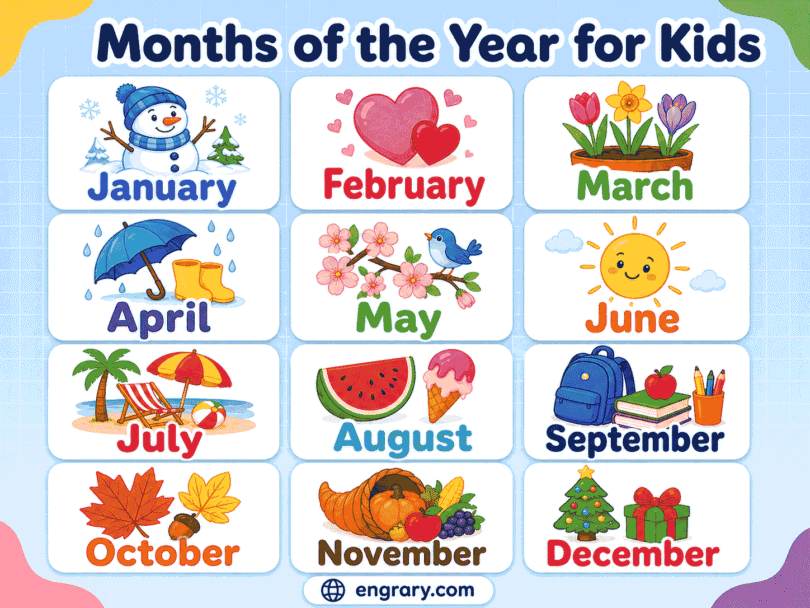
The 12 months are:
- January
- February
- March
- April
- May
- June
- July
- August
- September
- October
- November
- December
A simple way to explain months is:
Twelve months make one year. When December ends, a new year begins with January.
12 Months of the Year in the Right Order
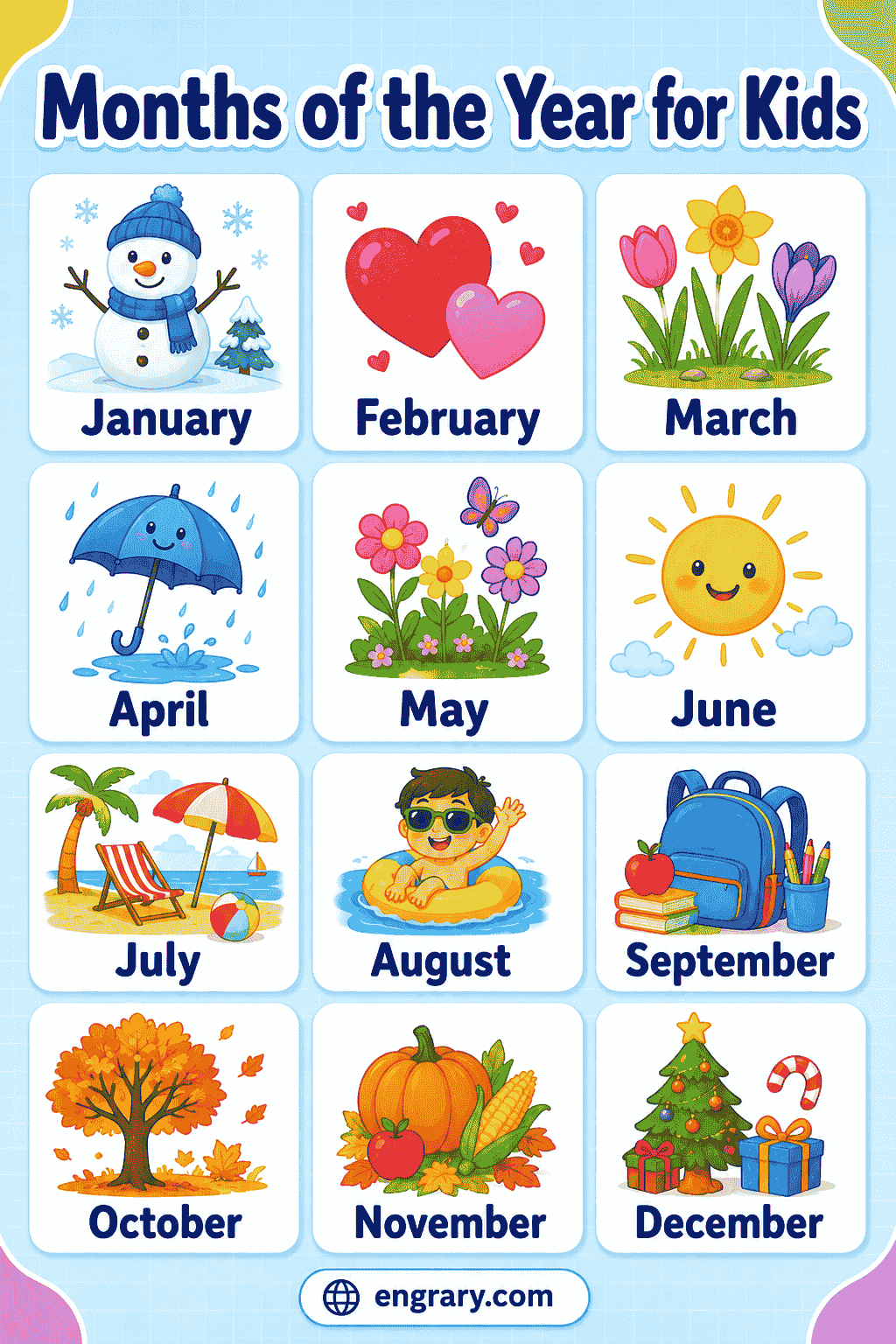
Children should first learn the months in the correct order. Saying the names aloud helps them remember the pattern of the year.
- January
- February
- March
- April
- May
- June
- July
- August
- September
- October
- November
- December
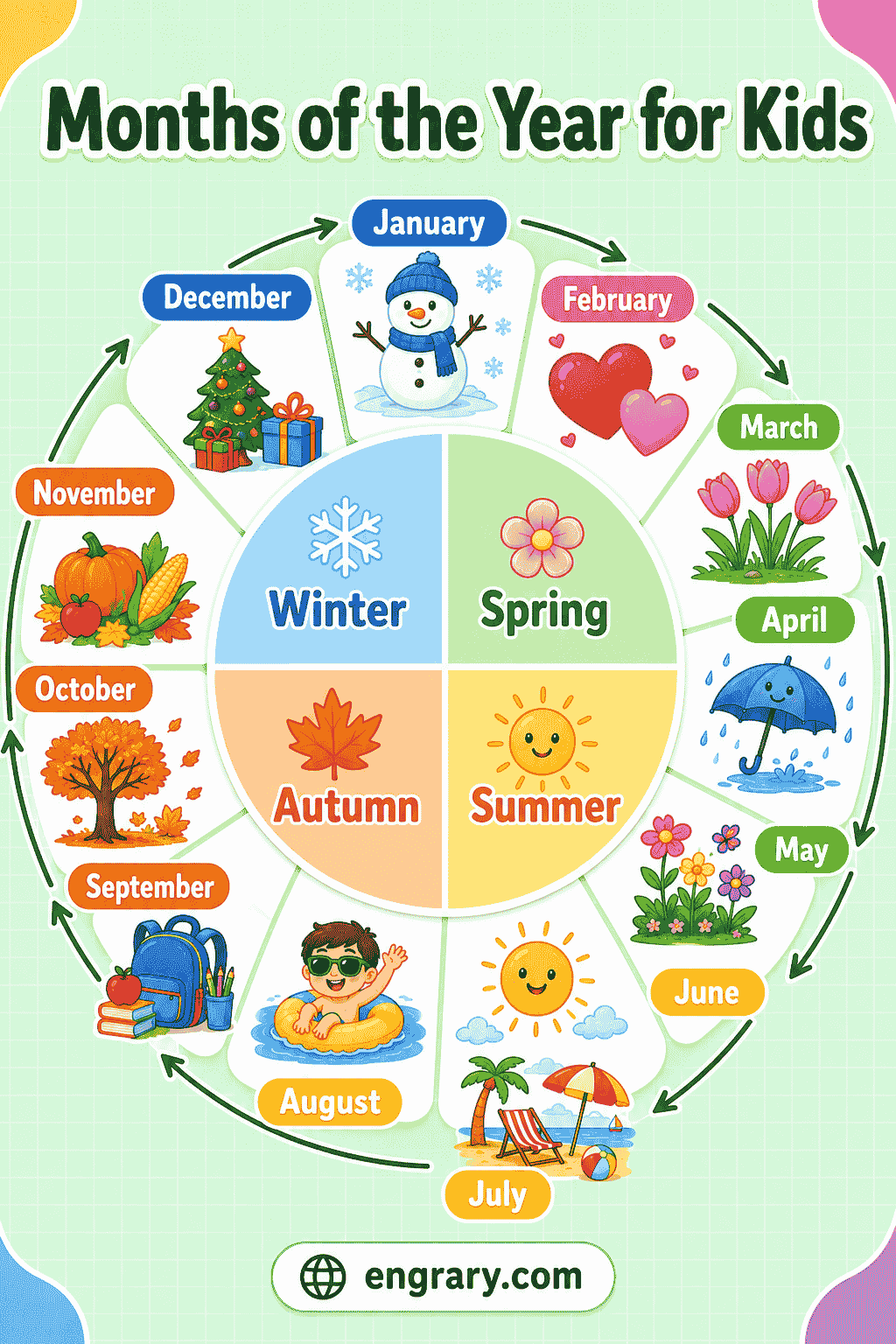
The months move in order from January to December. After December, the next month is January again because a new year begins.
A simple chant can help children remember the order:
January, February, March, April, May,
June and July are on the way.
August, September, October too,
November, December, the year is through.
Parents and teachers can point to each month on a calendar while saying the names. That way, children connect each word to a real place in the year.
Month Names with Easy Pronunciation
Some month names are short and easy to say, while others need more practice. February, September, October, November, and December are often harder for young learners because they are longer.
| Month | Easy Pronunciation | Listen and Say |
|---|---|---|
| January | JAN-yoo-air-ee | 🔊 January |
| February | FEB-roo-air-ee / FEB-yoo-air-ee | 🔊 February |
| March | March | 🔊 March |
| April | AY-pril | 🔊 April |
| May | May | 🔊 May |
| June | Joon | 🔊 June |
| July | joo-LY | 🔊 July |
| August | AW-gust | 🔊 August |
| September | sep-TEM-ber | 🔊 September |
| October | ok-TOH-ber | 🔊 October |
| November | noh-VEM-ber | 🔊 November |
| December | dee-SEM-ber | 🔊 December |
Helpful pronunciation notes:
- January has four parts: Jan-u-ar-y.
- February has an r in the spelling after Feb, but some people say that sound softly.
- March is short and clear.
- April starts with the long a sound.
- July is stressed at the end: joo-LY.
- September, November, and December all end with ber.
- October has a strong middle sound: TOH.
Children can also clap the word parts:
- Jan-u-ar-y
- Feb-ru-ar-y
- March
- A-pril
- May
- June
- Ju-ly
- Au-gust
- Sep-tem-ber
- Oc-to-ber
- No-vem-ber
- De-cem-ber
Beginning, Middle, and End of the Year
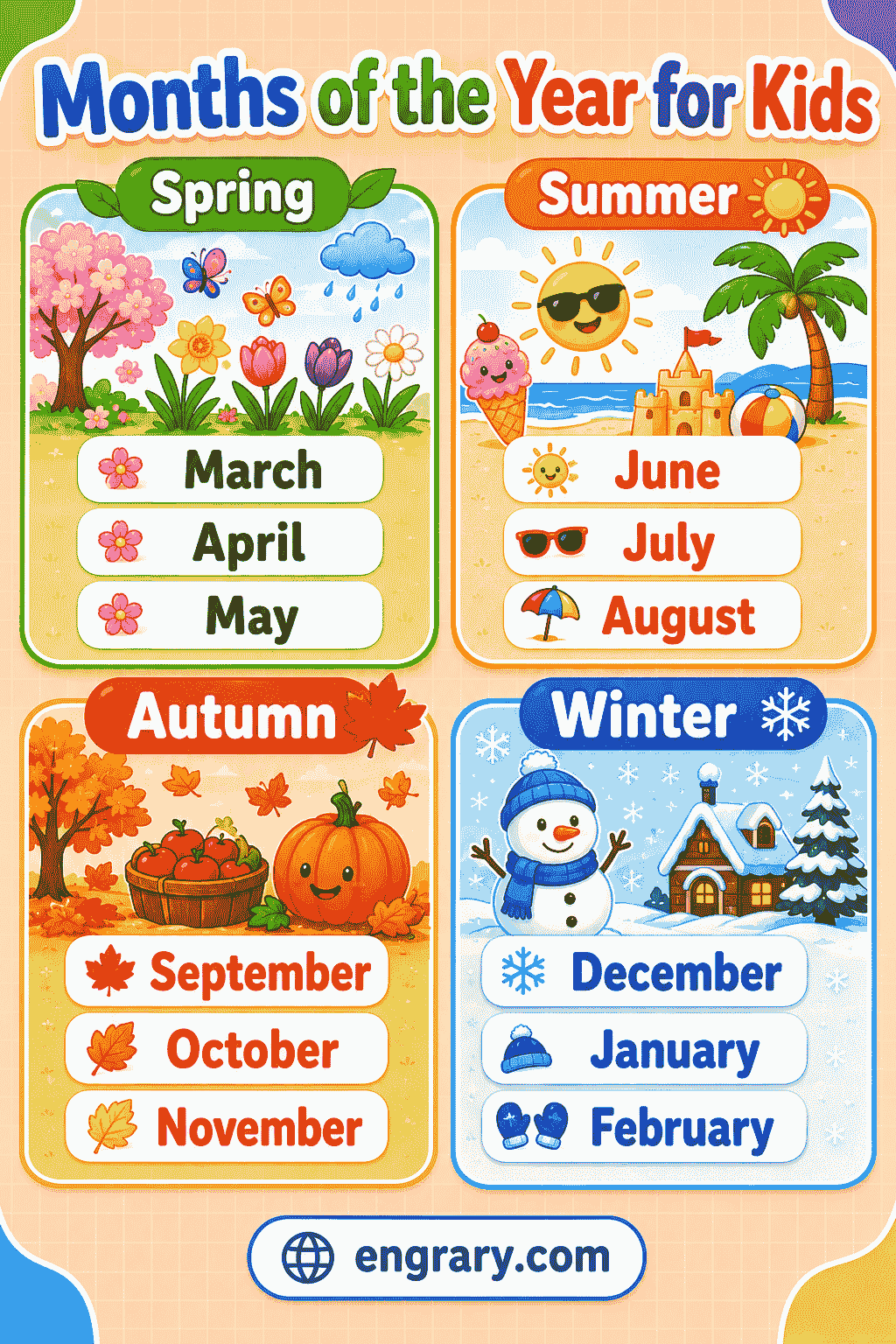
The 12 months can feel like a long list, so it helps to group them into smaller parts. This is not a strict rule; it is just an easy way for children to remember where months belong.
- Beginning of the year: January, February, March, April
- Middle of the year: May, June, July, August
- End of the year: September, October, November, December
Simple examples:
- January is at the beginning of the year.
- June is near the middle of the year.
- September starts the last group of months.
- December is the last month of the year.
Try this quick question:
Is October near the beginning, middle, or end of the year?
Answer: End of the year
This Month, Last Month, and Next Month
The words this month, last month, and next month help children talk about time. These words change as the calendar moves.
| Term | Meaning | Example |
|---|---|---|
| This month | The month we are in now | This month is April. |
| Last month | The month before this month | Last month was March. |
| Next month | The month after this month | Next month is May. |
More practice:
- If this month is January, last month was December, and next month is February.
- If this month is March, last month was February, and next month is April.
- If this month is June, last month was May, and next month is July.
- If this month is October, last month was September, and next month is November.
- If this month is December, last month was November, and next month is January.
Real-life examples make the words easier:
- This month is March. My birthday is this month.
- Last month was February. We made a class craft last month.
- Next month is April. We will visit the zoo next month.
A useful daily question is:
What month is it now?
The child can answer:
This month is June.
What Month Comes Before or After?
Once children know the month order, they can answer before and after questions. This helps them understand sequence.
Before means earlier.
After means next or later.
Simple examples:
- February comes after January.
- March comes before April.
- July comes after June.
- December comes before January when a new year starts.
Try these practice questions:
| Question | Answer |
|---|---|
| What month comes after January? | February |
| What month comes before April? | March |
| What month comes after June? | July |
| What month comes before September? | August |
| What month comes after December? | January |
| What month comes before November? | October |
| What month comes between May and July? | June |
For younger children, month cards make this easier. Place the cards in order, remove one card, and ask:
Which month is missing?
Easy Spelling Help for Month Names
Month names can be hard to spell because some are long. Children should first learn to recognize and say the names before they memorize every spelling.
Break each month into smaller parts:
- Jan-u-ar-y
- Feb-ru-ar-y
- March
- A-pril
- May
- June
- Ju-ly
- Au-gust
- Sep-tem-ber
- Oc-to-ber
- No-vem-ber
- De-cem-ber
Helpful spelling tips:
- Every month name starts with a capital letter.
- May is the shortest month name.
- September is the longest month name.
- January and February both end with -uary.
- September, November, and December end with -ber.
- October begins with Oct.
- February is tricky because it has Feb-ru at the start.
A simple spelling practice can follow this order:
- Say the month.
- Clap the word parts.
- Trace the word.
- Copy the word.
- Use the month in a sentence.
Example:
September
Clap: Sep-tem-ber
Sentence: School starts in September.
Short Month Names and Abbreviations
Month names are sometimes written in a short form. These short forms are called abbreviations. Children may see them on calendars, worksheets, planners, and classroom charts.
| Full Month | Short Form |
|---|---|
| January | Jan. |
| February | Feb. |
| March | Mar. |
| April | Apr. |
| May | May |
| June | Jun. |
| July | Jul. |
| August | Aug. |
| September | Sept. |
| October | Oct. |
| November | Nov. |
| December | Dec. |
Helpful notes:
- May is already short, so it usually stays the same.
- Short month names often use a period.
- Abbreviations save space on small calendars.
Simple examples:
- Jan. means January.
- Feb. means February.
- Oct. means October.
- Dec. means December.
How Kids Use Month Names in Sentences
Children need to use month names in real sentences, not only say them in order. Sentence practice helps them speak and write naturally.
Useful sentence patterns:
- January is the first month of the year.
- My birthday is in March.
- May comes after April.
- August comes before September.
- December is the last month of the year.
- This month is October.
- Last month was September.
- Next month is November.
- We have a school event in February.
- Our family trip is in July.
Question practice is also helpful:
- What month is it now?
- What month was last month?
- What month is next month?
- What month is your birthday in?
- Which month comes after June?
- Which month comes before December?
Children can answer in short, simple sentences:
- This month is April.
- Last month was March.
- Next month is May.
- My birthday is in August.
- July comes after June.
Common Mistakes Kids Make with Months
Children often mix up month names, order, spelling, and time words. These mistakes are normal because a year has many more parts than a week.
| Common Mistake | Better Way to Teach It |
|---|---|
| Mixing up June and July | Place the cards side by side and say each name slowly. |
| Forgetting what comes after December | Show that a new year begins with January. |
| Misspelling February | Break it into Feb-ru-ar-y. |
| Writing month names with small letters | Teach that month names begin with capital letters. |
| Confusing last month and next month | Use three cards: last month, this month, next month. |
| Forgetting the long months near the end | Practice September, October, November, and December together. |
For quick practice, children can complete this sentence frame:
This month is ____. Last month was ____. Next month will be ____.
Simple Ways to Practice the Months of the Year
Children learn month names better when they see, say, move, and repeat them in different ways. These simple activities work well at home or in class.
- Calendar pointing
Show a yearly or monthly calendar. Point to each month and say the name aloud. Then let the child point and repeat. - Month card ordering
Write the 12 month names on cards. Mix them up and ask the child to put them in order from January to December. - Missing month game
Place the month cards in order, then remove one card. Ask, “Which month is missing?” - This, last, next month chart
Make three boxes labeled Last Month, This Month, and Next Month. Change the cards when a new month begins. - Birthday month talk
Ask children to say their birthday month. For example, “My birthday is in May.” - Beginning, middle, end sort
Make three groups: Beginning, Middle, and End. Ask children to place each month card in the correct group. - Clap and say
Say each month name and clap the word parts, such as Jan-u-ar-y, Feb-ru-ar-y, and Sep-tem-ber. - Draw the year
Ask children to draw one small picture for a few months. They may draw a birthday cake for their birthday month, a school bag for a school month, or a suitcase for a travel month.
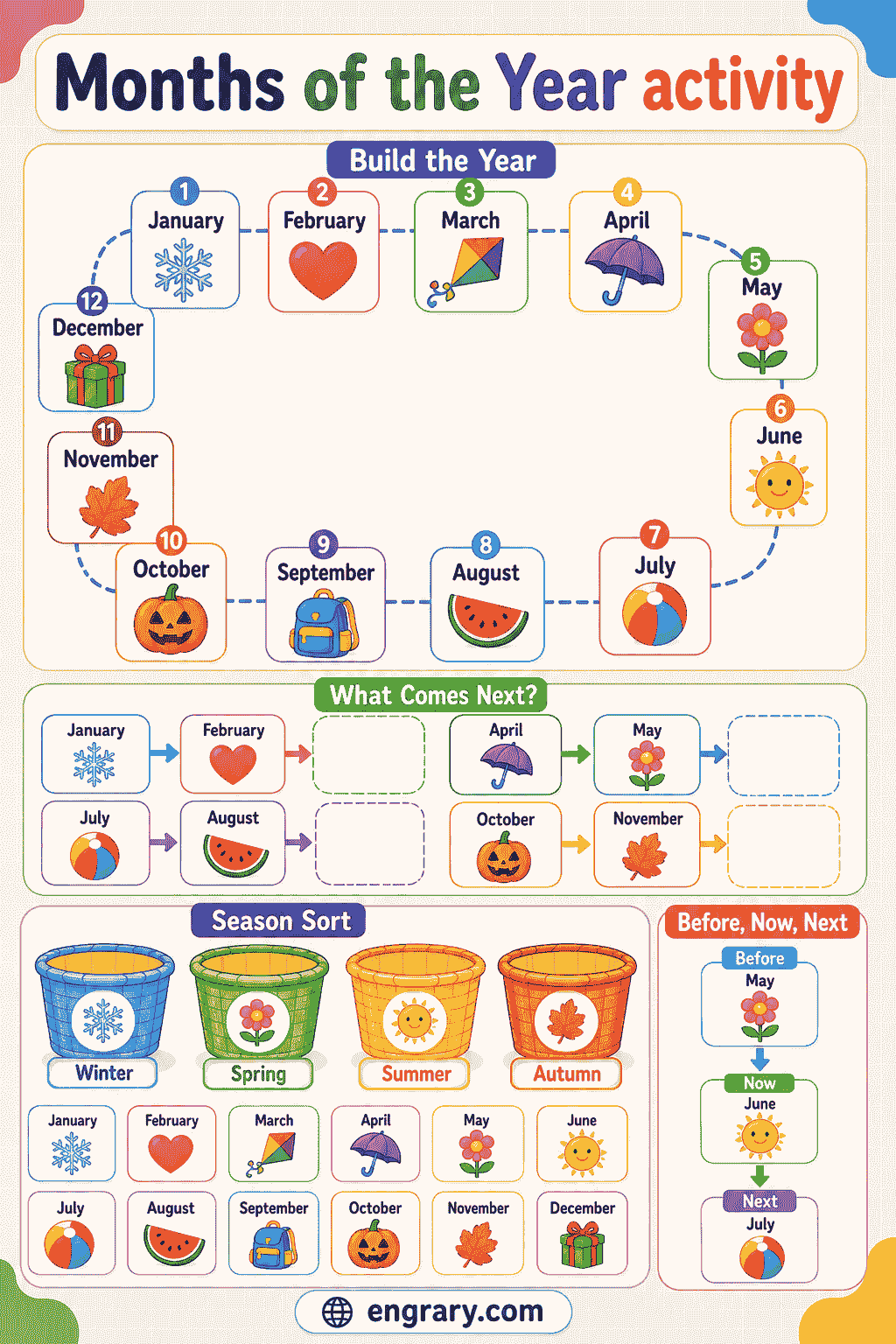
Months of the Year Practice Worksheet
Use this simple practice block for quick review at home or in class.
A. Fill in the missing months
- January, February, ________, April
- May, June, ________, August
- September, October, ________, December
- November, December, ________
- March, April, ________
B. Circle the correct answer
- What month comes after January?
February / June / October - What month comes before May?
April / August / December - Which month is the last month of the year?
January / December / July - If this month is March, next month is:
February / April / November - If this month is August, last month was:
July / September / May
C. Complete the sentences
- This month is ________.
- Next month is ________.
- Last month was ________.
- My birthday is in ________.
- The first month of the year is ________.
- The last month of the year is ________.
Answer key:
- A1: March
- A2: July
- A3: November
- A4: January
- A5: May
- B1: February
- B2: April
- B3: December
- B4: April
- B5: July
- C5: January
- C6: December
Months of the Year Quiz for Kids
Try the questions first, then check the answers below.
- How many months are in a year?
- What is the first month of the year?
- What is the last month of the year?
- What month comes after February?
- What month comes before August?
- Which month comes between May and July?
- If this month is October, what is next month?
- If this month is April, what was last month?
- Which month starts with “Dec”?
- Which month is the shortest month name?
Answers:
- 12 months
- January
- December
- March
- July
- June
- November
- March
- December
- May
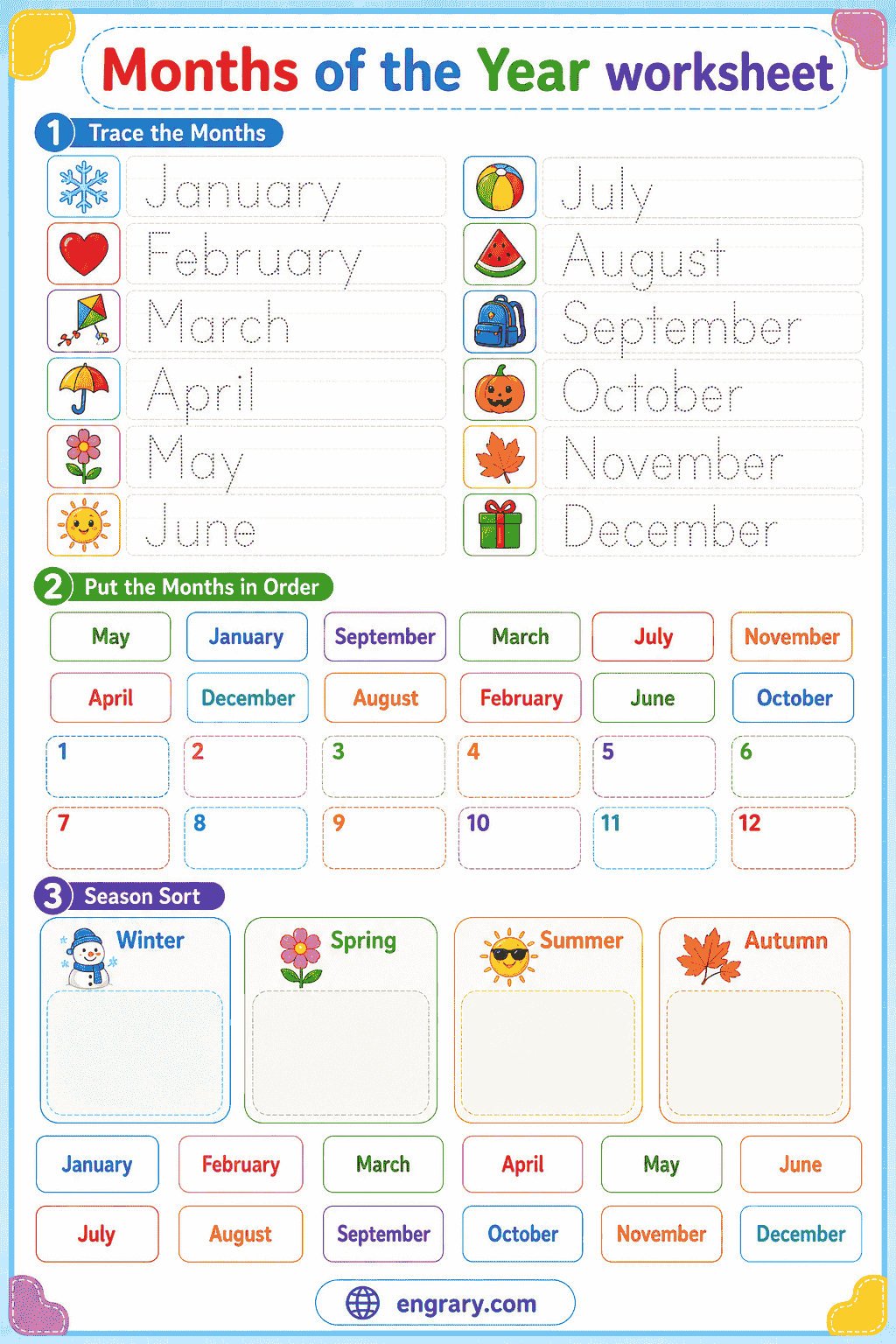
FAQs
The 12 months of the year are January, February, March, April, May, June, July, August, September, October, November, and December. They come in the same order every year.
Kids can remember the months by singing a month song, using month cards, pointing to a calendar, and practicing the order from January to December.
January is the first month of the year. A new year begins in January.
December is the last month of the year. After December ends, a new year starts with January.
January comes after December because a new year begins when December ends.
You May Also Like