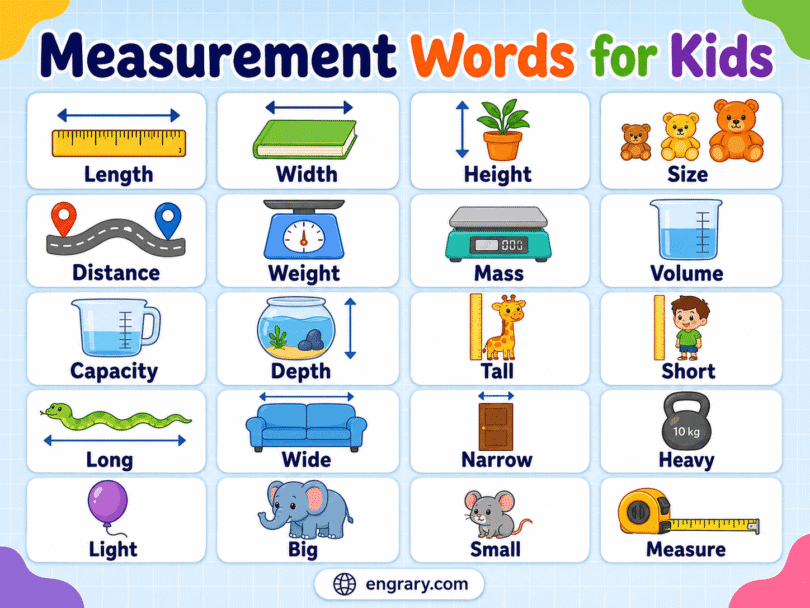
A child can place two pencils side by side and notice that one is longer. Then they can make a smart guess, measure with blocks or a ruler, and say the pencil is about six blocks long or seven inches long.
Measurement words help kids talk about size, amount, weight, temperature, and time more carefully. Children use these words when they compare objects, estimate before checking, choose a measuring tool, and say a simple unit.
How Do Measurement Words Help Kids?
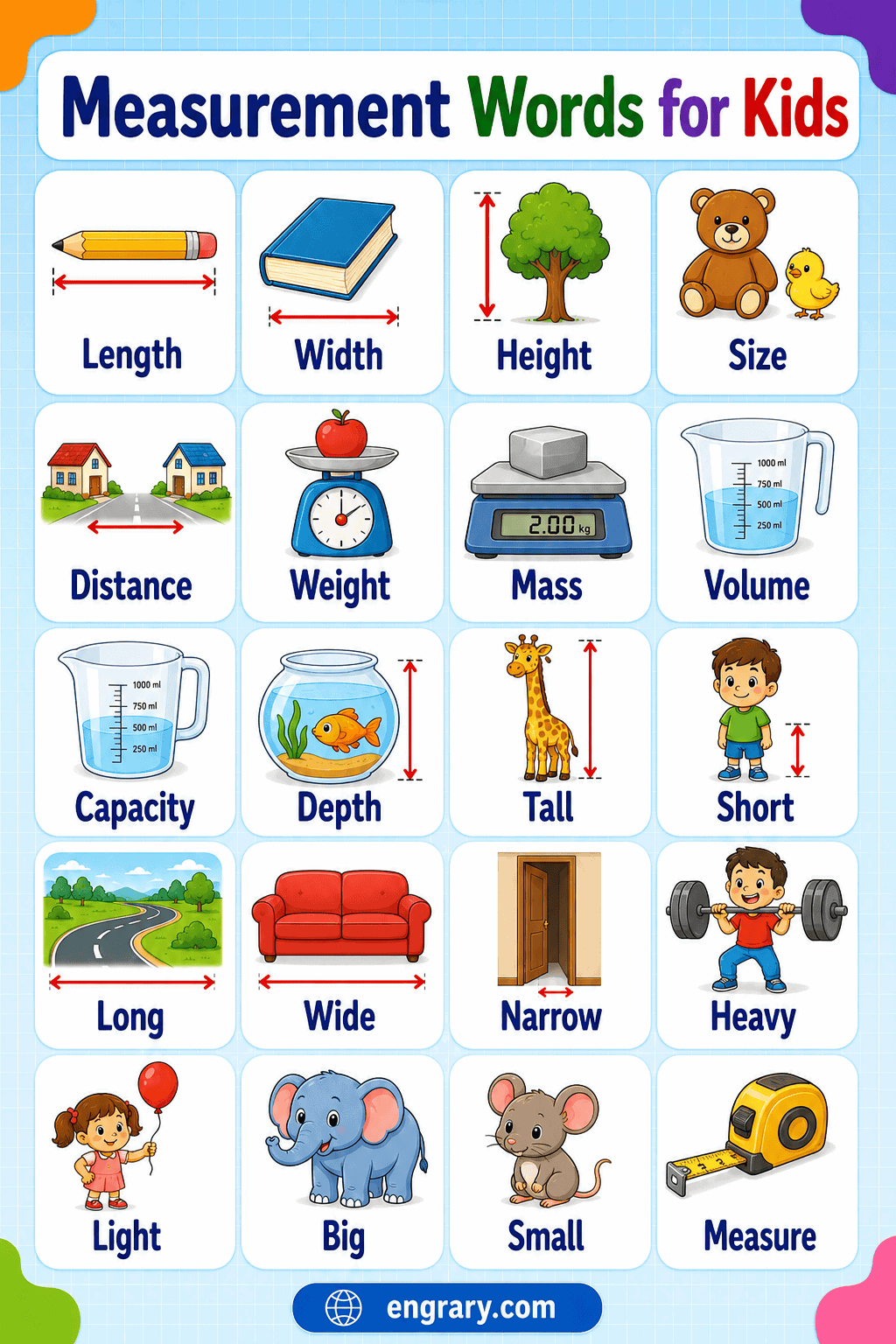
Measurement words are words children use when they compare, estimate, and measure real things. These words help them answer questions like How long is it?, How tall is it?, How heavy is it?, How much can it hold?, and How long did it take?
Many children first describe objects with simple size words such as big, small, heavy, or long. Later, measurement words help them become more exact. A child may first say a tower is tall, then estimate that it is about ten blocks high, and finally measure it with cubes or a measuring tape.
Measurement can use real objects, simple tools, and easy units. For example, a child may use blocks to measure a book, a ruler to measure a pencil, a scale to weigh a bag, a measuring cup to check water, or a timer to measure minutes.
Important teaching idea:
Measurement words help kids describe things more carefully than only saying big, small, heavy, or long.
Examples:
- measure the length of a pencil
- compare the height of two towers
- check the weight of a bag
- see how much water a cup can hold
- use a clock to measure time
Size Words vs Measurement Words
These two word groups are related, but they do not do the same job. Children use size words to describe what they notice quickly. With measurement words, they can compare, check, or describe something more carefully.
| Word Type | Tells | Example |
|---|---|---|
| Size words | how something looks or feels | big bag, small cup |
| Measurement words | how we compare or measure | length, weight, capacity |
A child may say a bag is big or heavy. Those words are useful, but measurement vocabulary can make the idea more exact. The child can talk about the bag’s weight, use a scale, and say whether it is heavier or lighter than another bag.
A pencil may look long, but the measurement word length helps children talk about how long it is. A cup may look small, yet capacity tells how much it can hold.
Measurement Action Words: Compare, Estimate, and Measure
Children often use three important measurement action words: compare, estimate, and measure. These words usually happen in order during early math activities.
| Measurement Word | Kid Meaning | Example |
|---|---|---|
| compare | look at two things | Which pencil is longer? |
| estimate | make a smart guess | It is about 5 blocks long. |
| measure | find the size or amount | It is 6 blocks long. |
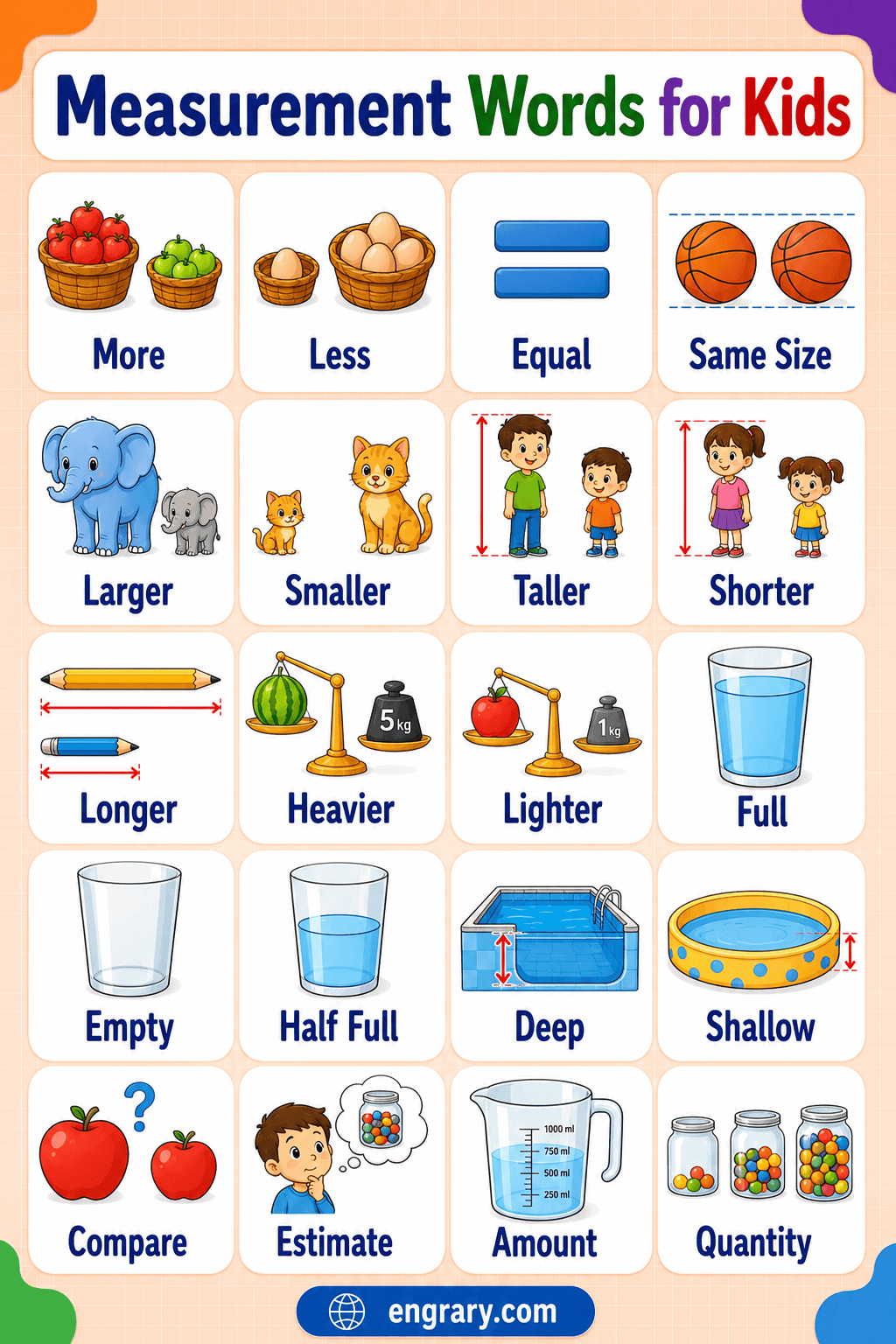
Compare means looking at two things to see how they are alike or different. A child can compare two pencils, two towers, two cups, or two bags.
Estimate means making a smart guess before measuring. The word about often goes with an estimate because the answer is close, not exact.
Measure means checking more carefully. Children can measure with blocks, cubes, rulers, scales, cups, timers, or other tools.
Useful examples:
- This pencil is longer.
- I estimate the book is about 6 blocks long.
- We can measure it with blocks or a ruler.
- The exact answer is 7 blocks long.
- My estimate was close.
Length, Height, and Width Measurement Words
Length, height, and width are measurement words that children often mix up. They all describe size, but each one looks at size in a different direction.
| Measurement Word | Tells | Example |
|---|---|---|
| length | how long | length of a pencil |
| height | how tall | height of a tree |
| width | how wide | width of a door |
Length tells how long something is from one end to the other. A rope, pencil, book, or road can have length.
Height tells how tall something is from bottom to top. A tree, tower, child, or building can have height.
Width tells how wide something is from side to side. A table, door, box, or book can have width.
Examples:
- the length of a rope
- the height of a tower
- the width of a table
- the length of a pencil
- the height of a child
- the width of a book
Real objects make these words easier to understand. Lay a pencil flat to show length, build a block tower to show height, and place a book sideways to show width.
Weight Measurement Words
Weight tells how heavy or light something is. When children learn measurement vocabulary, they also learn that weight can be checked, compared, and measured.
Important weight measurement words include:
- weight
- weigh
- heavy
- light
- heavier
- lighter
- scale
Weigh means to check weight. A scale is a tool used to weigh things. A child can weigh a bag, apple, toy, box, or classroom object.
Examples:
- weigh a bag on a scale
- a rock is heavier than a leaf
- a feather is lighter than a book
- a backpack can feel heavy
- a paper bag can feel light
Weight is not the same as visual size. A small rock can be heavy, and a big balloon can be light.
Capacity Measurement Words
Capacity means how much a container can hold. This measurement word is useful when children compare cups, bottles, bowls, buckets, jars, and jugs.
Useful capacity measurement words include:
- capacity
- hold
- holds more
- holds less
- full
- empty
- half-full
- fill
- pour
- container
A container is something that can hold things. Cups, bottles, bowls, buckets, and jugs are containers.
Examples:
- a cup can hold water
- a bottle can hold juice
- a bowl can hold soup
- a bucket can hold sand
- a glass can be full
- a bottle can be empty
- a cup can be half-full
Pouring activities make capacity easier to see. Children can pour water from a small cup into a larger cup, then talk about which container holds more or holds less.
Temperature and Time Measurement Words
Temperature and time are also measurement words. Keep them simple for young children so the lesson does not become a full clock-reading or weather unit.
Temperature measurement words include:
- temperature
- hot
- cold
- warm
- cool
- thermometer
- degrees
A thermometer is a tool that checks temperature. Children may hear this word when checking body temperature, weather, water, or food.
Examples:
- use a thermometer to check temperature
- soup can be hot
- water can be cold
- a day can feel warm
- a drink can be cool
- temperature can be measured in degrees
Time measurement words include:
- time
- clock
- timer
- second
- minute
- hour
- longer time
- shorter time
A clock shows time, while a timer can measure how long something takes. Children may use a timer for reading, running, cleaning up, or playing a quick game.
Examples:
- a timer can measure minutes
- a clock shows time
- one activity can take a longer time
- another activity can take a shorter time
- a race may last a few seconds
Measurement Tools and Unit Words Kids Should Know
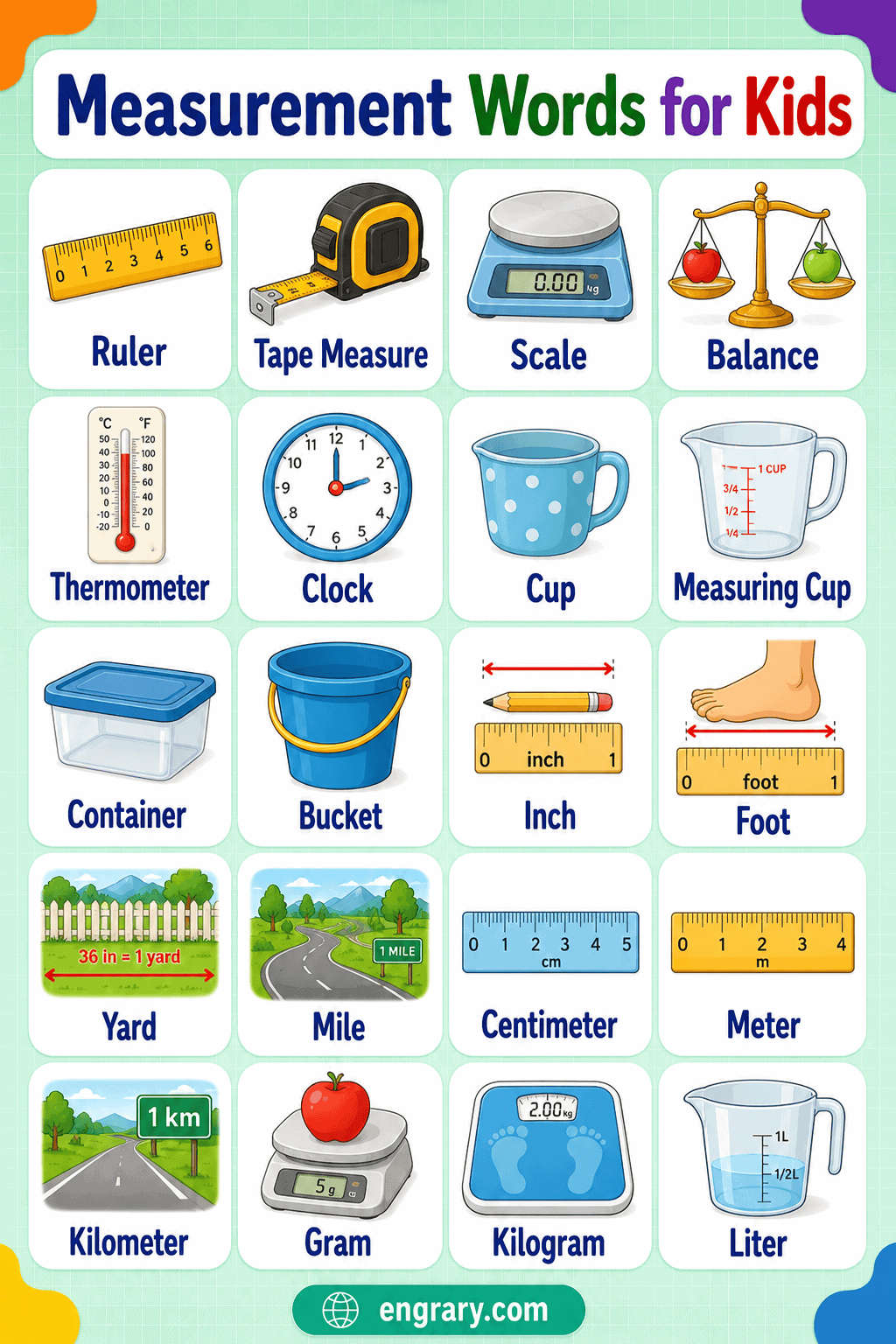
A measurement tool helps children measure more carefully. A unit word tells how the measurement is said, such as inches, centimeters, grams, liters, minutes, or degrees.
| Measurement Word | Tool | Example |
|---|---|---|
| length | ruler | measure a pencil |
| height | measuring tape | measure height |
| weight | scale | weigh a bag |
| capacity | measuring cup | measure water |
| temperature | thermometer | check temperature |
| time | clock or timer | measure minutes |
Children do not need long unit charts at the beginning. They can first use non-standard units like blocks, cubes, or paper clips. For example, a book may be 8 cubes long, or a pencil may be 5 paper clips long.
Later, children can hear simple standard units:
- inches
- centimeters
- grams
- liters
- minutes
- degrees
The aim is not unit conversion. The aim is to help children connect the measurement word, the tool, and the result.
Measurement Words Kids Often Mix Up
Some measurement words are close in meaning, so children may confuse them at first. A clear comparison helps them choose the right word.
| Mix-Up | Difference | Example |
|---|---|---|
| length / height | long vs tall | pencil length / tree height |
| weight / size | heavy vs big | small rock can be heavy |
| capacity / weight | holds vs weighs | cup holds water / bag weighs more |
| estimate / measure | guess vs check | about 5 blocks / exactly 6 blocks |
| tool / unit | use vs say | ruler / inches |
Length is not the same as height. Length tells how long something is, while height tells how tall something is.
Capacity is not the same as weight. Capacity tells how much a container can hold, while weight tells how heavy something is.
Estimate is not the final measured answer. An estimate is a smart guess. A measurement is checked more carefully.
Tool and unit are also different. A ruler is a tool. Inches or centimeters are units.
How to Teach Measurement Words with Real Objects
Real objects make measurement words easier to understand. Children learn better when they can compare, estimate, measure, pour, lift, check, and record.
Use this activity flow:
- Choose a real object.
- Compare it with another object.
- Estimate the measurement.
- Choose a tool.
- Measure the object.
- Say the unit.
- Record the answer.
- Check if the estimate was close.
Example practice:
- Compare two pencils and measure the length.
- Stack blocks and compare height.
- Use a scale to check weight.
- Pour water into a cup to show capacity.
- Use a timer to measure time.
Helpful teacher questions:
- Which object is longer?
- Can you estimate first?
- What tool should we use?
- What unit should we say?
- Is the answer about or exact?
- Which container holds more?
- Which object is heavier?
FAQs
Measurement words are words children use when they compare, estimate, and measure things. Examples include length, height, width, weight, capacity, temperature, time, tool, unit, estimate, and measure.
Kids should first learn simple action words like compare, estimate, and measure. Then they can learn category words such as length, height, width, weight, capacity, temperature, and time.
Compare means looking at two things. Estimate means making a smart guess. Measure means checking the size, amount, weight, temperature, or time more carefully with objects, tools, or units.
Length tells how long something is from one end to the other. Height tells how tall something is from bottom to top. Width tells how wide something is from side to side.
Teach measurement words with real objects. Compare two pencils, estimate the length, measure with blocks or a ruler, weigh a bag on a scale, pour water into cups, or use a timer to measure minutes.
You May Also Like