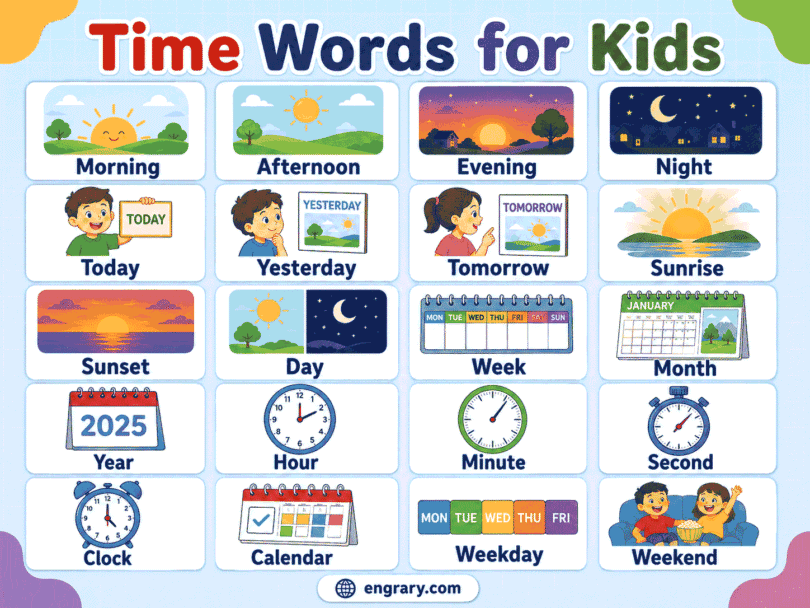
A child may say, “I ate breakfast in the morning,” “We will go to the park tomorrow,” or “I brush my teeth before bed.” These simple words help children talk about when something happens, what happened earlier, and what will happen later.
Time words help kids describe parts of the day, daily order, clock time, calendar time, and how long something takes. Children use them when they talk about school, meals, play, sleep, birthdays, weekends, and family plans. Once kids understand words like morning, today, before, after, clock, and minute, they can explain their day more clearly and follow simple time-based directions with confidence.
What Are Time Words for Kids?
Time words are words children use to talk about when something happens. They help kids explain if something happened before, is happening now, will happen later, or takes a short or long time.
Some time words name parts of the day, such as morning, afternoon, evening, and night. Other words show order, such as before, after, first, next, then, and last. Kids also use clock words like hour, minute, and o’clock, along with calendar words like day, week, month, and year.
This article focuses on time vocabulary children use in daily speech. It is not a full telling-time lesson, calendar chart, or routine-word list.
Quick examples:
- morning is when many children wake up
- today means this day
- before means earlier than something
- a clock shows time
- a minute tells a short amount of time
Parts of the Day Time Words
Children use day-part words to talk about meals, school, playtime, rest, and bedtime. These words are easy to teach because they connect to moments kids already know.
Morning is the early part of the day. Many children wake up, brush their teeth, eat breakfast, and get ready in the morning.
Noon is the middle of the day. Children often connect noon with lunchtime.
Afternoon comes after noon. Kids may rest, play, read, or come home from school in the afternoon.
Evening comes before night. Families may eat dinner, clean up, talk, or read together in the evening.
Night is the dark part of the day. Children usually sleep at night.
Midnight means the middle of the night. This word usually appears in stories, songs, or adult conversations.
Daily-life examples:
- brush teeth in the morning
- eat lunch around noon
- play in the afternoon
- eat dinner in the evening
- sleep at night
Time Order Words for Kids
Time order words help children explain what happens first, what happens next, and what happens later. These words are useful when kids talk about stories, school routines, meals, games, and daily events.
| Time Word | Meaning | Example |
|---|---|---|
| before | earlier than something | wash hands before eating |
| after | later than something | brush teeth after dinner |
| first | at the beginning | first wake up |
| next | after that | next get dressed |
| then | after that step | then eat breakfast |
| last | at the end | last go to bed |
Before means earlier than something. A child may wash hands before lunch.
After means later than something. A child may brush teeth after dinner.
First points to the beginning. In the morning, a child may first wake up.
Next tells what comes after that. A child may wake up first and next get dressed.
Then shows another step in the order. A child may get dressed and then eat breakfast.
Last tells what happens at the end. At night, a child may put on pajamas, brush teeth, read a story, and last go to sleep.
These words should stay time-focused. They help children explain event order without turning the lesson into a full ordinal-numbers topic.
Yesterday, Today, and Tomorrow Time Words
The words yesterday, today, and tomorrow help children talk about days. Young kids often mix them up, so simple real-life examples work best.
Yesterday is the day before today, so it already happened.
Today is the day we are in right now.
Tomorrow is the day after today, so it has not happened yet.
Kids may say:
- Yesterday, I played outside.
- Today, I am reading a book.
- Tomorrow, we will visit the park.
- Last night, I went to bed early.
- This morning, I ate breakfast.
- Tonight, I will sleep.
The phrases last night, this morning, and tonight connect time words to real life. Last night means the night before today. This morning means the morning of today. Tonight means the night of today.
Clock Time Words for Kids
Once children hear words like clock, hour, and minute, they can begin talking about exact times in a simple way. This section introduces clock vocabulary without turning the article into a full clock-reading guide.
Common clock words:
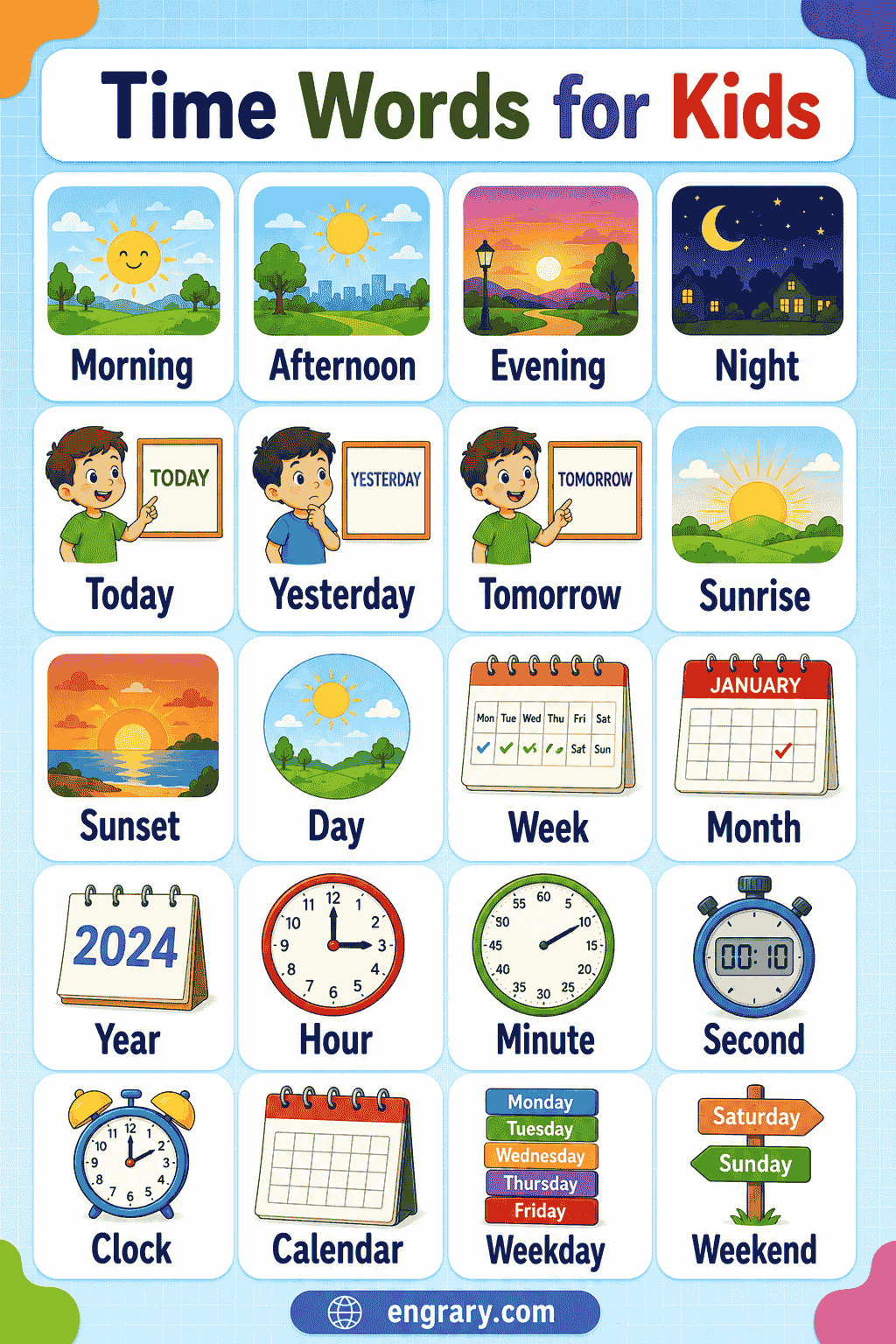
- clock — shows time
- watch — a small clock someone can wear
- hour — a longer time unit
- minute — shorter than an hour
- second — a very short time unit
- o’clock — an exact hour
- half past — 30 minutes after the hour
- timer — measures how long something takes
- alarm — makes a sound at a set time
Simple clock examples:
- Look at the clock.
- The class is one hour long.
- Wait five minutes.
- A quick clap takes one second.
- School starts at 8 o’clock.
- Set a timer for ten minutes.
- The alarm rings in the morning.
The terms a.m. and p.m. can be introduced briefly. A.m. usually means morning time, while p.m. usually means afternoon, evening, or night time.
Duration Time Words for Kids
Some time words tell how long something takes. Others tell whether something will happen soon, later, early, or late.
Useful duration words:
- soon
- later
- early
- late
- quick
- slow
- fast
- short time
- long time
- wait
- takes time
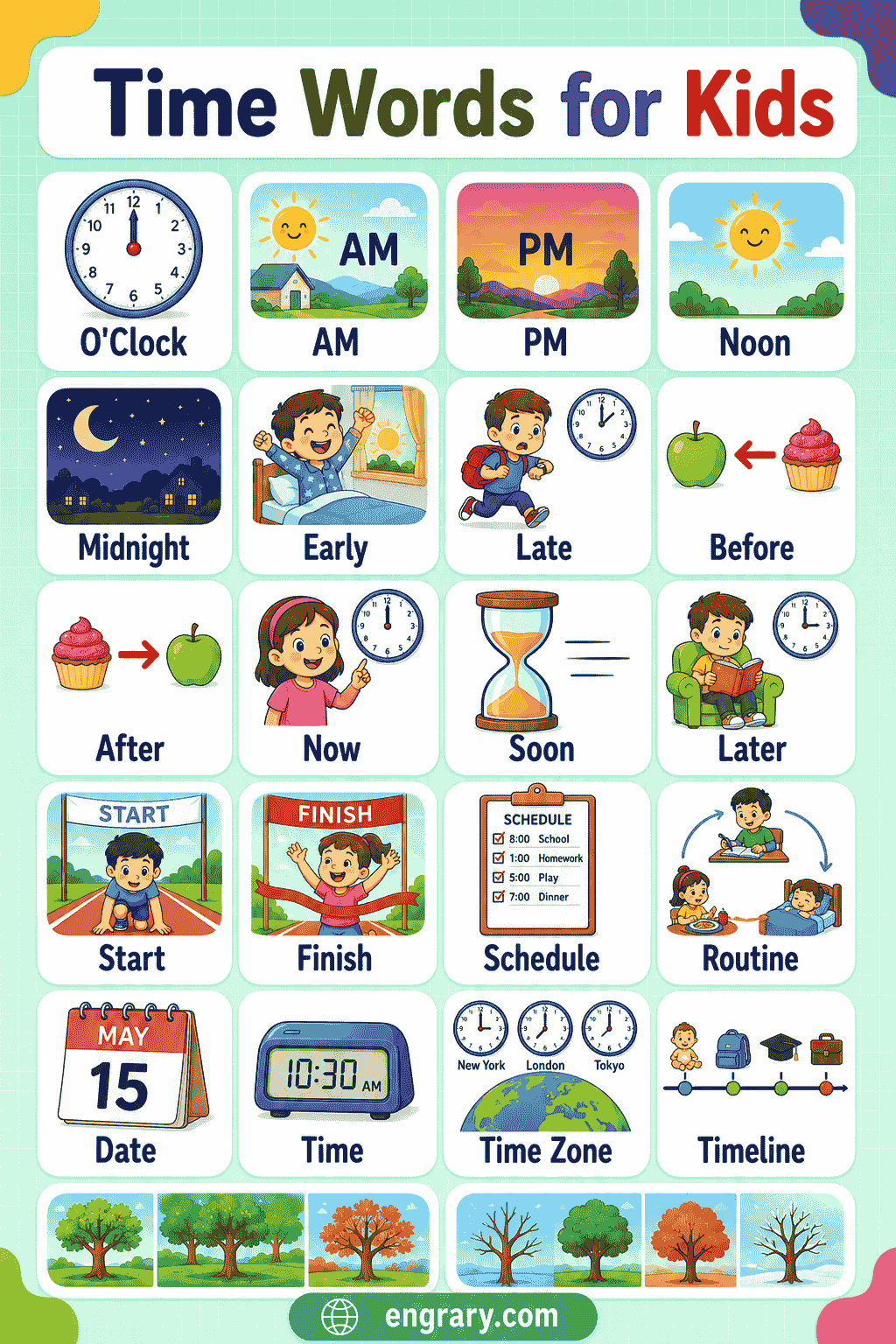
Soon means something will happen after a short time. A parent may say, “We will eat soon.”
Later means something will happen after more time. A teacher may say, “We will paint later.”
Early means before the expected time. A bus can come early, or a child can arrive early.
Late means after the expected time. A person can be late for school, dinner, or bedtime.
Quick and fast mean something happens in a short time. A short race can be quick.
Slow means something takes more time. Waiting in a long line can feel slow.
Try these examples:
- We will eat soon.
- We can play later.
- The bus came early.
- The bus came late.
- A race can be quick.
- Waiting can feel slow.
- Brushing teeth takes a short time.
- A long car ride takes a long time.
Calendar Time Words for Kids
Calendar words help children talk about days, weeks, months, years, and dates. These words are useful for school, birthdays, holidays, weekends, and family plans.
Basic calendar words:
- day
- week
- month
- year
- date
- calendar
- weekday
- weekend
- season
A day includes morning, noon, afternoon, evening, and night. Children may also talk about today, yesterday, and tomorrow as days.
One week has seven days. Kids often use this word when they talk about school, weekend plans, or weekly activities.
During a month, children may notice birthdays, holidays, or special school events.
A year has twelve months. Families may talk about a school year, a new year, or a birthday that comes once each year.
A date tells the exact day on a calendar. A calendar shows days, weeks, months, and dates.
Useful examples:
- weekdays are school or work days for many people
- the weekend comes at the end of the week
- a season is a part of the year, such as spring or summer
- a calendar helps us find birthdays and holidays
The days of the week and months of the year are also time words, but they can be taught in separate lessons when children are ready.
Time Words Kids Often Mix Up
Some time words are easy to confuse because they talk about similar ideas. A simple comparison helps children choose the right word.
| Mix-Up | Difference | Example |
|---|---|---|
| morning / night | start vs end of day | breakfast / bedtime |
| yesterday / tomorrow | before today vs after today | played yesterday / will play tomorrow |
| before / after | earlier vs later | before lunch / after lunch |
| early / late | before expected vs after expected | early bus / late bus |
| minute / hour | shorter vs longer time | 5 minutes / 1 hour |
Morning and night are different parts of the day. Morning is when many children wake up. Night is when many children sleep.
Yesterday already happened. Tomorrow has not happened yet.
Before means earlier than something. After means later than something.
Early and late depend on the expected time. If school starts at 8:00 and a child arrives at 7:50, the child is early. If the child arrives at 8:10, the child is late.
A minute is shorter than an hour. Five minutes is a short wait, but one hour is much longer.
How to Teach Time Words in Daily Life
Daily life gives children many chances to use time words naturally. Instead of teaching a long word list, connect time vocabulary to real moments children already know.
Use this activity flow:
- Choose one real moment in the day.
- Say when it happens.
- Use a time-order word.
- Add a clock or calendar word.
- Ask what happened before.
- Ask what happens next.
- Compare short time and long time.
- Repeat with a new daily moment.
Practice with familiar parts of the day:
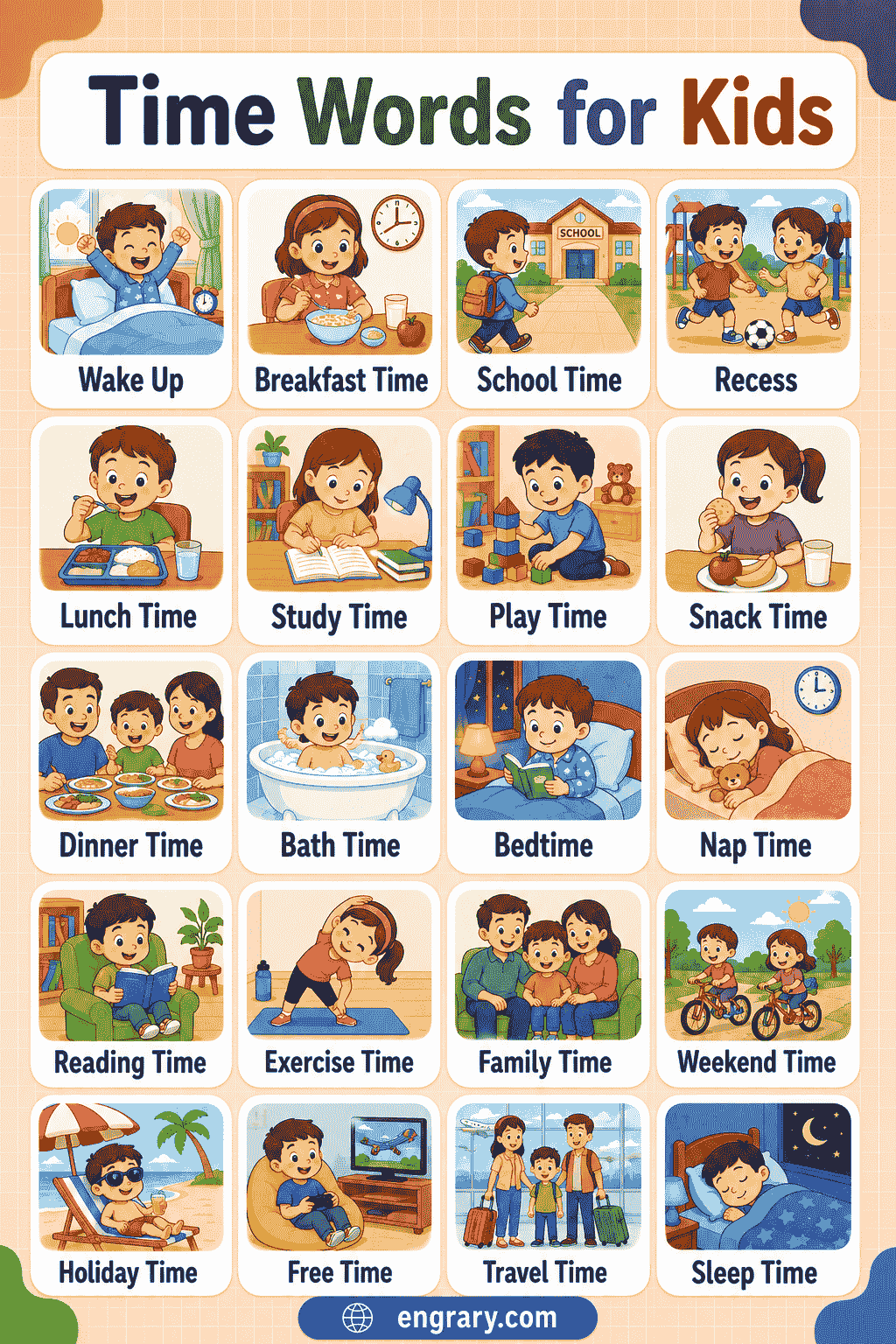
- Morning: wake up, brush teeth, eat breakfast
- Afternoon: eat lunch, rest, play
- Evening: eat dinner, clean up, read
- Night: wear pajamas, brush teeth, sleep
Helpful teacher questions:
- What happens in the morning?
- What did you do yesterday?
- What will we do tomorrow?
- What comes before lunch?
- What happens after dinner?
- Does this take a short time or a long time?
- Did we arrive early or late?
FAQs
Time words are words children use to talk about when something happens. Examples include morning, today, tomorrow, before, after, clock, hour, minute, day, week, and year.
Kids should first learn common daily time words such as morning, afternoon, night, today, tomorrow, before, after, soon, later, clock, and minute.
Parts of the day time words include morning, noon, afternoon, evening, and night. These words help children describe when daily events happen.
Yesterday means the day before today. Today means this day. Tomorrow means the day after today. For example, a child can say, “Yesterday I played,” “Today I read,” and “Tomorrow I will visit the park.”
Teach time words through daily life. Talk about what happens in the morning, what comes before lunch, what happens after dinner, what happened yesterday, and what will happen tomorrow.
You May Also Like