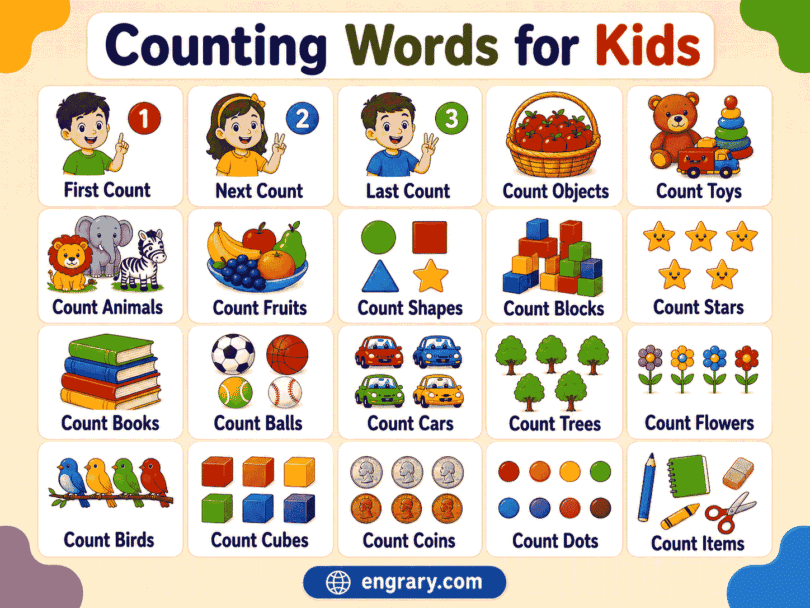
Counting is not only saying numbers in order. When children count blocks, crayons, buttons, snacks, or toys, they also use words like how many, count, total, altogether, more, less, fewer, same, and equal.
These counting words help kids talk through what they are doing. A child can ask a question, count each object, find the answer, compare two groups, and check their work. That makes counting words an important part of early math vocabulary.
Quick Counting Word Bank
This quick word bank shows the main jobs counting words do during a math activity.
| Counting Job | Words Kids Use |
|---|---|
| Ask | how many, which group |
| Count | count, touch, point, one by one |
| Answer | total, altogether, amount, last number |
| Compare | more, less, fewer, same, equal |
| Check | count again, each one, move aside |
Counting Words Kids Use Before They Start Counting
Before children count, they usually hear a question or instruction. These words help them understand what they need to do.
Common counting words used before counting include:
- how many
- count
- objects
- things
- group
- set
- all
- each
Examples children may hear:
- How many blocks are there?
- Can you count the crayons?
- Count all the buttons.
- Count each toy one by one.
- Look at this group of cubes.
- Count the set of cards.
The phrase how many is one of the most important counting phrases for kids. It tells children that they need to find the number of things in a group.
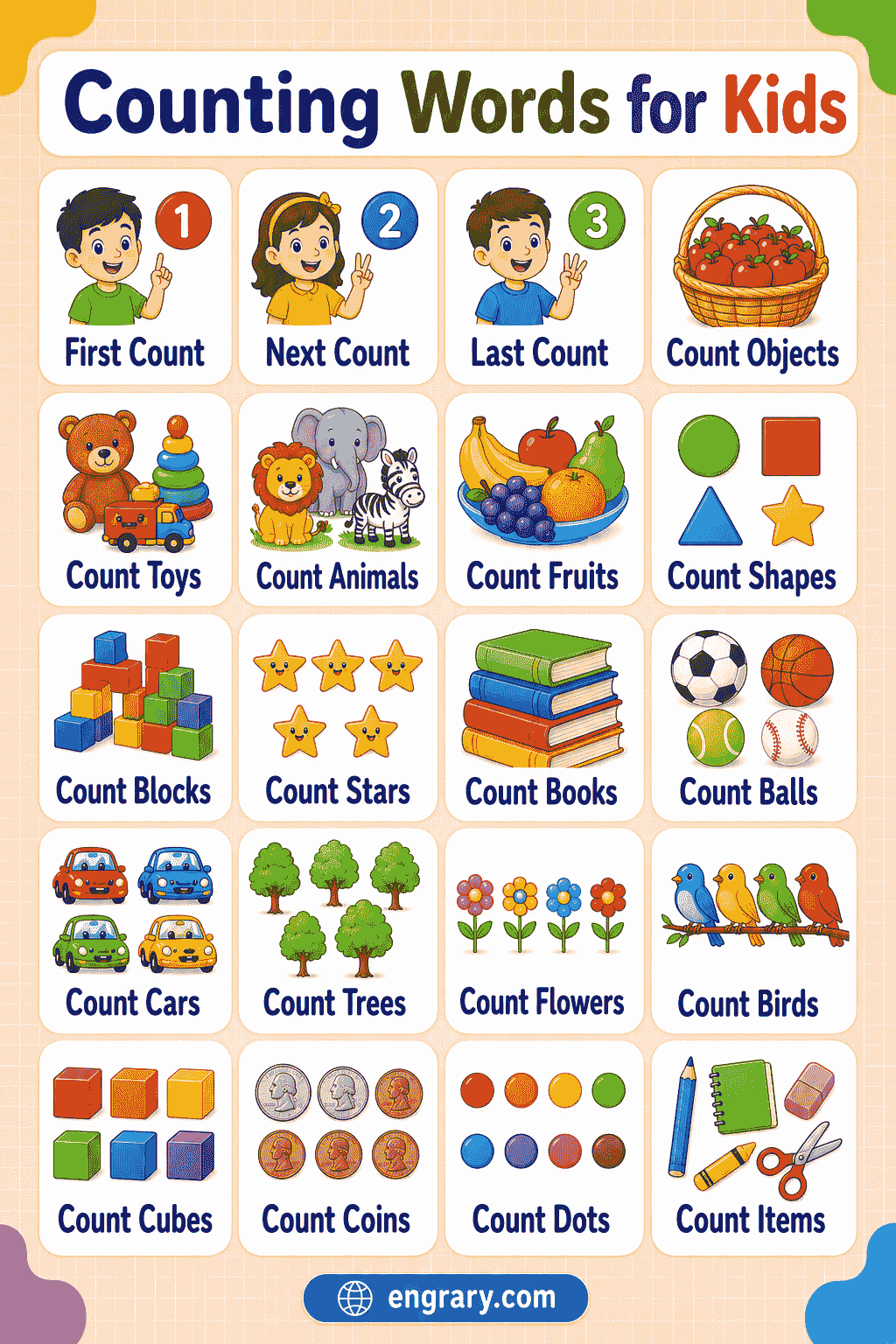
Words Kids Use While Counting Objects
While counting, children need words that help them slow down and count carefully. Young learners often say number words quickly, but careful counting means matching one number word to one object.
Helpful counting words for this step include:
- one by one
- touch
- point
- move
- next
- count on
- count again
A child can touch one block and say one number. Then the child can point to the next block and say the next number. This helps them avoid skipping objects or counting the same object twice.
Useful teacher-style directions:
- Count the cubes one by one.
- Touch each button as you count.
- Point to the next object.
- Move each counted item to the side.
- Let’s count again to check.
For hands-on learning, moving each counted object is often helpful. A child can move a bead, button, or block after counting it, so the counted objects stay separate from the uncounted ones.
Words That Tell the Answer After Counting
After children count, they need words that explain the final answer. This is where many kids need extra practice. Some children can say numbers in order but do not yet understand that the last number tells the answer.
Important answer words include:
- total
- altogether
- amount
- last number
- answer
- how many
The key idea is simple:
The last number tells how many objects there are.
For example, if a child counts blocks and says, “one, two, three, four, five,” the last number is five. That means the total is five blocks.
Easy examples:
- The total is five.
- There are five blocks altogether.
- The amount is five.
- The answer is five.
- The last number tells how many.
The words total and altogether are especially useful in early math because children hear them in worksheets, classroom questions, and simple word problems.
Counting Words for Groups, Sets, and Pairs
Counting often happens with things arranged in groups. Kids may count a group of toys, a set of cards, a pair of shoes, or all the buttons on a table. These words help children describe what they are counting before they find the number.
Useful grouping words:
- group — things placed together
- set — a group of things that belong together
- pair — two things together
- single — one thing by itself
- all — every one
- none — not any
- each — one by one
- every — all in a group
Simple examples:
- A pair of shoes means two shoes.
- A set of cards means cards grouped together.
- A single block means one block.
- None means there are not any.
- Count each button one by one.
- Count every crayon in the box.
Counting Questions Kids Should Learn
Counting questions help children understand what kind of answer they need. In class, a teacher may not only say “count.” They may ask children to compare groups, check the total, or count again.
Useful counting questions include:
- How many are there?
- Can you count them?
- Which group has more?
- Which group has fewer?
- Are the groups equal?
- What is the total?
- How many are there altogether?
- Did you count each one?
- Should we count again?
These questions teach children to think while they count. For example, How many are there? asks for a number answer. Which group has more? asks children to compare two groups. Did you count each one? helps children check their counting.
Parents and teachers can use these questions during simple daily routines:
- snack time
- toy cleanup
- block play
- counting crayons
- sorting buttons
- matching socks
- lining up picture cards
More, Less, Fewer, Same, and Equal
Children also need words for comparing amounts. These words help them explain which group is bigger, smaller, or the same.
| Word Pair | Kid Meaning | Example |
|---|---|---|
| more / less | bigger or smaller amount | more blocks / less water |
| fewer / less | fewer for things you count | fewer crayons / less juice |
| same / equal | not different in amount | same number / equal groups |
| most / least | biggest or smallest amount | most beads / least beads |
The word fewer is best for things children can count one by one, such as pencils, blocks, apples, or stickers. The word less is often used for general amounts, such as water, sand, juice, or space.
Simple comparison examples:
- This group has more blocks.
- That cup has less water.
- This box has fewer crayons.
- Both groups have the same number.
- These two groups are equal.
- This jar has the most beads.
- That bowl has the least rice.
Comparison words make counting more meaningful because children do not only find a number. They use the number to talk about amounts.

Counting Mistakes Kids Can Fix with Words
Children make counting mistakes for normal reasons. They may count too fast, skip an object, count one object twice, or forget that the last number is the answer. The right counting words can help them slow down and fix the mistake.
| Mistake | Helpful Words | Quick Fix |
|---|---|---|
| Skips an object | count each one | Point to every object. |
| Counts one twice | move it aside | Move counted items. |
| Goes too fast | slow count | Say one word per object. |
| Forgets the answer | last number | Repeat the final number. |
| Gets unsure | count again | Start from the first object. |
A child who skips an object may need the phrase count each one. A child who counts the same object twice may need to move it aside after counting it. A child who forgets the answer may need to repeat the last number.
Helpful correction phrases:
- Let’s count each one.
- Point to every object.
- Move it after you count it.
- Say one number for one object.
- What was the last number?
- Let’s count again.
Counting Words in Everyday Classroom Talk
Counting words become easier when children hear them in natural classroom talk. Teachers and parents can use counting language during short activities instead of waiting for a worksheet.
Good classroom directions and questions include:
- Count the blocks one by one.
- How many crayons are there altogether?
- Which group has more?
- Which group has fewer?
- Are both groups equal?
- Count each button.
- Move each bead after you count it.
- What is the total?
- Let’s count again to check.
- Did you count all the objects?
Children may hear total during a worksheet, more during a game, and count again when checking an answer. Repeating these words in real activities helps them become part of everyday math talk.
Math Counting Words vs Sentence Word Counting
The phrase counting words can mean two different things. This article focuses on math counting words, which children use when they count objects, compare groups, find totals, and check counting mistakes.
| Type | Meaning | Example |
|---|---|---|
| Math counting words | Words used to count objects and compare amounts | count, total, more, equal |
| Sentence word counting | Counting how many words are in a sentence | “I see cats” has 3 words |
Sentence word counting is a reading skill. Math counting words are early math vocabulary.
Counting Words Kids Can Use with Real Objects
Object examples help children understand counting words because they can see and touch what they are counting. These examples stay short and phrase-based so children can use them with picture cards, counters, toys, or worksheets.
- count the blocks
- how many apples
- all the crayons
- each button
- every sticker
- one by one with beads
- total stickers
- altogether in the box
- more toy cars
- less water
- fewer pencils
- same number of cubes
- equal groups of blocks
- pair of shoes
- set of cards
- group of buttons
- none left in the basket
- count again with counters
Best Counting Words to Teach First
Children learn counting vocabulary better in stages. Start with action words because they tell children what to do. Then add question words, answer words, and comparison words.
Start with action words
- count
- touch
- point
- move
- check
These words help kids count carefully instead of guessing.
Add question words
- how many
- which group
- did you count each one
- should we count again
These phrases help children understand what the teacher or parent is asking.
Teach answer words
- total
- altogether
- amount
- last number
- answer
These words help kids explain what they found after counting.
Then add comparison words
- more
- less
- fewer
- same
- equal
- most
- least
These words help children compare two groups after counting them.

Count-and-Compare Activity
This activity uses the most important counting words in one simple lesson. It works with blocks, buttons, beads, toy cars, counters, or crayons.
For younger children, use only two small groups. For children who are ready for more challenge, add a third group and ask which group has the most and which has the least.
- Place 5 blocks in one group.
- Place 3 blocks in another group.
- Ask: How many are in the first group?
- Ask: How many are in the second group?
- Ask: Which group has more?
- Ask: Which group has fewer?
- Add blocks until the groups are equal.
- Count the blocks again to check.
Helpful words to repeat during the activity:
- count
- how many
- total
- more
- fewer
- equal
- count again
FAQs
Counting words are words kids use when they count objects, ask how many, compare groups, and talk about amounts. Examples include count, how many, more, less, same, equal, total, and altogether.
They are related, but not exactly the same. Number words name numbers, such as one, two, and three. Counting words include number words plus other words used in counting, such as more, less, total, and equal.
Preschool kids should start with simple counting words such as count, one, two, three, how many, more, less, and same. These words are easy to practice with toys, snacks, fingers, and blocks.
Kindergarten kids can learn counting words such as total, altogether, equal, fewer, most, least, before, after, between, first, next, and last. These words help children compare groups and explain simple math ideas.
Teach counting words with real objects. Ask children to count blocks, find how many apples there are, compare which group has more or less, and make two equal groups.
You May Also Like