A face can smile, blink, frown, laugh, and show surprise. Children notice these changes every day, so learning face-part names helps them describe what they see and follow simple English instructions.
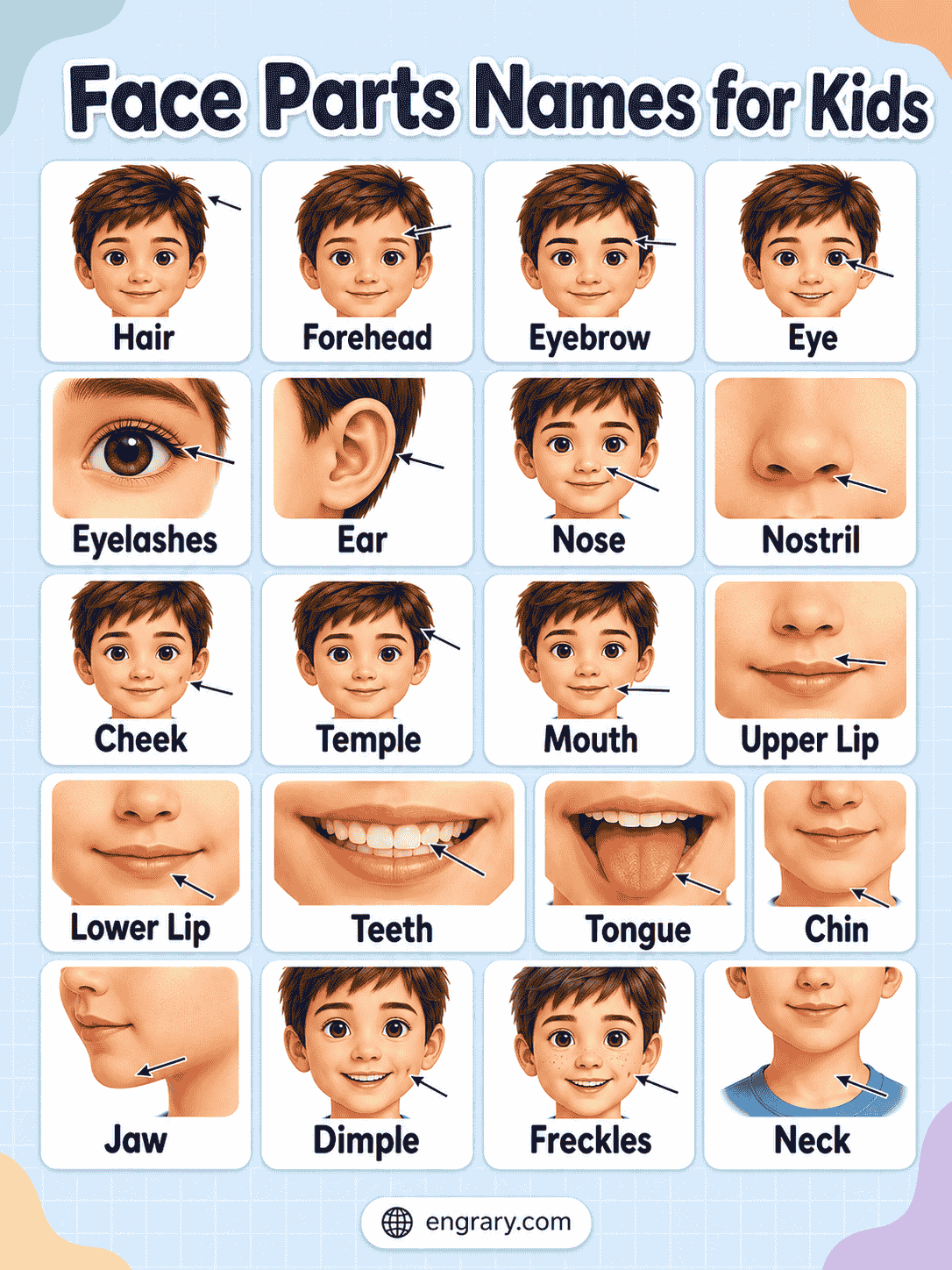
This guide teaches face parts names for kids in a clear order. It focuses on familiar features, where they are found, what they help us do, how a few words change in the plural, and how children can practice the vocabulary through pointing, labeling, and clues.
The Difference Between the Face and Head
The head is the whole top part of the body. It includes the face, hair, ears, sides, top, and back of the head. The face is the front part of the head. It includes the forehead, eyes, nose, cheeks, mouth, lips, and chin.
| Word | Simple meaning | Examples |
|---|---|---|
| Head | The whole top part of the body. It includes the face, hair, ears, top, sides, and back of the head. | Hair grows on the head. The ears are on the sides of the head. |
| Face | The front part of the head. It includes the forehead, eyes, nose, cheeks, mouth, lips, and chin. | The eyes, nose, and mouth are on the face. The chin is at the bottom of the face. |
Face Parts from Top to Bottom
Children can learn face-part names more easily by moving from the top of the face down to the chin.
- Hair grows on the head.
- The forehead is at the top of the face.
- Eyebrows are below the forehead.
- The eyes are below the eyebrows.
- The ears are on the sides of the head.
- The nose is near the center of the face.
- The cheeks are beside the nose and mouth.
- The mouth is below the nose.
- The lips form the outer edge of the mouth.
- The teeth are inside the mouth.
- The tongue is also inside the mouth.
- The chin is below the lips.
- The jaw runs along the lower sides of the face.
Useful examples:
- The eyebrows are above the eyes.
- The nose is between the eyes and mouth.
- The cheeks are beside the nose.
- The teeth and tongue are inside the mouth.
- The chin is below the lips.

Parts Around the Eyes
Several small features are found around the eyes.
| Face part | Simple explanation |
|---|---|
| Eyebrows | lines of hair above the eyes |
| Eyelids | skin that closes over the eyes |
| Eyelashes | small hairs along the eyelids |
| Eyes | the parts used for seeing |
Simple sentences:
- She raises her eyebrows.
- His eyelids close when he blinks.
- Eyelashes help keep dust away from the eyes.
- The eyes are on both sides of the nose.
Parts Around the Mouth
The mouth area includes features found outside and inside the mouth.
| Face part | Simple explanation |
|---|---|
| Mouth | the opening below the nose |
| Lips | the outer edges of the mouth |
| Teeth | hard parts inside the mouth |
| Tongue | the soft part inside the mouth |
| Chin | the lower front part of the face |
| Jaw | the lower part that moves when we chew |
Simple sentences:
- Her lips form a smile.
- The teeth are inside the mouth.
- The tongue helps us taste.
- The chin is below the lower lip.
Where Face Parts Are
Position words help children explain where features are located.
- The forehead is above the eyebrows.
- The eyes are beside the nose.
- The nose is between the eyes and mouth.
- The cheeks are beside the nose.
- The teeth and tongue are inside the mouth.
- The chin is below the mouth.
Useful position words:
- above
- below
- between
- beside
- inside
- around
Examples:
- The eyebrows are above the eyes.
- The cheeks are beside the nose.
- The tongue is inside the mouth.
Everyday Uses of Face Parts
Face parts help us with many everyday actions.
| Face part | Everyday use |
|---|---|
| Eyes | help us see |
| Ears | help us hear |
| Nose | helps us smell and breathe |
| Mouth | helps us eat and speak |
| Lips | help with speech, eating, and expressions |
| Teeth | help us bite and chew |
| Tongue | helps us taste and form sounds |
| Eyelids | close over and protect the eyes |
| Eyebrows | help keep sweat away from the eyes |
| Eyelashes | help keep dust away from the eyes |
| Jaw | moves when we chew and speak |
One Face Part and More Than One
Some face parts are usually found once, while others come in pairs.
Usually One
- one forehead
- one nose
- one mouth
- one tongue
- one chin
- one jaw
Usually Two
- two eyes
- two ears
- two eyebrows
- two eyelids
- two cheeks
Most plural words are made by adding -s or -es.
| One | More than one |
|---|---|
| eye | eyes |
| ear | ears |
| eyebrow | eyebrows |
| eyelid | eyelids |
| eyelash | eyelashes |
| cheek | cheeks |
| lip | lips |
| tooth | teeth |
Examples:
- This is my nose.
- These are my eyes.
- The child has one loose tooth.
- Teeth are inside the mouth.
Use hair when talking about all the hair on a person’s head:
- Her hair is black.
Use hairs for separate strands:
- A few hairs are on the brush.
Tricky Face Words to Say and Spell
Some face-part words are harder to read because their spelling and pronunciation do not match closely.
- Forehead — /ˈfɔːr.hed/ or /ˈfɒr.ɪd/ 🔊
Pronunciation varies by accent. - Eyebrow — /ˈaɪ.braʊ/ 🔊
- Eyelash — /ˈaɪ.læʃ/ 🔊
- Tongue — /tʌŋ/ 🔊
- Tooth — /tuːθ/ 🔊
- Teeth — /tiːθ/ 🔊
The word tongue is especially tricky because it does not sound the way it looks.
Useful examples:
- The tongue is inside the mouth.
- One tooth is loose.
- Brush your teeth.
Face Parts Kids Commonly Confuse
| Words | Easy difference |
|---|---|
| Head and face | The head is the whole top part. The face is the front part of the head. |
| Eye and eyelid | The eye is used for seeing. The eyelid closes over it. |
| Eyebrow and eyelash | The eyebrow is above the eye. Eyelashes grow along the eyelid. |
| Mouth and lips | The mouth is the opening and inside area. The lips form its outer edge. |
| Tooth and teeth | Tooth means one. Teeth means more than one. |
| Cheek and chin | The cheeks are on the sides of the face. The chin is below the mouth. |
| Chin and jaw | The chin is the front lower point. The jaw runs along the lower sides of the face. |
| Nose and nostril | The nose is the whole feature. A nostril is one opening at the bottom. |
| Hair and hairs | Hair usually means all the hair on the head. Hairs means separate strands. |
Face Parts and Expressions
The face changes when a person smiles, frowns, cries, or looks surprised.
Smile
A smile may lift the cheeks and move the lips upward.
- Her cheeks lift when she smiles.
- The child shows his teeth in a smile.
Frown
A frown may lower the eyebrows and change the shape of the mouth.
- His eyebrows move down when he frowns.
- Her lips turn downward.
Surprise
A surprised face may have raised eyebrows, wide eyes, and an open mouth.
- She raises her eyebrows.
- His eyes open wide.
Crying
Tears may run down the cheeks when someone cries.
- Tears roll down her cheeks.
- The child closes his eyes while crying.
Facial expressions can look different from one person to another, so one face movement does not always show exactly how someone feels.
Point to the Correct Face Part
Children can practise by listening and pointing.
- Point to your forehead.
- Touch both eyebrows.
- Blink your eyes.
- Touch your ears.
- Tap your cheeks.
- Point to your nose.
- Touch your lips.
- Point to your chin.
Try these two-step instructions:
- Touch your nose, then blink your eyes.
- Tap your cheeks, then touch your chin.
- Raise your eyebrows, then smile.
Complete the Face Picture
Give children a blank face outline and ask them to add or label the missing parts.
Add the Main Features
- two eyes
- two eyebrows
- one nose
- one mouth
- two ears
- one chin
- hair
Add More Detail
- eyelids
- eyelashes
- cheeks
- lips
- teeth
- tongue
Word bank:
forehead, eyebrows, eyes, ears, nose, cheeks, mouth, lips, teeth, tongue, chin
Children can describe the finished picture:
- The eyes are below the eyebrows.
- The nose is in the center of the face.
- The cheeks are beside the nose.
- The chin is below the mouth.
Guess the Face Part from the Clue
Read each clue and name the face part.
- I am above the eyebrows.
Answer: Forehead - You use two of me to see.
Answer: Eyes - I am in the center of the face and help you smell.
Answer: Nose - We grow along the eyelids.
Answer: Eyelashes - I am below the mouth.
Answer: Chin - We are inside the mouth and help you chew.
Answer: Teeth - I help you taste food.
Answer: Tongue - We are on both sides of the nose and mouth.
Answer: Cheeks
FAQs
Useful beginner words include face, forehead, eyes, ears, eyebrows, nose, cheeks, mouth, lips, teeth, tongue, and chin.
The head is the whole top part of the body. The face is the front part containing the eyes, nose, mouth, cheeks, and chin.
Eyebrows are the lines of hair above the eyes. Eyelashes are the small hairs that grow along the eyelids.
Tooth has a different plural form. One is a tooth, while more than one are teeth.
Children can point to features, label a face picture, follow position clues, practise singular and plural words, and use short sentences such as These are my eyes.
You May Also Like