A soft pillow rests on the bed, a refrigerator hums in the kitchen, and sunlight enters through the window. Familiar rooms and objects give children an easy starting point for building useful everyday language.
This home vocabulary for kids guide teaches common types of homes, room names, building parts, furniture, appliances, fixed features, household objects, and location words. The examples use American English while recognizing that homes may have different sizes, layouts, and shared spaces.
Home and House: What Is the Difference?
The words home and house are related, but they do not always mean the same thing.
- Home — The place where someone lives.
- House — A separate residential building.
- Room — A divided area inside a building.
- Household — A person or group of people who live together in one home.
- Indoors — Inside a building.
- Outdoors — Outside a building.
A house can be someone’s home, but not every home is a house. For example, an apartment, townhouse, condominium, or mobile home can also be a home.
Compare these sentences:
- We are at home.
- Mia lives in a house.
- Our teacher lives in an apartment.
- The children are playing indoors.
- A table stands near the front door.
People normally use home without to after verbs such as go, come, and return.
- Correct: We go home after school.
- Correct: Dad came home early.
- Incorrect: We go to home after school.
Common Types of Homes
People live in many kinds of homes. Some buildings stand alone, while others share walls, hallways, entrances, or outdoor areas.
House
A house is usually a separate building made for people to live in. It may have one floor or several levels.
Apartment
An apartment /əˈpɑːrtmənt/ 🔊 is a home inside a larger building. Residents may share hallways, elevators, stairs, or laundry areas.
Townhouse
A townhouse is a home that shares one or more side walls with neighboring homes. Many townhouses have two or more floors.
Condominium
A condominium /ˌkɑːndəˈmɪniəm/ 🔊, often shortened to condo, is an individually owned home in a shared building or residential community.
Mobile Home
A mobile home is built so it can be transported to a location. After installation, it usually remains in one place.
Homes do not all contain the same rooms or objects. Some have a yard, while others include a balcony, patio, or shared outdoor space. Likewise, a bedroom may be private or shared.
Rooms in a Home and Their Uses
A room is a separate area inside a home. Each room often has a main purpose, although people may use the same space in different ways.
| Room | Common use |
|---|---|
| Bedroom | Sleeping and storing clothes |
| Bathroom | Washing and using the toilet |
| Kitchen | Preparing and storing food |
| Living room | Relaxing or spending time together |
| Dining room | Eating meals |
| Hallway | Connecting rooms |
| Laundry area | Washing and drying clothes |
| Garage | Parking a vehicle or storing items |
| Study | Reading, homework, or quiet work |
A bedroom often contains a bed, pillow, blanket, dresser, and closet. However, some children share a bedroom with another person.
The kitchen usually contains appliances, cabinets, counters, and a sink. In smaller homes, it may connect directly with a dining or living area.
People often talk, read, relax, or watch television in the living room. Common items include a couch, chairs, a rug, and a coffee table.
A separate dining room does not appear in every home. Families may eat in the kitchen, living area, or another suitable space.
The bathroom usually contains a sink, toilet, mirror, and either a bathtub or shower. Some homes have one bathroom, while others have several.
A laundry area may be a separate room or part of a kitchen, bathroom, garage, basement, or shared building space.
Parts of a House and Building
House parts form the basic structure of a room or building. Unlike most furniture, these features usually stay attached to the home.
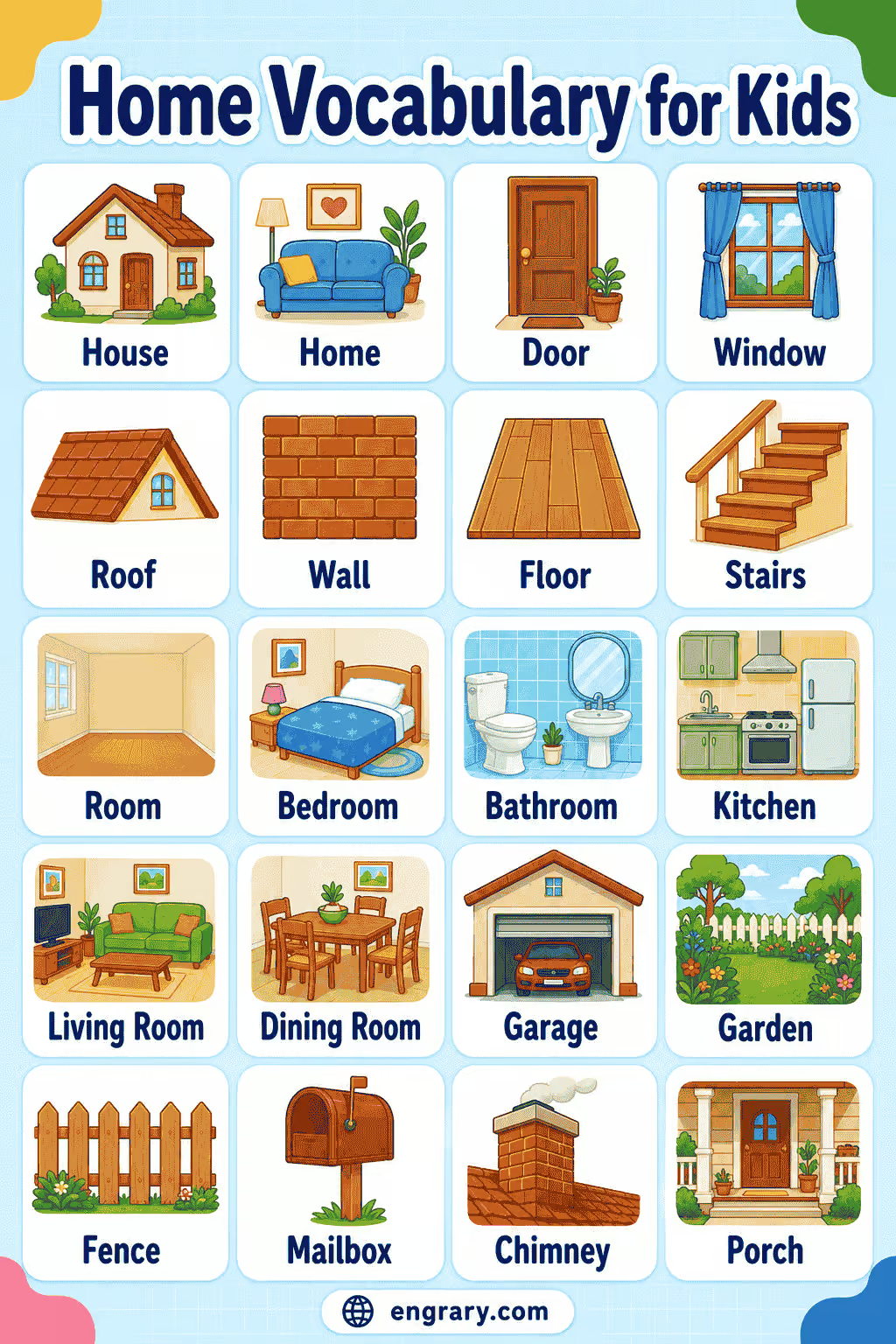
- Door — A movable panel used to enter or leave a room or building.
- Window — An opening with glass that lets in light and provides a view.
- Wall — A vertical surface that forms the side of a room.
- Floor — The inside surface people walk on.
- Ceiling — The upper inside surface of a room.
- Roof — The outside covering at the top of a building.
- Stairs — A connected set of steps between different levels.
- Step — One raised level in a staircase or entrance.
- Front door — The main outside door of a home.
- Entrance — The place where people enter.
- Porch — A covered area beside an outside entrance.
- Balcony — /ˈbælkəni/ 🔊 A raised outdoor platform attached to a building.
- Yard — An outdoor area beside or around a home.
A ceiling appears inside a room, whereas the roof covers the building from outside. Similarly, the floor is an indoor surface, but the ground is outside.
- A clock hangs on the wall.
- Sunlight enters through the window.
- The bedroom is upstairs.
- Shoes are beside the front door.
- Two chairs are on the balcony.
- Flowers are growing in the yard.
Fixed Home Features
Some familiar home items remain attached to a wall, floor, counter, or plumbing system. Therefore, they are not usually classified as furniture or appliances.
- Sink — A bowl-shaped fixture used for washing hands, food, or dishes.
- Faucet — A device that controls water flowing into a sink or bathtub.
- Toilet — A bathroom fixture used for getting rid of body waste.
- Bathtub — A large container used for bathing.
- Shower — A fixture that sprays water for washing.
- Counter — A flat work surface often found in a kitchen or bathroom.
- Closet — An enclosed storage space, often built into a room.
- Built-in cabinet — A storage unit attached to a wall or structure.
The faucet is above the sink, while the shower may stand beside the bathtub. Towels often hang near the sink or shower.
A closet differs from a dresser. The closet forms an enclosed storage area, while a dresser is movable furniture with drawers.
Likewise, a built-in cabinet stays attached to the home. A movable storage unit, by contrast, may count as furniture.
Furniture Words for Kids
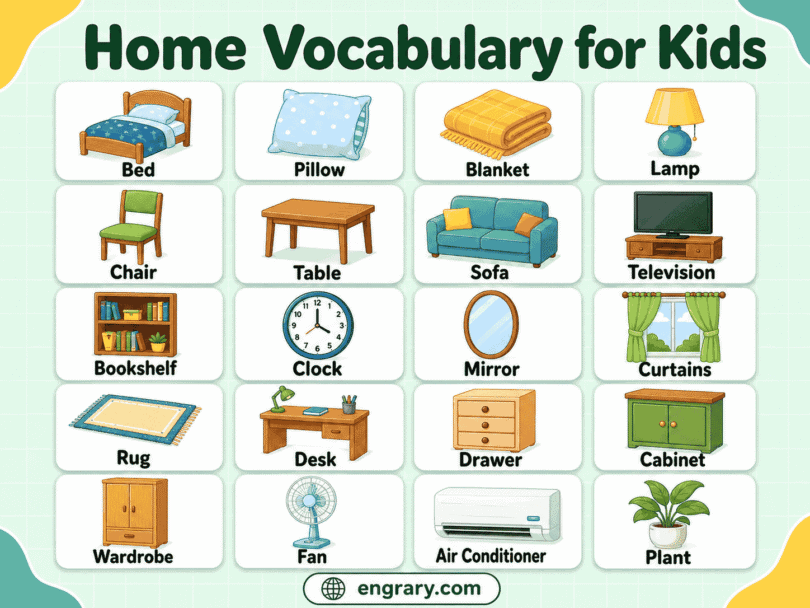
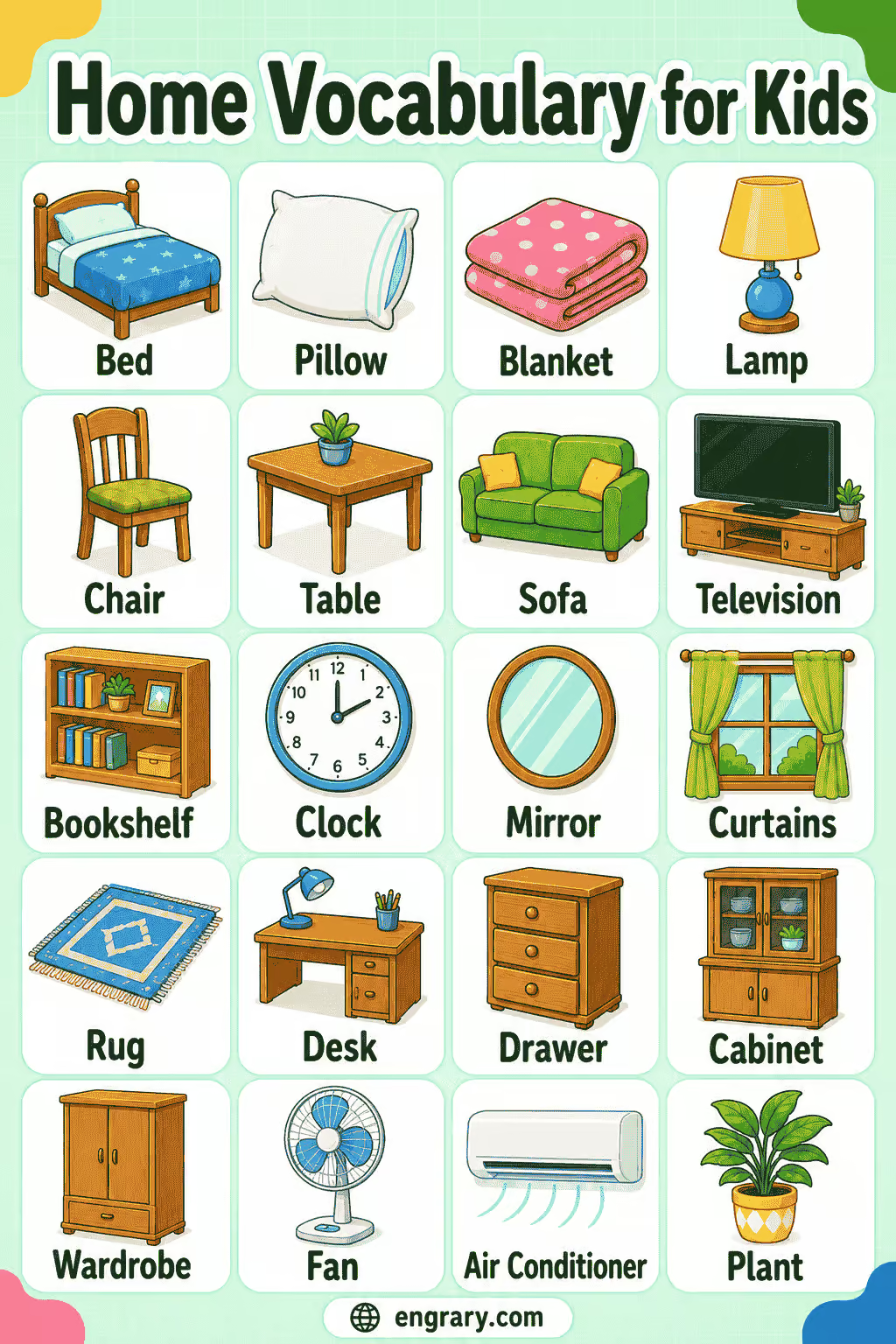
Words for furniture includes movable items used for sitting, sleeping, eating, working, or storing things.
- Bed — Furniture used for sleeping.
- Couch — A long padded seat for several people.
- Chair — A seat usually designed for one person.
- Table — Furniture with a flat top used for meals, work, or objects.
- Desk — A table mainly used for writing, studying, or computer work.
- Dresser — Furniture with drawers for storing clothes.
- Nightstand — A small table placed beside a bed.
- Bookshelf — Movable furniture with shelves for books and other items.
- Coffee table — A low table often placed in front of a couch.
- Dining table — A table used mainly for eating meals.
Furniture may appear in more than one room. For instance, a desk can stand in a bedroom, study, or living area.
- A pillow rests on the bed.
- The nightstand is beside the bed.
- Several books fill the bookshelf.
- Four chairs surround the dining table.
- A coffee table stands in front of the couch.
Home Appliance Names
An appliance /əˈplaɪəns/ 🔊 is a powered machine that performs a household task.
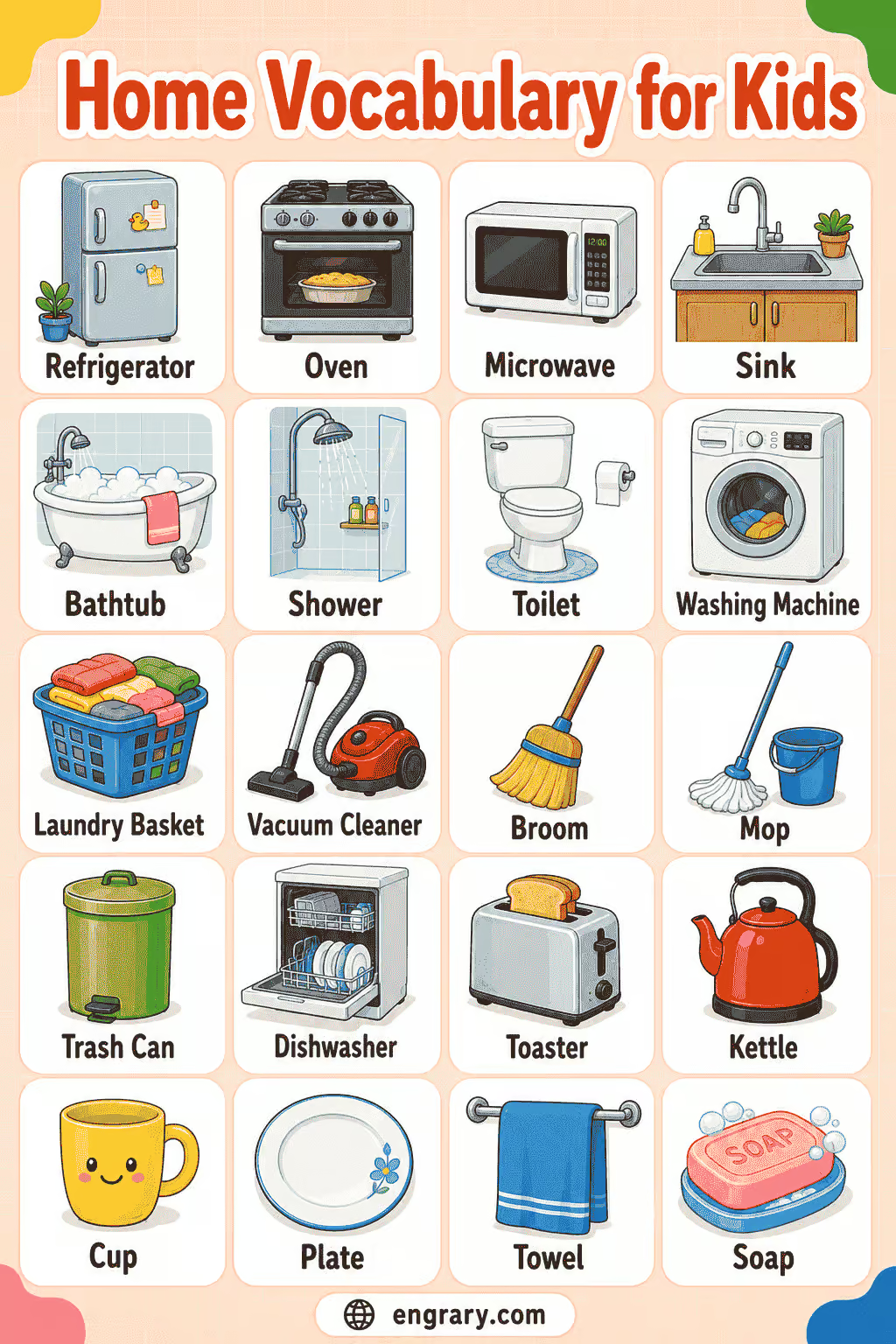
- Refrigerator — An appliance that keeps food and drinks cold.
- Stove — An appliance used for cooking food in pots or pans.
- Oven — An enclosed appliance used for baking or roasting.
- Microwave — An appliance that heats food quickly.
- Dishwasher — A machine that washes dishes.
- Washing machine — A machine that washes clothes.
- Dryer — A machine that dries clothes.
A refrigerator is an appliance, not furniture. The same classification applies to a stove, microwave, dishwasher, washing machine, and dryer.
In many American homes, the word stove may describe a cooking appliance with burners and an oven. Still, stove and oven can name separate cooking areas or machines.
- The refrigerator is beside the counter.
- Food is baking in the oven.
- A microwave stands above the stove.
- Wet clothes are in the washing machine.
- Clean dishes are inside the dishwasher.
Everyday Household Objects and Electronics
A household object is a smaller item that people use, store, or display in a home. Home electronics are powered devices used mainly for information, communication, or entertainment rather than household tasks.
- Pillow — A soft object used to support the head.
- Blanket — A warm covering used on a bed or couch.
- Lamp — A light placed on a table or floor.
- Rug — Thick fabric that covers part of a floor.
- Mirror — A surface that reflects an image.
- Clock — An object that shows the time.
- Curtain — Fabric used to cover a window.
- Towel — Absorbent fabric used for drying.
- Trash can — A container used for garbage.
- Picture — An image displayed on a wall, shelf, or table.
- Basket — A container used for carrying or storing objects.
- Television — An electronic device used for watching programs or videos.
- Remote control — A small electronic device used to control a television or another machine.
Smaller items may move between rooms. For example, a lamp can stand in a bedroom, living room, or study.
- The blanket is folded on the couch.
- A curtain covers the window.
- The mirror hangs above the sink.
- The towel is beside the shower.
- A remote control rests on the coffee table.
- Toys are stored in the basket.
Sorting Home Words by Type
Home words become easier to remember when children understand each item’s group.
| Home word | Word group |
|---|---|
| Kitchen | Room |
| Window | Building part |
| Sink | Fixed feature |
| Couch | Furniture |
| Refrigerator | Appliance |
| Television | Electronic device |
| Pillow | Household object |
| Yard | Outdoor home area |
A room is a separate area inside a home, whereas a building part forms the structure. Fixed features stay attached to the home, while furniture can usually be moved.
Appliances use power to perform household jobs. By contrast, electronic devices such as televisions mainly provide information or entertainment.
Household objects are usually smaller than furniture. They may also move easily from one room to another.
Location Words for Describing a Home
Location words explain where one object appears in relation to another.
- In — Inside something.
- On — Touching an upper surface.
- Under — Below something.
- Above — Higher than something.
- Beside — Next to something.
- Between — In the middle of two things.
- Behind — At the back of something.
- In front of — Before or ahead of something.
- Near — A short distance away.
Home scenes make these words easy to practice:
- The pillow is on the bed.
- Shoes are under the chair.
- A lamp stands beside the couch.
- The clock hangs above the shelf.
- One chair is between the desk and window.
- A curtain hangs in front of the window.
- The trash can is beside the cabinet.
- A basket sits near the dresser.
Use on when something touches a surface:
The lamp is on the table.
Choose in when an object is inside a room, space, or container:
The dishes are in the cabinet.
Words for Describing a Home
Descriptive words help children talk about size, appearance, sound, light, comfort, and location.
- Big — Large in size.
- Small — Limited in size.
- Clean — Free from unwanted dirt or mess.
- Messy — Not arranged neatly.
- Tidy — Neatly arranged.
- Quiet — Having little noise.
- Bright — Having plenty of light.
- Dark — Having little light.
- Comfortable — Pleasant and physically relaxing.
- Upstairs — On or toward a higher floor.
- Downstairs — On or toward a lower floor.
Children can combine these words with room and object names:
- The living room is bright.
- Our kitchen is small but comfortable.
- A quiet hallway connects the rooms.
- The books are arranged neatly.
- Several toys cover the messy floor.
- The bathroom is upstairs.
- A laundry area is downstairs.
- The bedroom becomes dark when the curtains close.
Home Description Sentence Patterns
A few simple patterns help children describe rooms and objects naturally.
Using There Is
Use there is with one person, place, or thing.
- There is a couch in the living room.
- One window is beside the desk.
- A lamp stands on the nightstand.
Using There Are
Use there are with more than one person, place, or thing.
- There are two chairs near the table.
- Several books are on the shelf.
- Three rooms are upstairs.
Using Have and Has
Use have with I, you, we, and they. Use has with he, she, it, or one singular noun.
- We have a small dining area.
- They have two bedrooms.
- The kitchen has one large window.
- Our apartment has a balcony.
Asking About Rooms and Objects
- What room is this?
- Where is the lamp?
- Is there a desk in the bedroom?
- Are any chairs beside the table?
- What is under the couch?
- Which appliance keeps food cold?
Giving a Short Home Description
This is a living room. A couch stands beside the wall, and a rug lies under the coffee table. Two lamps are near the chairs.
The apartment has one bedroom and a small kitchen. There are books on a shelf beside the window.
Common Mistakes with Home Words
Beginner learners often confuse singular and plural forms, location words, and home expressions.
| Incorrect sentence | Correct sentence |
|---|---|
| I live at an apartment. | I live in an apartment. |
| There is two chairs. | There are two chairs. |
| There are a bed in the room. | There is a bed in the room. |
| The lamp is in the table. | The lamp is on the table. |
| My home have three rooms. | My home has three rooms. |
| The books is on the shelf. | The books are on the shelf. |
| I go to home after school. | I go home after school. |
| The roof is inside the room. | The ceiling is inside the room. |
Use in before a home type:
- She lives in a townhouse.
- They live in an apartment.
Choose at home when describing someone’s location:
- My brother is at home.
After go, come, and return, use home without to:
- We go home at four.
- Please come home early.
- They returned home after lunch.
U.S. and British Home Words
English-learning materials may use different home words depending on the country. This article uses American English as the main form.
| U.S. English | Common British English |
|---|---|
| Apartment | Flat |
| Yard | Garden |
| Closet | Wardrobe |
| Couch or sofa | Sofa or settee |
| Stove | Cooker |
| Faucet | Tap |
| Trash can | Bin |
| First floor | Ground floor |
The word sofa is common in both American and British English. However, couch appears frequently in everyday American speech.
In American English, a garden usually means an area where flowers, vegetables, or other plants grow. British speakers may use garden for the whole outdoor area that Americans often call a yard.
Floor numbering can also cause confusion. In the United States, the first floor is usually the entrance level. In British usage, that level is generally the ground floor, while the level above it is the first floor.
How Similar Home Terms Differ
Several home words describe related objects or places but have different meanings.
| Home terms | Main difference |
|---|---|
| Home and house | Home is where someone lives; a house is one type of residential building. |
| Room and bedroom | Room is the general word; a bedroom is mainly used for sleeping. |
| Furniture and appliance | Furniture supports sitting, sleeping, eating, working, or storage; an appliance performs a powered household task. |
| Couch and chair | A couch usually seats several people; a chair usually seats one. |
| Closet and cabinet | A closet is an enclosed storage area; a cabinet is a smaller storage unit with doors or shelves. |
| Stairs and step | Stairs are a connected set; a step is one raised level. |
| Floor and ground | Floor is an indoor surface; ground is outdoors. |
| Ceiling and roof | Ceiling is inside; roof covers the building from outside. |
| Upstairs and downstairs | Upstairs means toward a higher floor; downstairs means toward a lower floor. |
| Apartment and flat | Both usually name the same type of home; apartment is standard in American English. |
Place, Sort, and Describe: Home Words Practice
Use these activities to practice room names, word groups, location words, and sentence patterns.
Place Each Object in a Possible Room
Match every object with one room where it is often found. Some objects may fit more than one answer.
- Bed
- Refrigerator
- Couch
- Towel
- Washing machine
- Desk
Possible rooms or areas:
- bedroom;
- kitchen;
- living room;
- bathroom;
- laundry area;
- study.
Sort the Home Words
Place each word in the correct group:
- window;
- chair;
- microwave;
- pillow;
- kitchen;
- balcony;
- sink;
- television.
Groups:
- room;
- building part;
- fixed feature;
- furniture;
- appliance;
- household object;
- electronic device;
- outdoor home area.
Complete the Sentence
- There ___ a lamp beside the bed.
- Two chairs ___ near the table.
- The rug is ___ the coffee table.
- Our apartment ___ one small kitchen.
- Towels are ___ the bathroom.
- A clock hangs ___ the shelf.
Describe a Kitchen Scene
Imagine a kitchen with a refrigerator beside the counter, a microwave above the stove, and a table near the window. Two chairs stand beside the table.
Answer these questions:
- What room is shown?
- Which items are appliances?
- Which items are furniture?
- Where is the microwave?
- Write one sentence with there is.
- Write one sentence with there are.
Answer Key
Possible room matches:
- bed → bedroom
- refrigerator → kitchen
- couch → living room
- towel → bathroom
- washing machine → laundry area, kitchen, bathroom, garage, or shared laundry space
- desk → study, bedroom, or living area
Word groups:
- window → building part;
- chair → furniture;
- microwave → appliance;
- pillow → household object;
- kitchen → room;
- balcony → outdoor home area;
- sink → fixed feature;
- television → electronic device.
Sentence answers:
- is
- are
- under
- has
- in
- above
Kitchen-scene answers:
- kitchen
- refrigerator, microwave, and stove
- table and chairs
- above the stove
- Example: There is a refrigerator beside the counter.
- Example: There are two chairs beside the table.
FAQs
Home vocabulary includes words for types of homes, rooms, building parts, fixed features, furniture, appliances, electronics, household objects, and their locations.
A home is the place where someone lives. A house is one kind of residential building that may serve as a home.
A refrigerator is an appliance because it uses electricity to keep food and drinks cold. Furniture includes items such as beds, chairs, couches, and tables.
Children can begin with familiar words such as home, house, room, bedroom, kitchen, bathroom, door, window, bed, chair, table, sink, and refrigerator.
Children can label room pictures, match objects with possible rooms, sort furniture and appliances, use location words, and describe a simple home scene with there is and there are.
You May Also Like