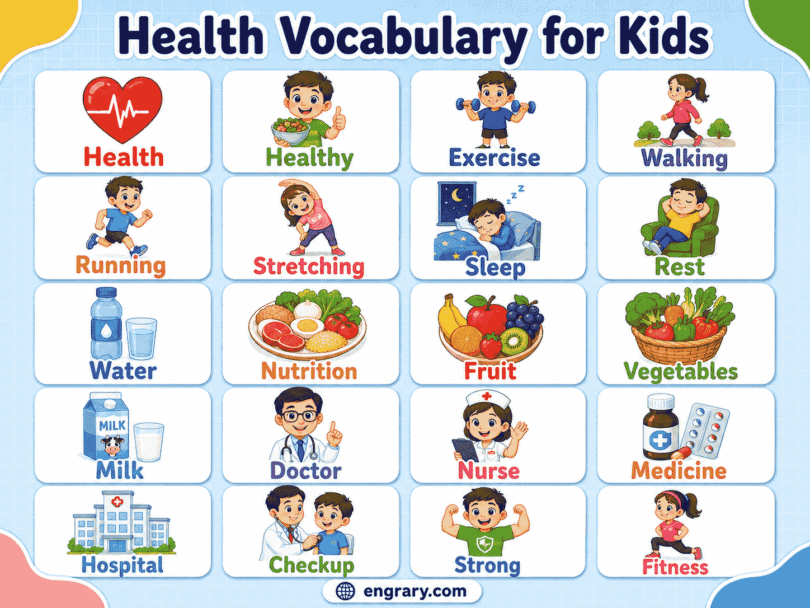
A child may feel fine before school, develop a headache during class, or scrape a knee at recess. Knowing the right health words makes it easier to explain what changed, where something hurts, and when an adult needs to help.
This guide to health vocabulary for kids covers feeling well, noticing symptoms, describing pain and injuries, receiving medical care, and following healthy routines. It teaches useful language rather than diagnosing health problems or recommending treatment.
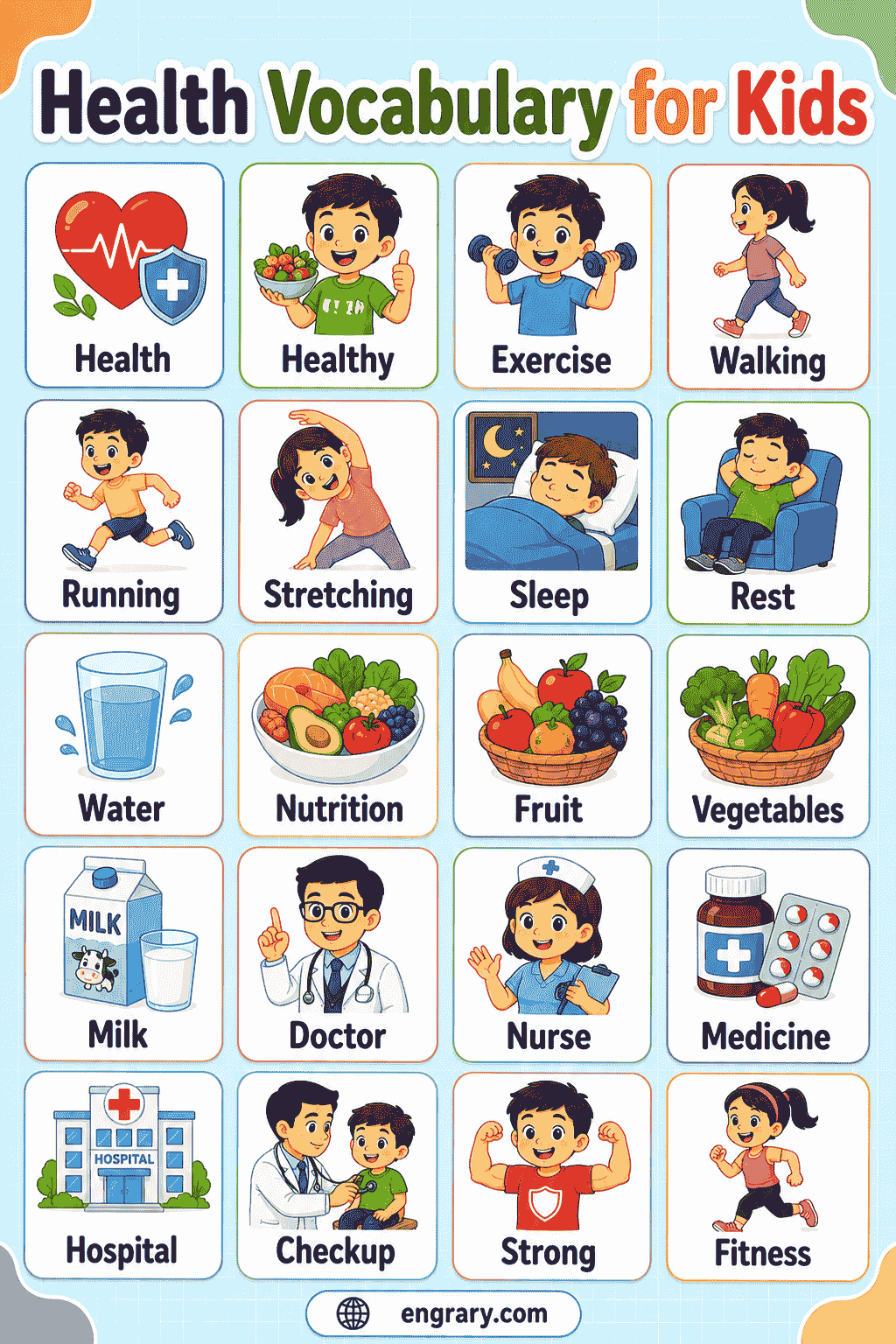
Health Words Children Use Every Day
Health describes how a person’s body and mind are doing. Some words refer to general health, while others describe a problem or the process of becoming well again.
| Health word | Simple meaning |
|---|---|
| Health | The condition of a person’s body and mind |
| Healthy | In good physical or mental condition |
| Well | Feeling healthy at the moment |
| Unwell | Not feeling healthy |
| Sick | Feeling unwell because of an illness |
| Symptom | Something a person feels or notices when they may be unwell |
| Illness | A disease or health condition that makes someone sick |
| Injury | Physical damage caused by an accident or harmful event |
| Recovery | The process of becoming well again |
| Checkup | A routine visit that reviews someone’s health |
A symptom is not the same as an illness. For example, a cough may be one symptom of a cold, while the cold is the illness. Health information is commonly organized into conditions, symptoms, tests, treatments, and wellness topics for the same reason.
Symptoms the Body May Show
A symptom is something a person feels or notices when something may be wrong. However, one symptom can have many causes, so it does not prove that a child has a particular illness.
- Cough — A sudden action that forces air out of the lungs through the throat and mouth.
- Sneeze — A quick burst of air through the nose and mouth.
- Fever — A body temperature that is higher than the normal range.
- Sore throat — Pain or irritation in the throat.
- Runny nose — Fluid coming from the nose.
- Stuffy nose — A blocked or congested nose.
- Rash — An area where the skin looks or feels irritated.
- Itch — A skin sensation that creates the urge to scratch.
- Swelling — An area that becomes larger or puffy.
- Dizzy — Feeling unsteady or as though the surroundings are moving.
- Nauseous — /ˈnɔːʃəs/ 🔊 Feeling as though you may vomit.
- Weak — Feeling that the body has less strength than usual.
A fever involves a measured increase in body temperature. In contrast, a child can feel hot after exercise, outdoor play, or wearing warm clothes without necessarily having a fever.
Talking About Pain
Pain is a general word for an unpleasant or hurting feeling. It may feel sharp or dull, mild or strong, temporary or continuing. People can also experience the same cause of pain differently.
Several common pain words end in -ache:
- Headache — Pain in the head.
- Toothache — Pain in or around a tooth.
- Earache — Pain inside or around the ear.
- Stomachache — Pain in the stomach or belly area.
- Backache — Pain in the back.
The ending -ache commonly describes steady or continuing pain in a body part:
- head + ache → headache;
- tooth + ache → toothache;
- stomach + ache → stomachache.
American English usually writes stomachache as one word. Children may also hear the informal phrase tummy ache.
Other useful pain words include:
- Sore — Tender, painful, or uncomfortable.
- Cramp — A sudden, painful tightening of a muscle.
- Sharp pain — Pain that feels sudden or pointed.
- Dull pain — Pain that feels less sharp but may continue.
Common Injury Words
An injury results from a fall, collision, burn, or another harmful physical event. Some injuries affect the skin, while others involve muscles, ligaments, joints, or bones.
- Cut — An injury that opens the skin.
- Scrape — A shallow injury caused by rubbing the skin against a rough surface.
- Bruise — A colored mark caused by bleeding beneath unbroken skin.
- Bump — A raised or swollen area after the body hits something.
- Burn — An injury caused by heat or another harmful source.
- Blister — A small pocket of fluid beneath the skin.
- Sprain — An injury to the ligaments around a joint.
- Broken bone — A bone that has cracked or broken.
- Fracture — The medical term for a broken bone.
- Nosebleed — Bleeding from inside the nose.
Cuts and scrapes damage the skin, whereas a bruise usually forms beneath skin that remains unbroken. A sprain affects ligaments around a joint, while a fracture affects a bone.

Familiar Illnesses and Health Conditions
Children hear many illness names, but they do not need an enormous medical dictionary. These words appear frequently in conversations at home, school, and healthcare appointments.
- Cold — A common infection of the nose and throat that may cause coughing, sneezing, or congestion.
- Flu — A respiratory infection that may cause fever, tiredness, coughing, chills, or body aches.
- Stomach bug — An informal name for an illness that may cause nausea, vomiting, diarrhea, or stomach pain.
- Infection — A health problem caused when harmful germs enter and multiply in the body.
- Allergy — The body’s reaction to a substance that is harmless to many other people.
- Asthma — A long-term condition that affects the airways and can make breathing difficult.
A cold and the flu are different viral infections, although they may share symptoms. Similarly, allergies can cause sneezing, itching, rashes, swelling, or a runny nose. Asthma is a continuing airway condition rather than a short illness.
How to Explain What Is Wrong
Different health words need different verbs. Choosing the correct pattern helps a child communicate clearly with a parent, teacher, school nurse, or healthcare professional.
Use Have
Use have with many symptoms, aches, and illnesses:
- I have a headache.
- She has a cough.
- He has a sore throat.
- I have a cold.
Use Feel
Use feel with sensations and general conditions:
- I feel sick.
- I feel dizzy.
- She feels weak.
- He feels better today.
Use Hurt
Use hurt when describing pain or an injury:
- My knee hurts.
- My stomach hurts.
- I hurt my wrist.
- Where does it hurt?
Use Be
Use am, is, or are with adjectives:
- I am sick.
- She is unwell.
- He is dizzy.
- They are healthy.
| Incorrect sentence | Correct sentence |
|---|---|
| I am a headache. | I have a headache. |
| I have dizzy. | I feel dizzy. |
| My stomach is hurt. | My stomach hurts. |
| I am cough. | I have a cough. |
Children can also use these short help-seeking phrases:
- I do not feel well.
- My throat hurts.
- I fell and hurt my ankle.
- I need to see the school nurse.
- Can you please help me?
- I need an adult.
Healthcare Professionals Children May Meet
Healthcare professionals have different training and responsibilities. Children may meet them during routine checkups, dental visits, illnesses, injuries, or emergencies.
- Doctor — A healthcare professional who examines, diagnoses, and treats health problems.
- Pediatrician — /ˌpiːdiəˈtrɪʃən/ 🔊 A doctor who specializes in children’s health.
- Nurse — A healthcare professional who checks health, provides care and treatment, and educates patients.
- School nurse — A nurse who assists students with health needs during the school day.
- Dentist — A healthcare professional who cares for teeth and gums.
- Pharmacist — /ˈfɑːrməsɪst/ 🔊 A healthcare professional who dispenses medicines, checks their safe use, and answers questions about them.
- Paramedic — /ˌpærəˈmɛdɪk/ 🔊 An emergency healthcare professional who provides urgent care.
A pediatrician focuses on children, while a dentist focuses on oral health. Meanwhile, pharmacists help people understand medicines and their labels rather than diagnosing every health problem.
Where Medical Care Happens
Healthcare can take place in several settings. These words describe the locations; they do not tell families which place to choose for a real medical problem.
- Doctor’s office — A place for appointments, checkups, and routine medical care.
- Pediatrician’s office — A doctor’s office that focuses on children.
- School nurse’s office — A room at school where students can report health concerns.
- Clinic — A place that provides medical services without usually keeping patients overnight.
- Urgent care — A clinic for problems that need prompt attention.
- Hospital — A medical facility that provides many kinds of care.
- Emergency room — A hospital department for urgent or serious emergencies.
- Pharmacy — A place where pharmacists dispense medicines and provide health products.
A clinic often provides outpatient care, whereas a hospital offers a wider range of services and may keep patients overnight.
Items Used for Checkups and Recovery
Children may see medical equipment during an examination or while recovering from an injury.
- Thermometer — A tool used to measure temperature.
- Stethoscope — /ˈstɛθəˌskoʊp/ 🔊 A tool used to listen to sounds inside the body.
- Adhesive bandage — A small covering placed over a minor cut or scrape.
- Gauze — Soft material used to cover or protect an injury.
- Bandage — Material used to cover, protect, or support part of the body.
- Cast — A hard covering that protects a healing bone.
- Crutches — Supports that help someone walk without placing full weight on an injured leg or foot.
- X-ray — An imaging test that creates pictures of structures inside the body.
In the United States, people often call an adhesive bandage a Band-Aid. However, Band-Aid is a brand name, while adhesive bandage is the general term.
A thermometer shows that someone’s temperature is being checked; it does not automatically mean the person has a fever. Likewise, a cast protects a healing area but does not reveal the exact type of injury.
Medicine Words and Safe Use
Medicine is a substance used to prevent, manage, or treat a health problem. Children should use medicine only with help from a parent, caregiver, or another trusted adult and according to the label or a healthcare professional’s directions.
- Pill — A small, solid form of medicine.
- Liquid medicine — Medicine that comes as a liquid.
- Dose — The amount of medicine used at one time.
- Label — Written information on a medicine container.
- Instructions — Directions explaining how the medicine should be used.
- Prescription — /prɪˈskrɪpʃən/ 🔊 Professional instructions for a particular medicine or treatment.
- Side effect — An unintended effect that may occur while using medicine.
Children should never take an unknown pill, share prescription medicine, or change an amount by themselves. Additionally, medicines made for adults should not be given to children unless a qualified healthcare professional has specifically directed their use.
Staying Clean and Limiting Germs
Hygiene /ˈhaɪdʒiːn/ 🔊 means habits that help keep the body clean. Personal hygiene includes washing the body and hands, grooming, caring for the face and teeth, and covering coughs and sneezes.
- Germs — Very small living things or infectious particles that can sometimes make people sick.
- Handwashing — Cleaning the hands with soap and water.
- Soap — A product that helps remove dirt and germs.
- Rinse — To wash away soap or dirt with water.
- Tissue — Soft paper used for the nose or mouth.
- Cover a cough — To cough into a tissue or the inside of the elbow.
- Hand sanitizer — A product that reduces many germs when soap and water are unavailable.
- Toothbrush — A brush used to clean teeth.
- Toothpaste — A paste used while brushing teeth.
- Floss — Thin material used to clean between teeth.
Schools commonly build handwashing into daily routines, particularly before eating and after bathroom breaks or outdoor play. Washing with soap and water also helps limit the spread of respiratory and stomach illnesses.
Healthy Routines at Home and School
Health vocabulary also includes words for everyday habits that support the body and mind.
- Sleep — A regular period when the body and mind rest.
- Rest — Time that allows the body or mind to recover.
- Exercise — Physical activity that helps the body move, build strength, and stay fit.
- Stretch — To lengthen muscles gently through movement.
- Hydrate — To give the body enough water.
- Nutritious — Providing nutrients that support the body.
- Balanced meal — A meal containing a useful variety of foods.
- Routine — A group of actions performed regularly.
- Dental care — Daily and professional care that supports healthy teeth and gums.
Children need a combination of nutritious food, physical activity, sleep, and support for mental as well as physical health. Therefore, no single habit represents complete health by itself.

Mental Well-Being and Support
Health includes thoughts, feelings, relationships, and the ability to manage everyday challenges. Children’s mental health also involves developing emotional skills and functioning at home, school, and in the community.
- Mental health — The health of a person’s thoughts, feelings, and daily functioning.
- Well-being — A general sense of health, safety, and functioning well.
- Stress — The body and mind’s response to pressure or difficulty.
- Support — Help, care, or encouragement from another person.
- Counselor — A trained professional who helps people discuss problems and find support.
- Trusted adult — An adult a child feels safe approaching for help.
A child might seek support from a parent, caregiver, teacher, school counselor, nurse, or another trusted adult. In addition, asking for help is an important health skill rather than a sign of failure.
Emergency Help in the United States
An emergency is a serious situation that needs immediate help from the police, fire department, or ambulance service.
- Ambulance — A vehicle that carries people who need urgent medical care.
- Paramedic — A healthcare professional who provides emergency medical help.
- First aid — Immediate basic care given before complete medical treatment.
- Emergency room — A hospital department that handles urgent medical emergencies.
- 911 — The emergency telephone number used throughout the United States.
During a true U.S. emergency, a caller should dial 911 and answer the call-taker’s questions as clearly as possible. The call-taker may ask for the location, phone number, and nature of the emergency. Children should not call 911 as a joke or for ordinary questions.
Health Terms That Are Easy to Mix Up
Several health words sound related but describe different ideas.
| Health terms | Main difference |
|---|---|
| Healthy and well | Healthy describes general health; well often describes how someone feels now. |
| Sick and hurt | Sick usually relates to illness; hurt relates to pain or injury. |
| Illness and injury | An illness is a disease or condition; an injury is physical damage caused by a harmful event. |
| Symptom and illness | A symptom is something a person notices; an illness is the health condition. |
| Pain and ache | Pain is the broad term; an ache often feels steady or continuing. |
| Bruise and cut | A bruise forms under unbroken skin; a cut opens the skin. |
| Sprain and fracture | A sprain affects ligaments; a fracture is a broken bone. |
| Fever and feeling hot | A fever involves raised body temperature; a person may feel hot for other reasons. |
| Medicine and prescription | Medicine is used for care; a prescription gives professional instructions. |
| Clinic and hospital | A clinic often provides outpatient care; a hospital offers a wider range of services. |
Health-Word Detective
Read each situation and choose the most accurate health word.
- Emma falls during recess and rubs the top layer of skin from her knee. What injury does she have?
- Liam feels as though the classroom is moving around him. Which symptom should he report?
- Olivia has pain inside one tooth. Which -ache word fits?
- Noah has a purple mark after bumping his leg against a table. What is the mark called?
- Sophia’s throat hurts when she swallows. Which symptom describes the problem?
- Ethan visits a healthcare professional who examines his teeth and gums. Who does he see?
- Ava needs a tool that measures her temperature. Which tool is used?
- Mason walks with supports while his leg heals. What are those supports called?
- Grace is gradually becoming well after the flu. Which word describes that process?
- Jackson has a cold. He also coughs and has a runny nose. Which word names the illness, and which words name the symptoms?
Answer key:
- scrape
- dizzy
- toothache
- bruise
- sore throat
- dentist
- thermometer
- crutches
- recovery
- Cold is the illness; cough and runny nose are symptoms.
FAQs
Health vocabulary includes words for feeling well, symptoms, illnesses, injuries, medical care, hygiene, healthy routines, and asking for help.
A symptom is something a person feels or notices, such as a cough or sore throat. An illness is the disease or health condition connected with one or more symptoms.
A child can name the body part and use hurts, as in “My knee hurts.” Certain pains also use have, as in “I have a headache.”
No. Tired describes a physical state or possible symptom. It may follow activity, limited sleep, stress, or an illness.
In the United States, 911 connects callers with emergency police, fire, or ambulance assistance.
You May Also Like