A child may grin after learning to ride a bike, feel nervous before a spelling bee, or become disappointed when a birthday party gets canceled. Choosing the right word helps children explain what is happening inside them more clearly than simply saying they feel “good” or “bad.”
This guide introduces common words for feelings and emotions with simple meanings and familiar examples. Children can learn basic emotion words, explore more precise choices, compare similar feelings, and use the vocabulary naturally in everyday American English.
What Feelings and Emotions Mean
In simple terms, an emotion is an inner response such as happiness, fear, anger, or surprise. A feeling is how a person notices and describes that experience. However, the two words often overlap in everyday conversation.
For example, a child might say:
- I feel happy because my friend came over.
- I am nervous about tomorrow’s test.
- I felt disappointed when soccer practice was canceled.
- I am excited about our field trip.
Feelings do not make a person good or bad. Some emotions feel pleasant, while others feel uncomfortable or difficult. Actions still matter, so feeling angry is different from yelling at someone or breaking something.
Basic Feeling Words for Kids
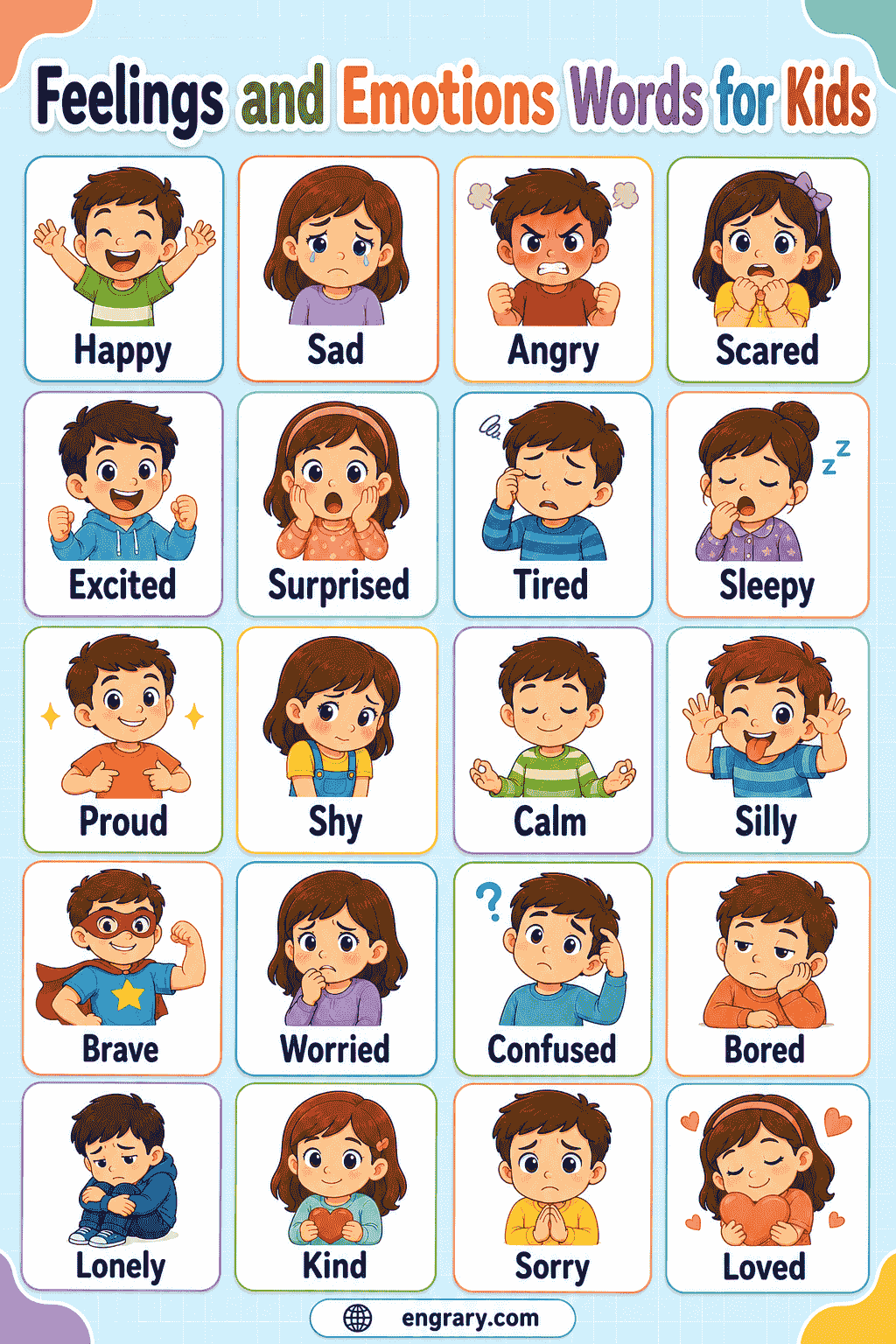
These common feeling words give children a useful starting point.
| Feeling word | Simple meaning |
|---|---|
| Happy | Feeling pleased or enjoying what is happening |
| Sad | Feeling unhappy, hurt, or low |
| Angry | Feeling strongly upset or displeased |
| Scared | Feeling afraid because something seems dangerous, threatening, or uncertain |
| Excited | Feeling eager and full of energy |
| Worried | Thinking that something unpleasant may happen |
| Calm | Feeling peaceful and not strongly upset |
| Surprised | Reacting to something unexpected |
Children may also use broad words such as upset when they cannot yet identify the exact emotion. With practice, they can choose more precise words such as frustrated, lonely, embarrassed, or relieved.
Happy and Excited Emotion Words
Happiness may feel quiet and peaceful or energetic and intense.
- Cheerful — Noticeably happy and positive.
- Pleased — Quietly happy or satisfied.
- Joyful — Feeling deep happiness.
- Delighted — Very pleased about something.
- Thrilled — Extremely happy and excited.
- Hopeful — Believing that something good may happen.
- Grateful — /ˈɡreɪtfəl/ 🔊 Feeling thankful.
- Proud — Feeling pleased about effort, progress, or achievement.
- Confident — Believing that you can handle a task or situation.
- Content — Feeling calmly satisfied with how things are.
A child may feel proud after finishing a difficult book, grateful when a neighbor helps find a lost dog, or thrilled before visiting an amusement park. Someone reading quietly at home may feel content rather than excited.
These words express different kinds of happiness. Pleased usually sounds quieter than delighted, while confidence focuses on belief in one’s ability rather than happiness alone.
Sad and Disappointed Feeling Words
Sadness can follow loss, separation, disappointment, or exclusion.
- Unhappy — Not feeling happy or satisfied.
- Disappointed — Feeling sad because something did not happen as hoped.
- Hurt — Feeling emotional pain because of someone’s words or actions.
- Lonely — Wanting more companionship or connection.
- Left out — Feeling excluded from a group or activity.
- Homesick — Missing home while staying somewhere else.
- Discouraged — Losing confidence or hope after difficulty.
- Miserable — /ˈmɪzərəbəl/ 🔊 Feeling extremely unhappy or uncomfortable.
- Heartbroken — Feeling very deep sadness.
A student might feel disappointed when a class trip gets postponed. Another child may feel left out when friends begin a game without inviting everyone. Someone spending the night at a grandparent’s house for the first time could feel homesick even while enjoying the visit.
Alone and lonely are different. Alone describes being by yourself, while lonely describes wanting more connection. A child can enjoy being alone, and someone can feel lonely in a crowded room.
Anger and Frustration Words
Anger-related words often differ in cause or strength.
- Annoyed — Mildly angry because of a small or repeated problem.
- Irritated — Bothered and slightly angry.
- Frustrated — /ˈfrʌstreɪtɪd/ 🔊 Upset because something blocks a goal or does not work.
- Angry — Strongly displeased or upset.
- Mad — A common informal American English word for angry.
- Furious — Extremely angry.
- Impatient — Finding it difficult to wait.
- Upset — Emotionally troubled by anger, sadness, worry, or several feelings together.
A repeated clicking sound may feel annoying, while a difficult model that will not fit together can make someone frustrated. Waiting for a turn may cause impatience, and being blamed unfairly may lead to anger.
A child can describe the emotion without acting hurtfully:
- I feel angry, so I need a moment.
- I am frustrated because this is not working.
- I feel upset, but I am not ready to talk yet.
Fear, Worry, and Nervous Feelings
Fear-related words may involve uncertainty, concern, or possible danger.
- Uneasy — Slightly uncomfortable or worried.
- Nervous — Tense or worried before an uncertain event.
- Worried — Thinking that something unpleasant may happen.
- Anxious — /ˈæŋkʃəs/ 🔊 Feeling strong worry or uneasiness.
- Scared — Feeling afraid.
- Frightened — Afraid, often because of something sudden or threatening.
- Terrified — Extremely scared.
- Panicked — Feeling sudden, overwhelming fear.
Someone may feel nervous before joining a new baseball team or visiting the dentist. A child could feel worried when a pet is missing and relieved when it returns. Loud thunder may feel frightening, while entering an unfamiliar building might create an uneasy feeling.
The word anxious can describe ordinary strong worry. However, children should not use it to diagnose themselves or another person.
Calm and Relieved Emotion Words
Some words describe emotional ease or the end of worry.
- Calm — Peaceful and not strongly upset.
- Relaxed — Free from tension.
- Peaceful — Quiet and emotionally settled.
- Comfortable — At ease physically or emotionally.
- Relieved — /rɪˈliːvd/ 🔊 Feeling better because worry or tension has ended.
- Content — Calmly satisfied.
- Settled — No longer restless, worried, or upset.
- Reassured — Feeling less worried after receiving comfort or helpful information.
A child may feel relieved after finding a missing backpack. Quiet music might help someone feel relaxed, while a clear explanation from a trusted adult can leave a worried child feeling reassured.
Calm and bored do not mean the same thing. A calm student may be interested and focused, whereas a bored student lacks interest or stimulation.

Surprise, Confusion, and Curiosity Words
Unexpected events and new information can create several different responses.
- Surprised — Feeling that something unexpected happened.
- Amazed — Feeling strong wonder or admiration.
- Shocked — Feeling a powerful and often upsetting surprise.
- Confused — Unable to understand something clearly.
- Puzzled — Unsure while trying to solve or understand something.
- Curious — /ˈkjʊriəs/ 🔊 Wanting to know or learn more.
- Interested — Wanting to give attention to something.
- Uncertain — Not sure what will happen or what to choose.
A surprise card may leave someone delighted, while seeing a huge dinosaur skeleton at a museum could make a child feel amazed. New directions might seem confusing, but an unusual science experiment can create curiosity.
Surprised may describe a pleasant, unpleasant, or neutral reaction. Shocked is usually much stronger and often follows troubling or upsetting news.
Social Feelings and a Sense of Belonging
Some emotions arise mainly in situations involving other people.
- Shy — Uncomfortable or quiet around people or attention.
- Embarrassed — /ɪmˈbærəst/ 🔊 Uncomfortable because of attention, a mistake, or an awkward moment.
- Ashamed — Deeply uncomfortable about something you believe you did wrong.
- Guilty — Feeling bad because you believe your action was wrong.
- Jealous — /ˈdʒɛləs/ 🔊 Upset or insecure because someone else has attention, affection, or a relationship you value.
- Envious — Wanting something another person has.
- Accepted — Feeling welcomed and respected.
- Included — Feeling that you belong in a group or activity.
- Left out — Feeling excluded.
- Connected — Feeling emotionally close to another person or group.
- Supported — Feeling that someone is helping or standing beside you.
A student may feel embarrassed after making a mistake during a presentation. Someone could feel guilty after blaming a sibling unfairly. Joining a welcoming club may help a new student feel included, connected, and supported.
People often use jealous when they mean envious. A child may feel jealous when a best friend spends time with someone new, while envy may arise when another child receives a toy they wanted.
Emotion Words with Different Strengths
Related emotion words may express different levels of intensity.
| Emotion family | Milder to stronger words |
|---|---|
| Happiness | pleased → happy → delighted → thrilled |
| Anger | annoyed → frustrated → angry → furious |
| Fear | uneasy → nervous → scared → terrified |
| Sadness | disappointed → sad → miserable → heartbroken |
| Excitement | interested → eager → excited → thrilled |
These ladders are teaching guides rather than exact scientific scales. The same situation may affect two people differently, and each person may choose a different word.
For example, one child might feel nervous before a spelling bee, while another feels excited. A delayed birthday celebration could cause mild disappointment for one person and stronger sadness for someone else.
Easily Confused Feelings and Emotions
Some emotion words seem similar but describe different experiences.
| Emotion words | Main difference |
|---|---|
| Angry and frustrated | Anger is strong displeasure; frustration usually comes from being blocked or unable to succeed. |
| Worried and scared | Worry focuses on what may happen; fear responds to possible danger or threat. |
| Shy and embarrassed | Shyness involves discomfort with attention; embarrassment often follows an awkward moment. |
| Jealous and envious | Jealousy often involves attention or a relationship; envy means wanting what someone else has. |
| Calm and bored | Calm feels settled; boredom comes from lacking interest. |
| Proud and confident | Pride often follows effort or success; confidence is belief in one’s ability. |
| Surprised and shocked | Surprise may be pleasant or neutral; shock is stronger and often upsetting. |
| Lonely and alone | Lonely is a feeling; alone describes being by yourself. |
A child struggling with a puzzle may feel frustrated rather than angry. Similarly, someone may feel nervous about meeting a new coach without feeling truly scared.
Emotions, Body States, and Personality Traits
Emotion words, physical conditions, and personality terms belong to different vocabulary groups.
| Category | Examples |
|---|---|
| Emotion words | happy, nervous, jealous, proud, worried |
| Body-state words | hungry, tired, thirsty, sleepy, cold, sick |
| Personality or behavior words | friendly, kind, quiet, helpful, rude |
Words such as hungry, sleepy, and sick are not emotions. Still, physical states can affect how someone feels. A tired child may become impatient, while someone who feels sick may also feel worried.
Personality and behavior words describe qualities or actions. Kind, helpful, friendly, and aggressive are not emotion words, although emotions may influence behavior.
Some words can change categories depending on the sentence. Shy may describe a temporary feeling in one situation or a common personality pattern.
Mixed Feelings and Emotions
People can experience more than one feeling at the same time.
A child may feel:
- excited and nervous before a performance;
- happy and sad when moving to a new neighborhood;
- proud and embarrassed after receiving public praise;
- relieved and tired after completing a difficult assignment;
- curious and cautious in an unfamiliar place;
- grateful but disappointed about a gift;
- worried and hopeful while waiting for news.
Mixed feelings are not dishonest or unusual. Different parts of the same experience can create different emotional responses.
Useful sentence patterns include:
- I feel both excited and nervous about tomorrow.
- I am happy about moving, but I will miss my friends.
- She felt proud and embarrassed when everyone clapped.
- He was relieved, although he still felt tired.
Facial Expressions and Body Clues
Facial expressions and physical sensations may offer clues about emotions.
Possible clues include:
- smiling;
- tears;
- raised eyebrows;
- a tense jaw;
- lowered eyes;
- a shaky voice;
- relaxed shoulders;
- a warm face;
- a fast heartbeat;
- a tight stomach.
These clues do not prove exactly how a person feels. Tears may come from sadness, happiness, pain, fear, or relief. Crossed arms might show discomfort, anger, coldness, or simply a comfortable position.
Careful descriptions include:
- The child may feel worried.
- Her face might show surprise.
- He looks upset, but we should ask how he feels.
- She seems nervous before the game.
People express emotions differently, so asking respectfully is more reliable than guessing.

Using Feeling Words in Simple Sentences
Children can use a few easy sentence patterns to express emotions.
- I feel nervous.
- She is disappointed.
- He looks worried.
- We felt relieved afterward.
- I feel proud because I finished the project.
- They are excited about the field trip.
- I feel both happy and sad.
- How do you feel?
- What made you feel that way?
- I need a quiet moment.
- Can you help me?
- I do not know the exact word yet.
Use look and seem carefully because they describe an impression rather than a confirmed feeling:
- Emma looks upset.
- Lucas seems confused.
- They look surprised.
Choose the Best Emotion Word
Choose the word that best matches each situation.
- Emma practiced hard and learned to ride her bike. She feels proud / jealous.
- Lucas cannot make his model fit together. He feels frustrated / grateful.
- Olivia’s lost dog returns home. She feels relieved / bored.
- Noah must speak at the school assembly. He feels nervous / content.
- Sophia expected a picnic, but rain canceled it. She feels disappointed / thrilled.
- Ethan’s friends start a game without inviting him. He feels left out / amazed.
- Ava sees a giant whale for the first time. She feels amazed / guilty.
- Mason wants the new skateboard his neighbor received. He feels envious / peaceful.
- Grace cannot understand the directions. She feels confused / delighted.
- Very strong anger is best described as annoyed / furious.
Answer key:
- proud
- frustrated
- relieved
- nervous
- disappointed
- left out
- amazed
- envious
- confused
- furious
FAQs
In simple terms, an emotion is an inner response, while a feeling is how someone notices and describes that experience. The words often overlap in everyday English.
Feelings are not morally good or bad. Some are pleasant, while others feel uncomfortable. A feeling is different from the action a person chooses.
Yes. A child may feel excited and nervous before a performance or happy and sad when moving to a new home.
No. Tired describes a physical state. However, tiredness can affect emotions and may make someone feel impatient, frustrated, or sad.
Worry usually focuses on something that may happen, while fear often responds to possible danger, threat, or uncertainty.
Check Out These Too