A family photo may show grandparents standing behind the parents while children smile in the front row. Each person has a personal name, but words such as mother, brother, aunt, and cousin explain how those people are connected.
This guide to family member names teaches common relationship words with clear meanings. Children will also learn how relatives connect across generations, how to read a simple family tree, and how to introduce family members in everyday American English.
Family Relationship Names and Personal Names
A personal name identifies a particular person. A family relationship name explains how that person is connected to someone else.
For example:
- Emily is a personal name.
- Mother is a family relationship name.
- Jack may be someone’s brother.
- Cousin describes a family connection.
Both types of names can appear in the same sentence:
Emily is Jack’s aunt.
In this example, Emily identifies the person, while aunt explains her relationship to Jack.
Families have many different structures. Children may live with parents, grandparents, stepparents, adoptive parents, foster parents, caregivers, or other relatives. Family words describe relationships without suggesting that every family must look the same.
Core Family Member Names
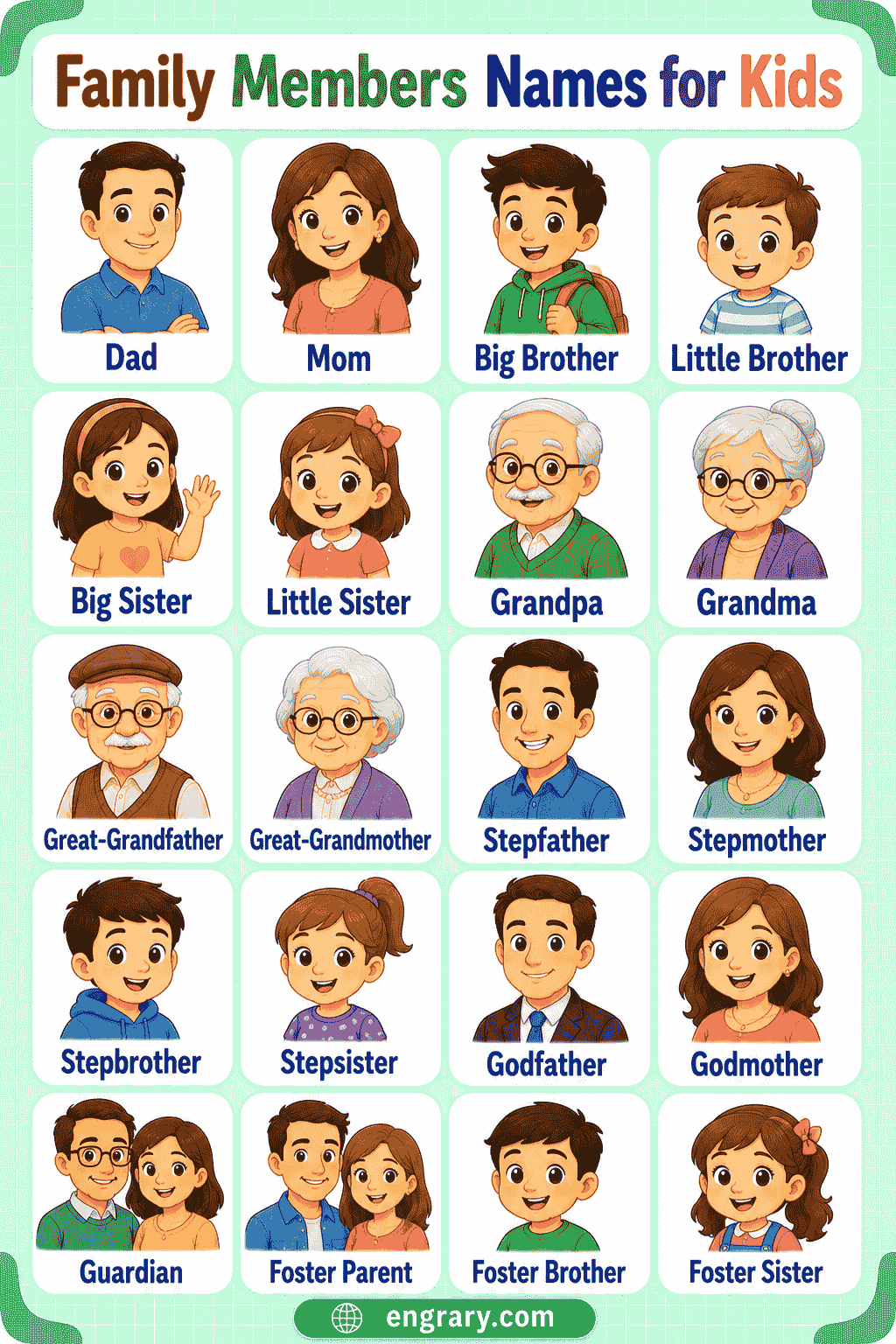
These familiar words describe parents, children, brothers, and sisters.
- Mother — A female parent. Mom is the common everyday American English form.
- Father — A male parent. Children often use dad in conversation.
- Parent — A person who has a parental relationship with a child.
- Brother — A male sibling.
- Sister — A female sibling.
- Sibling — A brother or sister.
- Son — A person’s male child.
- Daughter — /ˈdɔːtər/ 🔊 A person’s female child.
- Child — A person’s son or daughter.
- Baby — A very young child.
Relationship words work in both directions. A boy may be his mother’s son, while she is his mother. A girl may be her brother’s sister, while he is her brother.
Useful sibling expressions include:
- older brother;
- younger brother;
- older sister;
- younger sister;
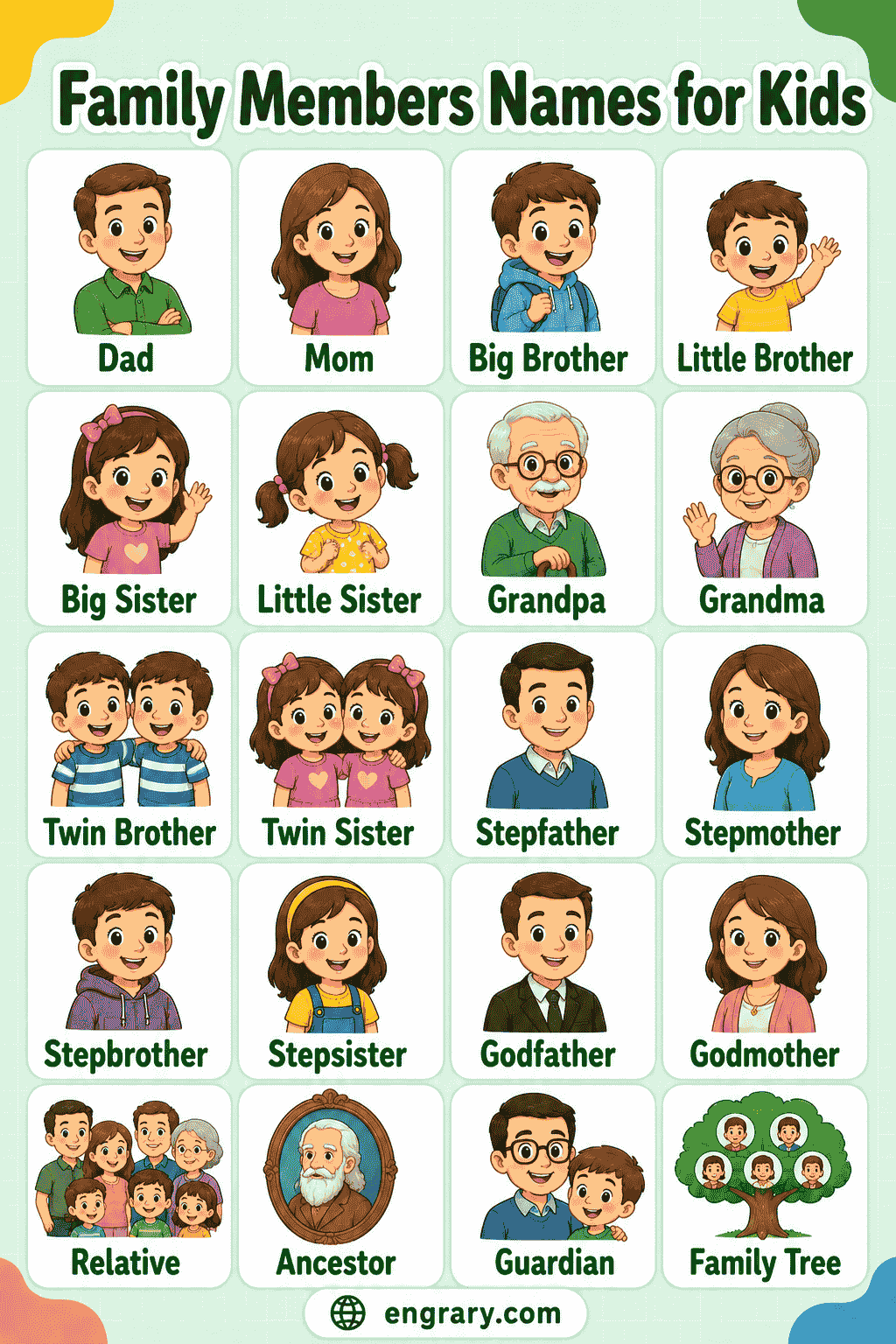
- twin brother;
- twin sister;
- only child.
An only child has no brothers or sisters. Twins are two children born from the same pregnancy, although they may also have older or younger siblings.
Family Members Across Generations
A generation is one level within a family. Grandparents belong to an older generation than parents, while children and grandchildren belong to younger generations.
| Family member | Simple meaning |
|---|---|
| Grandmother | A parent’s mother |
| Grandfather | A parent’s father |
| Grandparent | A grandmother or grandfather |
| Grandson | A person’s child’s son |
| Granddaughter | A person’s child’s daughter |
| Grandchild | A grandson or granddaughter |
| Great-grandmother | A grandparent’s mother |
| Great-grandfather | A grandparent’s father |
| Great-grandparent | A great-grandmother or great-grandfather |
A child is a grandchild to their grandparents. When gender is specified, the child may be called a grandson or granddaughter.
The prefix great- adds another generation:
- grandmother → great-grandmother;
- grandfather → great-grandfather;
- grandchild → great-grandchild.
Extended Family Member Names
Extended family commonly includes relatives beyond parents, children, and siblings.
- Aunt — A parent’s sister or the spouse or partner of a parent’s sibling.
- Uncle — A parent’s brother or the spouse or partner of a parent’s sibling.
- Cousin — /ˈkʌzən/ 🔊 Usually the child of an aunt or uncle.
- Niece — /niːs/ 🔊 A sibling’s daughter.
- Nephew — /ˈnɛfjuː/ 🔊 A sibling’s son.
- Relative — /ˈrɛlətɪv/ 🔊 A person connected to someone through family.
These relationships depend on who is speaking:
- My mom’s sister is my aunt.
- My dad’s brother is my uncle.
- My aunt’s child is my cousin.
- My sister’s daughter is my niece.
- My brother’s son is my nephew.
The word cousin is gender-neutral. American English uses the same word for male and female cousins.
In-Law Family Member Names
Marriage can create additional family relationships. The term in-law shows that someone is connected through marriage.
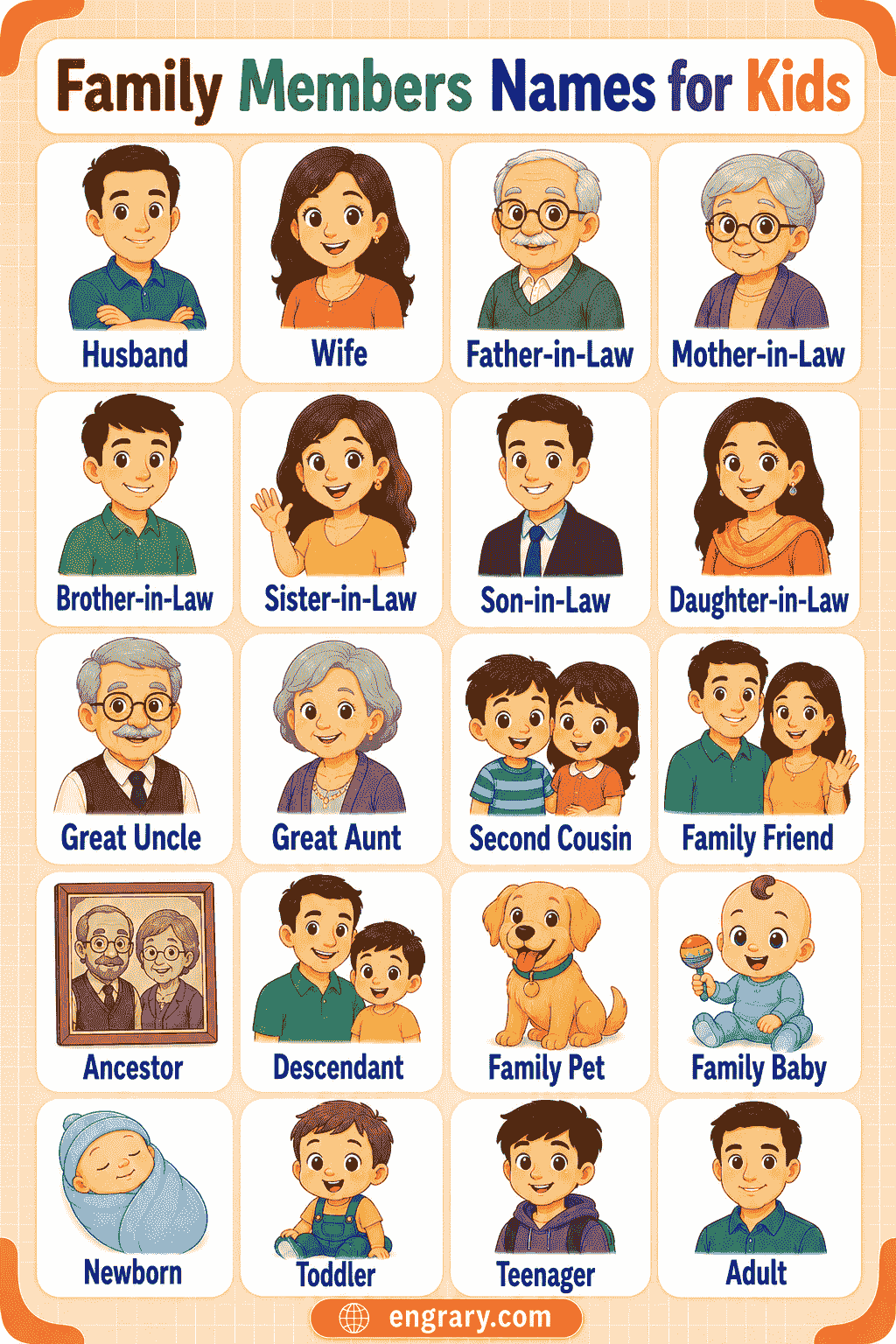
- Husband — A married man in relation to the person he is married to.
- Wife — A married woman in relation to the person she is married to.
- Spouse — /spaʊs/ 🔊 A person someone is married to.
- Mother-in-law — A spouse’s mother.
- Father-in-law — A spouse’s father.
- Sister-in-law — A spouse’s sister or a sibling’s wife.
- Brother-in-law — A spouse’s brother or a sibling’s husband.
- Daughter-in-law — The wife of someone’s child.
- Son-in-law — The husband of someone’s child.
Some in-law words can describe more than one connection. For example, a brother-in-law may be a spouse’s brother or a sibling’s husband.
The plural ending is added to the main family word:
- mothers-in-law;
- fathers-in-law;
- sisters-in-law;
- brothers-in-law.
Stepfamily and Half-Sibling Names
Stepfamily and half-sibling terms describe two different kinds of family connections.
- Stepparent — Usually a person married to a child’s parent who is not also that child’s parent.
- Stepmother — A female stepparent.
- Stepfather — A male stepparent.
- Stepbrother — A boy or man who becomes someone’s sibling through a parent’s marriage without sharing a parent with that person.
- Stepsister — A girl or woman who becomes someone’s sibling through a parent’s marriage without sharing a parent with that person.
- Stepsibling — A stepbrother or stepsister.
- Half-brother — A male sibling who shares one parent with another sibling.
- Half-sister — A female sibling who shares one parent with another sibling.
- Half-sibling — A sibling with whom someone shares one parent.
A stepbrother and a half-brother are not the same. Half-brothers share one parent, while stepbrothers are usually connected through their parents’ marriage and do not share a parent.
Adoptive and Foster Family Terms
Adoption and foster care create different family and caregiving relationships.
- Adoptive parent — A person who becomes a child’s legal parent through adoption.
- Adopted child — A child whose legal relationship with an adoptive parent was created through adoption.
- Adoptive family — A family formed or expanded through adoption.
- Foster parent — An approved caregiver who provides care through a formal foster arrangement.
- Foster child — A child receiving care through an approved foster arrangement.
- Foster family — A household that provides care through foster care.
Adoption creates a legal parent-child relationship. Foster care provides approved care for a child but does not mean the same thing as adoption.
Families may use ordinary words such as parent, mom, dad, brother, or sister according to the relationships and language used within their home.
Family Group Words and Plural Forms
Some family words refer to groups of relatives. Others are useful because they do not specify gender.
- Parents — Two or more parents.
- Siblings — Brothers, sisters, or both.
- Children — More than one child.
- Grandparents — Grandmothers, grandfathers, or both.
- Grandchildren — Grandsons, granddaughters, or both.
- Spouses — People described in relation to those they are married to.
- Relatives — People connected through family.
Useful gender-neutral family words include:
- parent instead of mother or father;
- sibling instead of brother or sister;
- child instead of son or daughter;
- spouse instead of husband or wife;
- grandparent instead of grandmother or grandfather;
- grandchild instead of grandson or granddaughter;
- cousin, which already works for any gender.
Most family words form their plural by adding -s:
- parent → parents;
- brother → brothers;
- sister → sisters;
- cousin → cousins.
Some plural forms change differently:
| Singular | Plural |
|---|---|
| child | children |
| grandchild | grandchildren |
| wife | wives |
| family | families |
| baby | babies |
Common incorrect forms include childs, grandchilds, wifes, and familys.
Everyday Names for Family Members
Children often use shorter or more affectionate family names in everyday American English.
- Mother — mom or mommy.
- Father — dad or daddy.
- Grandmother — grandma, granny, nana, or another family nickname.
- Grandfather — grandpa, granddad, papa, or another family nickname.
- Aunt — auntie in some families.
Family nicknames can come from a household’s language, culture, region, or personal traditions. However, standard relationship words remain useful when children explain family connections at school or to people outside the family.
Family Relationships on a Simple Family Tree
A family tree shows how people are connected across generations. Consider this fictional American family:
Michael ── Susan
│
├── Emily
│ ├── Noah
│ └── Lily
│
└── Daniel
└── Grace
Michael and Susan are married. Their children are Emily and Daniel. Emily has two children, Noah and Lily, while Daniel has one daughter, Grace.
From Noah’s viewpoint:
- Michael is his grandfather.
- Susan is his grandmother.
- Emily is his mother.
- Lily is his sister.
- Daniel is his uncle.
- Grace is his cousin.
From Grace’s viewpoint:
- Daniel is her father.
- Emily is her aunt.
- Noah and Lily are her cousins.
- Michael and Susan are her grandparents.
One person can have several family relationship names. Emily is a daughter to Michael and Susan, a sister to Daniel, a mother to Noah and Lily, and an aunt to Grace.
Easily Confused Family Relationship Words
Some family words describe connections that children may mix up.
| Family words | Main difference |
|---|---|
| Brother, sister, and sibling | Brother is male, sister is female, and sibling may mean either. |
| Cousin, niece, and nephew | A cousin is usually an aunt’s or uncle’s child; a niece or nephew is a sibling’s child. |
| Parent and grandparent | A parent has a parent-child relationship with someone; a grandparent is that parent’s parent. |
| Child and grandchild | A child is a son or daughter; a grandchild is a child’s son or daughter. |
| Stepbrother and half-brother | A half-brother shares one parent; a stepbrother does not. |
| Aunt and niece | An aunt is connected through a parent; a niece is a sibling’s daughter. |
| Uncle and nephew | An uncle is connected through a parent; a nephew is a sibling’s son. |
A simple relationship path can make these words easier to understand:
- your parent’s sibling → your aunt or uncle;
- your aunt’s or uncle’s child → your cousin;
- your sibling’s daughter → your niece;
- your sibling’s son → your nephew.
Possessives and Family Introductions
Possessive words show whose relative someone is.
Common examples include:
- my mother;
- your brother;
- his aunt;
- her cousin;
- our grandparents;
- their children.
Add ’s after a person’s name or a singular family word:
- Emma is Liam’s sister.
- Olivia is Ethan’s aunt.
- My father’s mother is my grandmother.
- Grace is Daniel’s daughter.
For a plural word ending in s, place the apostrophe after the final s:
- my parents’ house;
- the cousins’ grandmother.
For an irregular plural, add ’s:
- the children’s grandfather.
Children can introduce family members with short, natural sentences:
- This is my mom.
- He is my older brother.
- Grace is my cousin.
- These are my grandparents.
- I have one sister and two brothers.
- Daniel is Grace’s father.
- My mom’s brother is my uncle.
- Our aunt lives in another state.
Useful questions include:
- Who is he?
- Who is she?
- Is she your aunt?
- How is Emily related to Daniel?
- Do you have any brothers or sisters?
- How many cousins do you have?
Flexible family-introduction prompts include:
- I live with ______.
- This is my ______.
- I have ______ siblings.
- One person who cares for me is ______.
- My family includes ______.
Identify the Correct Family Member
Complete each sentence with the correct family relationship word.
- My mother’s father is my ______.
- A brother or sister is a ______.
- My aunt’s daughter is my ______.
- My sister’s son is my ______.
- My brother’s daughter is my ______.
- My parent’s sister is my ______.
- My child’s daughter is my ______.
- A person someone is married to is a ______.
- A male parent is a ______.
- A sibling who shares one parent is a ______ sibling.
Answer key:
- grandfather
- sibling
- cousin
- nephew
- niece
- aunt
- granddaughter
- spouse
- father
- half
FAQs
A sibling is a brother or sister. The word does not specify gender.
Yes. English uses cousin for both males and females.
A niece is a sibling’s daughter. A cousin is usually an aunt’s or uncle’s child.
Children is an irregular plural. It does not form by simply adding -s to child.
Extended family commonly includes relatives such as grandparents, aunts, uncles, cousins, nieces, and nephews. The exact meaning can vary by family, culture, and situation.
Check Out These Too