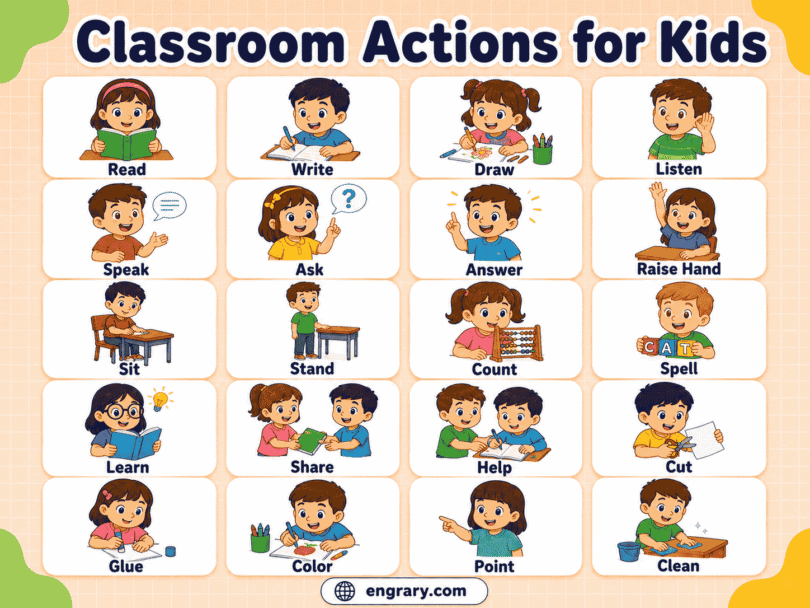
A classroom becomes lively when children start doing things. They open books, listen to the teacher, read words, write answers, ask questions, share with classmates, and clean up before the lesson ends. These everyday movements and tasks are called classroom actions.
Learning classroom actions for kids helps children understand the verbs they hear and use during lessons. Instead of memorizing a random action list, kids can learn these words through a real class routine: getting ready, listening, reading, writing, speaking, working together, making things, and putting everything away.
What Classroom Actions Mean
Classroom actions are things children and teachers do inside the classroom. Some actions happen before a lesson starts, some happen during learning, and some happen when children finish their work.
Common classroom actions include:
- sit
- stand
- open
- close
- listen
- look
- read
- write
- ask
- answer
- raise hand
- draw
- color
- cut
- paste
- share
- help
- clean up
A simple explanation for kids:
Classroom actions are things we do during class, such as reading, writing, listening, asking, answering, sharing, and cleaning up.
Useful examples:
- I listen to the teacher.
- I read a book.
- I write in my notebook.
- I raise my hand.
- I clean up my desk.
First Action Words for Classroom Learning
Young learners should begin with action words they can do, see, and act out easily. These verbs work well with movement games, picture cards, classroom routines, and simple sentences.
Important classroom action words include:
- read 🔊 /reed/
- write 🔊 /ryt/
- listen 🔊 /LIS-uhn/
- look 🔊 /look/
- ask 🔊 /ask/
- answer 🔊 /AN-ser/
- open 🔊 /OH-puhn/
- close 🔊 /klohz/
- draw 🔊 /draw/
- color 🔊 /KUH-ler/
- cut 🔊 /kut/
- paste 🔊 /payst/
- share 🔊 /shair/
- help 🔊 /help/
- clean up 🔊 /kleen up/
Easy meanings:
- Read means look at words and say or understand them.
- Write means make letters, words, or sentences.
- Listen means use your ears carefully.
- Look means use your eyes.
- Ask means say a question.
- Answer means reply to a question.
- Open means make something not shut.
- Close means shut something.
- Draw means make a picture.
- Color means add color to a picture.
- Cut means use scissors.
- Paste means stick something with glue.
- Share means let others use something too.
- Help means do something useful for someone.
- Clean up means make a place neat.

Getting Ready Before the Lesson
Before learning begins, children do small actions that help them get ready. These actions are simple, but they are important because they start the classroom routine.
Useful getting-ready words:
- sit
- stand
- open
- close
- take out
- put down
- get ready
- line up
Simple examples:
- I sit on my chair.
- I stand near my desk.
- I open my book.
- I close my notebook.
- I take out my pencil.
- I put down my school bag.
- Students line up near the door.
A useful classroom pattern:
I get ready for class.
More examples:
- I get ready with my book.
- I get ready with my pencil.
- I get ready to listen.
When the Teacher Starts Talking
When the teacher starts a lesson, children need actions that show attention. These words help kids understand what to do with their eyes, ears, and minds during class.
Useful listening and attention words:
- listen
- look
- watch
- follow
- repeat
- pay attention
Simple meanings:
- Listen means use your ears carefully.
- Look means use your eyes.
- Watch means look carefully for some time.
- Follow means do what the teacher says.
- Repeat means say or do something again.
- Pay attention means focus on the lesson.
Simple examples:
- I listen to the teacher.
- Look at the board.
- Watch the teacher’s hand.
- Follow the instructions.
- Repeat the word after me.
- Pay attention during the lesson.
These actions help children understand the lesson before they start reading, writing, or answering.

How Kids Read in Class
Reading actions help children follow stories, sound out words, and understand written language. These actions are common during story time, phonics lessons, worksheet practice, and reading groups.
Useful reading words:
- read
- point
- turn page
- spell
- sound out
- match
- circle
Simple meanings:
- Read means look at words and understand them.
- Point means show something with a finger.
- Turn page means move to the next page.
- Spell means say or write the letters in a word.
- Sound out means say the sounds in a word slowly.
- Match means put two things together because they belong together.
- Circle means draw a round line around something.
Simple examples:
- I read a story.
- I point to the word.
- I turn the page carefully.
- I spell my name.
- I sound out the word.
- I match the word to the picture.
- I circle the correct answer.
What Kids Do on Paper
Many classroom actions happen on paper. Children write letters, copy sentences, trace shapes, underline words, fill in blanks, and check their answers.
Useful paper-work words:
- write
- copy
- trace
- underline
- check
- complete
- fill in
Simple meanings:
- Write means make letters or words.
- Copy means write the same thing again.
- Trace means write over lines, letters, or shapes.
- Underline means draw a line under a word.
- Check means look again to see if something is correct.
- Complete means finish the work.
- Fill in means write in the blank space.
Simple examples:
- I write my name.
- I copy the sentence from the board.
- I trace the letter A.
- I underline the word.
- I check my answer.
- I complete the worksheet.
- I fill in the blank.
Asking, Answering, and Taking Turns
Classroom talk is also full of actions. Children ask questions, answer the teacher, say words aloud, speak politely, and wait for their turn.
Useful speaking words:
- ask
- answer
- say
- speak
- tell
- raise hand
- read aloud
- wait
Simple meanings:
- Ask means say a question.
- Answer means reply to a question.
- Say means speak a word or sentence.
- Speak means use your voice.
- Tell means give information.
- Raise hand means put your hand up to speak.
- Read aloud means read so others can hear.
- Wait means stay until your turn comes.
Simple examples:
- I ask a question.
- I answer the teacher.
- I say the word clearly.
- I speak in a polite voice.
- I tell my idea to the class.
- I raise my hand before speaking.
- I read aloud to my classmates.
- I wait for my turn.
Helping and Sharing with Classmates
Children often learn with classmates. They share supplies, help friends, pass papers, take turns, and work together in pairs or groups.
Useful classroom teamwork words:
- share
- help
- pass
- give
- take
- choose
- wait
- work together
Simple meanings:
- Share means let someone use something too.
- Help means make something easier for someone.
- Pass means move something to another person.
- Give means hand something to someone.
- Take means receive or pick up something.
- Choose means pick one thing.
- Wait means stay calmly until it is your turn.
- Work together means do a task with others.
Simple examples:
- I share crayons with my classmate.
- I help my friend read a word.
- Please pass the paper.
- I give the book to the teacher.
- I take one worksheet.
- We choose a picture.
- I wait for my turn.
- We work together in a group.

Making Things During Class Activities
Some lessons include drawing, coloring, cutting, pasting, folding, painting, and making simple projects. These classroom actions are common during art time, craft work, worksheets, and hands-on activities.
Useful making words:
- draw
- color
- cut
- paste
- make
- fold
- paint
Simple meanings:
- Draw means make a picture with a pencil, crayon, or marker.
- Color means add color to a picture.
- Cut means use scissors to separate paper.
- Paste means stick something with glue.
- Make means create something.
- Fold means bend paper.
- Paint means add color with paint.
Simple examples:
- I draw a picture.
- I color the flower.
- I cut the paper carefully.
- I paste the picture on the page.
- We make a card.
- I fold the paper in half.
- I paint the sky blue.
Use scissors, glue, and paint carefully during classroom activities.
Putting Things Away After Work
When work is finished, children need actions for cleaning, collecting, packing, and making the classroom neat. These words are useful at the end of a lesson or before going home.
Useful cleanup words:
- clean up
- put away
- tidy
- collect
- pack
- throw away
- close
Simple meanings:
- Clean up means make the area neat.
- Put away means place something back where it belongs.
- Tidy means make things neat and clean.
- Collect means gather things together.
- Pack means put things into a bag.
- Throw away means put something in the bin.
- Close means shut something.
Simple examples:
- I clean up my desk.
- I put away my book.
- We tidy the table.
- The helper collects the worksheets.
- I pack my school bag.
- I throw away paper scraps.
- I close my notebook.
Action Words and Classroom Instructions
Action words and classroom instructions are connected, but they are not exactly the same. An action word tells what someone does. A classroom instruction tells someone what to do.
| Action word | Classroom instruction |
|---|---|
| open | Open your book. |
| write | Write your name. |
| listen | Listen carefully. |
| raise hand | Raise your hand. |
| read | Read the sentence. |
| copy | Copy the word. |
| clean up | Clean up your desk. |
| put away | Put away your pencil. |
Simple examples:
- Open is an action word.
- Open your book is an instruction.
- Write is an action word.
- Write your name is an instruction.
Classroom Action Words Kids Often Confuse
Some classroom action words are easy to mix up because they happen together or sound similar. This table explains the differences in simple language.
| Mix-up | Easy difference |
|---|---|
| Ask vs answer | Ask means say a question. Answer means reply to a question. |
| Listen vs hear | Hear can happen naturally. Listen means pay attention. |
| Look vs watch | Look can be quick. Watch means look carefully for longer. |
| Open vs close | Open means make something not shut. Close means shut it. |
| Write vs copy | Write means make words. Copy means write the same words again. |
| Cut vs paste | Cut means use scissors. Paste means stick something. |
| Clean up vs put away | Clean up means make the area neat. Put away means place things back. |
| Stand up vs line up | Stand up means get on your feet. Line up means stand in a line. |
Simple Sentences with Classroom Actions
Children learn classroom actions better when they use the words in complete sentences. These examples are useful for speaking, reading, writing, ESL practice, and classroom role-play.
Useful classroom action sentences:
- I sit on my chair.
- I open my book.
- I listen to the teacher.
- I look at the board.
- I read a story.
- I point to the word.
- I write my name.
- I copy the sentence.
- I ask a question.
- I answer the teacher.
- I raise my hand.
- I share with my classmate.
- I help my friend.
- I draw a picture.
- I cut the paper.
- I paste the picture.
- I clean up my desk.
- I put away my book.
Question practice:
- What do you do with a book?
- What do you do when the teacher talks?
- What do you do before speaking?
- What do you do with scissors?
- What do you do after classwork?
Short answers:
- I read a book.
- I listen to the teacher.
- I raise my hand.
- I cut paper carefully.
- I clean up my desk.
Picture Acting and Classroom Action Games
Classroom action words are easy to practice with movement, pictures, and real classroom routines. These activities help children remember verbs by doing them.
Act out the action
Show an action card such as read, write, listen, draw, or clean up. Children act out the word.
Match actions to pictures
Give children pictures of classroom actions. They match read to a child reading, write to a child writing, and raise hand to a child raising a hand.
Teacher says game
Use classroom actions in a “Teacher says” game: Teacher says open your book, Teacher says raise your hand, Teacher says clean up.
Class routine order cards
Put action cards in order: sit, listen, read, write, answer, clean up, pack.
Who does the action? game
Ask, “Who writes on the board?” or “Who answers a question?” Children answer with simple sentences.
Action and object matching
Match actions with classroom objects: write — pencil, read — book, cut — scissors, paste — glue, color — crayons.
Classroom Actions Practice Worksheet
Use this practice block for classwork, homework, or quick revision.
A. Circle the classroom action
- read / pencil / apple
- write / chair / mango
- listen / notebook / cup
- cut / eraser / banana
- clean up / ruler / ball
B. Match the action
- Read — ________
- Write — ________
- Listen — ________
- Cut — ________
- Paste — ________
Word bank: use glue, use scissors, use ears carefully, look at words, make words
C. Complete the sentences
- I ________ a book.
- I ________ my name.
- I ________ to the teacher.
- I ________ my hand before speaking.
- I ________ up my desk.
D. Write before class, during class, or after class
- Open your book — ________
- Listen to the teacher — ________
- Write in a notebook — ________
- Clean up your desk — ________
- Pack your bag — ________
Answer key:
- A1: read
- A2: write
- A3: listen
- A4: cut
- A5: clean up
- B1: look at words
- B2: make words
- B3: use ears carefully
- B4: use scissors
- B5: use glue
- C1: read
- C2: write
- C3: listen
- C4: raise
- C5: clean
- D1: before class / during class
- D2: during class
- D3: during class
- D4: after class
- D5: after class
Classroom Actions Quiz for Kids
Try the questions first, then check the answers below.
- What action means look at words and understand them?
- What action means make letters or words?
- What action means use your ears carefully?
- What action means say a question?
- What action means reply to a question?
- What do you do before speaking in class?
- What action uses scissors?
- What action uses glue?
- What action means make your desk neat?
- What action means place things back where they belong?
Answers:
- Read
- Write
- Listen
- Ask
- Answer
- Raise your hand
- Cut
- Paste
- Clean up
- Put away
FAQs
Classroom actions for kids are action words children use during class, such as read, write, listen, ask, answer, open, close, draw, cut, paste, share, and clean up.
Children can start with common classroom actions like read, write, listen, look, ask, answer, open, close, draw, color, share, help, and clean up.
Not exactly. A classroom action tells what someone does, such as write. A classroom instruction tells someone what to do, such as Write your name.
Kids can learn classroom actions by acting them out, matching action pictures, playing classroom action games, using simple sentences, completing worksheets, and practicing real classroom routines.
Examples include I read a book, I write my name, I listen to the teacher, I ask a question, I raise my hand, and I clean up my desk.
You May Also Like