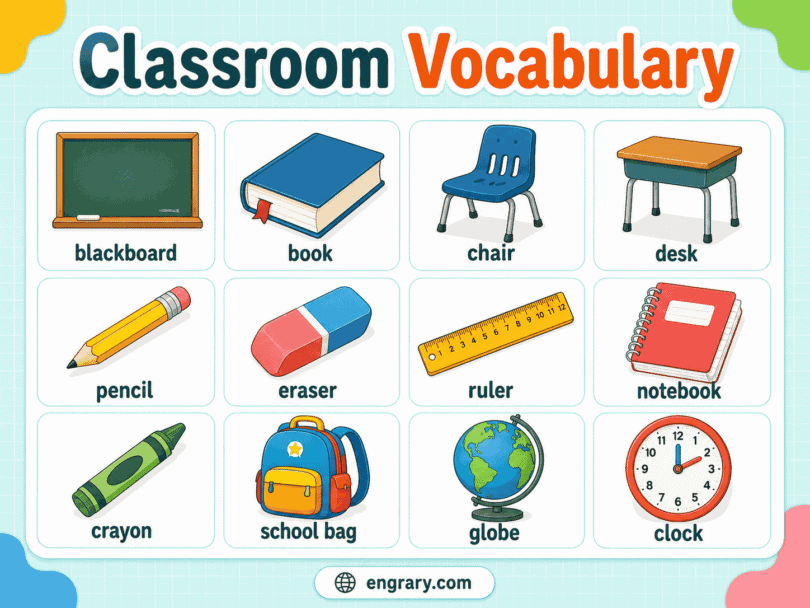
A classroom has its own small world of words. Children sit at a desk, listen to a teacher, open a book, answer a question, raise a hand, and clean up when the activity is finished. These words become easier when kids connect them with real classroom moments.
Learning classroom vocabulary for kids helps children understand the people, objects, actions, instructions, learning words, and simple sentences used inside a classroom. Instead of memorizing a random list, kids can learn these words by looking around the room, joining lessons, following instructions, and using the words while they speak, read, and write.
What Kids Notice Inside the Classroom
Children learn classroom words by watching what happens around them. They see the teacher near the board, students at their desks, books on shelves, pencils on tables, and worksheets in folders. They also hear words like lesson, question, answer, listen, and clean up during class.
Common classroom words children notice include:
- teacher
- student
- desk
- chair
- board
- book
- notebook
- pencil
- eraser
- question
- answer
- lesson
- worksheet
- door
- window
A simple explanation for children:
Classroom vocabulary words are words we use to talk about people, things, actions, instructions, and learning inside the classroom.
Useful examples:
- I sit on a chair.
- The teacher writes on the board.
- I read a book.
- I ask a question.
- I raise my hand.
Common Classroom Words Children Learn First
Young learners should begin with classroom words they can see, touch, hear, or use during lessons. These words work well with real objects, flashcards, picture cards, labeling games, and short speaking practice.
Important classroom vocabulary words include:
- classroom 🔊 /KLAS-room/
- teacher 🔊 /TEE-cher/
- student 🔊 /STOO-dent/
- desk 🔊 /desk/
- chair 🔊 /chair/
- board 🔊 /bord/
- book 🔊 /book/
- notebook 🔊 /NOHT-book/
- pencil 🔊 /PEN-suhl/
- eraser 🔊 /ih-RAY-ser/
- lesson 🔊 /LES-uhn/
- question 🔊 /KWES-chuhn/
- answer 🔊 /AN-ser/
- worksheet 🔊 /WORK-sheet/
- door 🔊 /dor/
Easy meanings:
- Classroom is a room where students learn.
- Teacher is a person who teaches.
- Student is a person who learns.
- Desk is a small table for schoolwork.
- Chair is used for sitting.
- Board is where the teacher writes.
- Book is used for reading.
- Notebook is used for writing.
- Lesson is what the teacher teaches.
- Question asks something.
- Answer tells something.
- Worksheet is a practice paper.

People Children See During Class
Classroom vocabulary is not only about objects. Children also need words for the people they see, talk to, and work with during lessons.
Common classroom people words:
- teacher
- student
- classmate
- friend
- helper
- monitor
Who does what in the classroom?
| Person | What they do |
|---|---|
| Teacher | teaches the lesson and helps students |
| Student | learns, listens, reads, writes, and answers |
| Classmate | learns in the same class |
| Friend | plays, shares, and works with others |
| Helper | helps the teacher or classmates |
| Monitor | helps with small classroom jobs |
Example sentences:
- The teacher explains the lesson.
- A student listens carefully.
- My classmate sits beside me.
- My friend shares crayons with me.
- The helper gives out worksheets.
- The monitor keeps the line neat.
Classroom Objects Kids Use at Their Desks
Many classroom objects are used during reading, writing, drawing, and worksheet practice. These words are useful because children touch or use them during class.
Common classroom objects include:
- desk
- chair
- book
- notebook
- pencil
- eraser
- ruler
- paper
- worksheet
- folder
- crayons
Simple examples:
- I sit at my desk.
- My book is open.
- I write in my notebook.
- The eraser is on the table.
- I draw a line with a ruler.
- My worksheet is in the folder.
Useful pattern:
I use a ________ at my desk.
Examples:
- I use a pencil at my desk.
- I use a notebook at my desk.
- I use crayons at my desk.
Learning Words Kids Hear in Class
Children hear many learning words during lessons. These words help them understand what the teacher is asking and what work they need to do.
Useful learning words:
- class
- lesson
- question
- answer
- story
- activity
- worksheet
- classwork
- homework
- test
- group
- pair
Easy meanings:
- Class can mean a group of students or learning time.
- Lesson is what the teacher teaches.
- Question asks something.
- Answer tells something.
- Story is something children read or listen to.
- Activity is a task children do.
- Classwork is work done in class.
- Homework is schoolwork done at home.
- Group means more than one student working together.
- Pair means two students working together.
Simple sentences:
- The lesson starts now.
- Our class reads a story.
- I answer a question.
- We work in a group.
- My partner helps me in a pair.
- I finish my classwork before break.
Classroom Areas Children Can Name
A classroom has different areas for learning, reading, storing supplies, showing work, and lining up. These area words make the lesson more specific than a simple classroom-object list.
Useful classroom area words:
- board area
- teacher’s desk
- reading corner
- bookshelf
- art table
- storage shelf
- carpet area
- classroom door
- classroom wall
- line area
Simple examples:
- The teacher stands near the board area.
- The books are on the bookshelf.
- We read in the reading corner.
- Paint and paper are on the art table.
- Bags are near the storage shelf.
- We sit on the carpet area.
- The line starts near the classroom door.
Useful question:
Where is it in the classroom?
Short answers:
- It is near the board.
- It is on the shelf.
- It is in the reading corner.

Action Words for Classroom Lessons
Classroom action words tell what children do during learning time. These words are useful for speaking practice because children can act them out, match them with pictures, and use them in short sentences.
Common classroom action words:
- read
- write
- draw
- listen
- speak
- ask
- answer
- learn
- copy
- repeat
- raise hand
- open
- close
- clean up
- put away
Classroom action sentences:
- I read the first line.
- I write my name.
- I draw a picture.
- I listen to the teacher.
- I ask politely.
- I answer in a clear voice.
- We learn new words.
- I copy the sentence from the board.
- I repeat the word after the teacher.
- I put my book away.
Classroom Instructions Kids Hear Often
Children hear classroom instructions every day. These phrases help kids understand what to do during lessons, group work, story time, and cleanup.
| Instruction | Simple meaning |
|---|---|
| Open your book. | Make the book ready to read. |
| Close your notebook. | Shut the notebook. |
| Raise your hand. | Put your hand up to speak. |
| Listen carefully. | Pay attention to the teacher or sound. |
| Sit down. | Sit on your chair. |
| Stand up. | Get up from your seat. |
| Line up. | Stand in a line. |
| Clean up. | Put things away and make the area neat. |
| Write your name. | Put your name on your paper. |
| Look at the board. | Look where the teacher is writing. |
Simple examples:
- Open your book to page five.
- Raise your hand before you speak.
- Listen carefully to the story.
- Write your name on the worksheet.
- Clean up after the activity.
Classroom Behavior Words Kids Should Know
Classroom behavior words help children understand how to learn safely and kindly with others. These words are part of everyday classroom vocabulary because teachers and students use them during lessons, games, and group work.
Useful classroom behavior words:
- quiet
- careful
- kind
- safe
- ready
- clean
- share
- wait
- turn
- help
Simple classroom behavior sentences:
- Be quiet during the lesson.
- Use scissors carefully.
- Be kind to your classmate.
- Keep your desk clean.
- Wait for your turn.
- Share the crayons.
- Help your friend.
- Get ready for class.
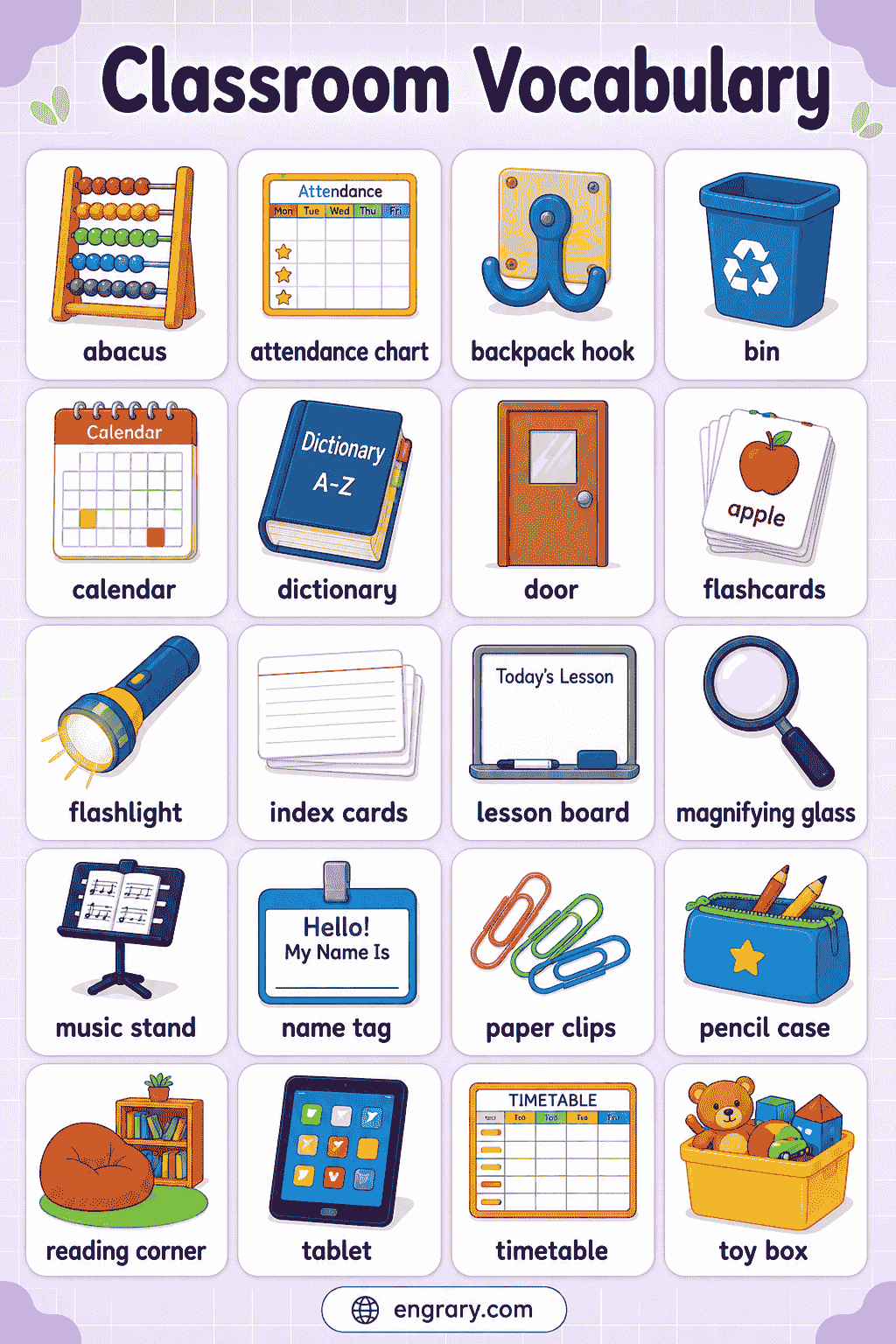
Simple Sentences with Classroom Vocabulary
Children learn classroom vocabulary better when they use words in complete sentences. These examples are useful for speaking, reading, writing, ESL practice, and classroom role-play.
Useful classroom sentences:
- This is my classroom.
- My teacher is writing.
- I am a student.
- My classmate sits near me.
- I sit at my desk.
- The chair is beside the desk.
- My book is open.
- I write in my notebook.
- The board is at the front.
- I ask a question.
- The teacher listens to my answer.
- I raise my hand before speaking.
- We work in a group.
- The worksheet is on my desk.
- We clean the classroom after the activity.
Question practice:
- Who teaches the class?
- Where do students sit?
- What do you write in?
- What do you raise before speaking?
- What do you clean after class?
Short answers:
- The teacher teaches the class.
- Students sit at desks.
- I write in my notebook.
- I raise my hand.
- I clean my desk.
Classroom Word Mix-Ups Kids Often Make
Some classroom words are easy to confuse. This simple table explains the differences.
| Mix-up | Easy difference |
|---|---|
| Desk vs table | A desk is usually for one student. A table can be shared. |
| Book vs notebook | A book is for reading. A notebook is for writing. |
| Question vs answer | A question asks something. An answer tells something. |
| Teacher vs student | A teacher teaches. A student learns. |
| Classroom vs school | A classroom is one room. A school is the whole place. |
| Classwork vs homework | Classwork is done in class. Homework is done at home. |
| Board vs wall | A board is used for writing. A wall is part of the room. |
| Pencil case vs school bag | A pencil case holds small supplies. A school bag carries many items. |
Picture Labeling and Classroom Word Games
Classroom vocabulary becomes easier when children connect words with pictures, real objects, actions, and classroom places.
Label a classroom picture
Give children a classroom picture. Ask them to label words such as teacher, student, desk, chair, board, book, window, and door.
People, objects, areas, and actions sorting
Sort words into groups. For example, teacher is a person, desk is an object, reading corner is an area, and write is an action.
What can you see? game
Ask children, “What can you see in the classroom?” They can answer with simple phrases like a board, a chair, a book, or a pencil.
Instruction action game
Say a classroom instruction and let children act it out: open your book, raise your hand, stand up, sit down, or clean up.
Who uses it? object game
Show an item and ask, “Who uses it?” Students may use a pencil, and the teacher may use the board.
Classroom area walk-and-name activity
Point to a classroom area and ask children to name it: reading corner, bookshelf, board area, teacher’s desk, or classroom door.
Classroom Vocabulary Practice Worksheet
Use this practice block for classwork, homework, or quick revision.
A. Circle the classroom word
- teacher / mango / spoon
- desk / pillow / apple
- notebook / shoe / carrot
- board / banana / sock
- question / plate / cup
B. Match the word
- Teacher — ________
- Student — ________
- Board — ________
- Notebook — ________
- Question — ________
Word bank: person who learns, used for writing, asks something, person who teaches, where the teacher writes
C. Complete the sentences
- I sit on a ________.
- The teacher writes on the ________.
- I write in my ________.
- I raise my ________.
- I ask a ________.
D. Write person, object, area, or action
- Teacher — ________
- Desk — ________
- Reading corner — ________
- Write — ________
- Student — ________
Answer key:
- A1: teacher
- A2: desk
- A3: notebook
- A4: board
- A5: question
- B1: person who teaches
- B2: person who learns
- B3: where the teacher writes
- B4: used for writing
- B5: asks something
- C1: chair
- C2: board
- C3: notebook
- C4: hand
- C5: question
- D1: person
- D2: object
- D3: area
- D4: action
- D5: person
Classroom Vocabulary Quiz for Kids
Try the questions first, then check the answers below.
- Who teaches the class?
- Who learns in the classroom?
- What do students sit on?
- Where does the teacher write?
- What do students write in?
- What do you raise before speaking?
- What word means work done in class?
- What instruction means put your hand up?
- What classroom area can have books?
- Name one classroom action word.
Answers:
- Teacher
- Student
- Chair
- Board
- Notebook
- Hand
- Classwork
- Raise your hand
- Reading corner / bookshelf
- Read, write, listen, ask, answer, draw, open, close, clean up, or raise hand
FAQs
Classroom vocabulary for kids means words children use inside the classroom, such as teacher, student, desk, chair, board, book, question, answer, read, write, and listen.
Children can start with common classroom words like classroom, teacher, student, desk, chair, board, book, notebook, pencil, eraser, lesson, question, and answer.
No. Classroom objects are things in the room, such as desks, chairs, boards, and books. Classroom vocabulary is broader because it also includes people, actions, learning words, instructions, areas, and simple classroom sentences.
Kids can learn classroom vocabulary with picture cards, real classroom objects, labeling games, instruction actions, simple sentences, worksheets, quizzes, and classroom speaking practice.
Common classroom instructions include open your book, close your notebook, raise your hand, listen carefully, sit down, stand up, line up, clean up, and write your name.
You May Also Like