A warm sweater feels cozy on a cold morning, rain boots splash through puddles, and soft pajamas signal that bedtime is near. Children meet clothing words throughout the day, so they can connect each name with something they already see, touch, or wear.
This guide to clothes names for kids introduces familiar garments, footwear, hats, and accessories with clear meanings. It also explains confusing clothing terms, plural forms, regional differences, descriptive words, and everyday phrases used while getting dressed.
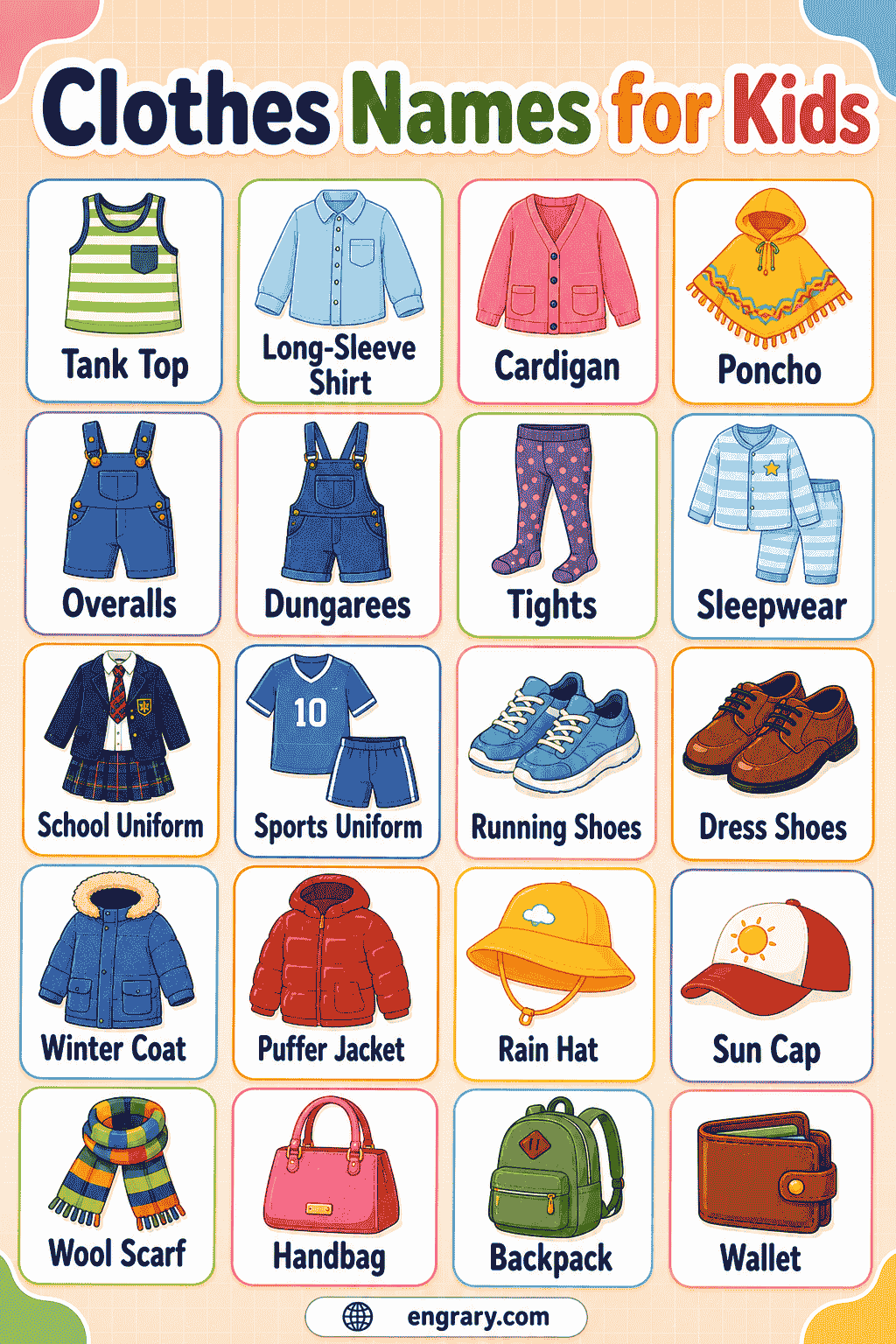
Common Clothes Names for Kids
Clothes can be grouped by where they are worn or why they are needed. Footwear, hats, and accessories are related wearable items, although they are not all garments.
Tops and Upper-Body Clothes
- T-shirt — A casual top that usually has short sleeves, no collar, and no opening down the front.
- Shirt — This upper-body garment often has a collar, sleeves, and buttons.
- Blouse — /blaʊs/ 🔊 A light or dressy shirt-style top, often made from soft fabric.
- Polo shirt — A casual shirt with a collar and a few buttons near the neck.
- Tank top — A sleeveless top held up by shoulder straps.
- Sweater — A warm knitted top that usually has long sleeves.
- Sweatshirt — A soft, thick casual top made for warmth and comfort.
- Hoodie — A sweatshirt or light jacket with an attached hood.
- Cardigan — This knitted layer opens at the front and fastens with buttons or a zipper.
- Tunic — A loose top that reaches below the hips and is often worn with pants or leggings.
Clothes Worn Below the Waist
- Pants — Clothing that covers the waist and both legs separately.
- Jeans — Strong casual pants traditionally made from denim.
- Shorts — Pants that end above or around the knees.
- Skirt — A garment that hangs from the waist without separating the legs.
- Leggings — Close-fitting, stretchy clothing worn over the legs.
- Sweatpants — Soft, loose pants made for comfort, exercise, or play.
- Joggers — Casual pants with narrow or elastic cuffs around the ankles.
- Overalls — Pants with a bib-shaped front and straps that pass over the shoulders.
Dresses and One-Piece Outfits
- Dress — A one-piece garment with an upper section and a skirt.
- Sundress — A light dress made for warm weather, usually with short sleeves or shoulder straps.
- Jumpsuit — A one-piece outfit with a connected top and long pants.
- Romper — A one-piece garment with an attached top and shorts.
- Pinafore — A sleeveless dress worn over a blouse, shirt, or other top.
- Leotard — A close-fitting one-piece garment used for gymnastics, dance, or similar activities.
Outerwear and Weather Clothes
- Jacket — A short outer layer worn for warmth, protection, or style.
- Coat — A heavier outer garment commonly worn in cold weather.
- Raincoat — Children wear this waterproof coat to keep their clothes dry in rain.
- Windbreaker — A lightweight jacket designed mainly to block the wind.
- Puffer jacket — A padded winter jacket with stitched sections that create a puffed shape.
- Fleece jacket — A soft, lightweight jacket that provides warmth.
- Poncho — A loose outer covering with an opening for the head and no fitted sleeves.
- Snowsuit — A thick winter outfit that covers much of the body during snowy weather.
Underwear, Socks, and Sleepwear
- Underwear — Clothing worn directly beneath outer clothes for comfort and coverage.
- Undershirt — A light shirt worn under another top.
- Briefs — Close-fitting underwear worn around the waist and upper legs.
- Boxer shorts — Loose shorts-style underwear with an elastic waistband.
- Socks — Soft coverings worn on the feet, usually inside shoes.
- Tights — Stretchy clothing that covers the feet, legs, and waist in one piece.
- Pajamas — /pəˈdʒɑːməz/ 🔊 Comfortable clothes worn for sleeping.
- Nightgown — A loose, dress-like garment worn at bedtime.
- Robe — A loose garment worn over pajamas or after bathing.
- One-piece pajamas — Sleepwear that connects the top and pants in one garment.
School, Sports, and Swim Clothes
- School uniform — A standard set of clothes required by some schools.
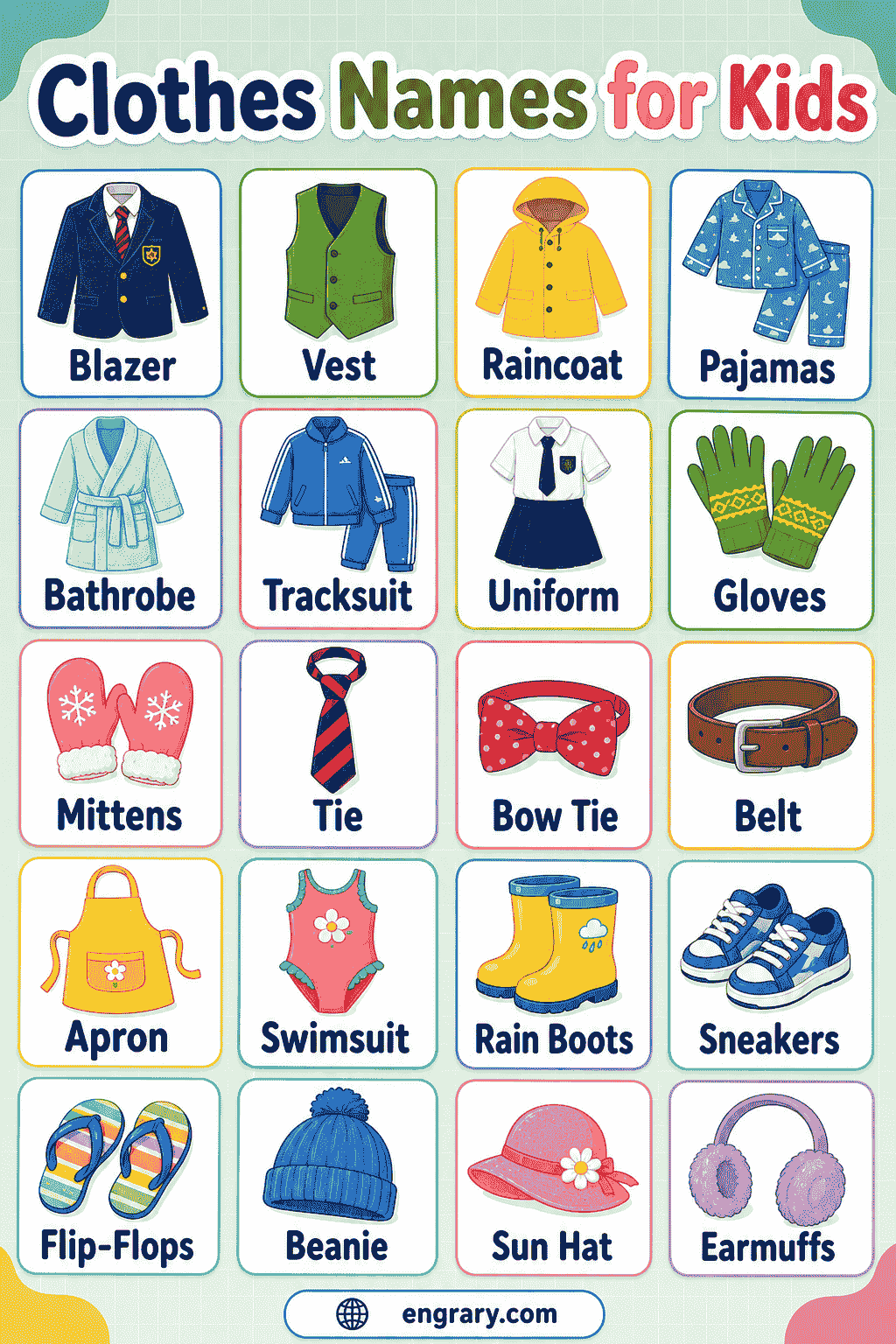
- Blazer — A structured jacket worn with some school or formal outfits.
- Sports jersey — A shirt that may display a team’s colors, name, or player number.
- Tracksuit — A matching sports jacket and pants used for exercise or warm-ups.
- Athletic shorts — Lightweight shorts designed for sports and active movement.
- Swimsuit — Clothing made for swimming and water activities.
- Swim trunks — Shorts designed for swimming, commonly worn by boys and men.
- Rash guard — A fitted swimming top that covers more of the upper body and reduces rubbing.
- Tutu — A light, layered skirt worn for ballet.
Clothes for Special and Cultural Occasions
- Suit — A matching formal outfit that usually includes a jacket and pants.
- Dress shirt — A neat buttoned shirt worn with formal clothing.
- Party dress — A dress chosen for birthdays, weddings, and other celebrations.
- Costume — Special clothing worn to look like a character, animal, or historical person.
- Cape — A sleeveless outer garment that hangs from the shoulders.
- Shalwar kameez — A South Asian outfit made from a long tunic and loose pants.
- Kurta — A loose South Asian tunic often worn with pants, pajamas, or a shalwar.
- Sari — A long piece of fabric draped around the body and worn with a blouse and underskirt.
- Kimono — A traditional Japanese robe with wide sleeves and a wrap-around front.
- Hanbok — Traditional Korean clothing made from separate flowing pieces, usually including a short jacket with a skirt or pants.
Shoes, Hats, and Accessories
Footwear protects the feet, while hats and accessories provide warmth, support, shade, or decoration.
- Shoes — A general name for coverings that protect and support the feet.
- Sneakers — Flexible shoes worn for sports, exercise, or everyday activities.
- Boots — Footwear that covers the foot and reaches above the ankle.
- Rain boots — Waterproof boots made for rain, puddles, and mud.
- Sandals — Open footwear held to the feet with straps.
- Slippers — Soft, comfortable footwear worn indoors.
- Cleats — Sports shoes with raised grips on their soles.
- Ballet shoes — Light, flexible shoes worn for ballet.
- Hat — A general name for a head covering.
- Cap — A fitted hat that usually has a visor at the front.
- Beanie — A close-fitting knitted hat worn in cold weather.
- Sun hat — A lightweight hat with a wide brim that shades the face and neck.
- Scarf — A long piece of fabric worn around the neck.
- Gloves — Hand coverings with a separate section for each finger.
- Mittens — Warm hand coverings that keep four fingers together in one section.
- Belt — A strip worn around the waist to hold clothing in place.
- Tie — A long strip of fabric worn around the neck with a collared shirt.
- Suspenders — Straps worn over the shoulders to hold up pants.

Clothing Words Children Often Confuse
Several garments look similar or serve related purposes. These common differences can help children choose the right word.
| Clothing words | Main difference |
|---|---|
| Shirt and T-shirt | A shirt often has a collar and buttons; a T-shirt usually has neither. |
| Sweater and sweatshirt | A sweater is usually knitted; a sweatshirt is made from soft, thick fabric. |
| Sweatshirt and hoodie | A hoodie has an attached hood; an ordinary sweatshirt does not. |
| Jacket and coat | A jacket is usually shorter and lighter; a coat is often heavier and warmer. |
| Dress and skirt | A dress covers the upper body and hangs below the waist; a skirt begins at the waist. |
| Pants and leggings | Pants come in many shapes; leggings are close-fitting and stretchy. |
| Shoes and sneakers | Shoes is a broad category; sneakers are casual or athletic shoes. |
| Gloves and mittens | Gloves separate each finger; mittens keep four fingers together. |
| Hat and cap | Hat is a general term; a cap usually has a fitted shape and a front visor. |
| Overalls and jumpsuit | Overalls have straps and need a top underneath; a jumpsuit has a complete attached top. |
Clothing designs vary, so these descriptions explain the usual differences rather than strict rules that apply to every style.
Pair and Plural Clothing Words
Most clothing names have regular singular and plural forms.
| One item | More than one |
|---|---|
| shirt | shirts |
| dress | dresses |
| coat | coats |
| shoe | shoes |
| sock | socks |
| glove | gloves |
| scarf | scarves or scarfs |
Some clothing words normally use a plural form even when they describe one complete garment.
| Clothing word | Correct example |
|---|---|
| pants | These pants are new. |
| jeans | My jeans are blue. |
| shorts | Her shorts are comfortable. |
| leggings | Those leggings have stripes. |
| tights | The tights are black. |
| pajamas | His pajamas are soft. |
| overalls | These overalls have large pockets. |
| swim trunks | The swim trunks are wet. |
Use a pair of when referring to one complete item:
- a pair of pants;
- a pair of shorts;
- a pair of jeans;
- a pair of pajamas;
- a pair of socks;
- a pair of shoes.
Clothes is already plural, so we say, “My clothes are clean.” Clothing is an uncountable category word, as in, “Pack warm clothing.”
American and British Clothing Terms
American and British speakers sometimes use different names for the same item.
| American English | British English |
|---|---|
| pants | trousers |
| sweater | jumper |
| sneakers | trainers |
| pajamas | pyjamas |
| rain boots | wellington boots or wellies |
| suspenders | braces |
| overalls | dungarees |
| undershirt | vest |
| formal vest | waistcoat |
Trousers — /ˈtraʊzərz/ 🔊
The word pants needs special care. In American English, it means trousers, but in British English, it commonly refers to underwear.
A vest also has different meanings. American speakers usually use it for a sleeveless garment worn over a shirt. In British English, vest often means an undershirt, while a formal sleeveless garment is called a waistcoat.
Simple Words for Describing Clothes
Children can describe clothes by mentioning their color, pattern, length, style, size, or fit. These details help listeners picture the item more clearly.
- Plain — Having one main color without a printed design.
He is wearing a plain blue shirt. - Striped — Decorated with long horizontal or vertical lines.
Maya chose a striped sweater. - Checked — Covered with crossing lines that form squares.
The checked shirt has red and white squares. - Spotted — Decorated with round marks or dots.
Her spotted dress has small black dots. - Floral — Printed with flowers or flower shapes.
She wore a floral dress to the party. - Long-sleeved — Having sleeves that cover most or all of the arms.
A long-sleeved top feels warmer in winter. - Short-sleeved — Having sleeves that end above the elbows.
His short-sleeved T-shirt is comfortable in hot weather. - Sleeveless — Having no sleeves.
The sleeveless dress has wide shoulder straps. - Loose — Fitting with extra space around the body.
Loose clothes can feel comfortable during play. - Tight — Fitting closely against the body.
These shoes feel too tight. - Fitted — Shaped to follow the body without being too tight.
The fitted jacket sits neatly around the shoulders. - Baggy — Very loose around the body or legs.
He is wearing baggy sweatpants. - Oversized — Made or worn larger than the usual size.
She chose an oversized hoodie.
Color words can be placed before clothing names, as in a red T-shirt, blue jeans, white socks, and a yellow raincoat. Children can also combine several details: He is wearing a loose, striped shirt with long sleeves.
Getting Dressed in Everyday English
Children need more than clothing names to talk about dressing. These common verbs explain whether clothes are already on the body, being added, removed, tested for size, or changed.
- Wear means to have clothes, shoes, or accessories on the body.
I wear a uniform to school.
She is wearing a yellow dress. - Put on describes the action of placing an item on the body.
Put on your socks before your shoes.
Omar is putting on his jacket. - Take off means to remove something being worn.
Take off your wet coat.
We take off our shoes at the door. - Get dressed means to put on the clothes needed for the day or an activity.
I get dressed after breakfast.
The children are getting dressed for school. - Try on means to wear an item briefly to check its size, fit, or appearance.
Try on the blue sweater.
She tried on the shoes before buying them. - Change clothes means to remove one outfit and put on another.
He changes clothes after soccer practice.
We changed into dry clothes after swimming.
Children can also button a shirt, zip up a jacket, tie their shoelaces, and fasten a belt. These expressions make clothing vocabulary useful in daily instructions and conversations.
Choose the Right Outfit
Select the clothing that best matches each situation.
- It is raining heavily outside.
T-shirt and sandals / Raincoat and rain boots - A child is getting ready for bed.
Pajamas / School uniform - The class is going swimming.
Swimsuit / Puffer jacket - Snow is falling, and the weather is very cold.
Coat, mittens, and boots / Tank top and sandals - A student is preparing for a sports lesson.
Jersey, shorts, and sneakers / Party dress and slippers - A child is attending a wedding.
Formal outfit / Muddy play clothes - The day is sunny and hot.
T-shirt, shorts, and sun hat / Snowsuit and scarf - A gymnast is preparing for practice.
Leotard / Raincoat
Answer key:
- Raincoat and rain boots
- Pajamas
- Swimsuit
- Coat, mittens, and boots
- Jersey, shorts, and sneakers
- Formal outfit
- T-shirt, shorts, and sun hat
- Leotard
FAQs
Children can begin with familiar names such as T-shirt, shirt, pants, shorts, dress, sweater, jacket, socks, shoes, and pajamas.
Shoes are usually classified as footwear rather than garments. They are often included in clothing vocabulary because they are worn as part of an outfit.
Pants have two leg sections and are traditionally treated as a plural word. One complete garment can therefore be called a pair of pants.
Clothes refers to the individual items people wear and takes a plural verb. Clothing is an uncountable word for clothes as a general category.
Yes. Pants is the usual American English term, while trousers is the common British English word for the same garment.
You May Also Like