A bell rings across the school hallway, a flower gives off a sweet smell, a lemon tastes sharply sour, and a soft blanket feels warm against the skin. Children use their senses from the moment they wake up, noticing colors, sounds, smells, flavors, textures, and temperatures all around them.
Learning five senses words for kids helps young learners explain these everyday experiences clearly. They can describe what something looks like, how a sound feels to the ears, whether a smell is fresh or strong, what a food tastes like, and whether an object feels smooth, rough, warm, or cold. This vocabulary also supports early science, speaking, reading, observation, and descriptive writing.
The Five Senses and Their Body Parts
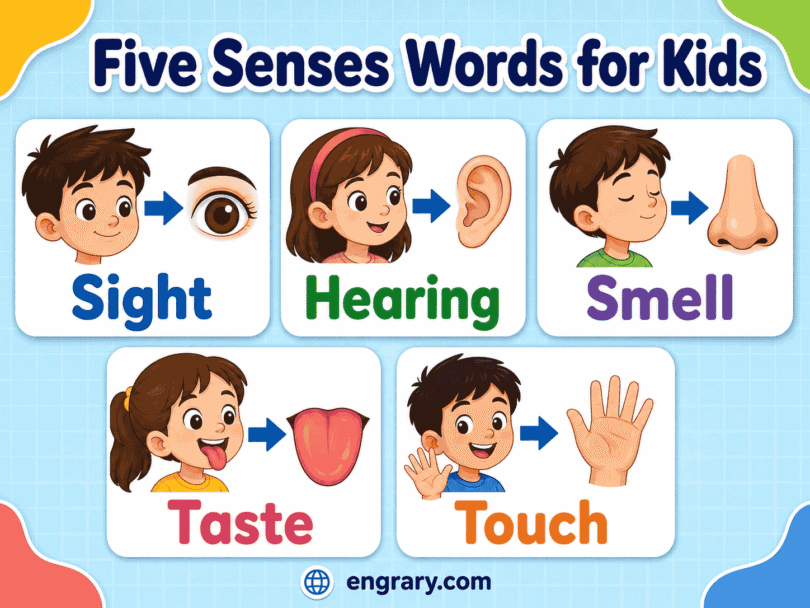
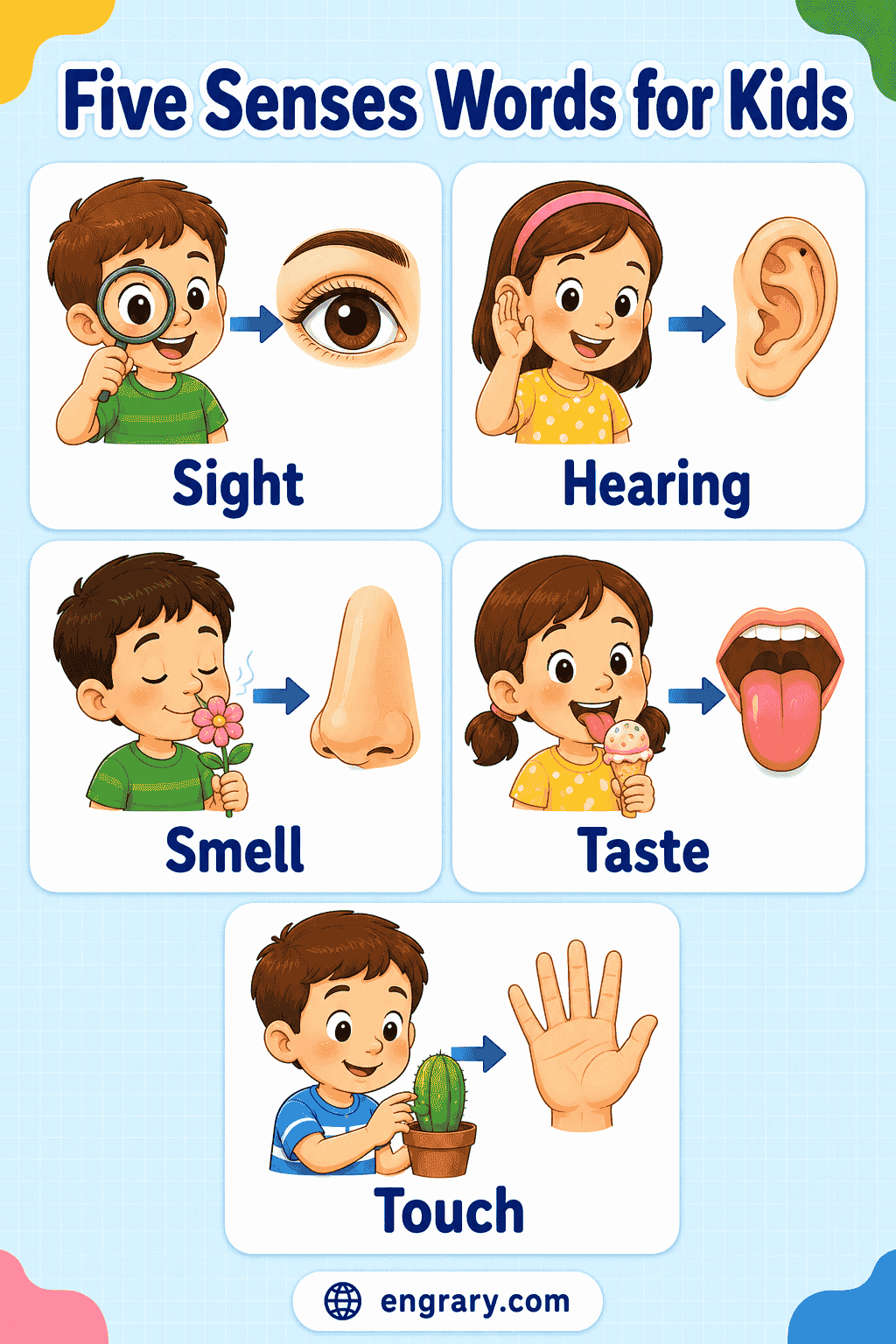
The five traditional senses are sight, hearing, smell, taste, and touch. Each sense is linked with a body part and an action word.
| Sense | Main body part | Action word | Example |
|---|---|---|---|
| Sight | eyes | see | I see a bright rainbow. |
| Hearing | ears | hear | I hear the school bell. |
| Smell | nose | smell | The flower smells sweet. |
| Taste | tongue and mouth | taste | The lemon tastes sour. |
| Touch | skin and hands | feel | The blanket feels soft. |
Children often use their hands to explore objects, but the sense of touch works through the skin across the body.
Describing What We See
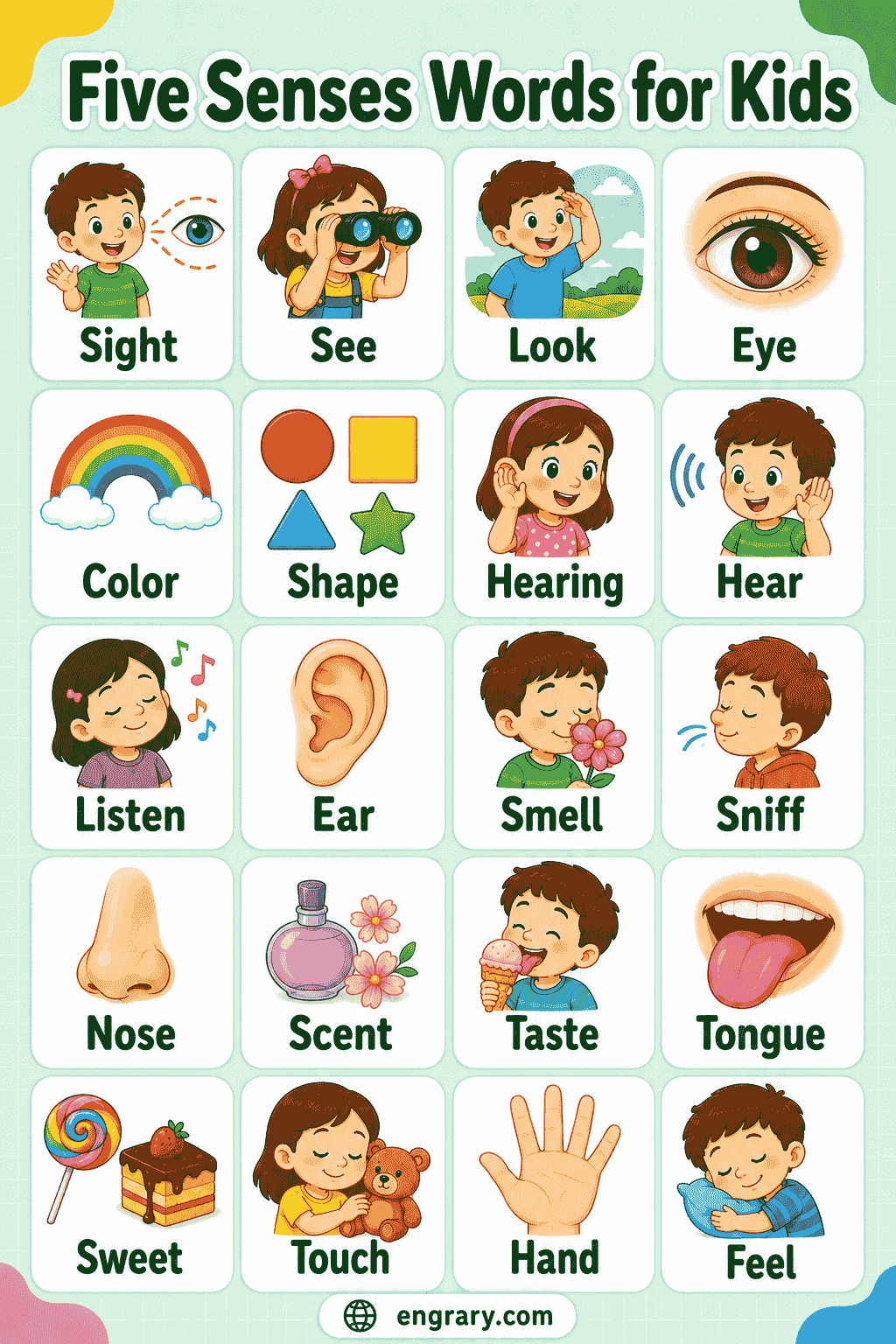
Sight is the sense we use with our eyes. It helps us notice color, shape, size, light, movement, and appearance.
Useful sight words:
- bright
- dark
- colorful
- shiny
- clear
- large
- small
- round
- square
- moving
Examples:
- The sun looks bright.
- I see a colorful butterfly.
- The coin is small and round.
- The window looks clear.
- We watch the birds move across the sky.
The words see, look, and watch have different uses:
- See means notice something with the eyes.
- Look means direct the eyes toward something.
- Watch means keep looking for some time.
Examples:
- I see a rainbow.
- Look at the picture.
- We watch the fish swim.
Sounds We Hear Every Day
Hearing is the sense we use with our ears. It helps us notice voices, music, bells, weather, animals, and sounds around us.
Useful sound words:
- loud
- quiet
- soft
- noisy
- silent
- high
- low
- musical
- ring
- buzz
Examples:
- The school bell sounds loud.
- I hear birds outside.
- The room is quiet.
- A bee makes a buzzing sound.
- The music sounds soft and calm.
The words hear and listen are related but different:
- Hear means notice a sound.
- Listen means pay attention to it.
Examples:
- I hear a car horn.
- Please listen to the teacher.
Describing Pleasant and Unpleasant Smells
The sense of smell helps us notice odors with the nose. Some smells are pleasant, while others may be strong or unpleasant.
Useful smell words:
- sweet
- fresh
- strong
- flowery
- fruity
- smoky
- spicy
- stale
- pleasant
- unpleasant
Examples:
- The flower smells sweet.
- Fresh bread has a pleasant smell.
- The soap smells clean and fresh.
- Smoke has a strong smell.
- Old food may smell stale.
The words smell and sniff are different:
- Smell means notice an odor.
- Sniff means breathe in gently through the nose to check a smell.
Children should never sniff unknown liquids, powders, smoke, or chemicals.
Recognizing Different Tastes
The sense of taste helps us notice what food and drinks are like. The tongue is important for taste, while smell also affects the full flavor of food.
Core taste words:
- sweet
- sour
- salty
- bitter
- bland
- spicy
| Taste word | Familiar example |
|---|---|
| Sweet | honey, ripe fruit, cake |
| Sour | lemon, lime, sour yogurt |
| Salty | crackers, salted popcorn |
| Bitter | some dark chocolate, bitter vegetables |
| Bland | plain rice, plain porridge |
| Spicy | chili sauce, spicy curry |
Examples:
- Honey tastes sweet.
- A lemon tastes sour.
- The crackers taste salty.
- Plain rice may taste bland.
- The curry tastes spicy.
Words such as juicy and delicious describe food, but they are not basic taste types. Spicy is also an everyday taste word, although it describes a hot or burning feeling.
Children should taste only familiar, allergy-checked foods with adult permission.
Textures and Temperatures We Feel
Touch helps us notice texture, temperature, and whether something feels wet or dry.
Useful touch words:
- soft
- hard
- smooth
- rough
- warm
- cold
- wet
- dry
- sticky
- bumpy
Examples:
- The blanket feels soft.
- The rock feels hard.
- Glass feels smooth.
- Sandpaper feels rough.
- Ice feels cold.
- The sponge feels wet.
The words touch and feel have different uses:
- Touch means make contact with something.
- Feel describes what the contact is like.
Examples:
- Touch the fabric.
- The fabric feels soft.
- Do not touch the hot pan.
- The water feels cool.
Sense Names and Action Words
The name of a sense is not always the same as the action word used in a sentence.
| Sense name | Action word | Example |
|---|---|---|
| Sight | see | I see a bird. |
| Hearing | hear | I hear music. |
| Smell | smell | I smell fresh bread. |
| Taste | taste | I taste the soup. |
| Touch | feel | I feel the soft blanket. |
Useful describing patterns:
- It looks bright.
- It sounds loud.
- It smells fresh.
- It tastes sweet.
- It feels smooth.
Sensory Words Kids Often Mix Up
| Words | Easy difference |
|---|---|
| See and look | See means notice with the eyes. Look means direct the eyes toward something. |
| Look and watch | Look may be brief. Watch means continue looking for some time. |
| Hear and listen | Hear means notice a sound. Listen means pay attention to it. |
| Smell and sniff | Smell means notice an odor. Sniff means breathe in gently to check it. |
| Touch and feel | Touch is the action of making contact. Feel describes the sensation. |
| Taste and flavor | Taste is what the tongue notices. Flavor includes taste, smell, and other sensations together. |
| Loud and noisy | Loud means strong in volume. Noisy usually means full of mixed or unwanted sounds. |
| Soft sound and soft texture | A soft sound is quiet. A soft texture is gentle to touch. |
Describing One Object with Several Senses
One object can be described with more than one sense.
An Apple
An apple may:
- look red, green, or yellow;
- feel smooth and firm;
- smell fresh;
- taste sweet or sour;
- sound crunchy when bitten.
The apple looks red, feels smooth, smells fresh, and tastes sweet.
Rain
Rain may:
- look gray or silver;
- sound soft or loud;
- feel cool and wet;
- smell fresh after it falls.
The rain sounds gentle and feels cool on my skin.
Popcorn
Popcorn may:
- look light and fluffy;
- smell warm and buttery;
- taste salty;
- sound crunchy.
The popcorn smells buttery, tastes salty, and sounds crunchy.
Using Sensory Words in Daily Life
- The classroom looks bright.
- The bell sounds loud.
- The paper feels smooth.
- The soap smells fresh.
- The pillow feels soft.
- The soup smells spicy.
- The grass feels wet.
- The birds sound musical.
- The juice tastes sweet.
- The lemon tastes sour.
Useful sentence frames:
- I can see _____.
- I can hear _____.
- I can smell _____.
- I can taste _____.
- I can feel _____.
- It looks _____.
- It sounds _____.
- It smells _____.
- It tastes _____.
- It feels _____.

Explore the Five Senses Safely
Sight Search
Find:
- something bright;
- something round;
- something colorful;
- something shiny.
Listening Pause
Listen for:
- a loud sound;
- a quiet sound;
- a repeating sound;
- a sound from outside.
Texture Bag
Use safe objects that feel:
- soft;
- rough;
- smooth;
- hard;
- bumpy.
Children should not taste unknown objects, sniff unsafe substances, touch hot or sharp items, or listen to sounds that are uncomfortably loud.
Match Sensory Words with the Right Sense
Place each word under the most suitable sense:
bright, loud, sweet, smooth, smoky, sour, colorful, rough, quiet, fresh
| Sight | Hearing | Smell | Taste | Touch |
|---|---|---|---|---|
| bright | loud | smoky | sweet | smooth |
| colorful | quiet | fresh | sour | rough |
Some words may connect with more than one sense. For example, soft can describe a quiet sound or a gentle texture.
Guess the sense:
- The drum sounds loud.
Answer: Hearing - The blanket feels soft.
Answer: Touch - The lemon tastes sour.
Answer: Taste - The flower smells sweet.
Answer: Smell - The stars look bright.
Answer: Sight - The ice feels cold.
Answer: Touch
FAQs
The five traditional senses are sight, hearing, smell, taste, and touch. They help children notice and describe the world around them.
The eyes are connected with sight, the ears with hearing, the nose with smell, the tongue and mouth with taste, and the skin with touch.
Hearing means noticing a sound. Listening means paying attention to that sound.
Children often use their hands to explore objects, but touch is sensed through the skin across the whole body.
Children can match words with senses, describe familiar objects, use safe sensory materials, complete sentence frames, and practice words such as bright, loud, sweet, rough, and fresh.
You May Also Like