A child blinks, smiles, claps, bends, and walks using different parts of the body. Learning the names of these parts helps children follow instructions, describe movement, and understand simple English sentences.
This guide teaches body parts names for kids in a clear order. It focuses on familiar external body parts, simple uses, correct plural forms, difficult spellings, and practical movement activities without turning into a detailed anatomy lesson.
Body Parts from Head to Toe
The body is the whole physical form of a person. It includes the head, upper body, arms, hands, legs, feet, and many smaller parts.
| Body area | Common body-part names |
|---|---|
| Head and face | head, face, hair, forehead, eyes, ears, eyebrows, cheeks, nose, mouth, lips, teeth, tongue, chin |
| Upper body | neck, shoulders, chest, back, waist, stomach |
| Arms and hands | arms, elbows, wrists, hands, palms, fingers, thumbs, nails |
| Legs and feet | hips, thighs, legs, knees, ankles, feet, heels, toes |
The word body can be pronounced /ˈbɒd.i/ or /ˈbɑː.di/ 🔊.
Simple examples:
- The head is above the neck.
- The arms are beside the body.
- The knees are in the middle of the legs.
- The feet touch the ground.
- The toes are at the front of the feet.
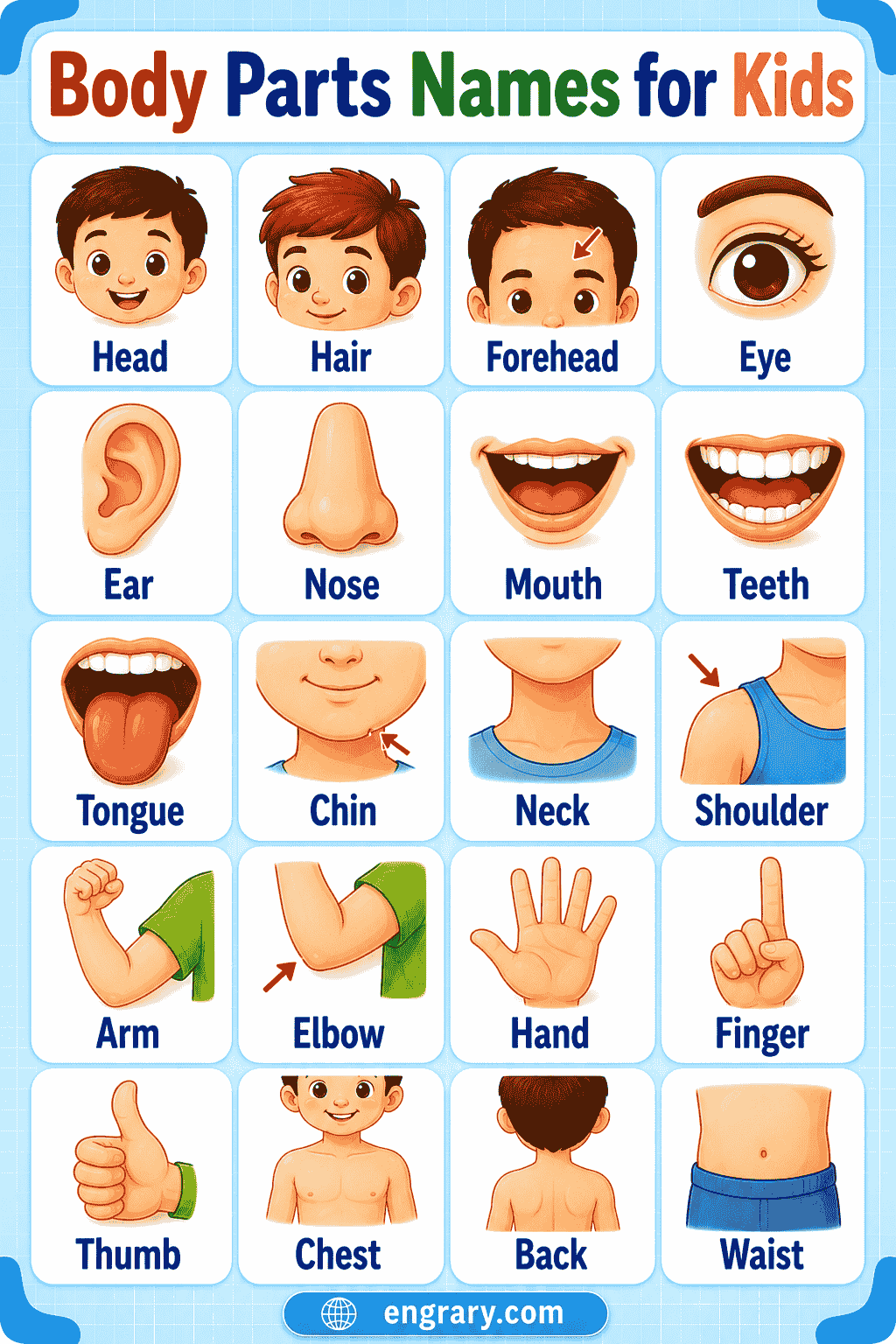
Head and Face Parts
The head is the top part of the body. The face is the front part of the head.
- Hair grows on the head.
- The forehead is above the eyebrows.
- Eyes are used for seeing.
- Ears are used for hearing.
- The nose is in the middle of the face.
- Cheeks are on both sides of the nose and mouth.
- The mouth contains the tongue and teeth.
- Lips form the outer edge of the mouth.
- The chin is below the mouth.
Useful sentences:
- Her hair is long.
- He closes his eyes.
- The ears are on the sides of the head.
- She touches her nose.
- The child smiles and shows his teeth.
Use hair when talking about all the hair on a person’s head:
- Her hair is curly.
Use hairs only for separate strands:
- There are two hairs on the brush.
Arms and Hands
In everyday English, the arm refers to the limb from the shoulder down to the hand.
- The shoulder joins the arm to the body.
- The elbow is the bending place in the middle of the arm.
- The wrist joins the hand to the arm.
- The palm is the inner surface of the hand.
- Each hand usually has four fingers and one thumb.
- Nails grow at the ends of the fingers.
Useful sentences:
- Raise your right arm.
- Bend your elbow.
- She wears a watch on her wrist.
- Place the coin in your palm.
- He holds the pencil with his fingers and thumb.
Legs and Feet
In everyday English, the leg refers to the limb from the hip down to the foot.
- The hip is where the upper leg joins the body.
- The thigh is the upper part of the leg.
- The knee bends in the middle of the leg.
- The ankle joins the foot to the leg.
- The heel is the back part of the foot.
- Toes are found at the front of the foot.
Useful sentences:
- The thigh is above the knee.
- Bend both knees.
- The sock covers the ankle.
- Put one foot forward.
- The child stands on her toes.
What Body Parts Help Us Do
Body parts often work together during everyday actions.
| Body part | Simple use |
|---|---|
| Eyes | help us see |
| Ears | help us hear |
| Nose | helps us smell and breathe |
| Mouth | helps us eat and speak |
| Tongue | helps us taste and form sounds |
| Neck | supports and turns the head |
| Arms | help us reach, lift, and carry |
| Hands | help us hold, write, touch, and clap |
| Fingers | help us pick up small objects |
| Legs | help us stand, walk, run, and jump |
| Knees | help the legs bend |
| Feet | support the body during standing and movement |
| Toes | help us balance when we stand and move |
Examples:
- We use our eyes to read.
- Hands hold pencils and books.
- Legs help us run.
- The neck turns the head.
- Feet support the body when we stand.
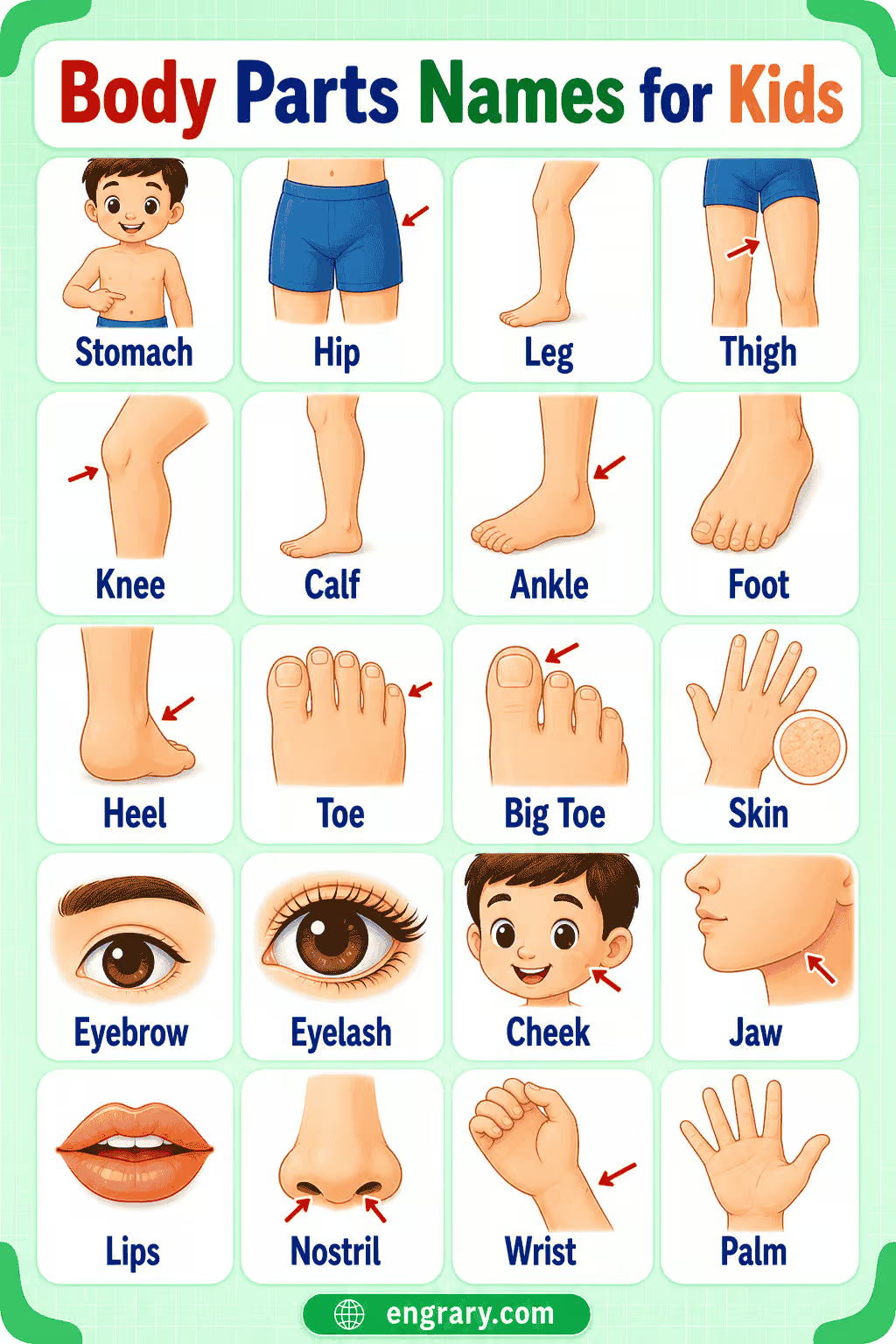
Body Parts Found in Pairs
Many body parts usually come in pairs.
- two eyes
- two ears
- two eyebrows
- two cheeks
- two shoulders
- two arms
- two elbows
- two wrists
- two hands
- two hips
- two legs
- two knees
- two ankles
- two feet
Some parts usually appear only once:
- one head
- one nose
- one mouth
- one chin
- one neck
- one chest
- one back
Examples:
- I have two eyes.
- Both hands are on the table.
- The child bends both knees.
- One nose is in the middle of the face.
One Body Part and More Than One
Most body-part words form the plural by adding -s or -es.
| One | More than one |
|---|---|
| eye | eyes |
| ear | ears |
| arm | arms |
| hand | hands |
| finger | fingers |
| leg | legs |
| knee | knees |
| toe | toes |
| tooth | teeth |
| foot | feet |
Use this is for one body part:
- This is my hand.
- This is my foot.
Use these are for more than one:
- These are my hands.
- These are my feet.
Irregular plurals need extra attention:
- one tooth, many teeth
- one foot, two feet
Body-Part Words with Tricky Spellings
Some body-part words contain silent letters or unexpected sounds.
- Knee — /niː/ 🔊
The k is silent. - Wrist — /rɪst/ 🔊
The w is silent. - Thumb — /θʌm/ 🔊
The final b is silent. - Stomach — /ˈstʌm.ək/ 🔊
In everyday speech, stomach often means the front area below the chest. - Shoulder — /ˈʃəʊl.dər/ 🔊
- Tooth — /tuːθ/ 🔊
- Teeth — /tiːθ/ 🔊
Examples:
- Bend your knee.
- The watch is on her wrist.
- The thumb is beside the fingers.
- One tooth is loose.
- Brush your teeth.
Body Parts Kids Often Mix Up
| Words | Easy difference |
|---|---|
| Head and face | The head is the whole top part of the body. The face is the front part. |
| Arm and hand | The arm reaches from the shoulder toward the hand. The hand is at the end of the arm. |
| Leg and foot | The leg reaches down from the hip. The foot is at the bottom. |
| Finger and toe | A finger is on the hand. A toe is on the foot. |
| Elbow and knee | The elbow bends the arm. The knee bends the leg. |
| Wrist and ankle | The wrist joins the hand and arm. The ankle joins the foot and leg. |
| Tooth and teeth | Tooth means one. Teeth means more than one. |
| Foot and feet | Foot means one. Feet means more than one. |
| Stomach and belly | Stomach is the standard term. Belly is more informal. |
Where Body Parts Are
Position words help children explain location.
- The eyes are above the nose.
- The mouth is below the nose.
- The ears are on the sides of the head.
- The neck is between the head and shoulders.
- The wrist is between the arm and hand.
- The knee is between the thigh and lower leg.
- The ankle is between the leg and foot.
- The heel is at the back of the foot.
- The toes are at the front of the foot.
Useful position words:
- above
- below
- between
- beside
- in front of
- behind
- at the top
- at the bottom

Point, Touch, Bend, and Move
Children can practise body-part names by following instructions.
- Point to your head.
- Touch your forehead.
- Blink your eyes.
- Tap both cheeks.
- Touch your nose.
- Open your mouth.
- Turn your head.
- Lift both arms.
- Bend your elbows.
- Circle your wrists.
- Clap your hands.
- Wiggle your fingers.
- Bend your knees.
- Stamp your feet.
- Stand on your toes.
Try these two-step instructions:
- Touch your nose, then clap your hands.
- Bend one knee and raise one arm.
- Point to both ears, then close your eyes.
- Tap your shoulders, then stamp your feet.
- Place one hand on your head and the other on your stomach.
Guess the Body Part
Read each clue and name the body part.
- I am at the top of the body.
Answer: Head - You use me to smell.
Answer: Nose - I bend in the middle of the arm.
Answer: Elbow - I join the hand to the arm.
Answer: Wrist - I am beside the fingers.
Answer: Thumb - I bend in the middle of the leg.
Answer: Knee - I join the foot to the leg.
Answer: Ankle - I am at the back of the foot.
Answer: Heel - You use two of me to hear.
Answer: Ears - I am the plural of tooth.
Answer: Teeth
FAQs
Useful beginner words include head, face, eyes, ears, nose, mouth, neck, shoulders, arms, hands, fingers, legs, knees, feet, and toes.
The head is the whole upper part of the body. The face is the front part containing the eyes, nose, mouth, and cheeks.
They are irregular words. One tooth becomes teeth, while one foot becomes feet.
The k is silent in knee, the w is silent in wrist, and the final b is silent in thumb.
Children can point to each part, follow movement instructions, use labeled pictures, practise singular and plural forms, and solve simple clues.
You May Also Like