A soft bed suggests a bedroom, a stove points to a kitchen, and running water helps children recognize a bathroom. When learners connect each room name with a familiar object and purpose, the vocabulary becomes easier to remember.
This guide explains the most useful names of rooms in a house, along with several connecting spaces, storage areas, and home levels that often appear in room lists. The examples use American English and recognize that homes can have different sizes, layouts, and shared spaces.
Rooms and Other Home Spaces
A room is an enclosed or clearly divided indoor area with a particular purpose. Walls, doors, counters, furniture placement, or another visible boundary may separate one room from another.
However, not every home-related space counts as a room. A hallway connects rooms, a pantry stores food, an attic sits beneath the roof, and a balcony remains outside the main building.
| Home space | Correct group |
|---|---|
| Bedroom | Room |
| Kitchen | Room or defined cooking area |
| Hallway | Connecting passage |
| Pantry | Storage space |
| Attic | Space beneath the roof |
| Basement | Lower building level |
| Balcony | Outdoor home area |
| Porch | Outdoor entrance area |
Common Room Names and Their Uses
These familiar room names give children and beginner English learners the strongest starting point.
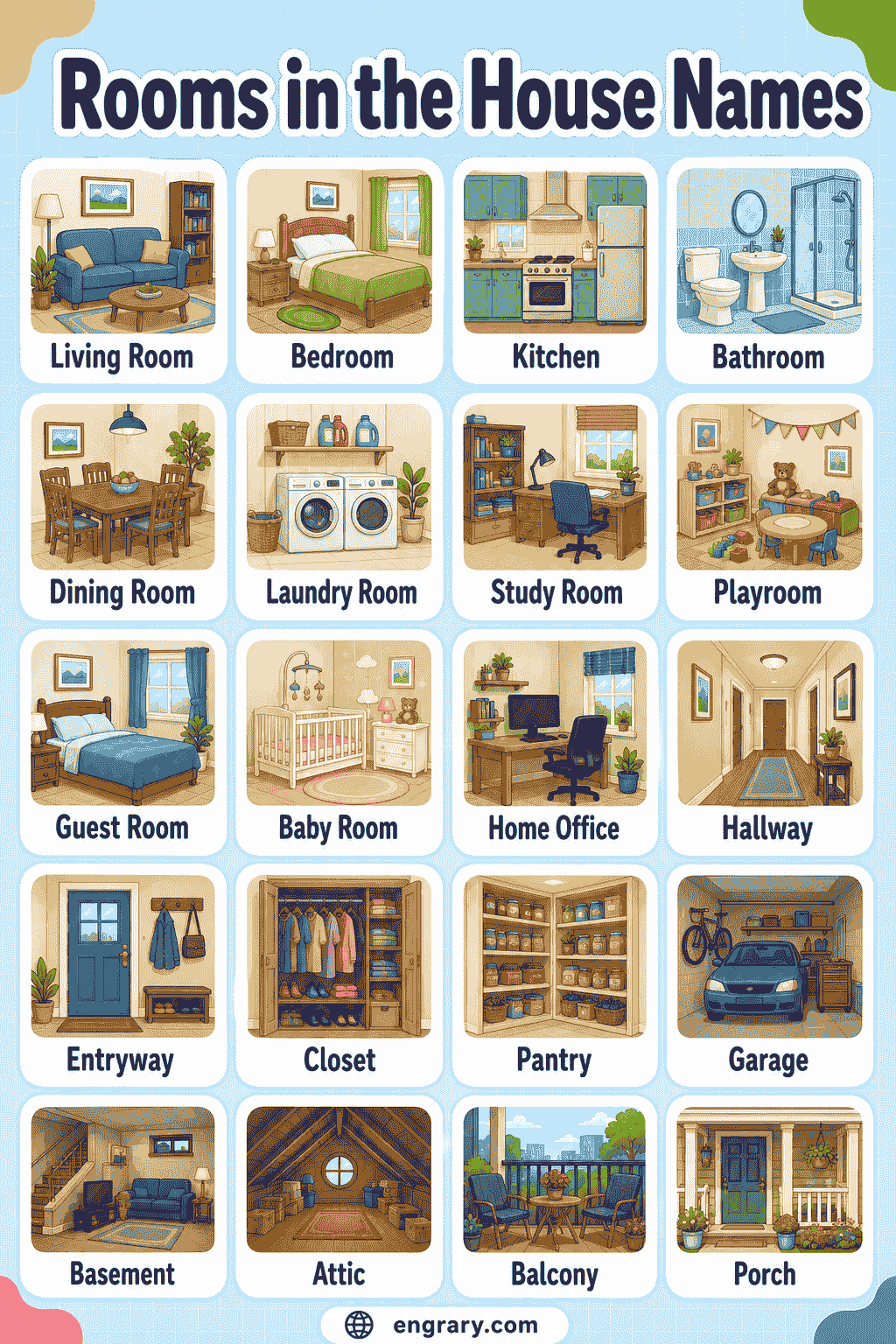
Bedroom — People mainly sleep and store clothes in a bedroom. A bed, pillow, blanket, dresser, or closet can help children identify it.
Bathroom — A bathroom contains a toilet and facilities for washing. Depending on the layout, it may also include a sink, bathtub, shower, or both bathing features.
Kitchen — People prepare and store food in a kitchen. Refrigerators, stoves, ovens, sinks, counters, and cabinets provide recognizable clues.
Living room — Household members often relax, talk, read, watch television, or spend time together in the living room. Common items include a couch, chairs, rug, and coffee table.
Dining room — People mainly eat meals in a dining room. A dining table and several chairs usually form the center of the space.
Laundry room — A laundry room or laundry area provides a place for washing and drying clothes. It may contain a washing machine, dryer, laundry basket, counter, or storage shelves.
Study — A study offers a quiet place for reading, homework, writing, or focused work. Desks, books, shelves, and lamps often appear there.
Home office — People use a home office for professional, business, or organized work. A computer, desk, office chair, files, and work supplies may help identify it.
Garage — A garage is an enclosed space for parking a vehicle, storing equipment, or completing projects. It may connect to the house or stand as a separate structure.

Room Names That Vary Between Homes
Some homes include extra rooms for visitors, children, work, storage, or entertainment. These names expand a learner’s vocabulary, but they do not represent features found in every home.
Guest room — A guest room is a bedroom prepared mainly for visitors. At other times, the household may use it for hobbies, storage, study, or another purpose.
Nursery — A nursery /ˈnɜːrsəri/ 🔊 is a room arranged for a baby or very young child. A crib, changing table, rocking chair, or small storage unit may appear there.
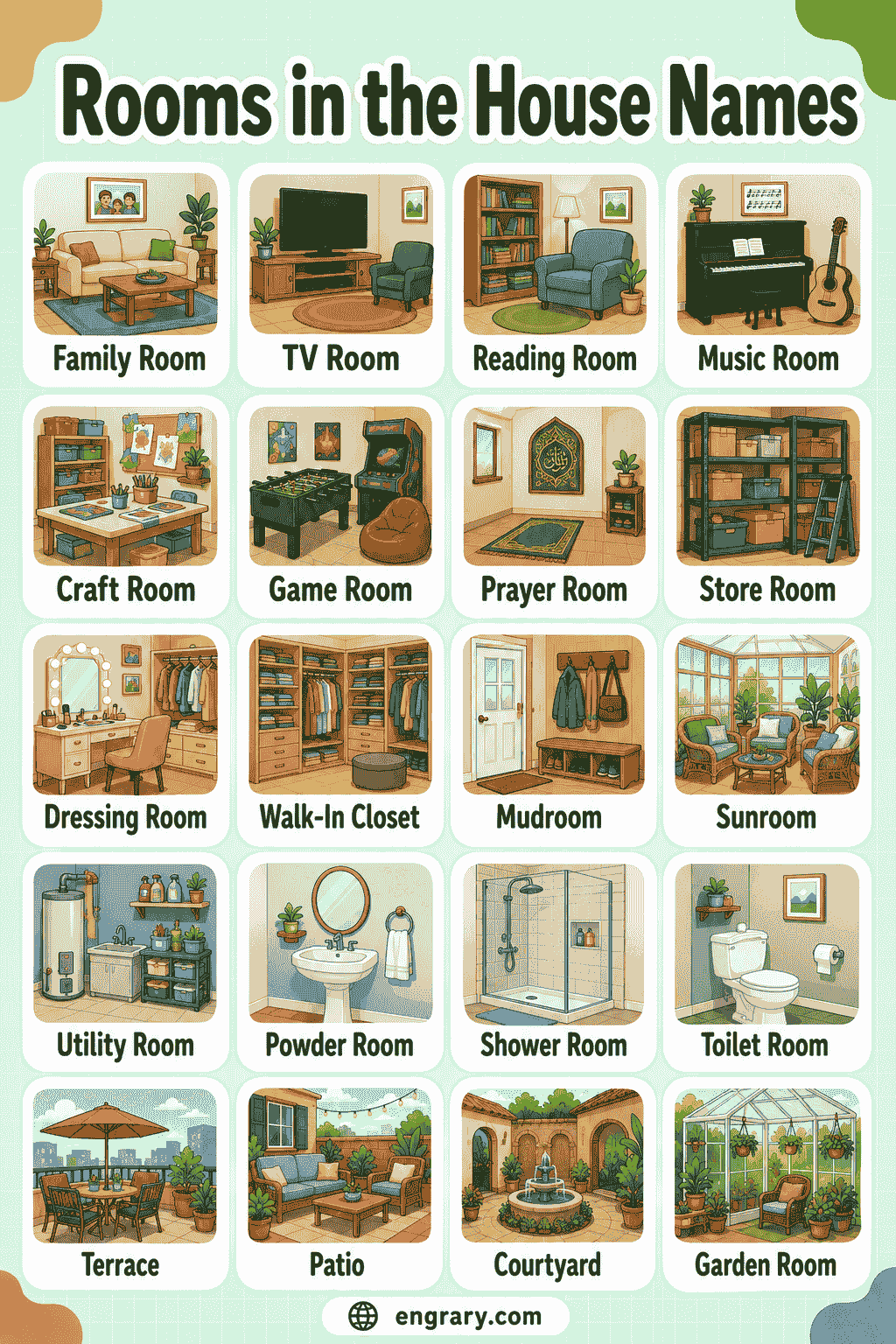
Family room — A family room provides a casual place for everyday relaxation, games, television, and shared activities. In many homes, the living room serves the same purpose.
Playroom — Children use a playroom for toys, crafts, games, and active play. Many families create a play area inside a bedroom or living room instead of using a separate room.
Game room — A game room contains space for board games, video games, table games, or other entertainment. Children, teenagers, adults, or the whole household may use it.
Mudroom — A mudroom sits near an entrance and provides storage for shoes, coats, umbrellas, backpacks, and outdoor clothing. Its layout helps keep dirt and wet items away from the main living areas.
Utility room — A utility room /juːˈtɪləti/ 🔊 may contain laundry machines, cleaning supplies, household equipment, or storage. Its exact purpose changes from one home to another.
Sunroom — Large windows bring plenty of natural light into a sunroom. People may use the space for reading, plants, meals, conversation, or quiet relaxation.
Primary bedroom — A primary bedroom or main bedroom usually means the home’s largest or main sleeping room. It describes the bedroom’s role rather than a completely different room type.
Connecting and Storage Spaces Around a Home
Several important home names describe passages, entrance areas, storage spaces, or building levels instead of ordinary rooms.
Hallway — A hallway connects rooms and helps people move through a home. Doors, lights, pictures, or a narrow table may appear along it.
Entryway — The entryway sits just inside the main entrance. People may place shoes, coats, bags, keys, or a bench in this area.
Landing — A landing is a flat space at the top of a staircase or between two groups of steps. Doors to upstairs rooms may open onto it.
Pantry — A pantry stores food, drinks, dishes, and kitchen supplies. Some pantries take the form of cabinets, while walk-in pantries provide enough space for a person to enter.
Closet — A closet provides enclosed storage for clothes, shoes, linens, cleaning supplies, or other belongings. A walk-in closet offers enough floor space to step inside.
Attic — An attic lies beneath the roof. Households often use it for storage, although a finished attic may contain a bedroom, office, or play area.
Basement — A basement forms a level below the main living area. It may contain storage, laundry equipment, household systems, or one or more finished rooms.
How to Recognize Each Room
A room’s objects and activities provide useful visual clues. Children should consider more than one clue because a single object may appear in several places.
| Room | Familiar clues | Common activity |
|---|---|---|
| Bedroom | Bed, pillow | Sleeping |
| Bathroom | Toilet, shower | Washing |
| Kitchen | Refrigerator, stove | Preparing food |
| Living room | Couch, television | Relaxing |
| Dining room | Table, chairs | Eating meals |
| Laundry room | Washer, dryer | Washing clothes |
| Study | Desk, books | Reading or studying |
| Garage | Vehicle, tools | Parking or storage |
A bed, pillow, and blanket usually suggest a bedroom. By contrast, a refrigerator, stove, and counter point to a kitchen.
Toilets, sinks, and showers help identify a bathroom. Meanwhile, couches, rugs, and coffee tables often appear in a living room.
Washer-and-dryer clues suggest a laundry area, although the machines may stand in a kitchen, bathroom, basement, garage, or shared laundry space. A desk and books may indicate a study, but they can also appear in a bedroom or home office.
How Similar Room Names Differ
Several room names describe related places, but their meanings are not identical.
| Room names | Main difference |
|---|---|
| Living room and family room | A living room supports general relaxation or visitors; a family room often feels more casual and serves everyday activities. |
| Study and home office | A study supports reading, homework, or quiet work; a home office focuses more on professional or organized work. |
| Bathroom and powder room | A bathroom usually includes bathing facilities; a powder room normally contains a toilet and sink without a bathtub or shower. |
| Bedroom and guest room | A bedroom serves regular sleeping needs; a guest room mainly welcomes visitors. |
| Kitchen and pantry | People prepare food in a kitchen; a pantry stores food and supplies. |
| Laundry room and utility room | A laundry room focuses on clothes washing; a utility room may also contain equipment, cleaning supplies, or storage. |
| Hall and hallway | Both words may describe a connecting passage, although regional usage and building design affect the preferred term. |
| Attic and basement | An attic lies beneath the roof; a basement lies below the main living level. |
| Playroom and game room | A playroom usually focuses on children’s play; a game room may provide entertainment for several age groups. |
| Garage and carport | A garage has enclosed walls; a carport is a covered parking structure with one or more open sides. |
British Room Terms Children May Encounter
American and British speakers share many room names, but children may encounter several alternatives in international books, videos, and worksheets.
Sitting room or lounge — British speakers may use either term for a living room. The phrase living room also remains widely understood.
Hall — In British English, hall may describe the entrance area or the passage connecting rooms. American speakers more often use entryway or hallway.
Utility room — This room may contain a washing machine, dryer, sink, cleaning products, storage, or household equipment. It overlaps with laundry room, but the meanings are not always identical.
Toilet or loo — These British terms may describe either the toilet itself or a small room containing one. In American English, speakers often say bathroom or restroom, even when no bathtub appears.
Ground floor — British speakers use ground floor for the entrance level of a building. Americans usually call the same level the first floor.
Garden — In British English, garden may describe the outdoor area around a home. American speakers usually call the general outdoor area a yard and use garden for a planted section.
Cellar — A cellar usually sits below ground and often provides storage. Although it may resemble a basement, the two words do not always describe the same size, design, or use.
How to Use Room Names in Sentences
Room names work naturally with location questions, there is, there are, has, and common action verbs.
Asking where someone is
- Where is Ava?
- She is in the kitchen.
- Where are the children?
- They are in the playroom.
Saying what a home contains
- There is one bathroom downstairs.
- Two bedrooms are upstairs.
- A small study stands beside the living room.
- The example home has a kitchen and dining area.
Describing activities
- We sleep in the bedroom.
- People prepare food in the kitchen.
- Clothes go into the washing machine in the laundry area.
- Jordan works in the home office.
Talking about objects
- A couch stands in the living room.
- The dining room has a large table.
- The family keeps several boxes in the garage.
- A crib sits near the nursery wall.
Explaining room locations
- The bathroom is beside the bedroom.
- A guest room is across from the study.
- The kitchen is near the dining room.
- The laundry area is in the basement.
The example home has two bedrooms and one bathroom. A kitchen sits beside the dining room, while the living room is near the front entrance.
Common Mistakes with Room Names
Beginner learners often confuse prepositions, singular nouns, plural nouns, and subject-verb agreement.
| Incorrect sentence | Correct sentence |
|---|---|
| I sleep on the bedroom. | I sleep in the bedroom. |
| There are a kitchen downstairs. | There is a kitchen downstairs. |
| The bathroom have a shower. | The bathroom has a shower. |
| We cook at the kitchen. | We cook in the kitchen. |
| The living room are large. | The living room is large. |
| My house has two bedroom. | My house has two bedrooms. |
| There is three rooms upstairs. | There are three rooms upstairs. |
Use in when someone or something is inside a room:
- Maya is in the bathroom.
- The chairs are in the dining room.
Choose there is with one room or object:
- There is a study upstairs.
Use there are with plural nouns:
- There are two bedrooms upstairs.
Guess, Sort, and Use the Room Names
Use these activities to practice meanings, visual clues, classifications, and sentence patterns.
Guess the Room
- A bed and pillow appear in this room.
- People prepare food here.
- This room contains a toilet and shower.
- A couch and coffee table provide useful clues.
- People often eat meals at a table here.
- A washer and dryer may appear in this room or area.
Sort the Home Spaces
Place each name in the correct group:
- bedroom;
- hallway;
- pantry;
- attic;
- basement;
- balcony;
- living room;
- porch.
Groups:
- room;
- passage;
- storage space;
- roof space;
- lower building level;
- outdoor home area.
Complete the Sentences
- We cook in the ______.
- A bed is in the ______.
- The washing machine is in the ______ area.
- A desk and books are in the ______.
- There ______ two bathrooms upstairs.
- The living room ______ a couch and two chairs.
Answer Key
Guess the room:
- bedroom
- kitchen
- bathroom
- living room
- dining room
- laundry room or laundry area
Sort the home spaces:
- bedroom → room;
- hallway → passage;
- pantry → storage space;
- attic → roof space;
- basement → lower building level;
- balcony → outdoor home area;
- living room → room;
- porch → outdoor home area.
Complete the sentences:
- kitchen
- bedroom
- laundry
- study
- are
- has
FAQs
Common room names include bedroom, bathroom, kitchen, living room, dining room, laundry room, study, and home office. However, not every home contains each room.
A hallway usually serves as a passage that connects rooms rather than a room with one main activity.
A living room supports general relaxation or visitors, while a family room often provides a more casual place for everyday activities. Some homes use one room for both purposes.
An attic is a space beneath the roof, while a basement forms a lower building level. Either space may contain finished rooms, but the words do not automatically describe ordinary rooms.
Children can connect each room with a familiar object and action, such as bed and sleep for bedroom, stove and prepare food for kitchen, or washer and wash clothes for laundry room.
You May Also Like