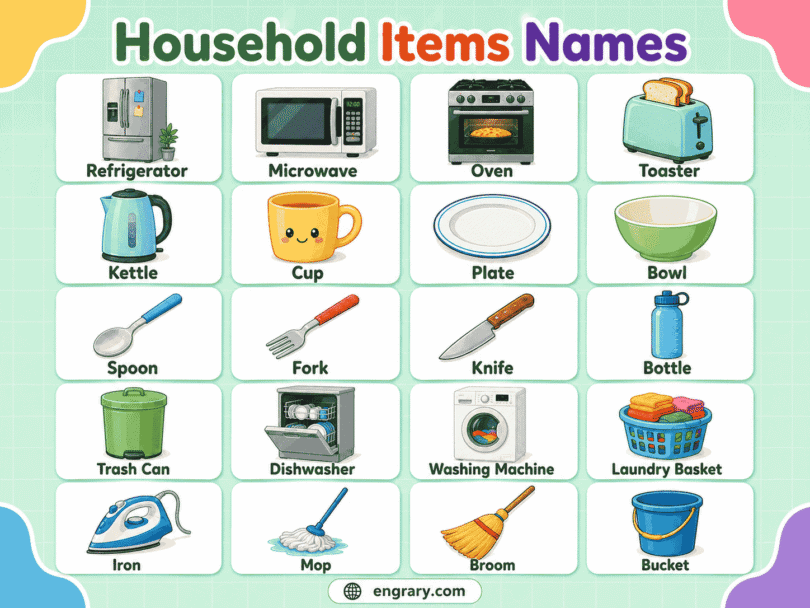
A broom sweeps crumbs from the floor, a soft pillow supports the head, and a small remote control changes television settings. Everyday objects like these help children connect English words with familiar shapes, actions, and purposes.
This guide explains common household item names through accurate categories, compact meanings, American English usage, pronunciation help, comparisons, plural forms, and practical activities. However, it leaves out building parts, rare products, and technical equipment that do not match beginner vocabulary needs.
Household Items and Parts of a Home
A household item is an object that people commonly use, keep, carry, clean with, or move around a home. Furniture, textiles, tableware, containers, appliances, and electronic devices all fit this practical meaning.
By contrast, rooms and structural features form part of the home itself. For example, a chair is a movable household item, while a wall belongs to the building.
| Word | Correct group |
|---|---|
| Chair | Household item and furniture |
| Broom | Household item and cleaning tool |
| Plate | Household item and tableware |
| Refrigerator | Household appliance |
| Window | Building feature |
| Wall | Structural house part |
| Stairs | Structural feature |
| Kitchen | Room or cooking area |
Common Household Items Used Every Day
Before learners explore detailed categories, they can begin with objects that appear frequently in homes, stories, classrooms, and picture worksheets.
| Household item | Familiar purpose |
|---|---|
| Chair | Gives a person a place to sit |
| Bed | Gives a person a place to sleep |
| Pillow | Supports the head |
| Towel | Dries hands, dishes, or the body |
| Plate | Holds food |
| Cup | Holds a drink |
| Broom | Sweeps dry dirt |
| Basket | Carries or stores objects |
| Trash can | Collects household waste |
| Refrigerator | Keeps food and drinks cold |
| Lamp | Provides light |
| Remote control | Operates an electronic device |

Furniture and Seating Around the Home
Furniture includes movable objects that support sitting, sleeping, eating, working, or storage. Although people often associate each piece with one room, many furniture items can appear in several parts of a home.
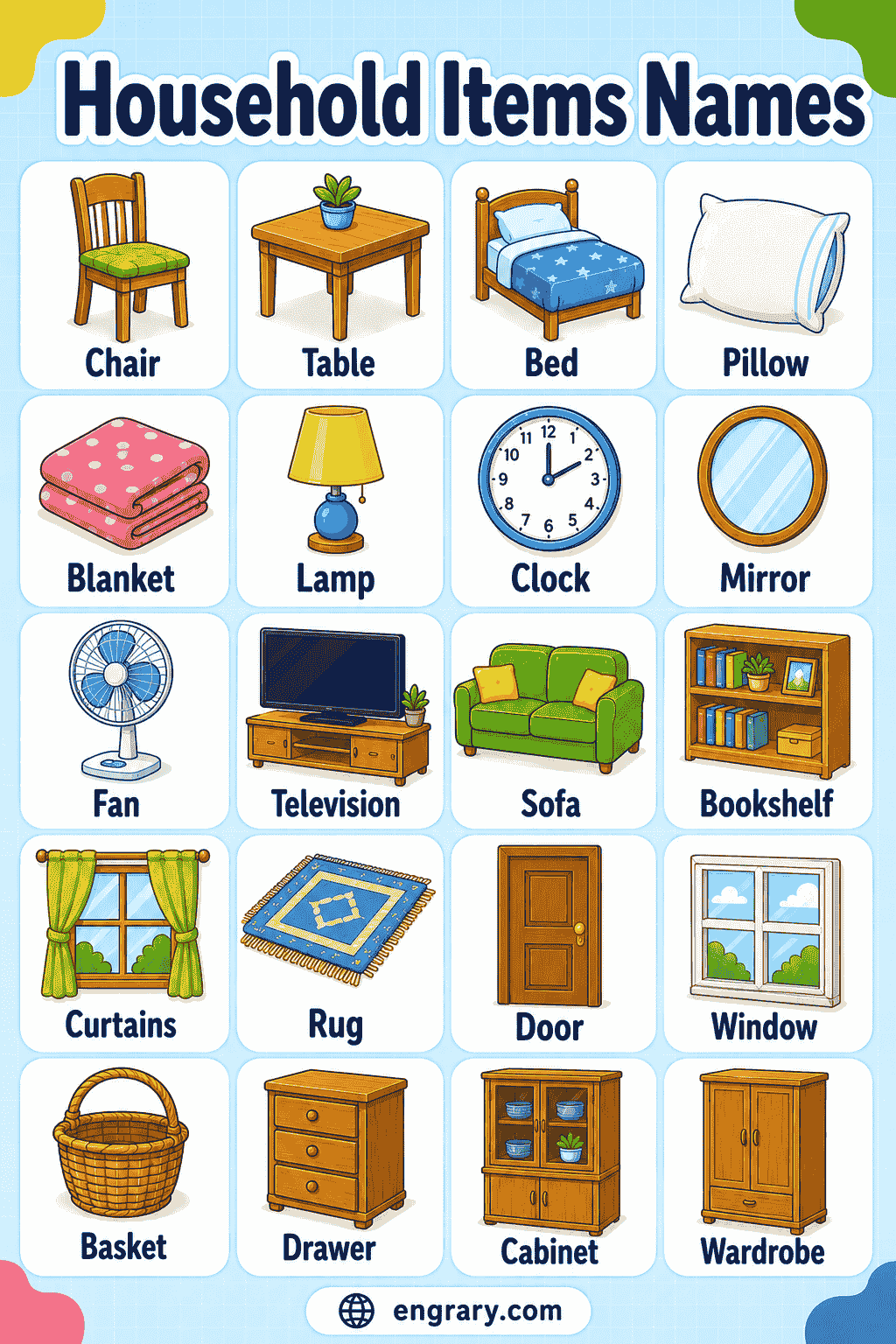
- Chair — Gives one person a place to sit.
- Couch — Provides a long padded seat for several people.
- Armchair — Offers a padded seat with supports for the arms.
- Table — Has a flat top for meals, work, or household objects.
- Desk — Provides a surface for writing, studying, or computer work.
- Bed — Gives a person a place to sleep.
- Dresser — Stores folded clothes inside several drawers.
- Nightstand — Stands beside a bed and holds small objects.
- Bookshelf — Holds books and displayed items on horizontal shelves.
- Stool — Gives one person a simple seat, usually without a back or arms.
Bedding and Home Textiles
Meanwhile, household textiles include soft fabric objects for sleeping, covering, drying, and protecting home surfaces. Their material, thickness, and purpose help learners distinguish one item from another.
- Mattress — Forms the padded part of a bed that supports the body.
- Pillow — Supports the head and neck during sleep.
- Pillowcase — Covers and protects a pillow.
- Sheet — Covers a mattress with a thin layer of fabric.
- Blanket — Adds warmth on a bed or couch.
- Comforter /ˈkʌmfɚtɚ/ 🔊 — Provides warmth through thick fabric and soft filling.
- Towel — Absorbs water from hands, dishes, or the body.
- Washcloth — Helps wash the face or body.
- Dish towel — Dries dishes, kitchen tools, or hands.
- Curtain — Covers a window, controls light, and provides privacy.
- Rug — Covers part of a floor, and people can usually move it.
- Doormat — Sits near a doorway so people can wipe their shoes.
Kitchen and Dining Items
Kitchen and dining vocabulary includes tableware, cookware, preparation tools, and food-storage objects. Because this category can become extremely large, the list focuses on items that children and beginners commonly encounter.
Tableware
- Plate — Holds a serving of food.
- Bowl — Holds foods such as soup, cereal, or salad.
- Cup — Holds water, milk, tea, or another drink.
- Mug — Holds hot or cold drinks in a sturdy, often straight-sided container.
- Drinking glass — Holds water, juice, or another beverage.
- Spoon — Scoops, stirs, or serves food.
- Fork — Lifts food with narrow pointed prongs.
- Knife — Cuts or spreads food.
Cookware and Preparation Tools
- Pot — Cooks food or liquid inside a deep container.
- Frying pan — Cooks food across a wide, shallow surface.
- Kettle — Heats water for tea, coffee, or another drink.
- Cutting board — Protects a counter while someone cuts food.
- Mixing bowl — Holds ingredients while someone combines them.
- Measuring cup — Measures liquid or dry ingredients.
- Can opener — Opens the metal lid of a can.
- Colander /ˈkʌləndɚ/ 🔊 — Drains water through many small holes.
Storage and Serving Objects
- Jar — Stores food or small objects inside a wide container with a lid.
- Food container — Keeps food covered during storage or transport.
- Serving tray — Carries food, drinks, or dishes on a flat surface with raised edges.
- Pitcher — Holds and pours water, juice, or another drink.
Everyday Bathroom Items
Bathroom objects support washing, grooming, drying, and personal cleanliness. Instead of including fixed features such as sinks and bathtubs, this section focuses on portable or replaceable household items.
- Toothbrush — Cleans the teeth with rows of small bristles.
- Toothpaste — Cleans the teeth when placed on a toothbrush.
- Bar of soap — Cleans the hands or body with water.
- Soap dispenser — Releases a small amount of liquid soap.
- Comb — Arranges hair with a row of teeth.
- Hairbrush — Smooths or untangles hair with bristles or flexible pins.
- Toilet paper — A roll of soft paper for personal cleaning after using the toilet.
- Tissue box — Holds disposable facial tissues.
- Bath mat — Absorbs water from feet near a bathtub or shower.
- Shower curtain — Keeps water inside a shower or bathtub area.
Cleaning Tools Used at Home
Likewise, cleaning tools become easier to remember when learners connect each object with a clear action. Some remove dry dirt, while others absorb liquid, wipe surfaces, or collect waste.
- Broom — Sweeps dry dirt from a floor.
- Mop — Washes a hard floor with water or cleaning liquid.
- Bucket — Carries water, cleaning tools, or other supplies.
- Dustpan — Catches dirt after someone sweeps it into a small pile.
- Vacuum cleaner /ˈvækjuːm ˌkliːnɚ/ 🔊 — Pulls dust and debris from floors or surfaces.
- Sponge — Absorbs liquid and wipes dishes or surfaces.
- Cleaning cloth — Wipes dust, spills, and marks from household surfaces.
- Spray bottle — Releases liquid in a fine mist or spray.
- Trash bag — Holds garbage before disposal.
- Trash can — Collects household waste inside a reusable container.
Laundry Items and Their Uses
Laundry items help people collect, wash, dry, hang, and press clothing. However, not every home contains every object because people may use shared machines, clotheslines, or different drying methods.
- Laundry basket — Carries clean or dirty clothes.
- Hamper — Stores dirty laundry before washing.
- Clothes hanger — Supports clothing inside a closet or on a rack.
- Clothespin — Clips clothing to a clothesline.
- Ironing board — Provides a padded surface for pressing clothes.
- Iron — Uses heat to smooth wrinkles in fabric.
- Laundry detergent /ˈlɔndri dɪˈtɝdʒənt/ 🔊 — Cleans clothes during washing.
- Drying rack — Holds wet clothes while they dry in the air.
Storage and Organization Items
Storage objects help people arrange, carry, protect, or group household belongings. In addition, one container can serve several purposes depending on what a household needs to store.
- Basket — Holds or carries laundry, toys, towels, or supplies.
- Box — Stores items inside a container with flat sides.
- Bin — Holds objects for storage, sorting, recycling, or waste.
- Storage container — Protects and organizes household items inside a reusable container.
- Hook — Holds coats, towels, keys, bags, or tools.
- Tray — Carries or organizes objects on a flat surface with raised edges.
- Shoe rack — Keeps several pairs of shoes arranged.
Appliances and Electronic Devices
An appliance /əˈplaɪəns/ 🔊 uses power to complete a household task. By contrast, an electronic device usually provides information, communication, control, light, or entertainment.
Household Appliances
- Refrigerator — Keeps food and drinks cold.
- Stove — Cooks food on burners or heating elements.
- Oven — Bakes or roasts food inside an enclosed heated space.
- Microwave — Heats food quickly.
- Dishwasher — Washes dishes, cups, and utensils.
- Washing machine — Washes clothing and household textiles.
- Dryer — Uses warm moving air to dry clothes.
- Toaster — Browns slices of bread.
- Electric fan — Circulates air with rotating blades.
Electronic Devices
- Television — Shows programs, movies, and videos.
- Remote control — Operates a television or another device from a short distance.
- Phone charger — Supplies electrical power to a phone battery.
- Flashlight — Produces portable light from battery power.
Small Tools and Useful Home Objects
Several useful household objects do not fit naturally into furniture, textile, kitchen, or cleaning categories. Because scissors, step stools, irons, and tools can cause injury, adults should supervise children when they handle them.
- Key — Opens or locks a door, drawer, box, or other lock.
- Umbrella — Protects a person from rain.
- Step stool — Adds a small amount of height for reaching a higher place.
- Toolbox — Carries and organizes household tools.
- Scissors — Cut paper, fabric, thread, or light packaging.
- Battery — Supplies power to a portable device.
- Lamp — A movable household object that provides light.
- Mirror — Reflects the image of a person or object.
- Clock — Shows the time.
How Similar Household Items Differ
Although several household objects look alike or serve related purposes, their shapes and usual functions help learners choose the correct name.
| Household items | Main difference |
|---|---|
| Couch and chair | A couch usually seats several people; a chair usually seats one. |
| Rug and carpet | A rug covers part of a floor, and people can usually move it; carpet often covers most or all of the floor. |
| Cup and mug | A cup can have several shapes and uses; a mug is usually larger, straight-sided, and common for hot drinks. |
| Glass and drinking glass | Glass can mean a material or, in everyday speech, a beverage container; drinking glass removes that ambiguity. |
| Pot and frying pan | A pot has deep sides; a frying pan has a wide, shallow cooking surface. |
| Broom and mop | A broom sweeps dry dirt; a mop cleans a floor with liquid. |
| Towel and cleaning cloth | A towel mainly dries; a cleaning cloth wipes household surfaces. |
| Sheet and blanket | A sheet forms a thin bed layer; a blanket adds warmth. |
| Blanket and comforter | A blanket usually has one layer; a comforter contains soft filling. |
| Basket and bin | A basket is often open and portable; a bin serves broader storage or waste purposes. |
| Laundry basket and hamper | A laundry basket often carries clothes; a hamper stores dirty laundry. |
| Lamp and light | A lamp is a particular lighting object; light can mean illumination or any device that produces it. |
American and British Household Terms
This article uses American English. Nevertheless, children may encounter related British terms in international books, videos, games, and worksheets.
| American term | British term or usage note |
|---|---|
| Trash can | Bin or rubbish bin |
| Trash bag | Bin bag |
| Flashlight | Torch |
| Dish towel | Tea towel |
| Washcloth | Flannel |
| Comforter | Duvet, depending on the bedding style |
| Stove | Cooker, depending on the appliance design |
| Pitcher | Jug |
| Vacuum cleaner | Hoover in informal speech; originally a brand name |
Plural Forms of Common Household Items
Most household nouns add -s, but several change their endings or spelling. Therefore, learners should notice both the object name and its plural form.
| Singular | Plural |
|---|---|
| Chair | Chairs |
| Key | Keys |
| Knife | Knives |
| Box | Boxes |
| Battery | Batteries |
| Hairbrush | Hairbrushes |
| Drinking glass | Drinking glasses |
| Bookshelf | Bookshelves |
| Tray | Trays |
| Clothespin | Clothespins |
- One knife lies beside the cutting board.
- Two knives are inside the drawer.
- A drinking glass stands near the plate.
- Several boxes sit on the bookshelf.
- Fresh batteries power the flashlight.
- These scissors are useful.
- I need a pair of scissors.
Describing Household Items and Their Locations
Learners can describe household objects with there is, there are, location words, action verbs, and purpose phrases. Meanwhile, questions help them request a name or locate an item.
Naming one object
- There is a lamp beside the couch.
- One basket stands near the dresser.
- A towel hangs beside the sink.
Naming several objects
- There are two pillows on the bed.
- Three plates sit on the table.
- Several boxes stand near the bookshelf.
Explaining location
- The broom is in the closet.
- A remote control rests on the coffee table.
- The trash can stands beside the cabinet.
- Clean towels are inside the basket.
Explaining purpose
- We use a broom for sweeping.
- A towel helps dry the hands.
- People use hangers to hold clothes.
- A kettle heats water.
Asking about an item
- What is this household item called?
- Where is the flashlight?
- Which tool sweeps the floor?
- Are the mugs in the cabinet?

Common Mistakes with Household Item Names
Beginner learners often confuse plural forms, prepositions, and subject-verb agreement. For example, objects inside an enclosed storage area usually take in, while objects resting on a supporting surface usually take on.
| Incorrect sentence | Correct sentence |
|---|---|
| There is two pillows. | There are two pillows. |
| The broom is on the closet. | The broom is in the closet. |
| She put the books in the bookshelf. | She put the books on the bookshelf. |
| This scissors is sharp. | These scissors are sharp. |
| I need two knifes. | I need two knives. |
| The towel are wet. | The towel is wet. |
| We use a broom to mopping. | We use a broom for sweeping. |
Identify, Sort, and Match the Items
Identify the Item from Its Purpose
- This tool sweeps dry dirt from a floor.
- This soft object supports the head during sleep.
- People use this fabric item to dry their hands.
- This small device changes television settings.
- This container often holds dirty clothes.
- This portable object shines light in a dark place.
Sort the Household Items
Place each item in the correct group:
- couch;
- refrigerator;
- plate;
- blanket;
- mop;
- basket;
- television;
- towel.
Groups:
- furniture;
- appliance;
- tableware;
- bedding;
- cleaning tool;
- storage container;
- electronic device;
- household textile.
Match the Item with the Action
- broom;
- towel;
- clothes hanger;
- kettle;
- basket;
- remote control.
Actions:
- sweep;
- dry;
- hang clothes;
- heat water;
- carry or store;
- operate a television.
Complete the Sentences
- There ___ two pillows on the bed.
- The broom is ___ the closet.
- We use a towel ___ drying.
- She placed the books ___ the bookshelf.
- Two ___ are beside the plates. (fork)
Answer Key
Identify the item:
- broom
- pillow
- towel
- remote control
- hamper
- flashlight
Sort the items:
- couch → furniture;
- refrigerator → appliance;
- plate → tableware;
- blanket → bedding;
- mop → cleaning tool;
- basket → storage container;
- television → electronic device;
- towel → household textile.
Match the item and action:
- broom → sweep;
- towel → dry;
- clothes hanger → hang clothes;
- kettle → heat water;
- basket → carry or store;
- remote control → operate a television.
Complete the sentences:
- are
- in
- for
- on
- forks
FAQs
Household items are objects that people commonly use, keep, carry, clean with, or store around a home.
Useful beginner words include chair, bed, pillow, towel, plate, cup, broom, basket, lamp, refrigerator, and remote control.
Yes. Furniture forms one household-item category alongside appliances, textiles, utensils, cleaning tools, containers, and electronic devices.
An appliance performs a household task, such as washing clothes or keeping food cold. By contrast, an electronic device mainly provides information, control, communication, light, or entertainment.
Children can label pictures, sort objects by function, match items with actions, compare similar objects, and describe where each item appears.
You May Also Like