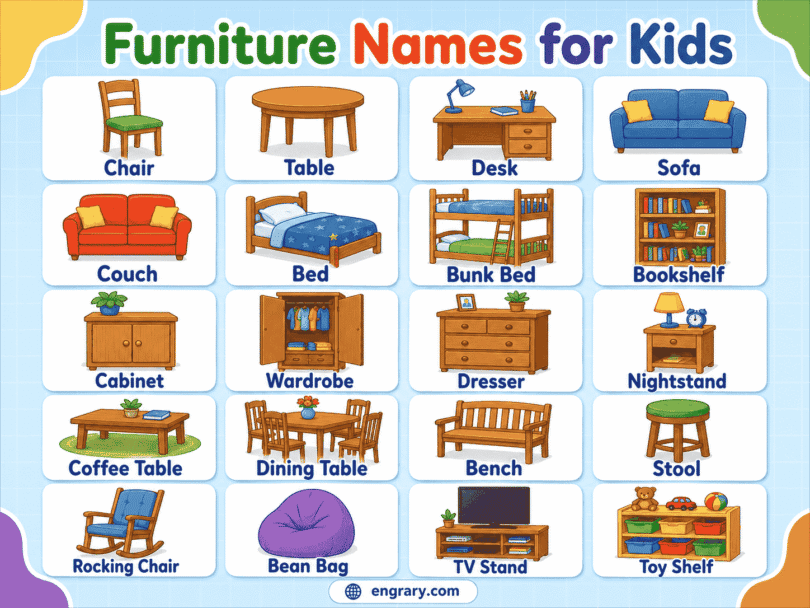
A rocking chair moves gently back and forth, a bunk bed stacks one sleeping space above another, and a bookcase displays neat rows of books. Because each piece has a recognizable shape and purpose, furniture names for kids become easier to understand through pictures and everyday examples.
This guide explains common furniture with child-friendly meanings, visual clues, American English terms, grammar support, comparisons, and practical activities. In addition, it separates true furniture from lamps, appliances, textiles, decorations, and structural parts of a home.
What Counts as Furniture?
Furniture means movable or semi-permanent pieces that make a space useful for sitting, sleeping, eating, studying, working, displaying objects, or storing belongings.
For example, a chair gives someone a place to sit, while a dresser stores clothing in drawers. A wall, window, or staircase does not count as furniture because it forms part of the building itself.
Although many furniture pieces can move, some remain in the same position for years because they are large or heavy. Nevertheless, people can usually rearrange them without changing the structure of the room.
Furniture commonly supports one or more of these purposes:
- seating;
- sleeping;
- eating;
- studying or working;
- displaying objects;
- storing belongings;
- supporting other household items.
The word furniture is uncountable. Therefore, English speakers say some furniture, a piece of furniture, or three pieces of furniture, not a furniture or three furnitures.
Furniture Compared with Other Home Furnishings
The term furnishings covers a wider group than furniture. In other words, furnishings may include furniture as well as curtains, rugs, lamps, mirrors, cushions, and decorations.
Classifications sometimes vary in stores or casual conversation. However, the following groups give children a clear and practical starting point.
| Object | Usual classification |
|---|---|
| Chair | Furniture |
| Bed | Furniture |
| Dresser | Furniture |
| Lamp | Usually a lighting object or furnishing |
| Mirror | Usually a home furnishing or wall object |
| Curtain | Soft furnishing |
| Rug | Floor furnishing |
| Refrigerator | Household appliance |
| Television | Electronic device |
| Window | Building feature |
Common Furniture Used Every Day
Before children study detailed categories, they can begin with furniture that appears frequently in homes, classrooms, picture books, and learning posters.
| Furniture | Main purpose |
|---|---|
| Chair | One-person seating |
| Couch | Shared seating |
| Table | Meals, work, or activities |
| Bed | Sleeping |
| Desk | Studying or working |
| Dresser | Storing folded clothes |
| Nightstand | Providing a bedside surface |
| Bookcase | Holding books |
| Stool | Simple one-person seating |
| Bench | Shared seating |
| Coffee table | Holding objects near a couch |
| Wardrobe | Storing clothes |
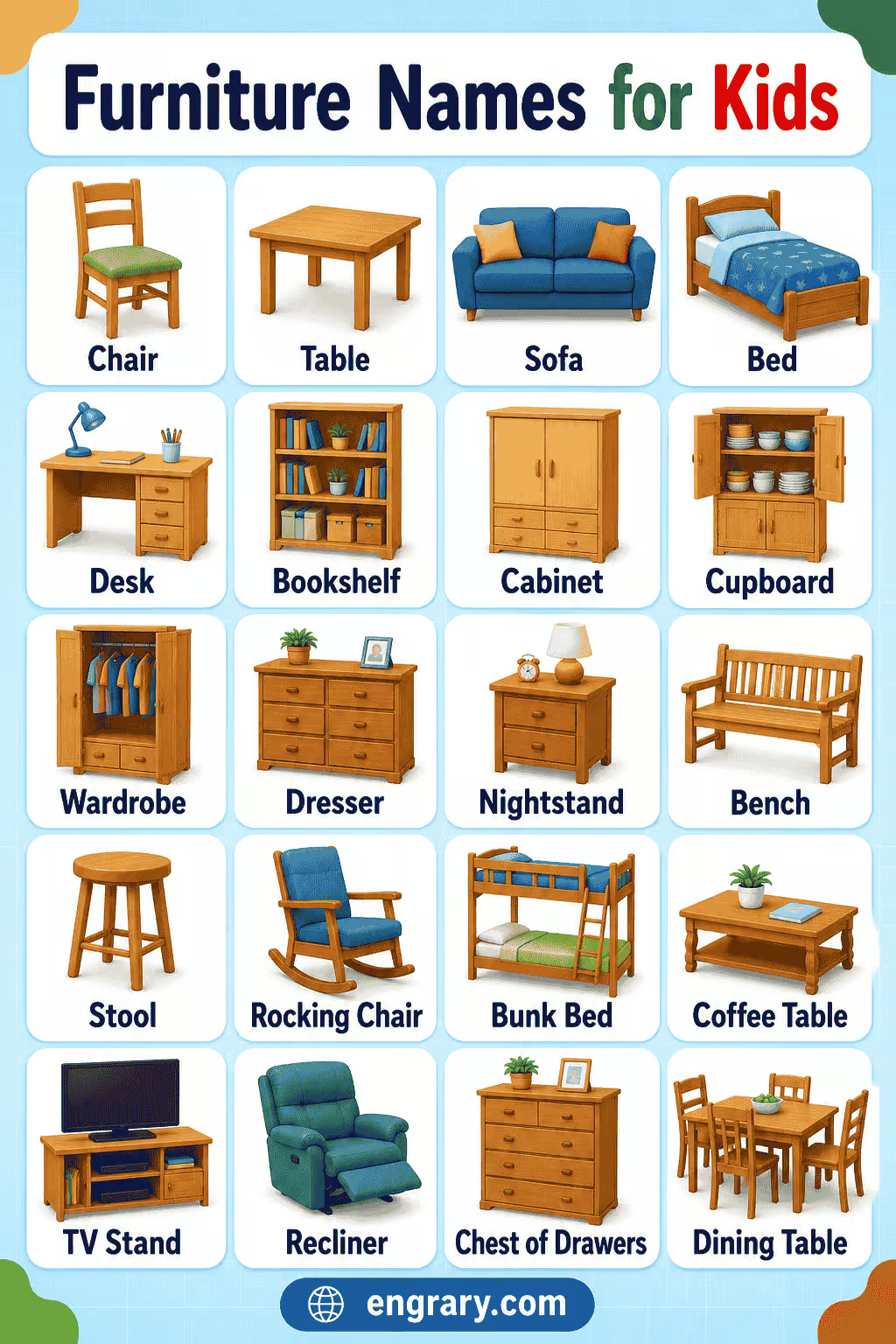
One-Person Seating Furniture
One-person seats differ in height, padding, movement, back support, and purpose. For instance, an office chair supports desk work, whereas a recliner supports relaxed sitting.
Chair — A chair gives one person a seat and normally includes a back. However, its shape, material, and padding can vary greatly.
Armchair — An armchair provides one padded seat with supports on both sides. As a result, it usually feels wider and softer than a basic chair.
Recliner /rɪˈklaɪnɚ/ 🔊 — A recliner tilts backward and often raises a footrest. Therefore, people commonly use it for reading, resting, or watching television.
Rocking chair — A rocking chair moves backward and forward on curved runners or another rocking base. Because of this movement, children can recognize it quickly in pictures.
Office chair — An office chair supports desk work and often turns on a central base. In addition, many models adjust in height.
Dining chair — A dining chair stands beside a dining table and usually has an upright back. Its seat height also matches the table’s eating surface.
Folding chair — A folding chair closes into a flatter shape for storage or transport. Consequently, people often use it when they need temporary extra seating.
Stool — A stool provides a simple one-person seat that usually lacks a back and arms. Moreover, some stools fit neatly beneath tables or counters.
Bar stool — A bar stool has a tall seat for a high counter or bar-height table. It often includes a lower support for the feet.
Ottoman /ˈɑtəmən/ 🔊 — An ottoman is a padded, backless piece that can support the feet or provide extra seating. Additionally, some ottomans contain hidden storage.
Footstool — A footstool is a small, low piece that raises and supports a seated person’s feet. Unlike an ottoman, it mainly supports the feet and rarely doubles as regular seating.
Furniture for Shared Seating
Shared seating gives two or more people a place to sit. Meanwhile, size, padding, firmness, and structure help distinguish one piece from another.
Couch — A couch provides a long padded seat for several people. Sofa is another widely used word for the same general furniture piece.
Loveseat — A loveseat is a compact padded seat specifically designed for two people. Therefore, it usually takes up less space than a couch.
Bench — A bench offers a long seat for two or more people. However, it normally feels firmer and simpler than a padded couch.
Sectional sofa /ˈsɛkʃənəl ˈsoʊfə/ 🔊 — A sectional sofa consists of connected seating sections. For example, people may arrange the sections in an L-shape, U-shape, or another layout.
Sofa bed — A sofa bed works as seating during the day and opens into a sleeping surface. As a result, it can serve two purposes in a small home.
Beds and Sleeping Furniture
Sleeping furniture includes complete beds, supporting frames, bedside pieces, and recognizable bed designs. By contrast, pillows, sheets, blankets, and mattresses belong to household textiles or bedding.
Bed — A bed supports a person during sleep or rest. Usually, it includes a frame or base that holds a mattress.
Bed frame — A bed frame supports the mattress and raises it above the floor. Manufacturers commonly make frames from wood, metal, or upholstered materials.
Bunk bed — A bunk bed has two or more sleeping frames stacked vertically to save floor space. In addition, a ladder usually provides access to the upper bed.
Crib — A crib is a small baby bed with high slatted sides around the sleeping space. Therefore, the enclosed design helps keep a baby inside.
Daybed — A daybed looks like a bed but can also function as seating during the day. Moreover, it often includes a back and two raised side panels.
Platform bed — A platform bed uses a low, solid, or slatted base to support a mattress. Consequently, it may not require a separate box spring.
Canopy bed /ˈkænəpi bɛd/ 🔊 — A canopy bed has tall posts that support a frame above the sleeping area. Sometimes, fabric hangs from that upper structure.
Nightstand — A nightstand is a small table or cabinet beside a bed. For example, it may hold a book, clock, glass of water, or phone.
Headboard — A headboard is an upright panel attached to or positioned behind the head of a bed. However, it is a furniture component rather than a complete furniture piece.
Tables and Work Surfaces
Tables and desks provide raised surfaces for meals, study, work, grooming, hobbies, and household tasks. In smaller homes, one multipurpose table may serve several of these needs.
Table — A table has a flat top supported by legs, a base, or another structure. People use it for meals, games, work, and household objects.
Dining table — A dining table provides a surface for eating meals. Usually, its size matches the number of chairs placed around it.
Coffee table — A coffee table is a low table that normally stands in front of a couch. In addition, it may hold books, cups, trays, or small objects.
Side table — A side table stands beside a couch, chair, or bed. Therefore, it provides a useful surface without taking up much floor space.
Console table /ˈkɑnsoʊl ˌteɪbəl/ 🔊 — A console table has a narrow top and often stands against a wall. For example, people may place it in an entryway, hallway, or living area.
Desk — A desk supports writing, studying, reading, or computer work. Some desks also include drawers, shelves, or cable openings.
Writing desk — A writing desk focuses on reading and handwritten work. As a result, its design often provides a simple surface with limited storage.
Study desk — A study desk gives a learner space for homework, books, and school supplies. It may stand in a bedroom or shared learning area.
Dressing table — A dressing table holds grooming items and often includes drawers. Additionally, a separate or attached mirror may stand above it.
Computer desk — A computer desk supports a computer, keyboard, screen, and related equipment. Moreover, some designs provide space for cables or a computer tower.
Workbench — A workbench has a strong surface for repairs, crafts, or practical projects. Therefore, adults may keep it in a garage, workshop, or utility area.
Folding table — A folding table closes or collapses for easier storage. Consequently, people often open it only when they need a temporary work or dining surface.

Storage and Display Furniture
Storage furniture protects, organizes, or displays clothes, books, dishes, toys, files, shoes, and electronic equipment. By contrast, a closet usually forms part of a room and does not count as movable furniture.
Dresser — A dresser stores folded clothes inside several wide drawers. In American English, the word often describes a low or medium-height bedroom unit.
Chest of drawers — A chest of drawers contains stacked drawers for clothing or other belongings. Generally, it is taller and narrower than a dresser.
Wardrobe /ˈwɔrˌdroʊb/ 🔊 — A wardrobe is a tall movable unit with doors for hanging or folding clothes. In addition, some wardrobes include drawers or shelves.
Cabinet — A cabinet provides enclosed storage behind doors or inside drawers. For example, it may hold dishes, files, clothing, toys, or supplies.
Cupboard — A cupboard stores food, dishes, or household items behind doors. However, British English often uses this word more broadly than American English.
Bookcase — A bookcase is a complete furniture unit with several shelves for books. It may have an open front or glass doors.
Bookshelf — A bookshelf can mean one horizontal shelf or a smaller open unit for books. Nevertheless, everyday speakers sometimes use bookshelf and bookcase interchangeably.
Filing cabinet — A filing cabinet contains deep drawers that organize documents in folders. Therefore, offices, schools, and home workspaces often contain one.
TV stand — A TV stand provides a low surface for a television. Additionally, it may include shelves or compartments for related equipment.
Shoe rack — A shoe rack keeps shoes in organized rows or levels. Moreover, open designs allow air to move around the footwear.
Toy chest — A toy chest is a large box-shaped furniture piece for storing toys. Often, a hinged lid covers the storage area.
Display cabinet — A display cabinet protects and shows decorative or valuable objects. Because it usually has glass doors, people can see the contents.
Sideboard — A sideboard is a low storage unit often placed near a dining area. For example, it may hold dishes, serving pieces, or table linens.
Media console — A media console stores electronic equipment, cables, games, or related items. In addition, it may support a television.
Coat rack — A freestanding coat rack uses hooks or arms to hold coats, hats, scarves, and bags. Unlike a wall hook, it functions as a movable furniture piece.
Child-Sized and Learning Furniture
Child-sized furniture helps young learners sit, play, create, study, or organize belongings at a comfortable height. However, children do not need every specialized piece because regular furniture can often serve the same purpose with suitable supervision.
Children’s chair — A children’s chair has a smaller seat and lower height for a young child. As a result, its proportions make sitting and standing easier.
Children’s table — A children’s table provides a low surface for drawing, eating, crafts, or play. Usually, several small chairs can fit around it.
School desk — A school desk gives a student a place for writing and classroom work. In some designs, the seat attaches directly to the desk.
Changing table — A changing table provides a raised surface for changing a baby. In addition, shelves or drawers may hold clothing and care supplies.
Activity table — An activity table supports crafts, building toys, puzzles, or sensory play. Moreover, its surface may include compartments or removable sections.
Toy organizer — A toy organizer uses open bins, shelves, or drawers to sort toys. Because it often stands at a low height, children can reach the contents more easily.
Common Outdoor Furniture
Outdoor furniture uses materials and finishes that can handle sunlight, moisture, and changing weather. Nevertheless, households may move some pieces indoors during storms or colder seasons.
Patio chair — A patio chair provides outdoor seating on a patio, balcony, or deck. Common materials include metal, wood, wicker, and weather-resistant plastic.
Outdoor bench — An outdoor bench gives two or more people a shared seat. For instance, it may stand beside a walkway, garden, porch, or wall.
Picnic table — A picnic table combines an outdoor eating surface with attached or nearby benches. Therefore, families often use it for meals and activities outside.
Porch swing — A porch swing hangs from chains or another support and moves gently backward and forward. Usually, its long seat holds more than one person.
Deck chair — A deck chair is a lightweight outdoor chair that often folds. In addition, many designs include a sloping back for relaxed sitting.
Patio table — A patio table provides an outdoor surface for food, drinks, games, or other items. Often, it matches a set of patio chairs.
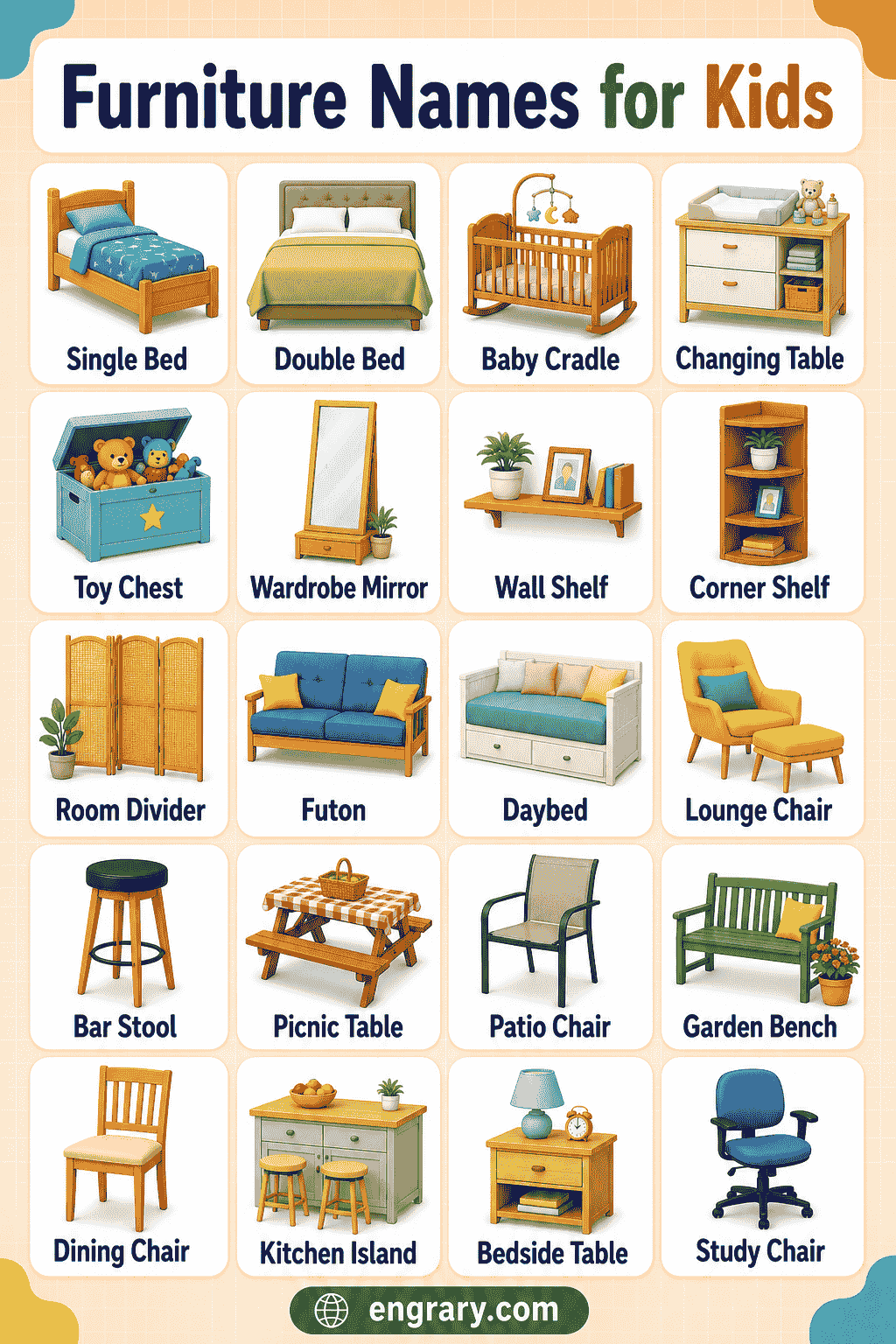
Furniture Shapes and Recognition Clues
Children can identify furniture by noticing height, width, padding, drawers, doors, shelves, and movement.
| Furniture piece | Main recognition clue |
|---|---|
| Armchair | One padded seat with two arm supports |
| Rocking chair | Curved runners or a rocking base |
| Stool | A seat without a back |
| Bunk bed | One sleeping frame above another |
| Dresser | Several wide drawers |
| Nightstand | A small table or cabinet beside a bed |
| Bookcase | Several open or enclosed shelves |
| Wardrobe | A tall storage unit with doors |
| Recliner | A tilting back and movable footrest |
| Coffee table | A low surface near a couch |
| Filing cabinet | Deep drawers for files |
| Loveseat | A compact padded seat for two people |
Furniture Names That Are Easy to Confuse
Similar furniture pieces may share a shape or purpose. Therefore, children should compare their size, position, structure, and usual function.
| Furniture names | Main difference |
|---|---|
| Chair and armchair | A chair is a general one-person seat; an armchair has arm supports and usually more padding. |
| Couch and loveseat | A couch is generally larger and may seat three or more people; a loveseat is specifically designed for two. |
| Stool and chair | A stool usually lacks a back; a chair normally has one. |
| Bench and couch | A bench has a firmer, simpler seat; a couch usually has padding, a back, and arms. |
| Ottoman and footstool | Both can support the feet, but an ottoman is usually larger and may also provide seating or storage. |
| Desk and table | A desk mainly supports study or work; a table serves a wider range of purposes. |
| Dresser and nightstand | A dresser stores clothes in several drawers; a nightstand provides a small bedside surface. |
| Bookshelf and bookcase | A bookshelf may mean one shelf or a shelving unit; a bookcase is a complete furniture piece. |
| Cabinet and cupboard | Both provide enclosed storage, but contents, location, and regional usage affect the preferred term. |
| Wardrobe and closet | A wardrobe is movable furniture; a closet is usually an enclosed storage space built into a room. |
| Coffee table and side table | A coffee table stands in front of seating; a side table stands beside it. |
| Recliner and rocking chair | A recliner tilts backward; a rocking chair moves backward and forward. |
American and British Furniture Terms
This article uses American English. However, British and international materials may use several alternative furniture names.
| American term | British or international term |
|---|---|
| Couch | Sofa; settee also appears in British English |
| Dresser | Chest of drawers |
| Nightstand | Bedside table |
| Crib | Cot |
| Cabinet | Cupboard in some rooms and contexts |
A wardrobe is movable clothes-storage furniture, whereas an American closet usually forms part of the room. Therefore, the two words describe related storage places but not the same object.
How to Count Furniture Correctly
Because furniture is uncountable, it does not normally take a or a plural -s.
| Incorrect | Correct |
|---|---|
| a furniture | a piece of furniture |
| two furnitures | two pieces of furniture |
| many furnitures | a lot of furniture |
| these furniture are new | this furniture is new |
Useful expressions include:
- some furniture;
- new furniture;
- a lot of furniture;
- one piece of furniture;
- four pieces of furniture;
- this furniture is heavy.
Individual furniture names remain countable. For example:
- one chair → two chairs;
- one table → three tables;
- one bench → two benches;
- one bookshelf → four bookshelves;
- one cabinet → several cabinets;
- one toy chest → two toy chests.
Describing Furniture and Where It Stands
Furniture vocabulary becomes more useful when children describe quantity, location, appearance, and purpose. In addition, these patterns support picture descriptions and simple speaking activities.
Using there is and there are
- There is an armchair beside the window.
- Two dining chairs stand near the table.
- There are three shelves in the bookcase.
- A small stool sits under the counter.
Describing position
- The nightstand is beside the bed.
- A coffee table stands in front of the couch.
- The dresser is against the wall.
- The toy chest is between two bookcases.
Explaining purpose
- People sit on a chair.
- A dresser stores folded clothes.
- We use a desk for studying.
- A filing cabinet organizes documents.
Describing appearance
- The wardrobe is tall and narrow.
- This bench has a wooden seat.
- The loveseat is smaller than the couch.
- Our coffee table has a round top.
Asking about furniture
- What is this piece of furniture called?
- Where is the rocking chair?
- Which piece of furniture has several drawers?
- Is the nightstand beside the bed?
Common Mistakes with Furniture Names
Learners often make errors with the uncountable word furniture, plural nouns, prepositions, and subject-verb agreement. For example, an object resting on a shelf takes on, while an object inside a cabinet takes in.
| Incorrect sentence | Correct sentence |
|---|---|
| We bought a furniture. | We bought a piece of furniture. |
| The room has many furnitures. | The room has a lot of furniture. |
| There is two chairs. | There are two chairs. |
| The books are in the shelf. | The books are on the shelf. |
| The dresser have four drawers. | The dresser has four drawers. |
| These furniture are new. | This furniture is new. |
| The stool is between the table. | The stool is beside the table. |
Identify, Sort, and Match the Furniture
Identify the Furniture from Its Clue
- This padded chair tilts backward and may raise a footrest.
- This small table stands beside a bed.
- This seat usually has no back or arms.
- This tall movable unit has doors and stores clothes.
- This low table normally stands in front of a couch.
- This piece of furniture contains several shelves for books.
Sort the Furniture by Purpose
Place each word in the correct group:
- chair;
- bed;
- desk;
- dresser;
- bookcase;
- dining table;
- nightstand;
- bench.
Groups:
- one-person seating;
- sleeping;
- studying;
- clothing storage;
- book storage;
- eating;
- bedside surface;
- shared seating.
Match the Furniture with Its Feature
- armchair;
- rocking chair;
- bunk bed;
- dresser;
- bookcase;
- recliner.
Features:
- arm supports;
- curved rocking base;
- stacked sleeping spaces;
- wide drawers;
- several shelves;
- tilting back.
Complete the Sentences
- There ___ two chairs near the table.
- The nightstand is ___ the bed.
- A bookcase ___ books.
- We bought three pieces of ___.
- The coffee table stands ___ front of the couch.
Answer Key
Identify the furniture:
- recliner
- nightstand
- stool
- wardrobe
- coffee table
- bookcase
Sort by purpose:
- chair → one-person seating;
- bed → sleeping;
- desk → studying;
- dresser → clothing storage;
- bookcase → book storage;
- dining table → eating;
- nightstand → bedside surface;
- bench → shared seating.
Match each feature:
- armchair → arm supports;
- rocking chair → curved rocking base;
- bunk bed → stacked sleeping spaces;
- dresser → wide drawers;
- bookcase → several shelves;
- recliner → tilting back.
Complete the sentences:
- are
- beside
- holds
- furniture
- in
FAQs
Furniture means movable or semi-permanent pieces that make a space useful for sitting, sleeping, eating, working, displaying objects, or storing belongings.
Furniture is an uncountable noun and normally takes a singular verb. Say this furniture is new, not these furniture are new.
Children can begin with familiar names such as chair, table, bed, couch, desk, dresser, bookcase, stool, bench, and nightstand.
They are usually taught as lighting objects, furnishings, or decorative home items rather than core furniture pieces.
Children can study labeled pictures, connect each piece with its purpose, compare similar furniture, describe its location, and solve clue-based activities.
You May Also Like