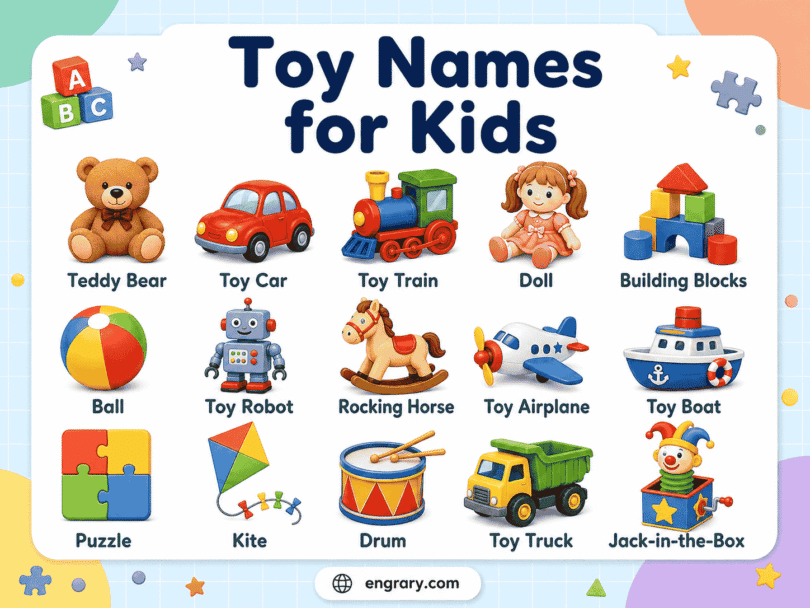
A yo-yo travels up and down a string, building blocks become tall towers, and a kite rises into the wind. Because toys connect words with shape, movement, sound, and imagination, toy names for kids can be especially enjoyable to learn.
A toy is an object made mainly for play, discovery, building, movement, or pretend situations. This guide also includes familiar puzzles, games, and creative play items because children often learn these words alongside everyday toy vocabulary.
Common Toy Names and Their Play Uses
Children can begin with familiar play items that appear often in homes, classrooms, books, and picture worksheets.
Ball — Throw, catch, bounce, roll, or kick.
Doll — Dress, carry, or use in pretend play.
Teddy bear — Hold, cuddle, or include in stories.
Toy car — Push, roll, race, or drive along a track.
Building blocks — Stack, arrange, or build structures.
Jigsaw puzzle — Join pieces to complete a picture.
Puppet — Move, perform with, or use in storytelling.
Kite — Fly in the wind while holding its string.
Yo-yo — Move up and down along a string.
Jump rope — Swing around the body and jump over.
Toy drum — Tap or beat to create rhythms.
Rocking horse — Rock backward and forward or pretend to ride.
Stuffed animal — Cuddle, carry, or use as a story character.
Action figure — Pose, move, or include in adventure play.
Toy train — Push, connect, or guide along a track.
Remote-control car — Drive, steer, or race with a controller.
Spinning top — Spin on a pointed base.
Hula hoop — Spin around the waist, arms, or legs.
Shape sorter — Match solid shapes with the correct openings.
Bubbles — Blow into the air and watch them float or pop.
Pretend-Play and Character Toys
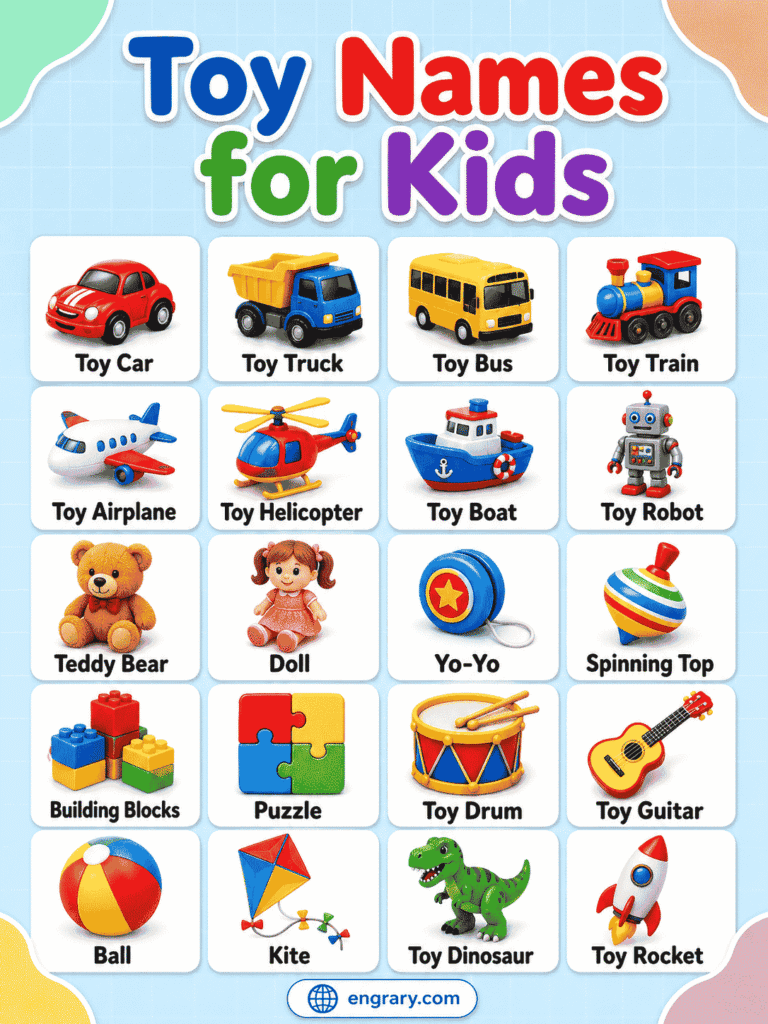
Pretend-play toys help children create stories, copy familiar activities, and act as different characters. They can also encourage conversation, imagination, and cooperative play.
Doll — A human-shaped toy that children dress, carry, or include in family and character stories.
Teddy bear — A soft stuffed toy shaped like a bear, often used as a comforting companion or story character.
Stuffed animal — A soft fabric toy shaped like an animal. British speakers may call it a soft toy or cuddly toy.
Action figure — A small character toy with movable parts, usually representing a hero, explorer, athlete, or fictional figure.
Puppet — A character toy moved by a hand, strings, or rods, so children can use it in conversations and performances.
Dollhouse — A small model house with rooms for dolls, miniature furniture, and pretend household scenes.
Toy kitchen — A child-sized pretend cooking area with play appliances, dishes, or food for meal-making stories.
Tea set — A collection of small cups, plates, and a teapot for pretend serving and conversation.
Doctor kit — A play set with safe pretend medical tools, such as a toy stethoscope, thermometer, or bandage.
Toy tool set — A group of safe play tools for pretend building and repairs, often including a hammer, wrench, or screwdriver.
Toy phone — A pretend phone for role-play, button pressing, sounds, or make-believe conversations.
Dress-up set — Clothing and accessories that help children pretend to be a chef, firefighter, astronaut, animal, or story character.
Doll stroller — A small stroller for carrying a doll or stuffed animal. British speakers may say doll’s pram or doll’s pushchair.
Toy camera — A pretend camera for imaginative photography play, sometimes with pictures, lights, or sound effects.
Toy Vehicles and Moving Toys
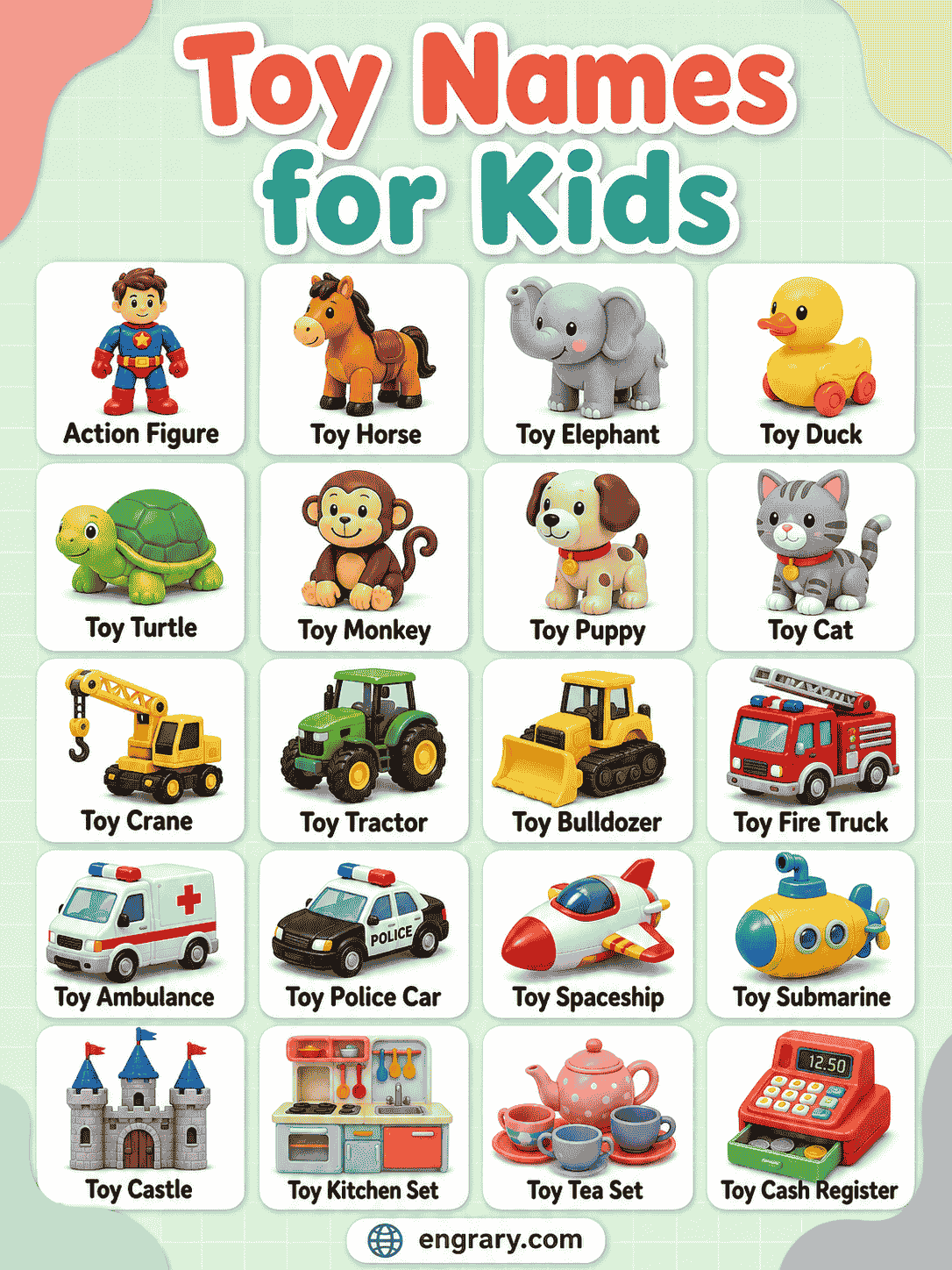
Toy vehicles copy the shapes and movements of real transportation. Therefore, the word toy makes it clear that each name refers to a play version.
Toy car — A small car-shaped toy that children push, roll, or race across a surface.
Toy truck — A truck-shaped toy that may carry blocks, sand, figures, or other small objects.
Toy bus — A small passenger-bus model that may include seats, figures, or opening doors.
Toy train — A train-shaped toy that rolls freely or travels along a track, often with several connected cars.
Toy airplane — A small aircraft-shaped toy with wings for pretend flights and travel stories.
Toy boat — A boat-shaped toy that children push on a surface or float during supervised water play.
Toy fire truck — A small toy modeled after a firefighting vehicle, often with a ladder, hose, lights, or sound buttons.
Toy race car — A small car with a fast, sporty design for racing and track play.
Remote-control car — A powered toy car that moves through a handheld controller rather than a direct push.
Pull-along toy — A wheeled toy that follows when a child pulls its string or handle.
Wind-up toy — A toy that walks, rolls, hops, or spins after someone turns a key or knob.
Toy tractor — A small farm vehicle for pretend farm play that may pull a trailer or toy equipment.
Toy robot — A robot-shaped toy that may move, light up, make sounds, or support imaginative character play.
Building Toys and Construction Sets
Building toys allow children to stack, connect, balance, and arrange pieces. As a result, they support creative play while introducing shapes, patterns, and simple problem-solving.
Building blocks — Solid pieces that children stack or arrange into towers, walls, houses, and other structures.
Interlocking bricks — Small building pieces that connect through fitted parts, so finished models hold together.
Magnetic tiles — Flat geometric pieces with magnetic edges that connect into shapes and three-dimensional structures.
Stacking rings — Rings placed over a central post, usually in an order based on size or color.
Stacking cups — Lightweight cups that fit inside one another or stack upward for building, sorting, sand, or water play.
Shape sorter — A toy with openings that match solid shapes, requiring each piece to enter the correct hole.
Marble run — A connected system of ramps, curves, and tunnels that guides marbles or balls downward.
Construction set — A collection of beams, wheels, connectors, or panels that children join to create models.
Gear set — Interlocking toy gears that rotate together when a child turns one part.
Building sticks — Long pieces arranged or connected to form letters, patterns, frames, and simple structures.
Puzzles and Thinking Toys
Puzzles ask children to solve, match, arrange, or complete something. Games, however, usually add rules, turns, a goal, or a scoring system.
Jigsaw puzzle — A picture divided into interlocking pieces that children join to complete the image.
Peg puzzle — A beginner puzzle with handled pieces that fit into matching spaces.
Puzzle cube — A cube-shaped puzzle solved by turning, sliding, or rearranging its parts.
Matching game — A game that asks players to pair related pictures, words, shapes, or objects.
Memory game — A matching activity in which players remember where hidden cards or pieces appear.
Bead maze — A toy with colorful beads that slide along curved wires or tracks.
Tangram /ˈtæŋɡræm/ 🔊 — A set of flat geometric pieces that children rearrange into pictures and shapes.
Board game — A rule-based game played on a board with pieces, cards, dice, questions, or goals.
Card game — A game played with cards showing numbers, pictures, colors, words, or symbols.
Dominoes — Rectangular pieces marked with dots or pictures for matching games or falling-line patterns.
Active and Outdoor Toys
Active toys encourage throwing, catching, balancing, riding, jumping, and movement. Although many suit outdoor play, some can also be used safely indoors when space allows.
Ball — A round play item that children throw, catch, bounce, roll, or kick.
Jump rope — A rope swung around the body while someone jumps over it. British speakers commonly say skipping rope.
Hula hoop — A large lightweight ring spun around the waist, arms, or legs.
Kite — A light frame that flies in the wind while a string keeps it connected to the person below.
Yo-yo — A round toy that travels down and up a string as the player controls its movement.
Spinning top — A pointed toy that rotates on a surface and stays upright while it maintains balance.
Flying disc — A flat disc that glides freely through the air after someone throws it.
Ring toss — A target toy in which players throw rings toward posts, pegs, or bottles.
Bowling set — A collection of toy pins and a ball that children roll to knock the pins down.
Scooter — A ride-on item with wheels, a standing platform, and a handlebar, usually pushed with one foot.
Tricycle — A three-wheeled ride-on toy with pedals that provides more balance than a bicycle.
Rocking horse — A horse-shaped toy that rocks backward and forward while a child pretends to ride.
Bubbles — Thin soap films blown through a wand so they float briefly before popping.
Musical Toys and Creative Play Sets
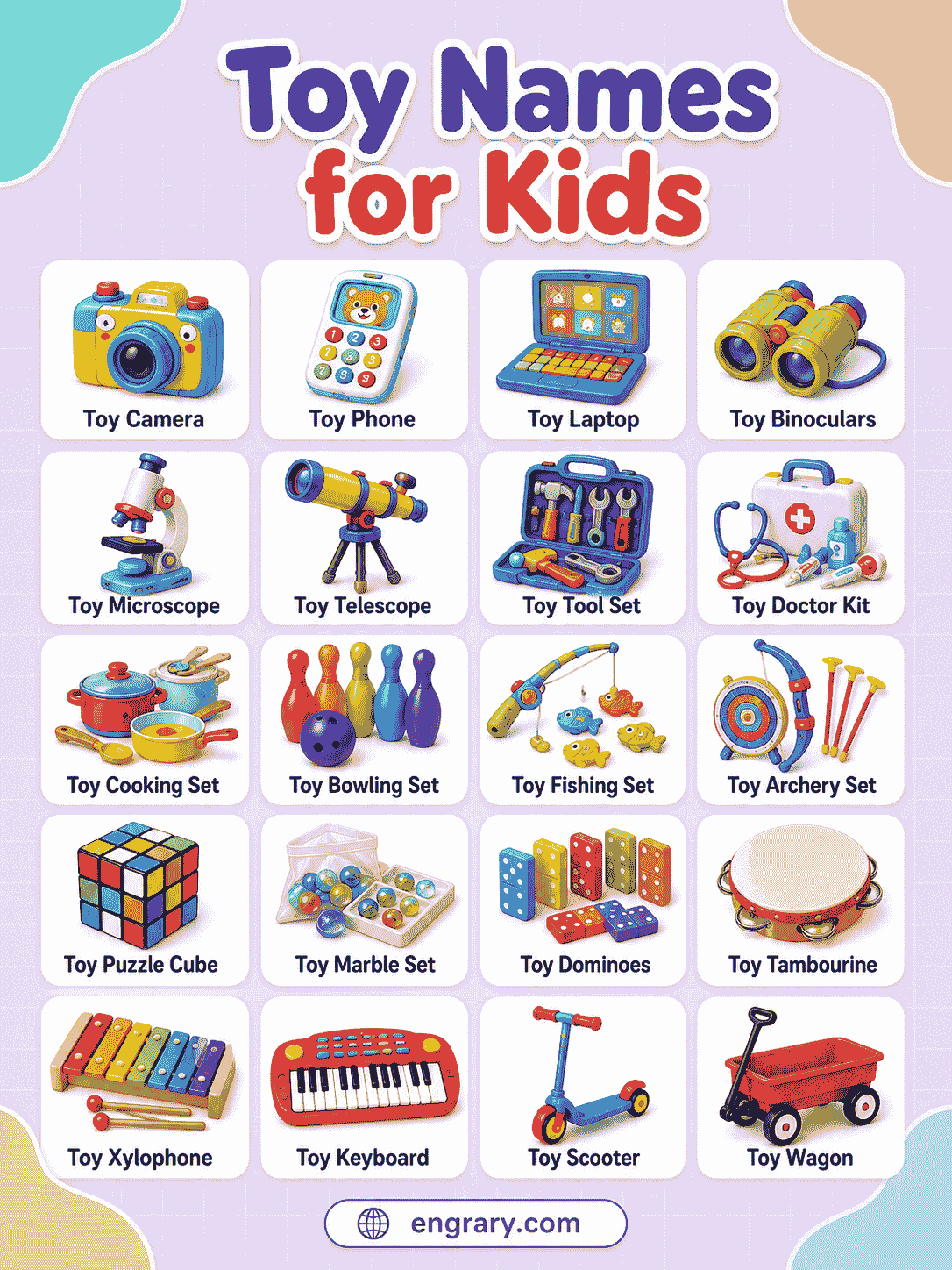
Musical toys let children explore rhythm, sound, and simple melodies, while creative sets support shaping, drawing, printing, and pattern-making.
Toy drum — A small drum that children tap with their hands or toy drumsticks.
Toy piano — A child-sized keyboard that produces simple notes, tunes, or electronic sounds.
Toy xylophone /ˈzaɪləfoʊn/ 🔊 — A child-friendly instrument with bars that create different notes when struck.
Toy maracas /məˈrɑkəz/ 🔊 — A pair of lightweight shakers that create rhythm when children move them.
Toy tambourine — A round handheld instrument with small metal discs that sound when tapped or shaken.
Modeling dough — A soft play material that children press, roll, cut, and shape into objects or figures.
Magnetic drawing board — A reusable toy surface that creates temporary pictures and erases them with a slider or button.
Stamp set — A collection of small stamps and ink pads for printing pictures, letters, and patterns.
Rhythm sticks — A pair of short sticks that children tap together to create beats and sound patterns.
Soft, Sensory, and Early-Play Toys
These toys support touch, sound, movement, comfort, and early discovery. Adults should check age guidance and supervise items with small parts, strings, batteries, or water.
Rattle — A baby toy that creates sound when someone shakes it.
Nesting toy — A group of pieces that fit inside one another or stack in size order.
Rubber duck — A soft or hollow duck-shaped bath toy that may float or squeak.
Bath toy — A waterproof toy designed for supervised play in a bathtub or water container.
Sensory ball — A textured ball that encourages touching, squeezing, grasping, and rolling.
Squishy toy — A soft toy that compresses under pressure and returns to its original shape.
Fidget spinner — A small handheld toy with rotating arms around a central part.
Crib mobile — Hanging shapes or figures that turn above a baby’s crib. British speakers may say cot mobile.
Activity gym — A padded baby play area with hanging toys, textures, mirrors, or sound-making parts.
Jack-in-the-box — A box toy with a figure that suddenly pops up after someone turns a handle.
Kaleidoscope /kəˈlaɪdəˌskoʊp/ 🔊 — A tube that creates changing colorful patterns when someone turns or moves it.
Play Actions That Match Each Toy
Connecting a toy name with a natural verb makes the word easier to remember and use.
| Toy or play item | Natural action |
|---|---|
| Ball | Throw, catch, bounce, or kick |
| Kite | Fly |
| Yo-yo | Move up and down |
| Spinning top | Spin |
| Doll | Dress or play with |
| Puppet | Move or perform with |
| Building blocks | Stack or build |
| Jigsaw puzzle | Solve or put together |
| Toy car | Push or race |
| Jump rope | Jump or skip |
| Bubbles | Blow |
| Rocking horse | Rock or ride |
| Rattle | Shake |
| Modeling dough | Press, roll, or shape |
Toy Names That Are Easy to Confuse
Some toys share a similar shape, purpose, or action. However, their construction and usual play style help children choose the correct name.
| Toy names | Main difference |
|---|---|
| Doll and action figure | A doll often supports family or character play; an action figure usually represents a specific character with movable parts. |
| Teddy bear and stuffed animal | A teddy bear specifically represents a bear; stuffed animal includes many soft animal toys. |
| Building blocks and interlocking bricks | Blocks stack freely; interlocking bricks connect through fitted parts. |
| Toy car and remote-control car | A child pushes a basic toy car by hand; a controller moves a remote-control car. |
| Jigsaw puzzle and board game | A puzzle focuses on completing or solving; a board game normally has rules, turns, and a goal. |
| Puppet and doll | A hand, strings, or rods move a puppet; a child handles a doll directly. |
| Tricycle and scooter | A tricycle has three wheels and pedals; a scooter has a standing platform and handlebar. |
| Spinning top and yo-yo | A top spins on a point; a yo-yo travels along a string. |
| Kite and flying disc | A kite stays attached to a string; a flying disc moves freely after a throw. |
| Rattle and toy maracas | A rattle mainly supports early play; toy maracas support musical and rhythm activities. |
Using Toy Names in Simple Sentences
Use play with when talking generally about dolls, toy vehicles, blocks, stuffed animals, and similar toys.
- I play with my doll.
- The children play with building blocks.
- Noah plays with a toy train.
- We play with puppets after lunch.
Specific verbs sound more natural when a toy has a clear action:
- Mia flies a kite.
- Leo rides a scooter.
- Ava bounces a ball.
- The baby shakes a rattle.
- We put together a jigsaw puzzle.
- They play a board game.
- Ella blows bubbles.
- Sam builds with magnetic tiles.
Toy names also work naturally in descriptions of favorites, colors, shapes, and locations:
- My favorite toy is a teddy bear.
- This stuffed animal feels soft.
- The toy truck has large wheels.
- Three dolls are inside the toy box.
- A puzzle lies on the table.
- Two toy cars are under the chair.
Common corrections
| Incorrect sentence | Correct sentence |
|---|---|
| I play my doll. | I play with my doll. |
| She have two toy cars. | She has two toy cars. |
| There is three balls. | There are three balls. |
| He fly a kite. | He flies a kite. |
| The blocks is in the box. | The blocks are in the box. |
| We are doing a board game. | We are playing a board game. |
Guess, Sort, and Match the Toy Names
Guess the Toy
- This soft toy looks like a bear.
- Children join its pieces to complete a picture.
- This toy flies in the wind while a string holds it.
- A controller makes this small vehicle move.
- Children stack these pieces to build towers.
- This round toy travels up and down a string.
Sort the Play Items
Place each name in the correct group:
- doll;
- building blocks;
- jigsaw puzzle;
- ball;
- toy drum;
- rattle;
- board game;
- stuffed animal.
Groups:
- pretend play;
- construction;
- puzzle;
- active play;
- musical play;
- early-play toy;
- rule-based game;
- soft toy.
Match the Toy with Its Action
- kite;
- ball;
- building blocks;
- jigsaw puzzle;
- rattle;
- bubbles;
- rocking horse;
- jump rope.
Actions:
- fly;
- bounce;
- stack;
- solve;
- shake;
- blow;
- rock;
- skip.
Complete the Sentences
- I play ___ my toy car.
- She ___ a kite at the park.
- We are putting ___ a puzzle.
- There ___ three dolls in the toy box.
- His favorite toy ___ a teddy bear.
Answer Key
Guess the toy:
- teddy bear
- jigsaw puzzle
- kite
- remote-control car
- building blocks
- yo-yo
Sort the play items:
- doll → pretend play;
- building blocks → construction;
- jigsaw puzzle → puzzle;
- ball → active play;
- toy drum → musical play;
- rattle → early-play toy;
- board game → rule-based game;
- stuffed animal → soft toy.
Match the toy and action:
- kite → fly;
- ball → bounce;
- building blocks → stack;
- jigsaw puzzle → solve;
- rattle → shake;
- bubbles → blow;
- rocking horse → rock;
- jump rope → skip.
Complete the sentences:
- with
- flies
- together
- are
- is
FAQs
Common examples include ball, doll, teddy bear, toy car, building blocks, jigsaw puzzle, puppet, kite, yo-yo, jump rope, and rocking horse.
Words such as car, train, phone, camera, and kitchen can name real objects. Adding toy makes it clear that the word describes a play version.
A puzzle is a problem-solving play item. Although people often include puzzles in toy lists, puzzles mainly focus on completing, arranging, or solving something.
Use play with for many toys, such as dolls, blocks, and toy cars. However, specific verbs such as fly, ride, bounce, build, shake, solve, and blow often sound more natural.
Children can study labeled pictures, connect each toy with an action, sort toys by play type, compare similar items, and practice with clues or matching activities.
You May Also Like