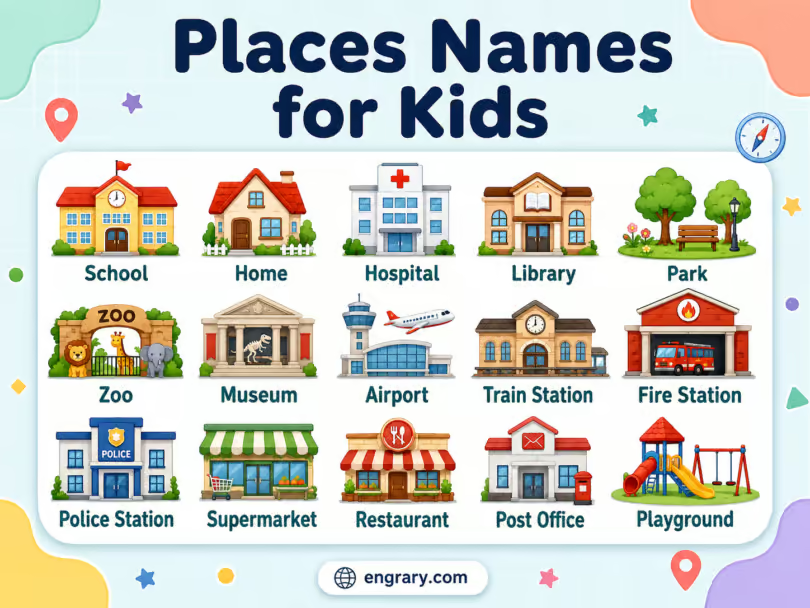
A school bus stops near a school, shoppers leave a supermarket, and children hurry toward a playground. Because each location has a purpose and recognizable features, pictures can help young learners connect its name with what happens there.
A place is a location where people learn, work, shop, travel, receive help, or spend time. For this guide, the vocabulary focuses on common places found in towns, cities, and neighborhoods, including buildings, businesses, transport points, and outdoor areas.
Places Children Commonly See Around Town
During everyday trips, children may notice many familiar places in their town or neighborhood. These locations help people learn, shop, travel, receive services, enjoy meals, and spend time outdoors.
- School
- Library
- Hospital
- Supermarket
- Restaurant
- Park
- Playground
- Police station
- Fire station
- Post office
- Bank
- Bus stop
- Train station
- Pharmacy
- Movie theater
Schools and Community Service Places
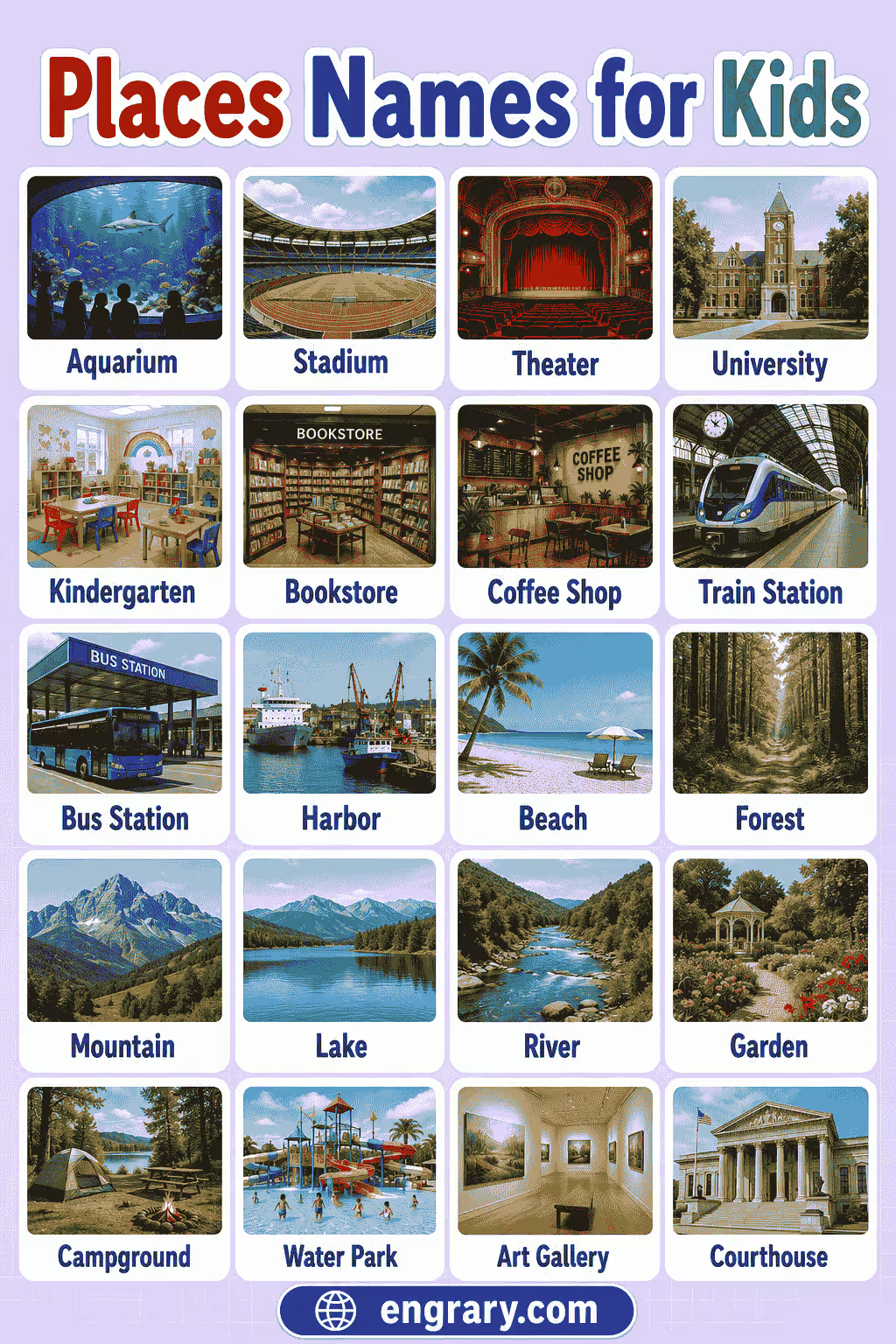
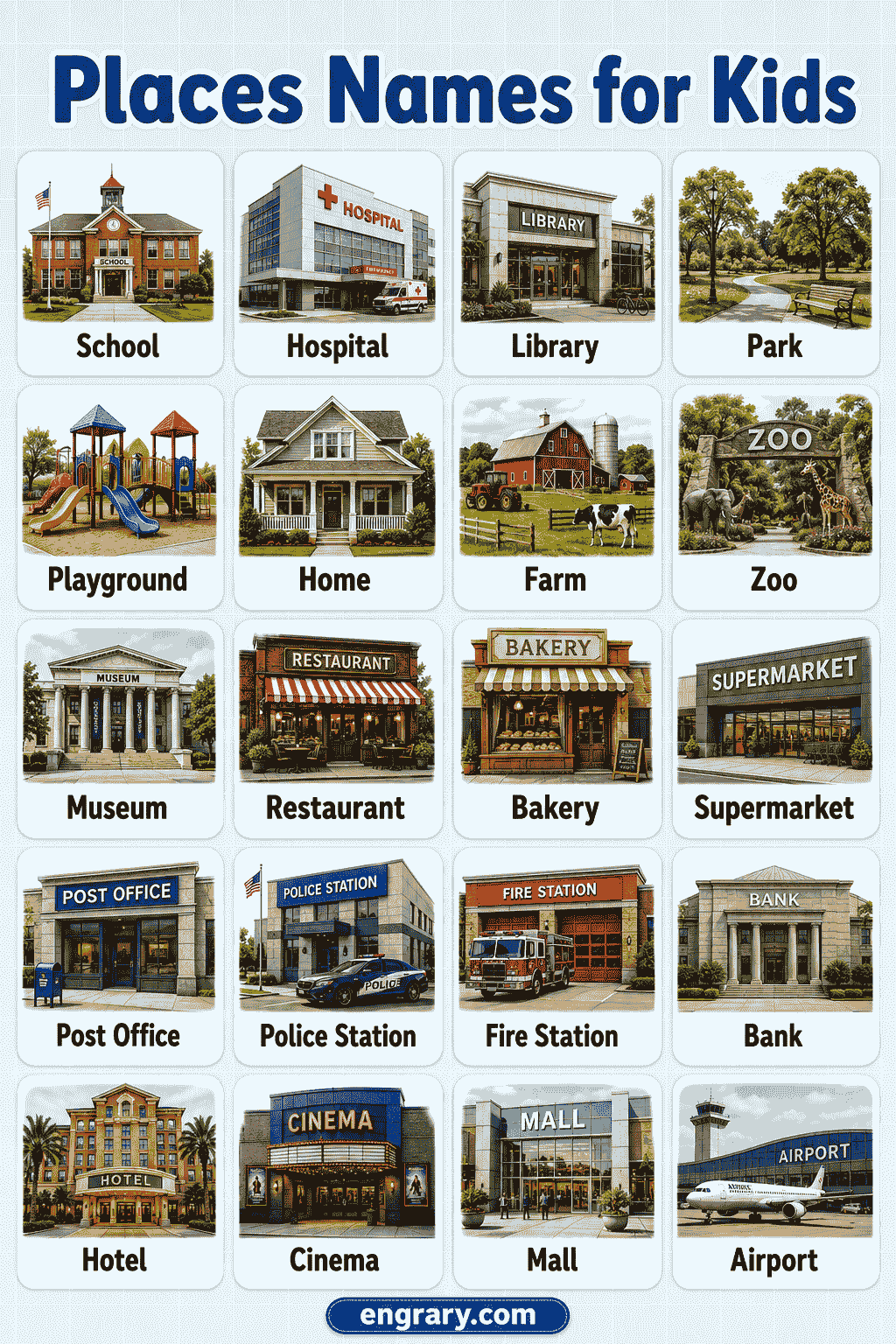
First, children can learn the names of locations that support education, childcare, public services, and community life. Although the buildings may look different, signs and familiar activities often reveal each purpose.
School — At school, children attend lessons, complete activities, and learn with teachers.
Preschool — Before elementary school, young children develop early language, number, routine, and social skills here.
College — After high school, students continue their education and prepare for academic or career goals.
Library — In addition, a library gives people space to read, study, use learning resources, and borrow books.
Community center — Meanwhile, local residents gather here for classes, meetings, sports, celebrations, and neighborhood programs.
City hall — Here, city leaders and local public offices manage services for the community.
Post office — For example, customers can send letters and packages, buy postage, or collect certain mailed items.
Daycare center — While parents or guardians are away, caregivers look after young children in this supervised place.
Place of worship — Similarly, community members may gather here for prayer, religious services, and shared activities.
Bank — At a bank, customers deposit, withdraw, save, or manage money.
Health and Emergency Places
Next, health and emergency locations help people and animals during illness, injury, fire, crime, or another urgent problem. Because quick help matters, these places often display clear signs or emergency vehicles.
Hospital — Since hospitals provide broad care, doctors and nurses may offer tests, surgery, treatment, and emergency services.
Clinic — By contrast, a clinic usually handles appointments, basic tests, and routine treatment on a smaller scale.
Pharmacy — Also, pharmacists prepare medicine and help customers find health products. British speakers may say chemist’s.
Dentist’s office — Dental professionals examine teeth, treat problems, and teach patients how to care for their mouths.
Urgent care center — When an illness or injury needs prompt attention but is not usually life-threatening, this facility can provide treatment.
Police station — Meanwhile, police officers work here, receive reports, and assist people in the community.
Fire station — Likewise, firefighters, fire trucks, rescue tools, and protective equipment remain ready at this building.
Animal hospital — Instead of treating people, veterinarians examine and care for sick or injured animals here.
Shopping Places Around Town
As families run errands, they visit places that sell food, clothing, books, toys, household goods, and other useful products. However, some shops focus on one type of item, while larger stores contain several departments.
Supermarket — A supermarket sells groceries, cleaning products, personal-care items, and household supplies in one large store.
Grocery store — By comparison, a grocery store mainly focuses on food, drinks, and everyday kitchen essentials.
Market — Often, separate sellers offer produce, clothing, crafts, or other goods from stalls and stands.
Shopping mall — In addition, many stores, restaurants, and services operate together inside one large complex. British English often uses shopping centre.
Department store — Different sections sell clothing, home goods, beauty items, furniture, and other products.
Convenience store — Because it is small and easy to enter, this shop suits quick purchases of snacks, drinks, and basic supplies.
Bookstore — Here, customers buy books, magazines, notebooks, and other reading materials. British speakers commonly say bookshop.
Toy store — Children and adults visit this shop to buy toys, puzzles, games, dolls, and play sets.
Clothing store — Meanwhile, shirts, pants, dresses, jackets, and other garments fill the racks.
Shoe store — Similarly, customers try on and purchase sneakers, boots, sandals, and other footwear.
Bakery — Bakers prepare or sell bread, cakes, cookies, pastries, and similar foods.
Flower shop — For special days or everyday decoration, florists arrange and sell flowers, plants, bouquets, and gifts.
Farmers’ market — Finally, local growers and sellers offer fruit, vegetables, baked foods, and other products at individual stalls.
Food and Dining Places
After shopping or traveling, people may visit a dining place for a meal, snack, dessert, or drink. For example, some locations provide table service, while others prepare food quickly.
Restaurant — At a restaurant, customers choose prepared meals from a menu and usually eat at a table.
Café /kæˈfeɪ/ 🔊 — By comparison, a café commonly serves coffee, tea, cold drinks, snacks, and light meals.
Diner — In the United States, a diner often offers breakfast foods, sandwiches, burgers, and other familiar meals.
Fast-food restaurant — Because the service is quick, customers may eat inside or take their food away.
Ice cream shop — Here, visitors buy cones, cups, sundaes, frozen yogurt, and other cold desserts.
Food court — Meanwhile, several food businesses share one seating area, often inside a mall or large public building.
Pizzeria /ˌpiːtsəˈriːə/ 🔊 — As its name suggests, this casual restaurant mainly prepares and serves pizza.
Transport and Travel Places
Meanwhile, transport and travel locations help people wait, board vehicles, park, buy fuel, or stay overnight. Unlike roads and traffic signs, each place offers a clear stop, facility, or service.
Bus stop — At a bus stop, passengers wait at a marked roadside point for a bus.
Bus station — However, a bus station is larger and may serve several buses or routes.
Train station — Travelers buy tickets, wait on platforms, and board or leave trains here.
Subway station — In cities with a subway or metro, passengers enter the system through this station.
Airport — Because airplanes arrive and depart here, an airport includes terminals, gates, and runways.
Parking lot — Drivers leave vehicles in marked outdoor spaces near buildings and businesses. British speakers say car park.
Parking garage — By contrast, a parking garage provides covered spaces on one or more levels.
Gas station — In addition, drivers buy fuel and may purchase snacks or basic travel supplies. British English uses petrol station.
Taxi stand — Here, taxis wait in a marked area until passengers need a ride.
Harbor — Meanwhile, boats and ships arrive, leave, load supplies, or remain protected in this water area.
Hotel — After a journey, travelers pay to stay overnight in private guest rooms.
Places for Play, Sports, and Culture
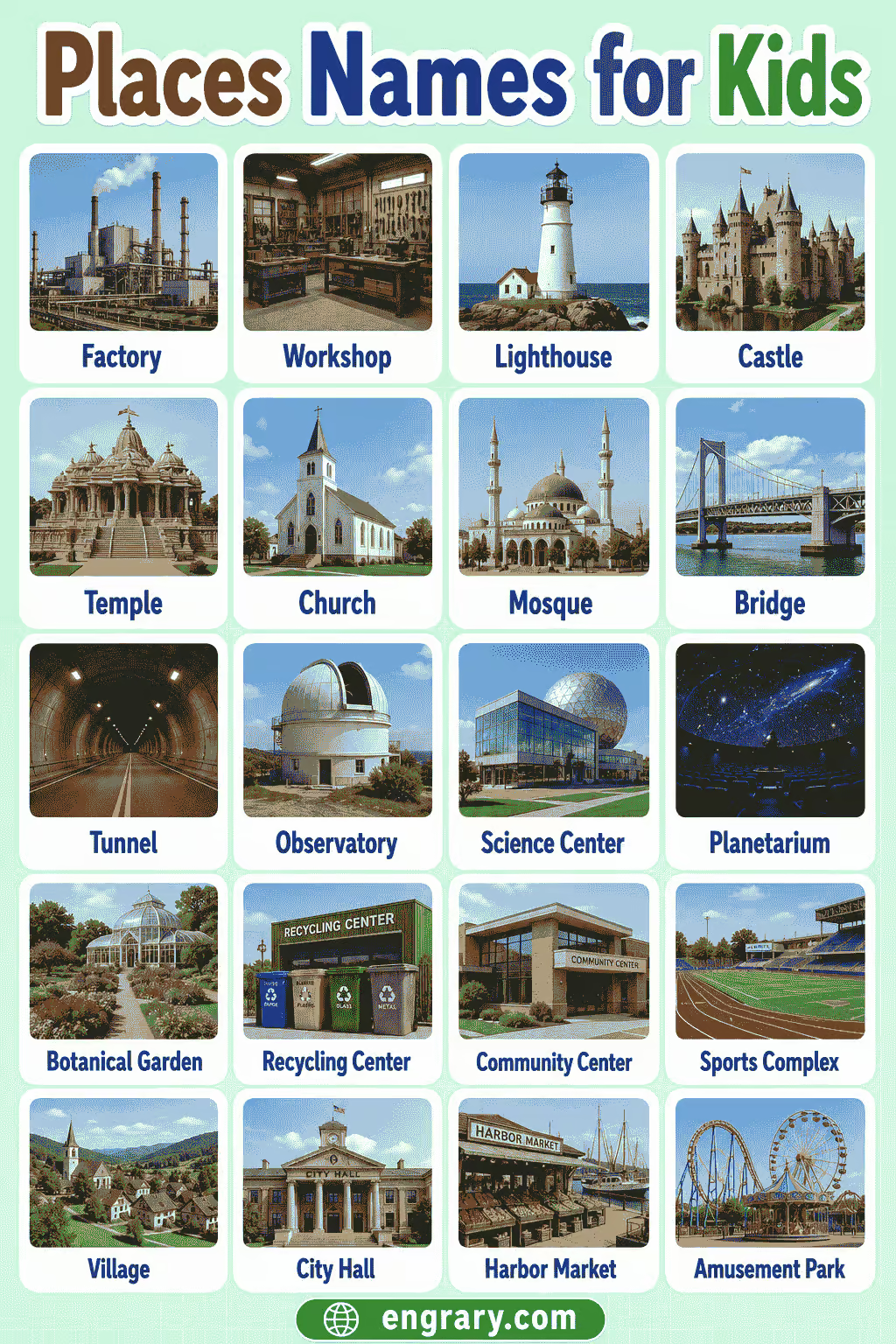
Besides completing daily tasks, families visit recreation and cultural places to exercise, explore, watch performances, and enjoy shared activities. For instance, some locations focus on animals or science, while others provide sports or entertainment.
Park — A park offers trees, grass, paths, benches, and open space for recreation and relaxation.
Playground — More specifically, a playground provides swings, slides, climbing frames, and other equipment for children.
Zoo — At a zoo, visitors observe animals and learn about their habitats, diets, and behavior.
Aquarium /əˈkweriəm/ 🔊 — Similarly, tanks and displays help visitors observe fish and other animals that live in water.
Museum — Through objects, models, pictures, and displays, a museum teaches visitors about history, science, or culture.
Art gallery — In contrast, visitors view paintings, photographs, sculptures, and other artworks in this space.
Movie theater — Audiences watch recorded films on a large screen here. British speakers usually say cinema.
Theater — Instead, actors, dancers, musicians, and other performers present live shows on a stage.
Stadium /ˈsteɪdiəm/ 🔊 — Because it holds large crowds, a stadium suits sports competitions, concerts, and major events.
Sports center — Inside a sports center, people use courts, exercise rooms, and training areas.
Swimming pool — Meanwhile, swimmers come here for lessons, exercise, competition, or recreation.
Amusement park — With rides, games, attractions, and food stands, an amusement park provides entertainment across a large area.
Science center — In addition, interactive experiments and displays help visitors explore science, engineering, space, and technology.
Bowling alley — At a bowling alley, players roll balls along narrow lanes and try to knock down pins.
Skate park — Finally, ramps, rails, bowls, and smooth surfaces support skateboarding, scootering, and similar activities.
Gardens, Squares, and Other Outdoor Places
Finally, outdoor community places provide space for walking, gathering, gardening, camping, eating, or enjoying nature. Although they may contain shelters or small buildings, the open area usually forms the main feature.
Town square — In many towns, shops, offices, and public buildings surround this central gathering space.
Community garden — Here, local residents share small plots where they grow flowers, herbs, fruit, or vegetables.
Picnic area — For outdoor meals, visitors use tables, benches, or open ground in this marked area.
Beach — Along an ocean, sea, lake, or river, sand or pebbles form a place for walking, relaxing, and water activities.
Campground — Meanwhile, campers stay in tents, cabins, or RVs at this outdoor location.
Walking trail — A marked path guides people through a park, neighborhood, or natural area.
Botanical garden — In addition, carefully arranged collections of flowers, trees, and other plants fill these landscaped grounds.
Place Names That Are Easy to Confuse
Some places provide related services; however, their size, purpose, or design makes each one different.
| Place names | Main difference |
|---|---|
| Hospital and clinic | Hospitals provide broad and emergency care, while clinics usually handle appointments and smaller treatments. |
| Supermarket and grocery store | Usually larger, a supermarket sells more types of products; by contrast, a grocery store focuses mainly on food and essentials. |
| Shopping mall and market | Permanent stores fill a mall complex, whereas individual sellers often use stalls in a market. |
| Library and bookstore | Libraries lend books that people return, while bookstores sell books that customers keep. |
| Restaurant and café | Full meals are common in restaurants; however, cafés often focus on drinks and lighter food. |
| Bus stop and bus station | Roadside pickup points are bus stops, whereas larger passenger facilities are bus stations. |
| Train station and subway station | Wider rail journeys begin at train stations, while city metro trips use subway stations. |
| Park and playground | Broad outdoor space defines a park; in contrast, play equipment forms the main feature of a playground. |
| Police station and fire station | Police officers work from police stations, while firefighters and fire vehicles operate from fire stations. |
| Movie theater and theater | Recorded films appear in movie theaters, whereas live performances usually take place in theaters. |
Using Place Names in Simple Sentences
First, use go to when someone travels toward or visits a location.
- We go to the library after school.
- Maya goes to the dentist’s office twice a year.
- Our class went to the science center.
- They are going to the supermarket.
- Liam walks to the playground with his sister.
Next, use at for a general location, activity, or meeting point.
- Dad is at the bank.
- The children are at school.
- We met at the train station.
- Ava is waiting at the bus stop.
- Several firefighters are at the fire station.
By contrast, use in when someone or something is physically inside an enclosed location.
- The doctor is in the clinic.
- Several customers are in the bookstore.
- Our family ate lunch in the restaurant.
- Many travelers are in the airport terminal.
- A new exhibit is in the museum.
In addition, position words explain where one place stands in relation to another.
- The pharmacy is beside the clinic.
- A café is across from the library.
- Near the school, children can find a playground.
- Between the bakery and the post office, a bank serves local customers.
- In front of the shopping mall, passengers wait at a bus stop.
- Behind the hotel, a parking garage provides covered spaces.
Some place expressions follow special patterns, so learners should notice the verb or preposition that goes with each one.
- People borrow books from a library but buy books from a bookstore.
- We say go home, not go to home.
- Someone waits at a bus stop but sits on a bus.
- Children usually study at school or in a classroom.
- Customers shop at a supermarket and walk through its aisles.
| Incorrect sentence | Correct sentence |
|---|---|
| I go at school every day. | I go to school every day. |
| She is in the bus stop. | She is at the bus stop. |
| We buy books from the library. | We borrow books from the library. |
| The hospital have an urgent care center. | The hospital has an urgent care center. |
| There is two parks nearby. | There are two parks nearby. |
| He goes to the home after school. | He goes home after school. |
Recognize Places from Clues and Activities
First, read each clue and name the place.
- People borrow books and study here.
- Firefighters and fire trucks stay here.
- Shoppers buy groceries and household supplies here.
- Passengers wait on platforms and board trains here.
- Children use swings, slides, and climbing equipment here.
- Doctors and nurses treat serious illnesses and injuries here.
- Audiences watch films on a large screen here.
- Travelers sleep in guest rooms here.
Next, place each word in the correct group:
- school;
- hospital;
- supermarket;
- restaurant;
- police station;
- airport;
- museum;
- park;
- bakery;
- bus station;
- zoo;
- community center.
Groups:
- learning;
- health care;
- shopping;
- dining;
- public safety;
- travel;
- culture;
- outdoor recreation;
- food shopping;
- transportation;
- animal attraction;
- community activities.
Then, match each place with its main activity:
- library;
- pharmacy;
- post office;
- café;
- aquarium;
- gas station;
- bowling alley;
- flower shop.
Activities:
- buy flowers;
- mail a package;
- see aquatic animals;
- borrow books;
- obtain medicine;
- purchase fuel;
- order a drink;
- knock down pins.
Finally, complete the sentences:
- We go ___ the library on Saturday.
- Dad is ___ the bank.
- Passengers wait ___ the bus stop.
- There ___ two parks near our neighborhood.
- People borrow books from the ___.
- The pharmacy is across ___ the clinic.
- Travelers stay overnight in a ___.
- Children play ___ the playground.
Answer Key
Guess the place
- library
- fire station
- supermarket
- train station
- playground
- hospital
- movie theater
- hotel
Sort the places
- school → learning;
- hospital → health care;
- supermarket → shopping;
- restaurant → dining;
- police station → public safety;
- airport → travel;
- museum → culture;
- park → outdoor recreation;
- bakery → food shopping;
- bus station → transportation;
- zoo → animal attraction;
- community center → community activities.
Match the place with the activity
- library → borrow books;
- pharmacy → obtain medicine;
- post office → mail a package;
- café → order a drink;
- aquarium → see aquatic animals;
- gas station → purchase fuel;
- bowling alley → knock down pins;
- flower shop → buy flowers.
Complete the sentences
- to
- at
- at
- are
- library
- from
- hotel
- at
FAQs
Useful starting words include school, library, hospital, supermarket, park, playground, restaurant, police station, fire station, post office, bus stop, and train station.
No. Schools, hospitals, and stores are buildings, but parks, bus stops, beaches, trails, parking lots, and town squares are also places.
A building is a constructed structure, while a place can also be an outdoor area, transport point, business, or open community space.
Use at for a general location, as in She is at the library. Use in when emphasizing that someone is physically inside, as in She is in the library reading area.
Children can study labeled pictures, connect each place with an activity, compare similar locations, describe places near their home, and practice with clues or matching games.
You May Also Like