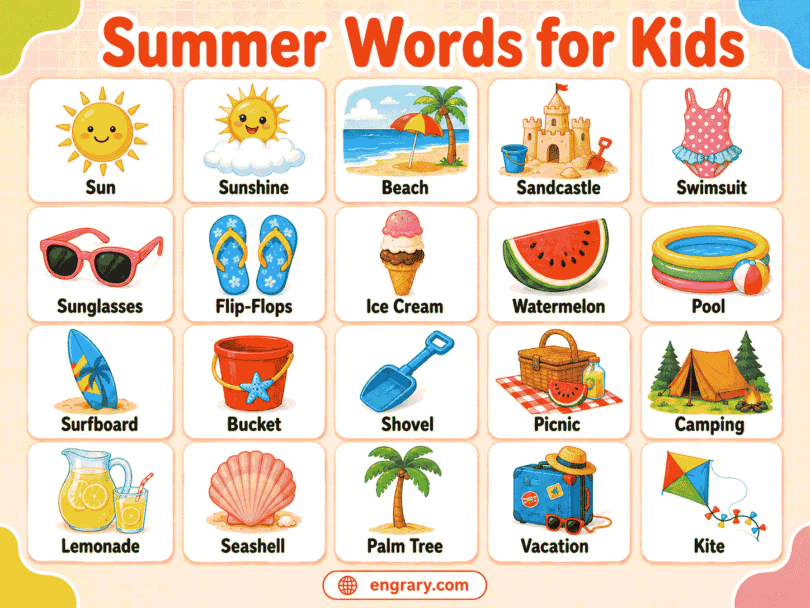
Sunlight brightens the yard, sprinklers send cool water into the air, and butterflies move between colorful flowers. Summer gives children many useful words for describing warm weather, outdoor places, foods, clothing, nature, and play.
A summer word names or describes something connected with the warmest season of the year. However, summer does not feel the same everywhere. Some regions become hot and humid, while others have mild temperatures, cool breezes, frequent rain, or cloudy days.
Common Summer Words
These familiar words name things children may see, wear, eat, use, or do during summer:
- Summer
- Sun
- Sunshine
- Hot
- Beach
- Pool
- Swimsuit
- Sunglasses
- Sunscreen
- Ice cream
- Watermelon
- Picnic
- Camping
- Butterfly
- Sunflower
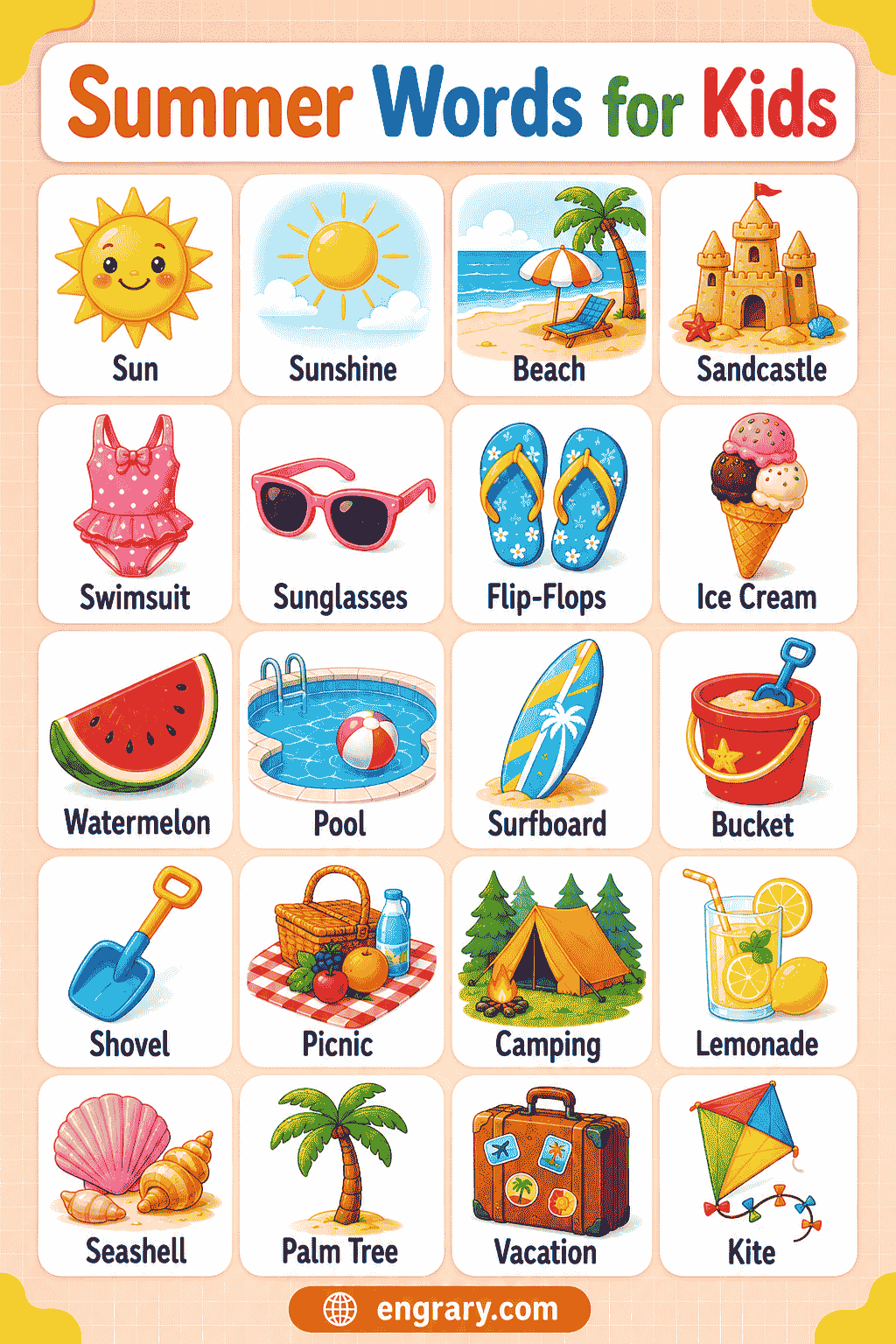
Summer Weather Words
These words help children talk about warm temperatures, sunlight, and the way summer air feels.
Summer — The warmest season of the year, occurring between spring and fall. Summer falls during different months in the Northern and Southern Hemispheres.
Sun — This star provides Earth with daylight, heat, and energy. It appears to move across the sky as Earth rotates.
Sunshine — Light and warmth that come directly from the sun are called sunshine. Bright sunshine can make outdoor spaces feel warm and cheerful.
Hot — Something is hot when it has a high temperature. Pavement, sand, or playground equipment may become hot after sitting in direct sunlight.
Warm — A warm temperature feels comfortably heated without being extremely hot. Summer evenings often remain warm after sunset.
Sunny — Clear weather with plenty of visible sunlight is described as sunny. Still, summer can also bring clouds and rain.
Humid — Humid air contains a large amount of moisture. Because sweat evaporates more slowly, humid weather may feel warmer than the measured temperature.
Heat wave — Several days of unusually hot weather form a heat wave. Unlike one warm afternoon, it continues for a longer period.
Breeze — A breeze is a light wind that moves gently through the air. It can make a hot day feel more comfortable.
Shade — Trees, umbrellas, roofs, and other objects create areas protected from direct sunlight. These cooler areas are called shade.
Beach and Pool Words
Summer water vocabulary includes outdoor places, natural features, and objects used around pools and beaches.
Beach — A beach is a sandy, pebbly, or rocky area beside an ocean, lake, or river. People may walk, rest, play, or swim there.
Shore — The land along the edge of a body of water is its shore. A beach is one type of shore.
Sand — Tiny, loose grains of rock form sand. Wet sand holds its shape more easily than dry sand.
Ocean — One of Earth’s largest bodies of salt water is an ocean. Waves, tides, plants, and animals are found within it.
Wave — Water rises and falls in a moving shape called a wave. Wind often creates waves on oceans and lakes.
Pool — Built for swimming, exercise, or play, a pool is a prepared area filled with water.
Splash pad — Ground-level fountains and sprays create a shallow water-play space called a splash pad. Children run through the water rather than swim in deep areas.
Beach ball — This large, lightweight inflatable ball is used for play on beaches, lawns, or in pools.
Sandcastle — Children make a sandcastle by packing and shaping wet sand into towers, walls, or other castle-like forms.
Pool float — An inflatable object that rests on the water’s surface is called a pool float. People may sit, lie, or play on it.
Summer Clothes and Sun Protection
Light clothing can feel comfortable in warm weather, while protective items help reduce direct exposure to strong sunlight.
T-shirt — A T-shirt is a lightweight shirt with short sleeves and no collar. It is common in warm weather.
Shorts — These pants end above or near the knees. Since they leave more of the legs uncovered, they usually feel cooler than long pants.
Swimsuit — Clothing designed for swimming or water play is called a swimsuit. Its fabric usually stretches and dries quickly.
Sandals — Open shoes held on the feet by straps are sandals. Their design allows air to reach more of the foot.
Flip-flops — Flip-flops have flat soles and straps that pass between the toes. Unlike many sandals, they usually leave the heel unsupported.
Sun hat — A brim around a sun hat creates shade for the face and sometimes the neck.
Sunglasses — Tinted lenses reduce the amount of bright light reaching the eyes. The frames hold those lenses securely in place.
Sunscreen — This lotion, cream, spray, or stick is applied to exposed skin to reduce damage from ultraviolet sunlight.
Useful Things for Summer
These objects help people create shade, carry food, stay comfortable, enjoy water, or spend time outdoors.
Beach towel — Larger than a hand towel, a beach towel is used for drying off or sitting near a beach or pool.
Beach umbrella — A wide canopy attached to a pole creates shade beneath a beach umbrella.
Cooler — Insulated walls help a cooler keep food and drinks cold. People often place ice packs or ice inside it.
Picnic basket — Food, drinks, plates, napkins, and other meal items can be carried in a picnic basket.
Hammock — Fabric or netting hangs between trees, posts, or a frame to form a hammock. It works as a swinging bed or seat.
Tent — Campers sleep or rest inside this portable fabric shelter. Poles or a frame support its shape.
Campsite — A campsite is the location where people place a tent, camper, or outdoor sleeping area. The tent is the shelter, while the campsite is the place.
Sprinkler — Water sprays from a sprinkler over grass, plants, or a play area. On warm days, children may also run through it.

Summer Activities
People can enjoy summer in parks, gardens, backyards, pools, campsites, and many other places.
Swimming — Moving through water with the arms and legs is called swimming. It may take place in pools, lakes, or approved ocean areas.
Splashing — During splashing, hands, feet, or toys strike the water and scatter drops into the air.
Diving — Diving means entering water headfirst or moving beneath its surface. It should take place only in a suitable designated area.
Camping — People go camping when they stay outdoors in a tent, camper, cabin, or another temporary shelter.
Picnic — A picnic is a meal eaten outdoors, often in a park, garden, or shaded open space.
Hiking — Walking along a trail or through a natural area for a longer distance is called hiking.
Biking — Riding a bicycle for travel, exercise, or enjoyment is known as biking.
Gardening — Gardening involves planting and caring for flowers, herbs, fruits, or vegetables. Warmth and sunshine help many plants grow.
Flying a kite — A steady breeze can lift a lightweight kite while someone controls it with a long string.
Water play — Games involving sprinklers, pools, splash pads, buckets, or other suitable water areas are forms of water play.
Summer Foods and Drinks
Frozen treats, juicy fruits, cool drinks, and outdoor meals often appear in summer pictures and conversations.
Ice cream — This sweet frozen dessert comes in many flavors and may be served in a cup, cone, or sandwich.
Ice pop — Frozen juice or flavored water forms an ice pop. It is usually served on a stick or inside a tube.
Lemonade — Lemon juice, water, and usually sugar are combined to make lemonade. Its flavor may taste sweet, sour, or both.
Watermelon — A hard rind surrounds the juicy flesh of a watermelon. People often serve this large fruit in slices.
Berries — Small, soft fruits such as strawberries, blueberries, raspberries, and blackberries are known as berries.
Corn on the cob — Kernels remain attached to the central cob when corn is served as corn on the cob. It may be boiled, steamed, roasted, or grilled.
Barbecue — Barbecue can mean food cooked over heat outdoors or the gathering where people prepare and eat that food.
Fruit punch — Several fruit juices are combined to make fruit punch. Some versions also contain pieces of fruit.
Summer Plants and Insects
Warm temperatures, longer daylight, and growing flowers make many plants and insects easier to notice during summer.
Sunflower — A sunflower is a tall plant with a large round center and bright petals. Many varieties have yellow petals.
Garden — Flowers, herbs, fruits, or vegetables grow in an area called a garden.
Leafy tree — A tree covered with many green leaves is a leafy tree. Its branches may provide cool shade.
Butterfly — Broad, often colorful wings help a butterfly fly between plants. Butterflies commonly drink nectar from flowers.
Bee — This flying insect gathers nectar and pollen. Bees also help many plants produce fruits and seeds through pollination.
Dragonfly — A dragonfly has a long body, large eyes, and two pairs of transparent wings. It often flies near ponds and streams.
Firefly — This small beetle produces flashes of light that are easy to notice during warm evenings.
Cricket — Many male crickets create a chirping sound. Their calls are often heard during warm nights.
Summer Describing Words and Actions
These adjectives, verbs, and verb phrases help children describe summer scenes and explain what people do.
Bright — Something that gives off or reflects plenty of light is bright. Summer sunshine can make the sky and water appear especially vivid.
Sandy — A surface covered with sand is sandy. Feet, towels, and toys may become sandy at the beach.
Sweaty — Heat or physical activity can leave a person covered with sweat and feeling sweaty.
Refreshing — A cool drink, gentle breeze, or swim may feel refreshing because it brings comfort after heat or activity.
Splash — Water splashes when someone causes it to scatter into drops with a hand, foot, toy, or paddle.
Cool down — A person cools down by becoming less hot. Resting in shade or drinking something cool may help.
Dry off — After swimming or water play, someone can dry off by removing water with a towel.
Paddle — People paddle by using a paddle, their hands, or their feet to move through water.

Summer Words Children Often Confuse
Several summer words describe related objects, places, or conditions. However, each one has a different meaning.
| Summer words | Main difference |
|---|---|
| Sun and sunshine | The sun is the star in the sky, while sunshine is the light and warmth it gives. |
| Hot and warm | Warm means comfortably heated, while hot means strongly heated. |
| Humid and muggy | Humid means the air contains much moisture, while muggy describes humid air that feels unpleasantly warm. |
| Shade and shadow | Shade is an area protected from sunlight, while a shadow is a dark shape made when something blocks light. |
| Beach and shore | A beach is usually sandy, pebbly, or rocky, while shore is the broader edge of a body of water. |
| Ocean and sea | An ocean is one of Earth’s largest saltwater bodies, while a sea is usually smaller and partly surrounded by land. |
| Pool and splash pad | A pool contains water for swimming, while a splash pad uses shallow sprays and fountains for play. |
| Sandals and flip-flops | Sandals may have several supporting straps, while flip-flops usually have a toe divider and open heel. |
| Tent and campsite | A tent is a portable shelter, while a campsite is the place where it is set up. |
| Swimming and splashing | Swimming moves the body through water, while splashing scatters water into drops. |
Building Simple Sentences with Summer Words
Weather sentences can use it is, feels, looks, or another linking verb:
- Today is hot and sunny.
- This afternoon feels warm and humid.
- Bright sunshine fills the yard.
- A gentle breeze makes the air feel cooler.
Use there is with one object or an uncountable word:
- Shade covers the ground beneath the tree.
- There is sand inside my sandals.
- A cooler sits beside the picnic basket.
- Sunlight fills the garden.
Plural summer objects often follow there are:
- Several beach balls float in the pool.
- There are sunflowers beside the fence.
- Colorful towels lie near the shore.
- Two butterflies rest on the flowers.
Clothing sentences commonly use wear, put on, take off, and apply:
- Maya wears shorts and a T-shirt.
- Before swimming, Leo puts on his swimsuit.
- Her sun hat shades her face.
- We apply sunscreen to exposed skin.
Water sentences need clear action verbs:
- The children are splashing in the pool.
- Ava built a sandcastle near the shore.
- Everyone dried off with a beach towel.
- Noah paddled across the shallow water.
Summer activities may use the past, present, or future tense:
- Our family went camping last weekend.
- The students are flying a kite.
- Mia enjoys gardening during summer.
- Tomorrow, we will have a picnic at the park.
Nature sentences describe plants, insects, and warm evenings:
- A butterfly rests on the sunflower.
- Bees visit the garden.
- After sunset, fireflies begin to glow.
- Crickets chirp beside the tall grass.
Food and drink sentences can describe taste, temperature, or action:
- The children ate cold watermelon.
- Dad poured lemonade into the cups.
- Her ice cream began to melt.
- A cooler kept the fruit punch cold.
| Incorrect sentence | Correct sentence |
|---|---|
| It is sun today. | It is sunny today. |
| The weather is heat. | The weather is hot. |
| We go to swimming. | We go swimming. |
| She is play in the pool. | She is playing in the pool. |
| There are a beach near us. | There is a beach near us. |
| We made picnic in the park. | We had a picnic in the park. |
Summer Word Practice
Guess the Summer Word
- It is the star that gives Earth daylight and warmth.
- People apply this product to exposed skin before strong sunlight.
- This frozen dessert may come in a cone or cup.
- Children build this structure from wet sand.
- People use this large towel after swimming.
- This insulated container keeps food and drinks cold.
- This insect glows during warm evenings.
- A light one of these can make a hot day feel cooler.
Sort the Summer Words
Place each word in the correct group:
- humid;
- breeze;
- swimsuit;
- sun hat;
- beach towel;
- cooler;
- swimming;
- camping;
- watermelon;
- lemonade;
- butterfly;
- firefly;
- sandy;
- refreshing;
- splash;
- dry off.
Groups:
- weather;
- clothing and protection;
- summer objects;
- activities;
- foods and drinks;
- plants and insects;
- describing words;
- action words.
Match Each Word with Its Meaning
- shade;
- wave;
- campsite;
- sunscreen;
- dragonfly;
- heat wave;
- picnic basket;
- pool float.
Meanings:
- an area protected from direct sunlight;
- moving water that rises and falls;
- a place where people set up a tent or camper;
- a product applied to skin for sun protection;
- a long-bodied flying insect with large eyes;
- a period of unusually hot weather;
- a container used to carry an outdoor meal;
- an inflatable object used in a swimming pool.
Complete the Sentences
- The bright ___ shines in the daytime sky.
- We apply ___ before spending time outdoors.
- Children built a ___ from wet sand.
- A ___ keeps drinks and food cold.
- Our family had a ___ beneath the tree.
- Fireflies ___ during warm evenings.
- A light ___ made the afternoon feel cooler.
- After swimming, we used towels to ___.
Answer Key
Guess the summer word
- sun
- sunscreen
- ice cream
- sandcastle
- beach towel
- cooler
- firefly
- breeze
Sort the summer words
- weather: humid, breeze;
- clothing and protection: swimsuit, sun hat;
- summer objects: beach towel, cooler;
- activities: swimming, camping;
- foods and drinks: watermelon, lemonade;
- plants and insects: butterfly, firefly;
- describing words: sandy, refreshing;
- action words: splash, dry off.
Match each word with its meaning
- shade → an area protected from direct sunlight;
- wave → moving water that rises and falls;
- campsite → a place where people set up a tent or camper;
- sunscreen → a product applied to skin for sun protection;
- dragonfly → a long-bodied flying insect with large eyes;
- heat wave → a period of unusually hot weather;
- picnic basket → a container used to carry an outdoor meal;
- pool float → an inflatable object used in a swimming pool.
Complete the sentences
- sun
- sunscreen
- sandcastle
- cooler
- picnic
- glow
- breeze
- dry off
FAQs
Children can begin with summer, sun, sunshine, hot, beach, pool, swimsuit, sunglasses, sunscreen, ice cream, watermelon, picnic, butterfly, and sunflower.
No. Some regions have hot or humid summers, while other places remain mild, rainy, windy, or dry.
The sun is the star visible in the daytime sky. Sunshine is the light and warmth that come from it.
No. Beach words describe coastal places and objects, while summer vocabulary also includes weather, clothing, foods, plants, insects, and activities.
Labeled pictures, short definitions, word sorting, matching games, clues, comparisons, and simple sentences help children connect each term with its meaning.
You May Also Like