Second graders begin meeting words that help them do more than name familiar objects. They need vocabulary for following directions, understanding stories, explaining ideas, describing feelings, solving problems, and writing with greater detail.
The 100 second grade vocabulary words below include classroom language, thinking words, story terms, action verbs, descriptive words, emotions, and common words from math, science, and social studies. Each word comes with a child-friendly meaning and a natural example sentence.
How Vocabulary Words Differ from Sight and Spelling Words
Vocabulary, sight words, and spelling words support different reading and writing skills.
| Word group | Main purpose | Examples |
|---|---|---|
| Vocabulary words | Understand meanings and use words correctly | curious, predict, enormous |
| Sight words | Recognize common words quickly while reading | because, always, would |
| Spelling words | Write words with the correct letter patterns | carried, running, brighter |
A child may recognize a sight word without studying its meaning in detail. Vocabulary learning, however, focuses on understanding a word, connecting it with other ideas, and using it correctly in speaking and writing.
Words Used During Lessons and Schoolwork
These classroom words help children follow instructions, complete tasks, and talk about what they are learning.
Answer — A response that gives requested information or solves a question. Mia wrote the answer beneath the math problem.
Attention — Careful listening, watching, or thinking. The class gave full attention to the science demonstration.
Choose — Selecting one option from two or more possibilities. Leo chose a mystery book for independent reading.
Complete — Finishing something so that no part is missing. Ava stayed focused until she completed the worksheet.
Connect — Joining ideas, objects, or pieces together. The students connected each animal with its habitat.
Correct — Accurate and free from mistakes. Noah checked his work and found every answer correct.
Create — Making something new. The children created a map of their neighborhood.
Detail — A small piece of information about a larger topic. One important detail showed where the story happened.
Example — Something that shows what an idea or rule means. The teacher shared an example of a complete sentence.
Follow — Acting according to directions or moving behind someone. Please follow the steps in the correct order.
Improve — Making something better. Daily reading can improve fluency and understanding.
Information — Facts or knowledge about a subject. The article provided information about how bees help plants.
Organize — Arranging things in a clear or useful order. Ben organized the art supplies in labeled boxes.
Question — A sentence that asks for information. Sara raised her hand to ask a question.
Skill — An ability developed through learning and practice. Reading aloud is a useful skill that becomes stronger over time.

Words for Understanding and Explaining Ideas
These academic words help second graders compare information, share opinions, and explain how they reached an answer.
Compare — Examining two or more things to find similarities and differences. The class compared two leaves by studying their shapes.
Decide — Making a choice after considering the possibilities. We decided to test the paper airplane near the window.
Describe — Giving details that tell what someone or something is like. Maya described the enormous tree as tall, rough, and leafy.
Discover — Finding or learning something for the first time. During the experiment, the children discovered that some objects float.
Explain — Making an idea clear by giving details or reasons. Carlos explained how he solved the subtraction problem.
Idea — A thought, plan, or suggestion. Lily had an idea for improving the class poster.
Imagine — Forming a picture or situation in the mind. Imagine that you are exploring a quiet forest.
Notice — Becoming aware of something through seeing, hearing, or thinking. I noticed that the caterpillar had grown larger.
Observe — Watching something carefully in order to learn about it. The children used magnifying glasses to observe the insect.
Opinion — A personal belief or judgment that may differ from another person’s view. In my opinion, the fox was the funniest character.
Predict — Saying what you think will happen before it happens. Dark clouds helped us predict that rain was coming.
Reason — A fact or explanation that tells why something happened or why a person made a choice. Ava gave one reason for choosing the larger container.
Remember — Keeping information in the mind or bringing it back to mind. Try to remember the three steps in the experiment.
Similar — Alike in some ways but not exactly the same. The shells looked similar because both had spiral shapes.
Solution — An answer to a problem or a way to fix it. Working together helped the group find a solution.
Reading and Story Words
These terms help children understand and discuss fiction, nonfiction, and longer books.
Author — The person who writes a book, poem, story, or article. The author used humor to make the story entertaining.
Beginning — The first part of a story or event. At the beginning, the character was afraid to leave home.
Character — A person, animal, or imaginary being in a story. The main character solved the mystery.
Chapter — One section of a longer book. We finished chapter three before recess.
Ending — The final part of a story or event. The ending revealed what happened to the missing puppy.
Fact — A statement that can be checked and shown to be true. It is a fact that spiders have eight legs.
Fiction — Writing about invented characters, places, or events. The story about a talking moon was fiction.
Illustrator — The person who creates pictures for a book. The illustrator drew colorful jungle scenes.
Moral — A lesson about choices, behavior, or values that readers may learn from a story. The moral showed why honesty matters.
Narrator — The voice that tells a story. The narrator may be a character or an outside storyteller.
Nonfiction — Writing that gives facts about real people, places, events, or subjects. We read a nonfiction book about ocean animals.
Setting — The time and place in which a story happens. The setting was a snowy village many years ago.
Strong Action and Movement Words
These verbs help children understand movement and replace vague words such as went, moved, and looked.
Arrange — Placing things in a planned order. The students arranged the books from shortest to tallest.
Avoid — Staying away from something. The hiker stepped carefully to avoid the muddy puddle.
Collect — Bringing several things together. We collected fallen leaves for the science project.
Dash — Moving quickly and suddenly. The rabbit dashed across the field.
Dive — Moving headfirst into water or traveling quickly below its surface. The duck dove beneath the water to find food.
Gather — Bringing people or objects together in one place. The children gathered around the table.
Leap — Jumping high or far. A frog leaped from the rock into the pond.
Protect — Keeping someone or something safe from harm. A hard shell helps protect the turtle.
Search — Looking carefully for someone or something. We searched the classroom for the missing pencil case.
Settle — Moving downward and coming to rest. After the wind stopped, the dust began to settle.
Tremble — Shaking slightly because of fear, cold, or excitement. The small dog trembled during the thunderstorm.
Vanish — Disappearing suddenly or completely. The rainbow seemed to vanish behind the clouds.
Words for Feelings and Personal Qualities
These words help children describe emotions, behavior, and the qualities of people or story characters.
Brave — Willing to face something difficult or frightening. The brave child spoke in front of the whole class.
Calm — Peaceful and not upset or excited. Deep breathing helped Marcus remain calm.
Cheerful — Noticeably happy and positive. Her cheerful voice made everyone smile.
Curious — Wanting to learn or know more. The curious student asked how the machine worked.
Eager — Strongly wanting to begin, do, or receive something. We were eager to start the field trip.
Friendly — Kind, pleasant, and welcoming toward others. The new student gave everyone a friendly greeting.
Helpful — Willing or able to assist someone. Jade was helpful when she carried the books.
Lonely — Unhappy because a person feels alone or left out. The character felt lonely after moving to a new town.
Nervous — Uneasy before or during an event. Eli felt nervous before the spelling test.
Patient — Able to wait without becoming upset or complaining. The children were patient while the paint dried.
Proud — Pleased because of an achievement or good action. Nina felt proud of the story she had written.
Worried — Thinking that something may go wrong. Dad looked worried when the dog did not return.
Nervous often describes uneasiness before an event, while worried usually means thinking that a problem may happen.
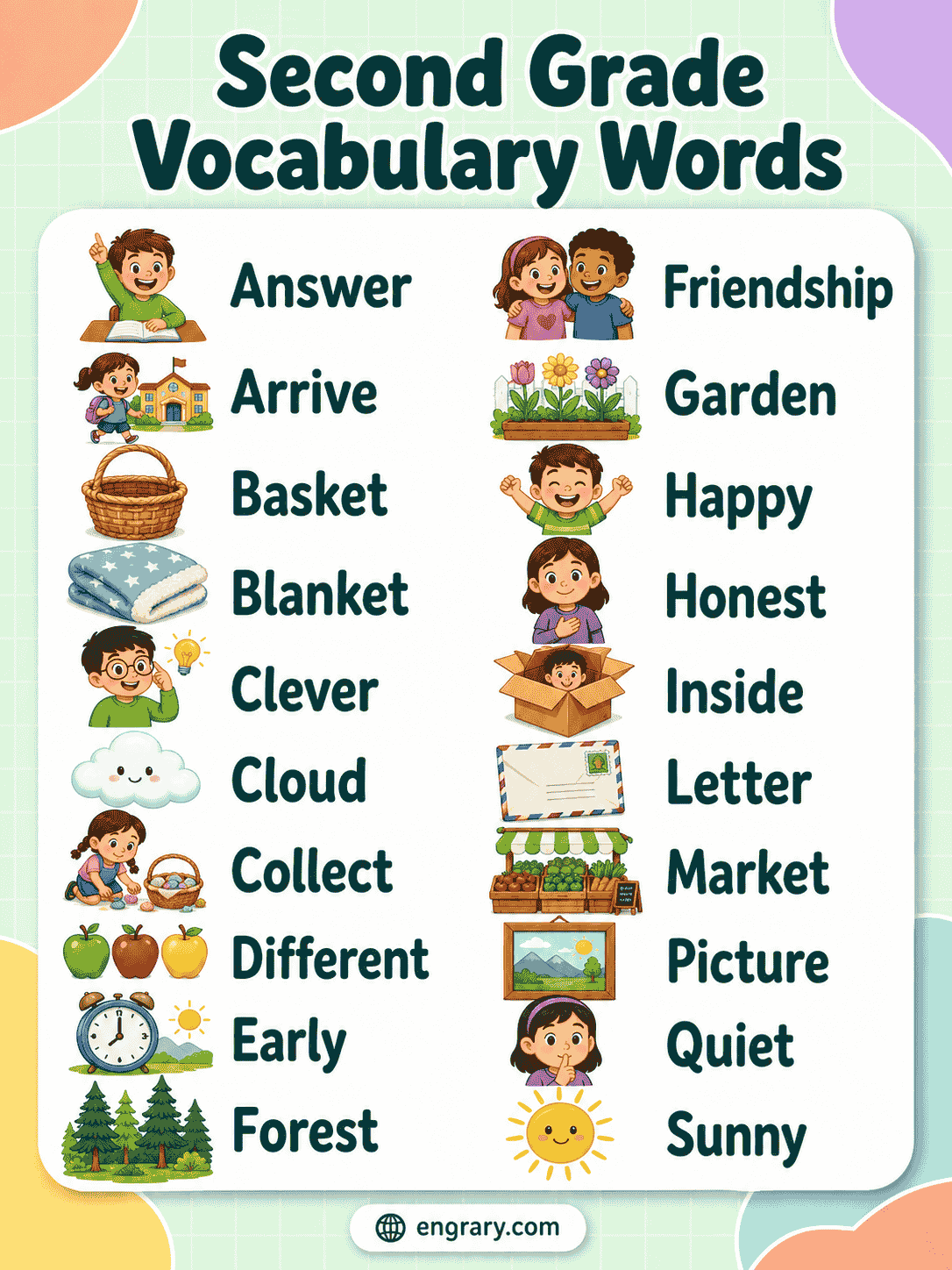
Describing Words That Add Detail
These adjectives help children make descriptions more precise.
Dangerous — Likely to cause harm or injury. The broken glass created a dangerous situation.
Damp — Slightly wet but not completely soaked. The towel was still damp after hanging outside.
Deep — Extending far downward or inward. The rabbit disappeared into a deep hole.
Enormous — Extremely large. An enormous pumpkin rested beside the barn.
Exact — Completely accurate or matching precisely. Please measure the exact length of the paper strip.
Famous — Known by many people. The museum displayed a painting by a famous artist.
Fresh — New, recently made, or not stale. We bought fresh bread from the bakery.
Local — Connected with a nearby area or community. The class visited a local fire station.
Pale — Light in color or lacking strong color. The morning sky was pale blue.
Smooth — Even and not rough. The river stone felt cool and smooth.
Steady — Firm, regular, or not changing suddenly. She held the ruler with a steady hand.
Tiny — Extremely small. A tiny ant carried a crumb across the sidewalk.
Words Used in Math, Science, and Social Studies
These subject words appear frequently in second-grade lessons and informational texts.
Addition — Combining numbers to find a total. We used addition to count the apples in both baskets.
Citizen — A person who legally belongs to a country. Citizens may also help care for their local communities.
Community — A group of people who live, work, or learn in the same area. Our community has a library, school, park, and clinic.
Continent — One of Earth’s seven major land areas. Africa is the second-largest continent.
Energy — The ability to make things move, change, or work. Food gives our bodies energy.
Equal — Having the same amount, number, size, or value. Both groups had an equal number of blocks.
Globe — A round model of Earth. The teacher used a globe to show the oceans and continents.
Habitat — The natural home of a plant or animal. A pond is a habitat for frogs, fish, and insects.
Insect — An animal with six legs and three main body sections. A butterfly is an insect.
Mammal — An animal with hair or fur whose mother produces milk for her young. A whale is a mammal even though it lives in water.
Map — A drawing that shows where places or features are located. We followed the map to find the nature trail.
Subtraction — Taking one number away from another. Subtraction helped us find how many cookies remained.
Temperature — A measurement of how hot or cold something is. The thermometer showed that the temperature had fallen.
Weather — The condition of the air and sky at a particular time and place. Today’s weather is cool, windy, and cloudy.
Related Words and Opposites
Some words share a base, while prefixes and suffixes can change their meanings.
Agree — Having the same opinion or accepting an idea. We agree that the class pet needs fresh water.
Disagree — Having a different opinion. The two friends disagreed about which game to play.
The prefix dis- can give a word an opposite meaning. Therefore, disagree means not having the same opinion.
Careful — Taking time to avoid mistakes or danger. Be careful when carrying the full glass.
Careless — Not giving enough attention to safety or accuracy. A careless mistake changed the answer.
The suffix -ful can mean “showing” or “full of,” while -less means “without.” As a result, careful describes someone who shows care, while careless describes someone who does not show enough care.
| Word | Related word | Relationship |
|---|---|---|
| Cheerful | happy | synonym |
| Enormous | huge | synonym |
| Tiny | small | synonym |
| Dangerous | safe | opposite |
| Deep | shallow | opposite |
| Beginning | ending | opposite |
| Protect | protection | word family |
| Collect | collection | word family |
Words with More Than One Meaning
The sentence around a word often reveals which meaning the writer intends.
Light — This word can mean brightness or something that is not heavy. Sunlight filled the room. The empty box was light enough to carry.
Present — A present can be a gift or mean being in a place now. Mia opened her birthday present. Every student was present in class.
Seal — A seal can be a sea mammal or the action of closing something tightly. A seal rested on the rock. Please seal the envelope.
Watch — Watch can mean looking carefully or a device that shows time. We watched the bird build its nest. Dad checked his watch.
| Word | Meaning 1 | Meaning 2 |
|---|---|---|
| Light | brightness | not heavy |
| Present | a gift | here or happening now |
| Seal | a sea animal | close tightly |
| Watch | look carefully | a timepiece |
Using Context Clues to Find Word Meanings
Context clues are nearby words, actions, or details that help readers understand an unfamiliar word.
| Sentence | Helpful clue | Meaning |
|---|---|---|
| The towel was damp, so Mia placed it in the sun to dry. | placed it in the sun to dry | slightly wet |
| The enormous pumpkin was too large for one child to carry. | too large for one child | extremely large |
| Leo felt nervous, and his hands shook before he stepped onstage. | hands shook before the event | worried or uneasy |
| The rabbit seemed to vanish when it disappeared behind the bushes. | disappeared behind the bushes | disappear suddenly |
Readers can look for examples, descriptions, actions, comparisons, causes, and results. These clues often reveal enough information to make a sensible guess.
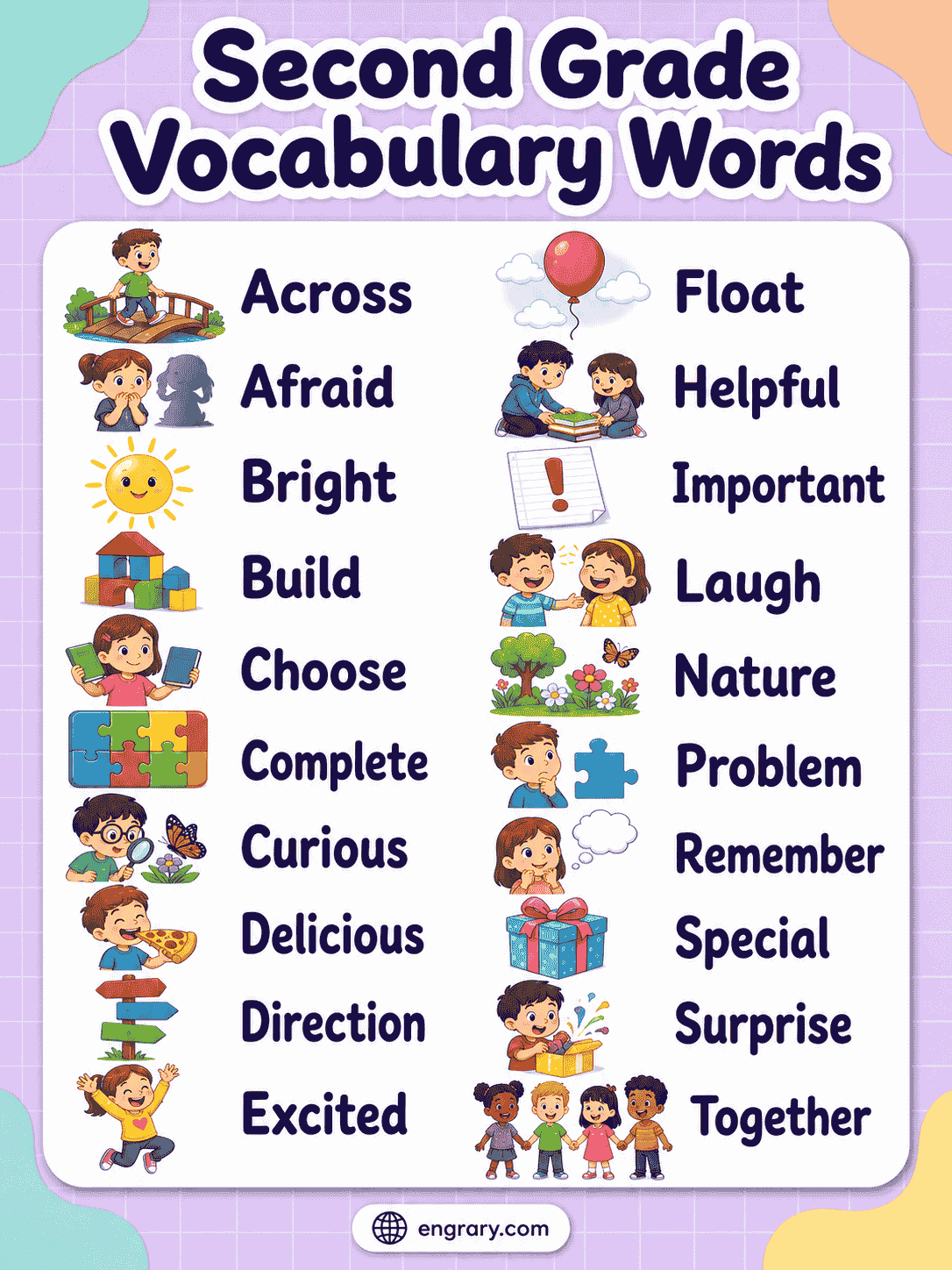
Using Stronger Words in Sentences
More exact vocabulary can make a sentence clearer and more interesting.
| Basic sentence | Stronger sentence |
|---|---|
| The big dog went across the yard. | The enormous dog dashed across the yard. |
| Mia looked at the insect. | Mia observed the insect carefully. |
| The boy jumped over the puddle. | The boy leaped over the puddle. |
| We looked for the missing key. | We searched for the missing key. |
| The rabbit went away. | The rabbit vanished into the bushes. |
| The child was happy. | The cheerful child smiled at everyone. |
Choose the most accurate word rather than simply choosing the longest one. Dash works when someone moves quickly, while settle fits something that moves downward and comes to rest.
Vocabulary Practice with Clues and Sentences
Match the Word with Its Meaning
- curious
- enormous
- predict
- protect
- solution
- observe
- vanish
- damp
a. slightly wet
b. wanting to know more
c. disappear completely
d. keep safe from harm
e. extremely large
f. an answer to a problem
g. watch carefully
h. say what may happen next
Choose the Best Word
Use the words in the box.
observe · organize · predict · protect · search · vanish
- Dark clouds helped us ___ that rain was coming.
- The class began to ___ for the missing ruler.
- A thick shell can ___ a turtle.
- Maya used labels to ___ the supplies.
- The magician made the coin appear to ___.
- We used a magnifying glass to ___ the beetle.
Find the Synonym
- calm → __________
- tiny → __________
- dash → __________
- famous → __________
Choices: hurry · peaceful · small · well-known
Find the Opposite
- dangerous → __________
- deep → __________
- agree → __________
- careful → __________
Choices: careless · disagree · safe · shallow
Use Context Clues
1. The path was damp after the light rain.
What does damp mean?
a. very hot
b. slightly wet
c. completely dry
2. The enormous elephant was much larger than the goat.
What does enormous mean?
a. extremely large
b. very quiet
c. slightly pale
3. The curious child asked several questions about the cocoon.
What does curious mean?
a. wanting to know more
b. feeling lonely
c. moving steadily
Choose the Correct Meaning
| Sentence | Correct meaning |
|---|---|
| The feather was light enough to float. | brightness / not heavy |
| Every student was present for the photograph. | a gift / here now |
| Please seal the envelope before mailing it. | a sea animal / close tightly |
| We watched the bird build its nest. | look carefully / a timepiece |
Improve the Sentence
Replace the basic words with stronger vocabulary.
- The big dog went quickly across the yard.
- Mia looked carefully at the insect.
- The frog jumped over the rock.
- The rabbit suddenly went away.
Answer Key
Match the word with its meaning
- curious → b
- enormous → e
- predict → h
- protect → d
- solution → f
- observe → g
- vanish → c
- damp → a
Choose the best word
- predict
- search
- protect
- organize
- vanish
- observe
Find the synonym
- calm → peaceful
- tiny → small
- dash → hurry
- famous → well-known
Find the opposite
- dangerous → safe
- deep → shallow
- agree → disagree
- careful → careless
Use context clues
- b. slightly wet
- a. extremely large
- a. wanting to know more
Choose the correct meaning
- light → not heavy
- present → here now
- seal → close tightly
- watch → look carefully
Improve the sentence
- The enormous dog dashed across the yard.
- Mia observed the insect carefully.
- The frog leaped over the rock.
- The rabbit suddenly vanished.
FAQs
There is no single required number, but a focused list of 80–120 useful words provides variety without overwhelming most learners.
They should learn classroom language, story terms, action verbs, descriptive words, feelings, and common words from math, science, and social studies.
No. Sight words are recognized quickly while reading, whereas vocabulary words are studied for meaning and correct use.
Children remember words more easily when they meet them in stories, discuss their meanings, connect them with pictures, and use them in several situations.
Context clues help children infer unfamiliar meanings by using nearby descriptions, actions, examples, comparisons, causes, and results.
You May Also Like