Fifth graders read longer texts, compare sources, explain evidence, and write organized responses across several subjects. Therefore, they need vocabulary that supports research, reasoning, discussion, technical learning, and precise communication.
The 160 fifth grade vocabulary words below include academic language, research terms, reasoning words, action verbs, personal qualities, descriptive vocabulary, transitions, and major concepts from math, science, history, government, geography, and economics. Each word includes a clear meaning and a natural example sentence.
How Vocabulary, Sight, and Spelling Words Differ
Vocabulary, sight words, and spelling words develop different language skills.
| Word group | Main purpose | Examples |
|---|---|---|
| Vocabulary words | Understand meanings and use words accurately | resilient, corroborate, inevitable |
| Sight words | Recognize frequent words automatically | although, throughout, neither |
| Spelling words | Apply correct spelling patterns | immediately, privilege, accommodate |
| Academic words | Understand ideas across subjects | synthesize, criteria, substantiate |
| Technical words | Understand a particular field | photosynthesis, volume, amendment |
Vocabulary learning goes beyond recognition or correct spelling. A student should understand a word’s meaning, select the definition that fits the context, and use the word accurately in speaking and writing.
Academic Words for Schoolwork
These words help students plan projects, follow expectations, compare possibilities, and complete independent assignments.
Acquire — Gaining, obtaining, or learning something. Students acquired useful information from several reliable sources.
Adequate — Enough to meet a basic need or requirement. The paragraph contained adequate evidence but needed more explanation.
Allocate — Dividing time, money, or materials for a particular purpose. The group allocated ten minutes to each part of the presentation.
Alternative — Another possible choice or course of action. When the first experiment failed, we developed an alternative plan.
Anticipate — Expecting something before it happens. The class anticipated several questions from the audience.
Applicable — Relevant and useful in a particular situation. Only rules applicable to the investigation belonged in the procedure.
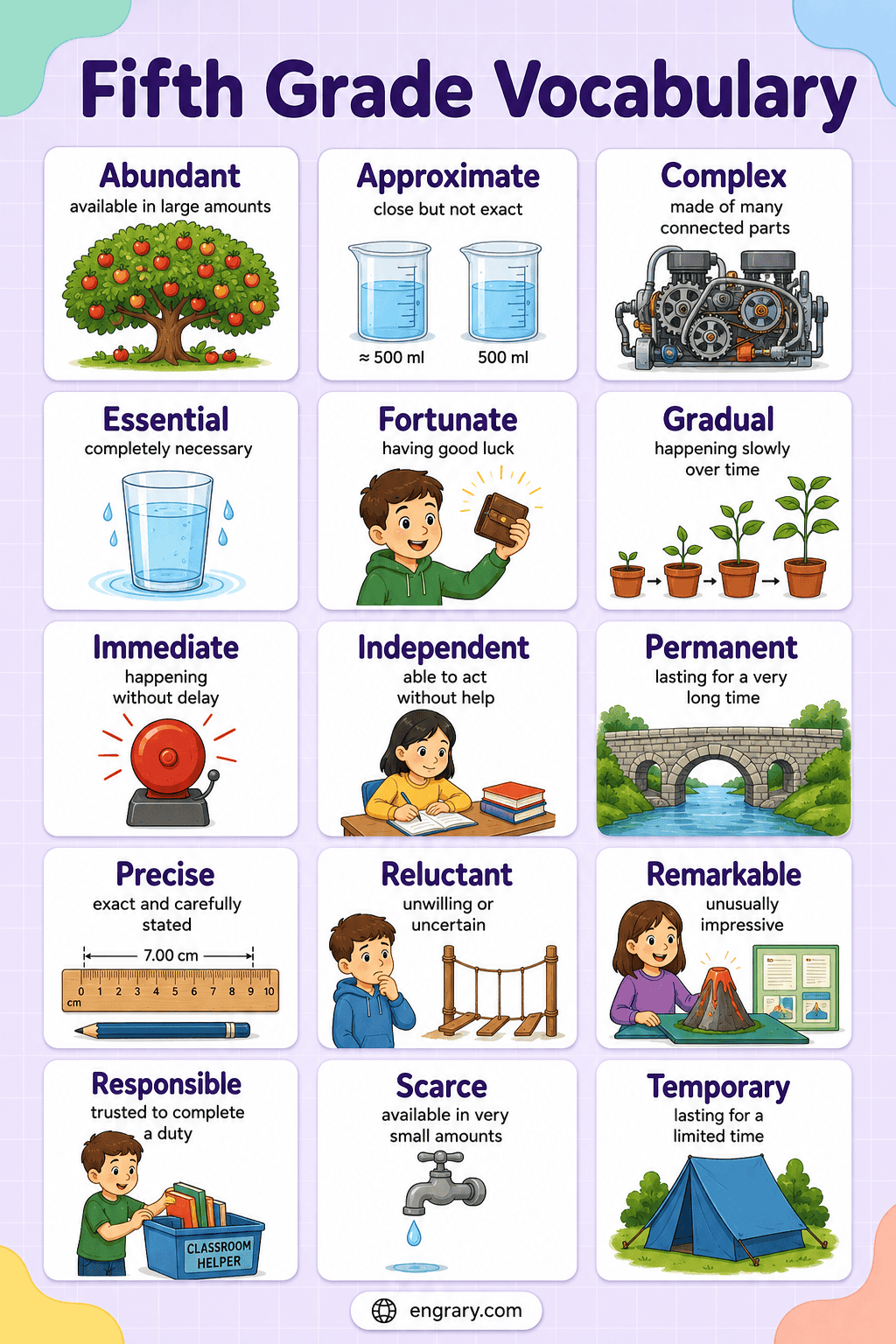
Approximate — Close to the correct amount without being exact. The approximate distance between the towns was fifty miles.
Capacity — The greatest amount something can hold or the ability it has to perform a task. The container had a capacity of two liters.
Circumstance — A condition or fact that affects a situation. Under normal circumstances, the library closes at five o’clock.
Comprehensive — Covering nearly all important parts of a subject. Her comprehensive report included geography, history, and population data.
Consistent — Remaining steady in quality, behavior, or pattern. Consistent practice helped Amir improve his reading fluency.
Criteria — Standards used to judge, compare, or choose something. Our design had to meet three safety criteria.
Designate — Choosing or naming someone or something for a particular role. The teacher designated Maya as the discussion leader.
Eliminate — Removing something that is unnecessary, incorrect, or unwanted. We eliminated two choices that did not match the evidence.
Essential — Completely necessary or extremely important. Clean water is essential for every living organism.
Formulate — Developing a question, idea, or plan carefully. The students formulated a hypothesis before beginning the investigation.
Implement — Putting a plan or decision into action. The school implemented a new recycling program.
Maximum — The greatest amount allowed or possible. The elevator has a maximum capacity of twelve people.
Minimum — The smallest amount required or possible. The assignment required a minimum of three supporting details.
Preliminary — Completed before the main work or final decision. Preliminary research helped us choose a manageable topic.
Retain — Keeping information, an object, or a condition over time. Drawing a diagram helped Nina retain the scientific information.
Substantial — Large or important enough to matter. The second source provided substantial evidence for the claim.
Reading and Research Words
These terms help fifth graders analyze texts, compare sources, and organize information.
Allusion — A brief reference to a well-known person, event, story, or idea. The phrase “Achilles’ heel” was an allusion to Greek mythology.
Annotate — Adding notes, comments, or marks to a text. We annotated the article by underlining claims and circling unfamiliar terms.
Bias — An unfair preference that influences how information is selected or presented. The article showed bias by discussing only one side of the issue.
Central idea — The main point developed in an informational text. The central idea explained how drought affects agriculture.
Characterization — The methods a writer uses to reveal what a character is like. Through characterization, readers learned that Lina was resourceful and honest.
Chronology — The order in which events happen over time. The timeline presented the events in correct chronology.
Citation — Information that identifies the source of a fact, quotation, or idea. Every borrowed fact needed a citation.
Compile — Collecting information from several places and arranging it together. The class compiled its survey results into one chart.
Convey — Communicating or making an idea known. The author used imagery to convey the loneliness of the setting.
Corroborate — Confirming information by finding another independent source that supports it. A newspaper report helped corroborate details from the diary.
Excerpt — A short passage taken from a longer work. We read an excerpt from the explorer’s journal.
Footnote — A note at the bottom of a page that gives a source or extra information. The footnote explained where the quotation first appeared.
Imagery — Language that appeals to the senses and creates a mental picture. Detailed imagery helped readers imagine the crowded marketplace.
Integrate — Combining parts so they work together. Maya integrated information from three sources into one clear explanation.
Interpretation — An explanation of what something means. The students offered different interpretations of the poem’s ending.
Manuscript — The original or unpublished version of a written work. The museum displayed an early manuscript of the novel.
Mood — The feeling a text creates for the reader. Dark descriptions created a mysterious mood.
Primary source — A record created by someone directly connected to an event or period. The soldier’s letter was a primary source.
Publication — A printed or digital work made available to readers. The science magazine was a respected publication.
Secondary source — A work created later by someone using primary and other sources. The history textbook was a secondary source.
Synthesize — Combining ideas from several sources to form a new understanding. We synthesized information from maps, letters, and articles.
Voice — The writer’s distinctive style or personality. The author’s humorous voice made the essay enjoyable.
Reasoning and Evidence Words
These words help students evaluate ideas, compare positions, and explain how evidence supports a conclusion.
Advocate — Publicly supporting a cause, idea, or action. The students advocated for a safer crosswalk near the school.
Assertion — A statement presented as true. The author’s assertion needed stronger evidence.
Challenge — Questioning an idea or testing whether it is correct. The new discovery challenged the earlier explanation.
Consensus — General agreement within a group. After a long discussion, the committee reached a consensus.
Contradiction — A statement or fact that conflicts with another. The second report revealed a contradiction in the timeline.
Counterpoint — A different idea or position offered for comparison. The speaker presented a counterpoint to the proposed rule.
Debate — A structured discussion in which different positions are presented. The class held a debate about school uniforms.
Generalize — Forming a broad idea from several examples or patterns. A generalization may be unreliable when it is based on too little evidence.
Hypothesis — A testable explanation or prediction. Our hypothesis stated that warmer water would dissolve sugar faster.
Impartial — Fair and not favoring one side. An impartial judge listened carefully to both arguments.
Indicate — Showing, pointing out, or suggesting something. The graph indicated a steady rise in temperature.
Objection — A reason for disagreeing with a plan or statement. One objection was that the proposal would cost too much.
Plausible — Believable or reasonably possible. The explanation seemed plausible because it matched the available clues.
Principle — A basic belief or rule that guides actions and decisions. Fairness was an important principle in the class agreement.
Propose — Suggesting a plan or idea for consideration. Our group proposed adding native plants to the garden.
Reasoning — The thinking that connects evidence to a conclusion. Clear reasoning showed why the facts supported the claim.
Reinforce — Strengthening an idea, structure, or behavior. Another example helped reinforce the main point.
Resolve — Solving a problem or settling a disagreement. The two teams met to resolve the conflict.
Substantiate — Supporting a statement with strong evidence. The writer used statistics to substantiate the assertion.
Weigh — Carefully considering the importance of different choices or evidence. We weighed the advantages and disadvantages before deciding.

Action and Communication Words
These verbs provide precise alternatives to broad words such as change, say, work, begin, move, and fix.
Alter — Changing part of something. The team altered the model after testing its stability.
Articulate — Expressing an idea clearly and effectively. Jamal articulated his opinion during the discussion.
Collaborate — Working with others toward a shared goal. Three classes collaborated on the community project.
Demonstrate — Showing clearly how something works or why it is true. The experiment demonstrated that air takes up space.
Emphasize — Giving special importance to something. The speaker emphasized the need to conserve water.
Encounter — Meeting or experiencing something unexpectedly. The hikers encountered a fallen tree across the trail.
Execute — Carrying out a plan, task, or instruction. The group executed the procedure carefully.
Express — Communicating a thought, feeling, or idea. The poem expressed the writer’s gratitude.
Initiate — Beginning a process or action. The principal initiated a schoolwide reading challenge.
Intervene — Becoming involved in order to change or improve a situation. The teacher intervened before the disagreement became serious.
Negotiate — Discussing differences in order to reach an agreement. The teams negotiated how to divide the materials.
Preserve — Protecting something from damage, change, or loss. The museum works to preserve historical documents.
Pursue — Continuing to work toward a goal or follow an interest. Elena decided to pursue her interest in astronomy.
Reconstruct — Building something again or forming an account from available evidence. Historians reconstructed the event from letters and maps.
Relocate — Moving someone or something to a different place. Workers relocated the young trees before construction began.
Restore — Returning something to an earlier or better condition. Volunteers restored the damaged trail.
Submit — Formally giving work or information for review. Please submit the final report by Monday.
Withdraw — Removing, taking back, or moving away. The team withdrew its proposal after discovering a major problem.
Feelings and Personal Qualities
These words describe attitudes, emotions, habits, and character traits.
Accountable — Expected to accept responsibility for actions and results. Each group member was accountable for one part of the project.
Adaptable — Able to adjust to new situations or conditions. The adaptable team changed its plan when the weather shifted.
Apprehensive — Worried or uneasy about something that may happen. Jordan felt apprehensive before the difficult interview.
Assertive — Confidently expressing needs or opinions without being disrespectful. Maya was assertive when she explained why the rule seemed unfair.
Conscientious — Careful, responsible, and determined to do work well. The conscientious student checked every citation.
Cooperative — Willing to work peacefully and helpfully with others. The cooperative group completed the task ahead of schedule.
Decisive — Able to make choices firmly and without unnecessary delay. The captain was decisive during the emergency drill.
Dedicated — Strongly committed to a goal, task, or purpose. The dedicated volunteers returned every weekend.
Disciplined — Able to control behavior and follow a plan. His disciplined study routine improved his results.
Empathetic — Able to understand another person’s feelings. The empathetic student listened without interrupting.
Envious — Unhappy because someone else has something desirable. Marcus felt envious of his friend’s new bicycle.
Honorable — Honest, fair, and worthy of respect. Returning the lost wallet was an honorable action.
Insecure — Uncertain about abilities, value, or safety. She felt insecure about presenting her work to the class.
Resourceful — Skilled at finding practical ways to solve problems. The resourceful campers repaired the shelter with available materials.
Resilient — Able to recover after difficulty or change. The resilient community rebuilt after the flood.
Skeptical — Doubtful and unwilling to accept something without evidence. We were skeptical of the claim until we checked another source.

Precise Describing Words
These adjectives describe seriousness, appearance, complexity, importance, change, and risk.
Acute — Very serious, intense, or sharp. The region faced an acute shortage of clean water.
Apparent — Seeming clear or easy to notice, though not always fully proven. It became apparent that the first calculation was incorrect.
Barren — Unable to support much plant life. Few plants survived on the barren hillside.
Compact — Closely packed or taking up little space. The compact device fit easily inside the bag.
Conventional — Following common or widely accepted methods. The team rejected the conventional design and tested a new one.
Crucial — Extremely important to a result. Accurate measurements were crucial to the experiment.
Diverse — Including many different types or groups. The wetland supports a diverse collection of organisms.
Exceptional — Unusually good, impressive, or uncommon. Her exceptional research earned the highest score.
Extensive — Covering a large area, amount, or range. The library contains an extensive collection of historical maps.
Gradual — Happening slowly over time. The gradual rise in temperature lasted several hours.
Inevitable — Certain to happen or impossible to avoid. After days of heavy rain, some flooding seemed inevitable.
Intricate — Made of many small, connected details. The artist created an intricate pattern.
Isolated — Separated from other people, places, or things. The isolated village could be reached only by boat.
Peculiar — Strange or unusual. A peculiar sound came from the empty room.
Prominent — Important or easy to notice. The mountain was a prominent feature of the landscape.
Stable — Firm, steady, and unlikely to change suddenly. The table remained stable after we tightened the legs.
Subtle — Difficult to notice because it is slight or indirect. The author gave a subtle clue about the ending.
Vulnerable — Open to possible harm or damage. Young plants are vulnerable during severe frost.
Math and Science Words
These terms support fifth-grade work with decimals, coordinate planes, volume, matter, weather, and living systems.
Coordinate — One number in an ordered pair that helps locate a point on a grid. The first coordinate showed the horizontal position.
Expression — A mathematical phrase containing numbers, symbols, or operations. The expression 6 × 4 + 2 does not include an equals sign.
Hundredth — One of one hundred equal parts; in a decimal, it is the second place to the right of the decimal point. In 0.47, the 7 is in the hundredths place.
Mixed number — A number made of a whole number and a fraction. Two and one-half is a mixed number.
Numerical — Expressed or represented using numbers. The table included numerical data from the experiment.
Operation — A mathematical action such as addition, subtraction, multiplication, or division. We selected the correct operation before solving the problem.
Ordered pair — Two numbers written in a fixed order to locate a point. The ordered pair (3, 5) identified the point on the grid.
Place value — The value of a digit based on its position in a number. In 4.62, the 6 has a value of six tenths.
Thousandth — One of one thousand equal parts; in a decimal, it is the third place to the right of the decimal point. In 0.008, the 8 represents eight thousandths.
Volume — The amount of three-dimensional space an object occupies or a container can hold. We found the volume of the rectangular prism using unit cubes.
Atom — A basic unit of an element. Every element consists of atoms.
Chemical — Relating to substances, their properties, and the changes they undergo. The mixture produced a chemical reaction.
Conservation — The careful protection and wise use of natural resources. Water conservation reduces unnecessary waste.
Dissolve — Becoming evenly mixed into a liquid. Salt began to dissolve in the warm water.
Evaporation — The process in which a liquid changes into a gas. Evaporation caused the puddle to disappear.
Gravity — The force that pulls objects toward one another. Earth’s gravity pulls falling objects toward the ground.
Mixture — Two or more materials combined without forming one new substance. Trail mix is a mixture of several foods.
Molecule — Two or more atoms joined together. A water molecule contains hydrogen and oxygen atoms.
Photosynthesis — The process plants use to make sugar from water and carbon dioxide using light energy. Photosynthesis occurs mainly in green leaves.
Precipitation — Water that falls from clouds as rain, snow, sleet, or hail. Heavy precipitation filled the river.
Property — A measurable or observable feature of matter, such as color, mass, or hardness. Scientists compared the physical properties of the minerals.
Substance — A particular kind of matter with its own properties. Water is a substance that can exist as a solid, liquid, or gas.
History, Government, and Economics Words
These terms help students discuss laws, trade, political systems, and historical change.
Amendment — A change or addition to an official document. The amendment added a new protection to the constitution.
Authority — The recognized power to make decisions or enforce rules. The council had the authority to approve the project.
Commerce — The buying, selling, and exchange of goods or services. River travel helped commerce grow between towns.
Compromise — An agreement in which each side accepts part of the other’s position. The two groups reached a compromise.
Conflict — A serious disagreement, struggle, or clash. The conflict began over control of the land.
Federal — Relating to a national government that shares power with states or regions. Federal laws apply across the country.
Independence — Freedom from outside control. The nation declared independence after years of disagreement.
Legislation — Laws or proposed laws created by a government. The new legislation focused on protecting public land.
Representation — The act of speaking or acting for other people. Citizens wanted fair representation in government.
Revolution — A major change in political power, society, or ideas. The revolution replaced the old government.
Rights — Freedoms and protections that people are entitled to have. The document explained the rights of citizens.
Settlement — A place where people establish a community. The settlement grew near a reliable water source.
Words That Connect Ideas
These transitions help writers organize comparisons, additions, contrasts, and sequences.
Additionally — Adds another related point. The plant needs sunlight; additionally, it requires water.
Although — Introduces a contrast or limitation. Although the route was longer, it was safer.
Alternatively — Presents another choice. We could revise the design; alternatively, we could begin again.
Conversely — Introduces an opposite relationship. Dense materials may sink; conversely, less dense materials may float.
Furthermore — Adds stronger supporting information. The plan saves money; furthermore, it reduces waste.
Nevertheless — Shows that something remains true despite difficulty. The evidence was limited; nevertheless, the explanation was plausible.
Similarly — Introduces a related comparison. Wolves live in groups; similarly, many wild dogs form packs.
Specifically — Introduces an exact detail or example. The report focused specifically on water conservation.
Subsequently — Shows what happened later. The road flooded and was subsequently closed.
Whereas — Contrasts two facts or situations. Copper conducts electricity, whereas rubber resists its movement.
Claims, Evidence, and Reasoning
A strong argument includes a position, support, and an explanation of how the support proves the position.
| Term | Function |
|---|---|
| Claim | The position or idea being presented |
| Evidence | Facts, data, examples, or quotations that support it |
| Reasoning | The explanation connecting evidence to the claim |
| Counterpoint | A different position that should be considered |
For example, a student may claim that the school should create a vegetable garden. Survey results and scientific research provide evidence. The reasoning explains how the garden would support learning and healthy eating, while a counterpoint might mention cost or maintenance.
Evidence does not support a claim automatically. Writers must explain why each fact matters.

Primary and Secondary Sources
Research becomes stronger when students understand how different sources were created.
| Source type | Meaning | Examples |
|---|---|---|
| Primary source | Created by someone directly connected to an event or time | diary, letter, photograph, interview |
| Secondary source | Created later by someone using primary and other sources | textbook, documentary, biography, encyclopedia article |
A primary source may provide direct evidence, but it can still reflect limited knowledge or personal bias. A secondary source may combine several accounts, though its writer still selects and interprets information.
Source type alone does not determine reliability. Students should also examine the author, purpose, evidence, date, and publication.
Summarizing, Paraphrasing, and Synthesizing
These research skills serve different purposes.
| Skill | Purpose |
|---|---|
| Summarize | State only the most important points |
| Paraphrase | Restate one passage or idea in new words |
| Synthesize | Combine ideas from several sources |
| Quote | Repeat the exact original wording |
A summary shortens a complete text, while a paraphrase restates a particular idea. Synthesis connects information from several sources to create a broader understanding.
Even when students paraphrase, they should still cite the original source.
How Word Parts Build Meaning
Fifth graders can combine prefixes, roots, and suffixes to understand long words.
| Word | Parts | Meaning path |
|---|---|---|
| Unpredictable | un + predict + able | not able to be predicted |
| Misinterpretation | mis + interpret + ation | an incorrect understanding |
| Reconstruction | re + construct + ion | the act of building again |
| Transportation | trans + port + ation | the system of carrying across |
| Microscopic | micro + scop + ic | related to viewing something very small |
| Biodegradable | bio + degrade + able | able to be broken down by living organisms |
| Word part | Meaning | Examples |
|---|---|---|
| anti- | against | antifreeze, antisocial |
| inter- | between | interact, international |
| micro- | small | microscope, microscopic |
| mis- | wrongly | misunderstand, misinterpret |
| trans- | across | transport, transfer |
| -able | capable of | portable, renewable |
| -tion | act or process | conservation, interpretation |
| -ive | having a quality | cooperative, decisive |
Word parts provide valuable clues. However, readers should still use context because roots do not always reveal the complete meaning.
Using Context Clues Across Paragraphs
Fifth graders should combine several clues rather than depend on one nearby synonym.
Restatement
The region faced an acute shortage of water. The problem was so severe that families received only a small daily supply.
The second sentence shows that acute means serious or intense.
Contrast
Most teams used a conventional design. Ava’s group, however, developed an unusual model with movable parts.
The contrast reveals that conventional means following common methods.
Cause and Effect
The island was isolated from the mainland. Consequently, supplies arrived only once each month.
The delivery problem shows that isolated means separated from other places.
Word Parts and Context
The packaging was biodegradable. Living organisms could break it down, so it did not remain in the soil for many years.
The word parts and explanation work together to reveal the meaning.
Strong readers combine surrounding details, transition words, word parts, background knowledge, and reference tools.
Connotation and Shades of Meaning
Related words can share a basic meaning while creating different impressions.
| Word group | Main difference |
|---|---|
| Assertive, forceful, aggressive | confident expression to hostile pressure |
| Curious, inquisitive, intrusive | healthy interest to unwanted involvement |
| Determined, persistent, stubborn | positive effort to refusal to change |
| Frugal, economical, miserly | careful personal spending, efficient use, or extreme unwillingness to spend |
| Unusual, peculiar, bizarre | mildly different to extremely strange |
| Slender, thin, gaunt | positive or neutral description to an unhealthy appearance |
A thesaurus may place these words together, but they are not fully interchangeable. For example, assertive usually has a positive or neutral tone, while aggressive often suggests hostility.
Understanding Figurative Language
Figurative language creates images, mood, and emphasis beyond literal meaning.
Simile compares using like or as:
The clouds moved like ships across the sky.
Metaphor makes a direct comparison:
The city was a sleeping giant before sunrise.
Personification gives human actions to something nonhuman:
The wind whispered through the leaves.
Hyperbole uses deliberate exaggeration:
I have told you a million times.
Idiom has a conventional nonliteral meaning:
Back to square one means returning to the beginning.
Proverb expresses familiar wisdom:
Don’t judge a book by its cover means appearance does not reveal everything.
Multiple-Meaning Words
Context, part of speech, and pronunciation can change a word’s meaning.
| Word | Meaning 1 | Meaning 2 |
|---|---|---|
| Abstract | existing as an idea | a short summary |
| Compound | made of combined parts | a substance formed from elements |
| Content | information inside something | satisfied |
| Contract | a legal agreement | become smaller |
| Digest | break down food | a collection or summary |
| Impact | a strong effect | strike forcefully |
| Minute | sixty seconds | extremely small |
| Produce | create or make | fruits and vegetables |
Some of these words also change stress or pronunciation:
- CON-tent means information, while con-TENT means satisfied.
- CON-tract is an agreement, while con-TRACT means become smaller.
- PRO-duce means fruits and vegetables, while pro-DUCE means create.
- MIN-it measures time, while my-NOOT means extremely small.
Readers should examine sentence structure, pronunciation, and surrounding words before choosing a definition.

Analogies and Word Relationships
Analogies show how two word pairs share the same relationship.
Part and Whole
petal : flower :: page : book
Tool and Function
thermometer : temperature :: scale : weight
Cause and Effect
drought : scarcity :: heavy rain : flooding
Category and Example
mineral : quartz :: renewable resource : sunlight
Degree of Intensity
concerned : apprehensive :: unusual : bizarre
Action and Result
corroborate : confirmation :: negotiate : agreement
Recognizing the relationship matters more than simply knowing each word separately.
Using Dictionaries and Other Reference Tools
Different tools answer different questions.
| Tool | Best use |
|---|---|
| Dictionary | meanings, pronunciation, parts of speech, and usage |
| Glossary | subject-specific terms from a book |
| Thesaurus | related words and possible alternatives |
| Index | locations of topics within a book |
| Encyclopedia | broad background information |
| Atlas | maps and geographical information |
When a word has several definitions, students should compare every meaning with the sentence. They should also check the part of speech and pronunciation.
A thesaurus can suggest alternatives, but the replacement must match both meaning and tone.
Choosing Precise Words in Writing
Exact vocabulary improves clarity, organization, and tone.
Narrative Writing
Basic:
We went to the old building. It looked strange, and I was worried.
Improved:
We approached the isolated building at dusk. Its peculiar shape made me apprehensive, yet I continued toward the entrance.
Informational Writing
Basic:
Plants use sunlight to make food. This is important.
Improved:
Through photosynthesis, plants use light energy to produce sugar. This process is essential because it supports nearly every food chain.
Opinion Writing
Basic:
Our school should save water because water is important.
Improved:
Our school should implement a conservation plan because clean water is essential and may become scarce during dry periods.
Research Summary
Basic:
Two sources said the town began near the river.
Improved:
A historical map and a firsthand letter corroborated the claim that the settlement developed beside the river.
Fifth Grade Vocabulary Practice
Match Each Word with Its Meaning
- acute
- corroborate
- crucial
- inevitable
- resilient
- skeptical
- substantial
- vulnerable
a. open to possible harm
b. certain to happen
c. extremely important
d. able to recover from difficulty
e. confirm with another source
f. serious or intense
g. doubtful without enough evidence
h. large or important enough to matter
Choose the Best Academic Word
Use these words:
bias · corroborate · crucial · formulate · substantial · synthesize
- The historian used a second document to ___ the account.
- The writer combined information from three sources to ___ a conclusion.
- The new evidence was ___ because it changed the investigation.
- We examined the article for possible ___.
- The team had to ___ a plan before beginning the project.
- The evidence was not ___ enough to prove the assertion.
Analyze the Word Parts
Match each word with its meaning.
- biodegradable
- reconstruction
- transportation
- microscopic
- unpredictable
- misinterpretation
a. an incorrect understanding
b. too small to see easily without magnification
c. able to be broken down by living organisms
d. not able to be predicted
e. the system of carrying people or goods
f. the act of building again
Use Context Across Paragraphs
1.
The shortage became acute. Hospitals and homes received only a limited water supply.
What does acute mean?
a. mild
b. serious
c. hidden
2.
The village was isolated. No roads connected it to nearby towns.
What does isolated mean?
a. separated
b. crowded
c. modern
3.
The clue was subtle. Most readers did not notice it the first time.
What does subtle mean?
a. obvious
b. difficult to notice
c. incorrect
Compare Connotation
Choose the most suitable word.
- The student explained her opinion clearly without insulting anyone.
a. assertive
b. aggressive
c. intrusive - The reporter asked private questions unrelated to the interview.
a. inquisitive
b. curious
c. intrusive - The athlete continued practicing after several failures.
a. persistent
b. stubborn
c. aggressive - The creature had an extremely strange appearance.
a. unusual
b. peculiar
c. bizarre
Identify Figurative Language
- “The river was a silver ribbon” is a:
a. metaphor
b. simile
c. proverb - “The leaves danced in the wind” uses:
a. hyperbole
b. personification
c. idiom - “I waited forever” is an example of:
a. hyperbole
b. allusion
c. quotation - “Back to square one” means:
a. return to the beginning
b. draw a square
c. solve a math problem
Complete the Analogies
- petal : flower :: page : __________
- thermometer : temperature :: scale : __________
- drought : scarcity :: heavy rain : __________
- mineral : quartz :: renewable resource : __________
- corroborate : confirmation :: negotiate : __________
Choices:
- agreement;
- book;
- flooding;
- sunlight;
- weight.
Choose the Correct Reference Tool
- To check the pronunciation and part of speech of apprehensive: __________
- To find a synonym for crucial: __________
- To locate photosynthesis in a science textbook: __________
- To find background information about the American Revolution: __________
- To locate the Andes Mountains: __________
Choices:
- atlas;
- dictionary;
- encyclopedia;
- index;
- thesaurus.
Improve the Writing
Rewrite each sentence using precise vocabulary from the article.
- The plan was very important.
- Two sources said the same thing.
- The team made a plan and used it.
- The article seemed unfair toward one side.
- The community recovered after the storm.
Answer Key
Match each word with its meaning
- acute → f
- corroborate → e
- crucial → c
- inevitable → b
- resilient → d
- skeptical → g
- substantial → h
- vulnerable → a
Choose the best academic word
- corroborate
- synthesize
- crucial
- bias
- formulate
- substantial
Analyze the word parts
- biodegradable → c
- reconstruction → f
- transportation → e
- microscopic → b
- unpredictable → d
- misinterpretation → a
Use context across paragraphs
- b. serious
- a. separated
- b. difficult to notice
Compare connotation
- assertive
- intrusive
- persistent
- bizarre
Identify figurative language
- a. metaphor
- b. personification
- a. hyperbole
- a. return to the beginning
Complete the analogies
- book
- weight
- flooding
- sunlight
- agreement
Choose the correct reference tool
- dictionary
- thesaurus
- index
- encyclopedia
- atlas
Improve the writing: possible answers
- The plan was crucial to the project’s success.
- A second source corroborated the original account.
- The team formulated a plan and implemented it.
- The article showed bias toward one side.
- The resilient community recovered after the storm.
FAQs
There is no universal total, but a focused list of about 150–170 high-value words can support reading, research, writing, and subject learning.
They should understand academic language, research terms, reasoning words, precise verbs and adjectives, transitions, and important vocabulary from math, science, history, and government.
Fifth-grade work uses more abstract reasoning, complex word parts, source comparison, synthesis, connotation, analogies, and paragraph-level context clues.
Students remember words more effectively when they connect meanings with context, roots, related words, examples, and repeated use in speaking and writing.
Morphology reveals how prefixes, roots, and suffixes contribute to meaning, while context shows which definition fits a particular sentence or passage.
You May Also Like