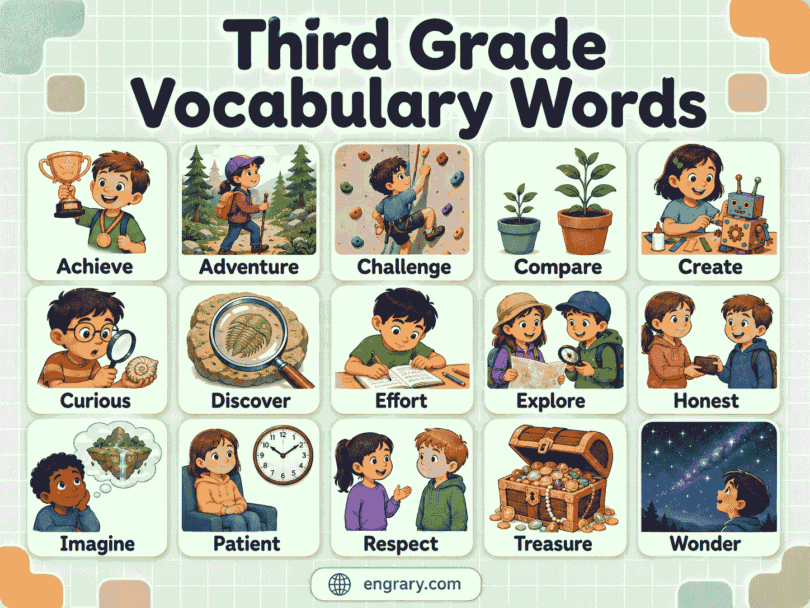
Third graders meet more challenging words in stories, classroom directions, informational texts, and subject lessons. These words help children explain ideas, understand evidence, describe events, solve problems, and write with greater precision.
The 120 third grade vocabulary words below include academic language, reading terms, action verbs, emotions, descriptive words, and common terms from math, science, geography, and history. Each word has a simple meaning and a natural example sentence.

Vocabulary, Sight Words, and Spelling Words
These three word groups support different language skills.
| Word group | Main purpose | Examples |
|---|---|---|
| Vocabulary words | Understand meanings and use words correctly | infer, fragile, typical |
| Sight words | Recognize common words quickly while reading | although, enough, through |
| Spelling words | Write words with correct letter patterns | suddenly, beautiful, carried |
| Academic words | Understand ideas and directions across subjects | evidence, determine, summarize |
| Subject words | Learn concepts from a particular subject | fraction, ecosystem, government |
Vocabulary learning goes beyond recognizing or spelling a word. A child should understand what the word means, notice how it works in context, and use it accurately in speaking or writing.
Words Used at School
These words help students understand assignments, follow procedures, and discuss classroom work.
Accurate — Correct and free from mistakes. Mia checked the measurements to make sure they were accurate.
Additional — Extra or added to what is already there. The teacher gave us additional time to finish the project.
Assignment — A task given as part of schoolwork. Our reading assignment included two chapters and five questions.
Category — A group of things that share a common feature. We placed each animal in the correct category.
Concentrate — To give full attention to one activity or idea. Liam moved to a quiet table so he could concentrate.
Direction — An instruction that tells what to do or where to go. Read each direction carefully before beginning the activity.
Identify — To recognize or name someone or something. The students identified three types of clouds.
Individual — One person or thing considered separately from a group. Each individual wrote a different ending for the story.
Instruction — Information that explains how to do something. The first instruction told us to fold the paper in half.
Method — A particular way of doing something. Ava used a different method to solve the multiplication problem.
Particular — Referring to one specific person, thing, or situation. We searched for a particular book about volcanoes.
Procedure — A series of steps followed in a certain order. The class followed the safety procedure during the experiment.
Process — A set of actions that produces a result. Plant growth is a slow process that begins with a seed.
Purpose — The reason something exists or is done. The purpose of the chart was to compare temperatures.
Record — To write down or save information for later use. We recorded the results in our science notebooks.
Require — To need something or make it necessary. Some assignments require careful planning.
Specific — Clear and exact rather than general. The teacher asked for a specific example from the passage.
Task — A piece of work that needs to be completed. Sorting the cards was the final task of the lesson.
Reading and Writing Words
These terms help third graders understand stories, informational texts, and writing assignments.
Audience — The people who read, watch, or listen to something. The writer used simple language because the audience was young.
Caption — A short explanation placed near a picture or diagram. The caption explained how the caterpillar changed.
Conclusion — An idea or decision reached after examining information. After comparing the results, we reached a conclusion.
Dialogue — The words spoken by characters in a story or play. The dialogue showed that the two characters were angry.
Evidence — Facts or details that support an idea. Maya used evidence from the passage to explain her answer.
Genre — A type or category of literature. Mystery is the genre I enjoy reading most.
Heading — A title that tells what a section is about. The heading helped us find the part about desert animals.
Main idea — The most important point of a text or paragraph. The main idea was that bees play an important role in nature.
Paragraph — A group of related sentences about one main idea. Noah added a detail to the second paragraph.
Plot — The important events that make up a story. The plot became more exciting when the treasure disappeared.
Point of view — The position or perspective from which a story is told. The story’s point of view allowed readers to hear Mia’s thoughts.
Quotation — The exact words spoken or written by someone. Ben used a quotation from the article as evidence.
Revise — To improve writing by changing words, ideas, or organization. I revised my paragraph by adding a clearer topic sentence.
Sequence — The order in which events or steps happen. The recipe showed the sequence for making bread.
Summarize — To state the most important ideas in a shorter form. Elena summarized the chapter in three sentences.
Theme — A broad message or lesson developed in a story. Friendship was an important theme in the book.
Thinking and Problem-Solving Words
These words help students examine information, make decisions, and explain how they solved a problem.
Analyze — To study something carefully by examining its parts. We analyzed the graph to find the largest change.
Cause — The reason something happens. Heavy rain was the cause of the flooded field.
Conclude — To decide something after considering facts or clues. From the muddy tracks, we concluded that a deer had crossed the path.
Consider — To think carefully about something before deciding. Please consider both choices before answering.
Contrast — To focus on how two things are different. The class contrasted city life with life on a farm.
Determine — To find out or decide after examining information. We used the clues to determine which animal made the nest.
Effect — A change or event caused by something else. One effect of the storm was a power outage.
Estimate — To make a reasonable guess close to the exact amount. I estimated that the jar contained about fifty buttons.
Examine — To look at something closely and carefully. The scientist examined the leaf under a microscope.
Infer — To form an idea by using clues and what you already know. The empty bowl helped us infer that the dog had eaten.
Investigate — To study or search for facts about something. The class investigated why some objects floated.
Recognize — To know someone or something because you have seen or learned it before. I recognized the bird by its bright red feathers.
Result — The outcome produced by an action or event. The result of mixing blue and yellow paint was green.
Strategy — A plan used to reach a goal or solve a problem. Drawing a diagram was a useful strategy.
Support — To provide facts, details, or help for an idea. The writer used examples to support the main idea.
Verify — To check that something is true or accurate. We used a second source to verify the information.
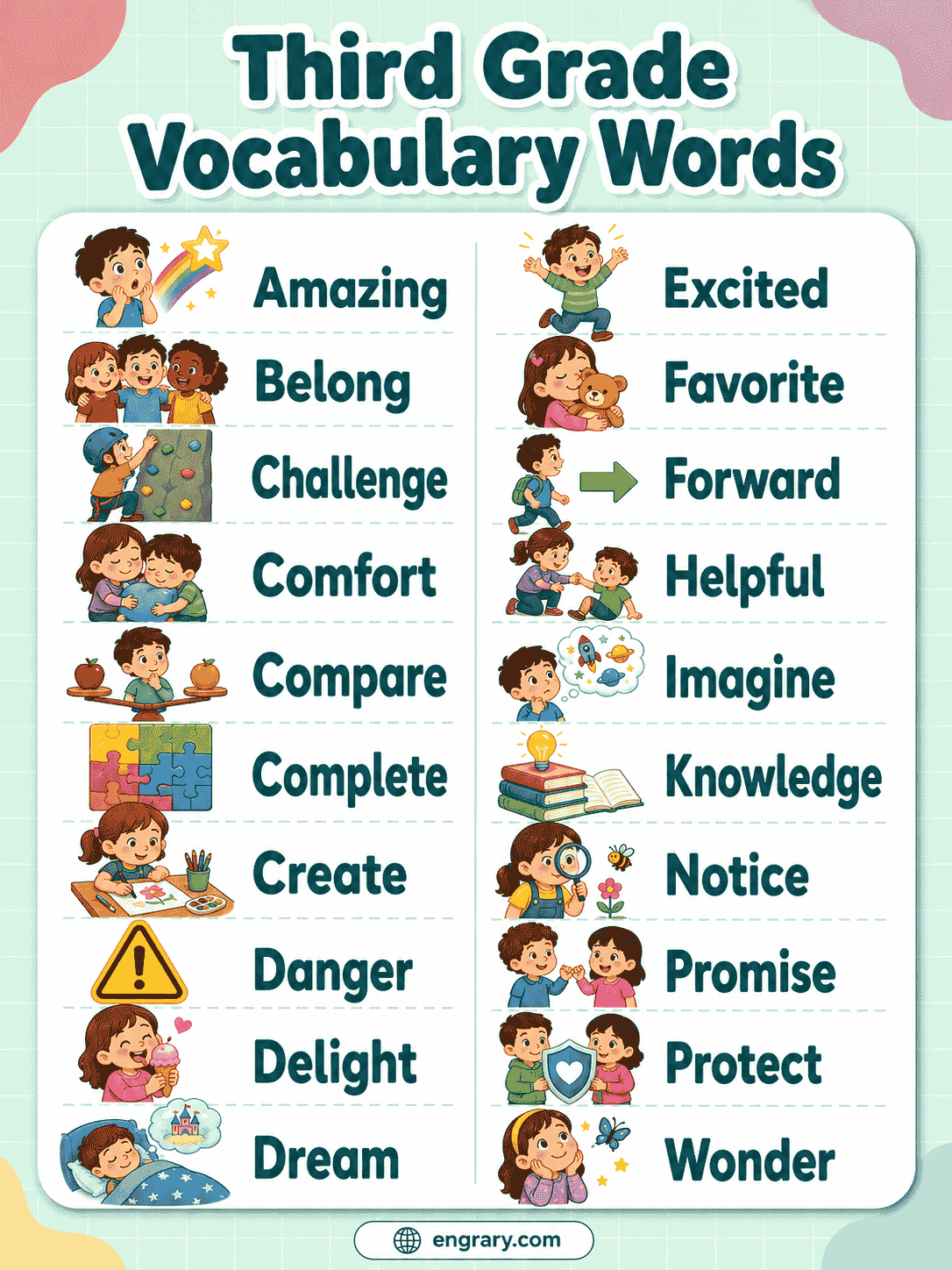
Cause, Effect, Result, and Conclusion
These words are related, but they do not mean the same thing.
| Word | Meaning |
|---|---|
| Cause | Why something happens |
| Effect | A change caused by something |
| Result | The final outcome |
| Conclusion | An idea reached after examining information |
For example, heavy rain may be the cause of flooding. The flooded streets are an effect, while a canceled event may be the result. After examining the evidence, officials may reach the conclusion that the area is unsafe.
Action and Movement Words
These verbs help children replace vague words such as went, moved, looked, and held.
Approach — To move closer to someone or something. We slowed down as we approached the narrow bridge.
Capture — To catch or take control of something. The photographer captured an image of the eagle in flight.
Combine — To join two or more things together. We combined the flour and water in a large bowl.
Dart — To move suddenly and quickly. A lizard darted beneath the rock.
Defend — To protect someone, something, or an idea. The bird spread its wings to defend its nest.
Drag — To pull something along a surface. We dragged the heavy branch away from the trail.
Escape — To get away from danger or a place of control. The mouse escaped through a small opening.
Glide — To move smoothly and quietly. The swan glided across the lake.
Grip — To hold something firmly. Maya gripped the rope with both hands.
March — To walk with regular, strong steps. The band marched down the street.
Peer — To look closely, especially when something is difficult to see. Ben peered through the foggy window.
Rescue — To save someone or something from danger. Firefighters rescued the kitten from the roof.
Scatter — To move or spread in different directions. The birds scattered when the gate opened.
Struggle — To try very hard to do something difficult. The hikers struggled to climb the steep path.
Feelings and Personal Qualities
These words help children describe emotions, reactions, and character traits.
Anxious — Worried or uneasy about what may happen. Sofia felt anxious before performing onstage.
Confident — Feeling sure about your abilities or decisions. After practicing, Ethan felt confident about the test.
Considerate — Careful about the feelings and needs of others. It was considerate of Mia to hold the door open.
Determined — Firmly decided to complete a goal. The determined runner continued despite the strong wind.
Disappointed — Unhappy because something did not happen as hoped. We felt disappointed when the trip was canceled.
Embarrassed — Uncomfortable because of a mistake or unwanted attention. Noah felt embarrassed after forgetting his lines.
Fortunate — Lucky or having a good result. We were fortunate that the rain stopped before the game.
Generous — Willing to share or give more than expected. The generous child donated several books.
Grateful — Thankful for help, kindness, or something received. Ava was grateful for her friend’s support.
Responsible — Dependable and able to be trusted with duties. Caleb was responsible for feeding the class pet.
Startled — Suddenly surprised or frightened. The loud crash startled everyone in the room.
Thoughtful — Showing careful thinking or concern for others. Her thoughtful note made the new student feel welcome.
Describing Words
These adjectives make descriptions more exact and informative.
Ancient — Extremely old or from a time long ago. We studied an ancient building made of stone.
Average — Typical or found by dividing a total into equal parts. The average temperature was lower this week.
Brief — Lasting only a short time. We had a brief discussion before lunch.
Complex — Made of many connected parts and not simple. The machine had a complex system of gears.
Distant — Far away in space or time. We could see distant mountains beyond the lake.
Familiar — Known because it has been seen, heard, or experienced before. The melody sounded familiar to me.
Fragile — Easily broken or damaged. Nora carried the fragile model with both hands.
Gloomy — Dark, dull, or lacking cheer. Gray clouds made the afternoon look gloomy.
Ordinary — Common and not unusual. At first, the stone appeared ordinary.
Rare — Uncommon or difficult to find. The park protects several rare plants.
Rough — Uneven, bumpy, or not smooth. The tree bark felt rough beneath my fingers.
Steep — Rising or falling at a sharp angle. We climbed a steep hill to reach the lookout.
Sturdy — Strong, solid, and not easily damaged. The sturdy table held all the heavy boxes.
Typical — Usual or expected for a person, place, or situation. Warm afternoons are typical during summer.
Math and Science Words
These terms appear often in third-grade lessons, diagrams, experiments, and word problems.
Area — The amount of space inside a flat shape. We found the area by counting square units.
Balance — A state in which weight or force is evenly divided. The scale remained in balance when both sides matched.
Climate — The usual weather pattern of a place over many years. A desert climate is often hot and dry.
Data — Facts, numbers, or observations collected for study. We displayed the data in a bar graph.
Decimal — A number written with a decimal point to show part of a whole. The number 2.5 contains a decimal point.
Ecosystem — A community of living things and their environment. A pond ecosystem includes plants, insects, fish, and water.
Fraction — A number that represents part of a whole. One-half is a fraction.
Force — A push or pull that can change movement. The force of the wind moved the leaves.
Life cycle — The stages a living thing passes through as it grows. A butterfly’s life cycle begins with an egg.
Matter — Anything that has mass and takes up space. Air, water, and rocks are forms of matter.
Multiply — To find the total in equal groups. We multiplied four groups of three to get twelve.
Perimeter — The distance around the outside of a shape. We added all four sides to find the perimeter.
Product — The answer to a multiplication problem. The product of five and six is thirty.
Variable — Something that can change in an experiment or problem. The amount of sunlight was the variable we changed.
Geography and History Words
These words help students understand maps, communities, people, and events from the past.
Border — A line that separates places or regions. The river forms part of the border between the two states.
Capital — A city where a government is based. Washington, D.C., is the capital of the United States.
Culture — The customs, beliefs, arts, and way of life shared by a group. Food and music are important parts of culture.
Government — The system or group that makes and carries out rules for a country or community. The local government manages public parks.
History — The study or record of past people and events. We learned about local history at the museum.
Region — An area with shared physical or cultural features. The Southwest is a region of the United States.
Resource — Something useful that people can use to meet a need. Water is an important natural resource.
Tradition — A custom or practice passed from one generation to another. Baking the same holiday bread was a family tradition.
Time and Place Words
These words show sequence, location, or direction.
Afterward — At a later time, after something else has happened. We finished the experiment and cleaned the table afterward.
Beneath — Directly under something. The rabbit hid beneath the wooden deck.
Beyond — Farther than or outside a certain point. The trail continued beyond the bridge.
Eventually — After some time or after several events. The lost dog eventually found its way home.
Meanwhile — During the same period that something else is happening. Maya prepared the poster; meanwhile, Noah gathered the supplies.
Nearby — Close and not far away. We heard water flowing in a nearby stream.
Toward — In the direction of someone or something. The hikers walked toward the distant cabin.
Within — Inside a place, limit, or period of time. Please return the book within two weeks.
Shades of Meaning
Words with similar meanings can show different levels, movements, or emotions.
| Word group | How the meanings differ |
|---|---|
| look, glance, stare, peer | ordinary looking, quick looking, fixed looking, or difficult careful looking |
| walk, stroll, march, wander | normal, relaxed, organized, or without a clear direction |
| damp, wet, soaked | slightly wet, clearly wet, or completely wet |
| concerned, anxious, terrified | mild worry, strong uneasiness, or extreme fear |
| move, hurry, dart | ordinary movement, faster movement, or a sudden quick movement |
| strong, sturdy, powerful | physical strength, firmness, or great force |
Consider these examples:
- Mia looked at the painting.
- Mia glanced at the painting for one second.
- Mia stared at the painting without looking away.
- Mia peered at the painting through the dark glass.
Although these verbs relate to seeing, each one creates a different picture.
Word Parts and Related Words
Prefixes and suffixes can change a base word’s meaning or form.
| Base word | New word | Meaning clue |
|---|---|---|
| appear | disappear | dis- can mean away or not |
| possible | impossible | im- creates an opposite |
| view | preview | pre- means before |
| cycle | recycle | re- means again |
| help | helpful | -ful means showing or full of |
| care | careless | -less means without |
| conclude | conclusion | -ion changes an action into a noun |
| determine | determination | -ation forms a noun |
For example, a preview is something seen before the complete version. Similarly, to recycle means to process or use something again.
Multiple-Meaning Words
Some words have different meanings depending on how they are used.
| Word | Meaning 1 | Meaning 2 |
|---|---|---|
| Bark | the sound made by a dog | the outer covering of a tree |
| Current | happening now | flowing water or electricity |
| Draft | an early version of writing | a flow of cool air |
| Plot | the events in a story | a small area of land |
| Pupil | a student | the dark center of the eye |
| Scale | a measuring system | a thin plate on a fish or reptile |
Examples:
- The dog’s bark echoed through the yard.
- The tree’s bark felt rough.
- I revised the first draft of my story.
- A cool draft entered through the window.
Readers can use the surrounding sentence to choose the correct meaning.
Using Context Clues
Third graders often need to use clues across more than one sentence.
The path became steep. We leaned forward and took shorter steps as we climbed.
The second sentence shows that steep means rising sharply.
The bowl was fragile. Ben wrapped it carefully so it would not crack.
The words carefully and would not crack reveal that fragile means easily broken.
The forest looked gloomy. Thick clouds blocked the sunlight, and the trees appeared dark.
The description in the second sentence explains that gloomy means dark or lacking cheer.
Useful context clues include:
- definitions;
- examples;
- descriptions;
- actions;
- comparisons;
- contrasts;
- causes;
- results.

Choosing Better Words in Writing
Precise words help readers picture an event more clearly.
Basic paragraph:
We went up the big hill. I looked at the path. It was hard, but we kept going.
Improved paragraph:
We marched up the steep hill. I examined the narrow path ahead. Although the climb was difficult, our determined group continued toward the top.
The improved paragraph uses words that show exact movement, appearance, and attitude. However, the best word is not always the longest word. It should match the writer’s meaning.
Third Grade Vocabulary Practice
Match Each Word with Its Meaning
- ancient
- conclude
- fragile
- infer
- region
- sturdy
- typical
- verify
a. check that something is true
b. easily broken
c. usual or expected
d. form an idea from clues
e. very old
f. a large area with shared features
g. strong and solid
h. decide after examining information
Choose the Best Word
Use the words below.
category · cause · effect · infer · support · verify
- We used several clues to ___ that the animal was nocturnal.
- The writer added facts to ___ the main idea.
- Place each object in the correct ___.
- Ava checked another source to ___ the information.
- Heavy rain was the ___ of the flood.
- One ___ of the storm was a fallen tree.
Use Context Clues
1. The path became steep. Mia leaned forward and took smaller steps as she climbed.
What does steep mean?
a. rising sharply
b. completely flat
c. covered in water
2. The vase was fragile. We wrapped it carefully so it would not break.
What does fragile mean?
a. heavy
b. easily damaged
c. brightly colored
3. The forest looked gloomy. Dark clouds blocked the sunlight.
What does gloomy mean?
a. bright and cheerful
b. dark and dull
c. warm and dry
Compare Shades of Meaning
Arrange each group from the least intense or slowest word to the strongest or fastest word.
- soaked · damp · wet
- terrified · concerned · anxious
- dart · move · hurry
- beam · smile · grin
Use Word Parts
Complete each word and meaning.
- im- + possible = __________
- dis- + appear = __________
- pre- + view = __________
- re- + cycle = __________
- help + -ful = __________
- care + -less = __________
Choose the Correct Meaning
1. We read the first draft of the article.
a. cool moving air
b. an early version of writing
2. A cold draft came through the door.
a. cool moving air
b. an early version of writing
3. The story’s plot included a missing map.
a. the events in a story
b. a small piece of land
4. The gardener planted vegetables in a small plot.
a. the events in a story
b. a small piece of land
Improve the Paragraph
Replace the basic words with more exact vocabulary.
We went toward the hill. It was big and hard to climb. I looked at the path, but we kept going.
Possible words:
- approached;
- steep;
- examined;
- determined;
- struggled;
- marched.
Answer Key
Match each word with its meaning
- ancient → e
- conclude → h
- fragile → b
- infer → d
- region → f
- sturdy → g
- typical → c
- verify → a
Choose the best word
- infer
- support
- category
- verify
- cause
- effect
Use context clues
- a. rising sharply
- b. easily damaged
- b. dark and dull
Compare shades of meaning
- damp → wet → soaked
- concerned → anxious → terrified
- move → hurry → dart
- smile → grin → beam
Use word parts
- impossible
- disappear
- preview
- recycle
- helpful
- careless
Choose the correct meaning
- b
- a
- a
- b
Improve the paragraph
We approached the steep hill and examined the narrow path. Although we struggled during the climb, our determined group marched toward the top.
FAQs
There is no single required total, but a focused collection of 100–150 useful words can support reading, writing, and classroom discussion.
They should learn academic terms, reading words, precise action verbs, emotions, descriptive words, and vocabulary from math, science, geography, and history.
Third-grade vocabulary includes more abstract words, wider context clues, shades of meaning, multiple meanings, and useful prefixes and suffixes.
Children remember words more easily when they meet them in stories, discuss their meanings, connect them with examples, and use them in speaking and writing.
Context clues help children infer unfamiliar meanings by using nearby descriptions, actions, comparisons, causes, and results.
You May Also Like