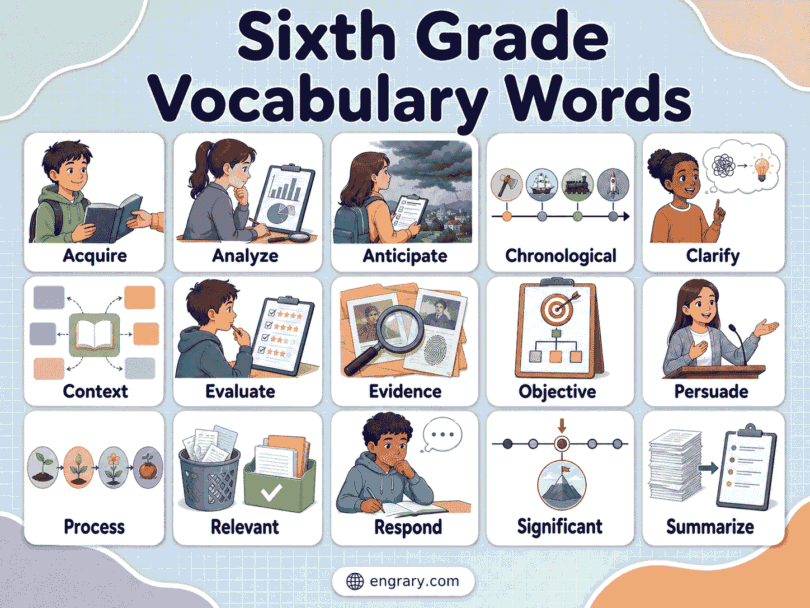
Sixth graders begin using more formal academic language, analyzing literature, evaluating sources, and building evidence-based arguments. They also encounter technical vocabulary across mathematics, science, history, government, geography, and other middle-school subjects.
The 180 sixth grade vocabulary words below include clear meanings and natural example sentences. The article also teaches argument structure, source credibility, word families, cross-subject context clues, connotation, literary devices, multiple meanings, and formal writing.

How Vocabulary, Spelling, and Academic Words Differ
These word groups build different language skills.
| Word group | Main purpose | Examples |
|---|---|---|
| Vocabulary words | Understand meaning and use words accurately | ambiguous, viable, obstinate |
| Spelling words | Apply correct letter patterns | maintenance, occurrence, privilege |
| Academic words | Discuss ideas across several subjects | derive, explicit, validate |
| Literary terms | Analyze stories, poems, and drama | antagonist, irony, symbolism |
| Technical words | Understand one field of study | coefficient, ecosystem, monarchy |
Correct spelling does not always show full understanding. Strong vocabulary knowledge includes meaning, context, grammatical role, connotation, and accurate use in speaking and writing.
Academic Words Used Across Subjects
These terms appear in directions, discussions, assignments, experiments, and formal explanations.
Abstract — Existing mainly as an idea rather than a physical object. Freedom is an abstract concept that people may understand in different ways.
Arbitrary — Based on personal choice rather than a clear rule or reason. The ruler imposed an arbitrary tax without explaining how the amount was chosen.
Compatible — Able to work, exist, or be used together successfully. The new software was compatible with the school’s computers.
Complex — Made of several connected parts and difficult to understand quickly. The class divided the complex problem into smaller steps.
Component — One part of a larger system or structure. The battery is an essential component of the device.
Concurrent — Happening during the same period. The concurrent investigations took place during the same three-week period.
Concept — A general idea used to organize knowledge. The teacher introduced the concept of proportional relationships.
Constraint — A limitation that restricts choices or actions. Cost was the main constraint on the design.
Definitive — Final, authoritative, or conclusive. The new evidence provided a definitive answer to the question.
Derive — Obtaining something from a source or reaching it through reasoning. Scientists derived the estimate from several measurements.
Dimension — A measurable feature, such as length, width, height, or depth. The drawing showed each dimension of the rectangular prism.
Explicit — Stated clearly and directly. The instructions gave explicit steps for completing the experiment.
Framework — A basic structure used to organize ideas or work. The outline provided a framework for the research report.
Fundamental — Basic and necessary for understanding a larger idea. Knowing place value is fundamental to decimal computation.
Implicit — Suggested without being stated directly. The character’s silence carried an implicit warning.
Methodical — Following a careful and organized procedure. Her methodical approach reduced errors in the investigation.
Parameter — A boundary or condition that controls a task. One parameter required every design to fit inside a twelve-inch square.
Predominant — More common, powerful, or noticeable than others. Blue was the predominant color in the painting.
Procedure — An ordered set of steps for completing a task. The students followed the laboratory procedure carefully.
Scope — The range or extent of a subject, project, or investigation. The broad scope of the topic made the report difficult to organize.
Tentative — Not yet final or completely certain. The committee announced a tentative date for the event.
Theoretical — Based mainly on ideas or principles rather than direct practice. The model offered a theoretical explanation for the pattern.
Uniform — Remaining the same throughout or following one standard. The tiles formed a uniform pattern across the floor.
Viable — Capable of working successfully under the available conditions. The smaller conservation plan was financially viable.

Literary Analysis Words
These terms help students explain character roles, text structure, conflict, language, and meaning.
Antagonist — A character, force, or obstacle that opposes the protagonist. In the novel, the antagonist prevented the hero from completing the journey.
Protagonist — The central character in a literary work. The protagonist changed greatly after facing the conflict.
Narrator — The voice or character that tells a story. The narrator described events from a limited point of view.
Diction — A writer’s deliberate choice of words. Formal diction made the speech sound serious and respectful.
Foreshadowing — An early clue that suggests what may happen later. The broken compass served as foreshadowing of the difficult journey ahead.
Irony — A meaningful difference between what is expected, stated, or intended and what actually happens. It was ironic that the fire station needed help putting out its own fire.
Symbolism — The use of an object, color, action, or image to represent an additional idea. The open window became a symbol of freedom.
Genre — A category of literature with shared features. Science fiction is a genre that often explores future technology.
Plot — The organized sequence of major events in a story. The plot became more complicated after the missing letter was discovered.
Setting — The time and place in which a story occurs. The isolated mountain setting increased the sense of danger.
Climax — The point of greatest tension or a major turning point. The story reached its climax when the two rivals finally met.
Exposition — The opening information that introduces characters, setting, and background. The exposition explained why the family had moved.
Resolution — The part of a story that shows how the central conflict ends. In the resolution, the community repaired the damaged bridge.
Flashback — A scene that returns to an earlier event. The flashback revealed why the character feared deep water.
Suspense — A feeling of uncertainty or excitement about what will happen. Short sentences and hidden clues created suspense.
Dialogue — Spoken words exchanged by characters. The dialogue revealed tension between the two friends.
Point of view — The position from which a story is told. The first-person point of view allowed readers to know the narrator’s thoughts.
Theme — A message or insight developed through a literary work. One theme of the story is that courage can grow through experience.
Motif — A repeated image, phrase, object, or idea that supports a larger meaning. Repeated references to darkness formed a motif throughout the novel.
Alliteration — Repetition of beginning consonant sounds in nearby words. “Wild winds whipped” uses alliteration.
Onomatopoeia — A word that imitates a sound. The word crash is an example of onomatopoeia.
Personification — Giving human qualities or actions to something nonhuman. The sentence “The storm pounded angrily on the roof” uses personification.
Hyperbole — Deliberate exaggeration used for humor or emphasis. “This backpack weighs a ton” is hyperbole.
Subplot — A smaller storyline connected to the main plot. The friendship subplot developed alongside the central mystery.
Research and Source Evaluation Words
These terms help students locate, evaluate, document, and use information responsibly.
Authenticate — Establishing that an object, record, or source is genuine. Experts examined the signature to authenticate the letter.
Credibility — The quality of being trustworthy and believable. The author’s credentials increased the source’s credibility.
Currency — The degree to which information is recent enough for a purpose. Currency matters when researching rapidly changing technology.
Database — An organized collection of searchable information. Students used a library database to locate scholarly articles.
Documentation — Records or evidence that support a claim, process, or event. The report included documentation of every source consulted.
Plagiarism — Presenting another person’s words or ideas as one’s own. Copying a paragraph without attribution is plagiarism.
Reliability — The quality of producing dependable and consistent information or results. Repeated tests increased confidence in the measurement’s reliability.
Verification — The process of checking whether information is accurate or true. The editor requested verification of the surprising statistic.
Attribution — Identification of the person or source responsible for information or creative work. Proper attribution showed where the image originated.
Archive — A collection of historical records or the place where they are stored. Researchers found the original map in a digital archive.
Copyright — Legal protection that gives creators control over how their original work is copied, shared, or adapted. Copyright limits how another person’s book may be reproduced or distributed.
Credentials — Qualifications, training, or experience that show expertise. The scientist’s credentials included advanced study in marine biology.
Evidence-based — Supported by reliable facts, research, or observations. The committee preferred an evidence-based recommendation.
Objectivity — The practice of presenting information fairly without favoring one side. Objectivity requires writers to separate evidence from personal preference.
Publication date — The date on which a source became publicly available. We checked the publication date to see whether the information was current.
Research question — A focused question that guides an investigation. The research question asked how urban growth affected local wildlife.
Search term — A word or phrase entered into a search tool. Using a more precise search term produced better results.
Research log — An organized record of sources, search terms, notes, and useful findings. Ella updated her research log after examining each database article.
Reasoning and Argument Words
These terms help students examine evidence, build arguments, and identify weak reasoning.
Assumption — A belief accepted without enough proof. The conclusion depended on the assumption that every witness was accurate.
Causation — A relationship in which one event directly produces another. The experiment tested whether sunlight directly caused the difference in plant growth.
Correlation — A pattern in which two things change or occur together. The graph showed a correlation between practice time and test scores.
Counterclaim — A claim that opposes the main position in an argument. The essay addressed the counterclaim that the plan would cost too much.
Counterexample — An example that shows a broad statement is not always true. One flightless bird provided a counterexample to the claim that all birds can fly.
Deduction — A conclusion reached by applying facts or rules. From the footprints and broken branches, the ranger made a deduction about the animal’s path.
Discrepancy — A difference between details that should agree. Investigators noticed a discrepancy between the two records.
Fallacy — Faulty or misleading reasoning. Claiming that one event caused another merely because it happened first is a fallacy.
Implication — A meaning, result, or consequence suggested indirectly. The report’s implication was that the policy needed revision.
Inference — A conclusion formed from evidence and prior knowledge. Readers made an inference from the character’s actions.
Logic — Clear and valid reasoning. The argument followed a logical sequence from premise to conclusion.
Premise — A starting statement or idea on which an argument is based. The argument began with the premise that clean water is a basic need.
Probability — The likelihood that an event will occur. The probability of drawing a red card was one-half.
Rationale — The reason or set of reasons behind a decision. The principal explained the rationale for changing the schedule.
Rebuttal — A response that challenges a counterclaim or opposing argument. The writer used new evidence in the rebuttal.
Refute — Showing that a claim is false, inaccurate, or unsupported. The records helped refute the rumor.
Relevance — The degree to which information connects directly to a topic or question. The committee questioned the relevance of the final example.
Validity — The quality of being logically sound, accurate, or well supported. Strong evidence improved the validity of the conclusion.
Conclusion — A judgment reached after considering evidence or reasoning. The data supported the conclusion that temperature affected the reaction.
Distinction — A meaningful difference between related ideas. The lesson explained the distinction between correlation and causation.
Evidence — Facts, examples, observations, or data used to support a claim. The writer included evidence from two reliable studies.
Qualification — A limitation added to make a claim more accurate. The phrase “in most cases” added a useful qualification.

Analysis and Writing Words
These verbs help students explain, organize, compare, evaluate, and revise ideas.
Analyze — Breaking something into parts to understand how it works. Students analyzed the poem’s imagery and structure.
Categorize — Arranging items into groups based on shared features. The class categorized the sources by type and date.
Compose — Creating a written, musical, or artistic work. Lena composed a clear introduction for the essay.
Consolidate — Combining separate parts into a more organized whole. The group consolidated its notes into one outline.
Contextualize — Placing an idea or event within the circumstances that help explain it. The historian contextualized the speech by describing the conflict surrounding it.
Contrast — Explaining important differences between two or more things. The response contrasted the two narrators’ viewpoints.
Differentiate — Identifying how related things are distinct. Students differentiated fact, opinion, and inference.
Examine — Looking at something closely to understand or judge it. We examined the evidence before reaching a conclusion.
Extrapolate — Extending a known pattern to predict beyond the available information. Scientists extrapolated future growth from the current data.
Reconcile — Resolving differences or making conflicting ideas consistent. The researcher tried to reconcile the two accounts.
Revise — Improving writing by changing ideas, organization, wording, or detail. Marcus revised the paragraph to strengthen its reasoning.
Scrutinize — Examining something with especially close attention. The editor scrutinized every quotation and citation.
Specify — Stating something clearly and exactly. The directions specified which materials were permitted.
Summarize — Stating the most important ideas in a shorter form. The final paragraph summarized the report’s main findings.
Defend — Supporting a claim or decision with reasons and evidence. Each student had to defend a proposed solution.
Qualify — Limiting or modifying a statement to make it more accurate. The writer qualified the claim by noting two exceptions.
Trace — Following the development, movement, or sequence of something. The essay traced the growth of the city over time.
Validate — Confirming that an idea, result, or method is sound or acceptable. A second experiment helped validate the original findings.
Feelings and Personal Qualities
These words describe habits, attitudes, judgment, and character.
Analytical — Skilled at examining information logically and in detail. Her analytical approach helped the team identify the error.
Arrogant — Showing excessive pride or a belief in one’s superiority. The arrogant player dismissed everyone else’s suggestions.
Authentic — Genuine and true to one’s real beliefs or character. Her authentic response reflected what she truly believed.
Cynical — Doubting people’s sincerity or expecting selfish motives. His cynical response suggested that he trusted no public promise.
Diplomatic — Skilled at handling disagreement without causing unnecessary conflict. The diplomatic student helped both groups reach an agreement.
Discreet — Careful about speech or behavior in order to protect privacy. The counselor was discreet when discussing the private matter.
Diligent — Showing steady and careful effort. The diligent researcher checked every date twice.
Ethical — Following accepted principles of right and responsible behavior. Ethical researchers report results honestly.
Impulsive — Acting quickly without enough thought. An impulsive decision caused the team to waste materials.
Introspective — Thoughtfully examining one’s own feelings or motives. The journal entry was honest and introspective.
Obstinate — Unreasonably unwilling to change an opinion or action. The obstinate leader ignored every useful suggestion.
Perceptive — Quick to notice and understand important details. Her perceptive comment revealed a hidden conflict in the story.
Rational — Guided by clear reason rather than emotion alone. The group made a rational decision after reviewing the evidence.
Self-aware — Conscious of one’s own feelings, strengths, and weaknesses. A self-aware speaker recognizes when nervousness affects delivery.
Tactful — Careful to avoid embarrassing or offending others. His tactful response corrected the mistake without humiliating anyone.
Tolerant — Willing to respect people whose backgrounds, beliefs, or harmless practices differ from one’s own. A tolerant community allows respectful disagreement while maintaining fair rules.
Precise Describing Words
These adjectives describe clarity, possibility, structure, frequency, and quality.
Accurate — Correct and free from error. The map provided an accurate representation of the region.
Ambiguous — Open to more than one reasonable interpretation. The final sentence was ambiguous, so readers disagreed about its meaning.
Concise — Clear and brief without unnecessary words. Her concise summary included every essential point.
Controversial — Causing strong disagreement. The council delayed its decision on the controversial proposal.
Deficient — Lacking something necessary or expected. The soil was deficient in nitrogen.
Discrete — Separate and individually distinct. The chart displayed five discrete categories.
Distinct — Clearly different or easy to recognize. The two minerals had distinct textures.
Dynamic — Characterized by active change or movement. The coastal ecosystem is dynamic and changes with every season.
Feasible — Possible and practical under the available conditions. The engineers decided that the smaller bridge was feasible.
Hypothetical — Based on an imagined situation rather than an established fact. The class discussed a hypothetical change in the law.
Inherent — Existing as a natural or essential part of something. Some uncertainty is inherent in long-term predictions.
Notable — Important or unusual enough to deserve attention. The report described a notable decline in pollution.
Prevalent — Common within a particular place, group, or period. Seasonal illness was more prevalent during winter.
Random — Lacking a deliberate pattern or predictable order. The computer selected a random sample.
Rigid — Stiff, fixed, or unwilling to change. The rigid schedule left no time for unexpected delays.
Selective — Carefully choosing some options while rejecting others. The editor was selective about which details remained.
Sustainable — Able to continue without exhausting resources or causing serious harm. The city invested in sustainable transportation.
Systematic — Following an organized method or plan. The team conducted a systematic review of the evidence.
Uncertain — Not known, decided, or dependable. The outcome remained uncertain after the first trial.
Versatile — Able to perform several functions or adapt to different uses. The versatile tool could cut, measure, and tighten screws.

Math and Science Words
These terms support sixth-grade work with numbers, algebra, statistics, matter, energy, cells, and ecosystems.
Mathematics
Absolute value — A number’s distance from zero on a number line. The absolute value of negative seven is seven.
Coefficient — The numerical factor multiplied by a variable. In 5x, the coefficient is 5.
Coordinate plane — A grid formed by two perpendicular number lines. The students plotted four points on the coordinate plane.
Equation — A mathematical statement showing that two expressions are equal. The equation 3x = 18 has one solution.
Exponent — A number showing how many times a base is used as a factor. In 2³, the exponent is 3.
Inequality — A mathematical statement comparing quantities that may not be equal. The inequality x > 6 represents values greater than six.
Integer — A whole number, its opposite, or zero. Negative four is an integer.
Mean — The average found by dividing the total by the number of values. The mean of 4, 6, and 8 is 6.
Median — The middle value in an ordered set of numbers. In 3, 5, and 9, the median is 5.
Ratio — A comparison between two quantities. The ratio of red marbles to blue marbles was three to two.
Rate — A comparison between quantities measured in different units. Sixty miles per hour is a rate.
Variable — A symbol representing an unknown or changing value. In the expression 4n, the letter n is a variable.
Science
Adaptation — An inherited feature that helps an organism survive or reproduce. Thick fur is an adaptation that helps some animals live in cold climates.
Cell — The basic structural and functional unit of life. A plant cell contains structures that perform specialized jobs.
Compound — A substance formed when elements join chemically in fixed proportions. Water is a compound made of hydrogen and oxygen.
Density — The amount of mass in a given volume. The metal sank because its density was greater than the water’s density.
Ecosystem — A system formed by interactions among living and nonliving parts of an environment. The pond ecosystem included fish, plants, sunlight, and water.
Element — A pure substance made of one kind of atom. Oxygen is an element.
Energy transfer — The movement of energy from one object or system to another. Energy transfer occurred when the warm spoon heated the ice.
Heredity — The passing of traits from parents to offspring. Heredity influences features such as eye color.
Particle — A very small unit of matter. Heating caused the particles to move faster.
Reaction — A process in which substances change and new substances may form. The unexpected color change indicated that a chemical reaction had occurred.
System — A set of interacting parts that work together. The digestive system includes several organs.
Thermal energy — Energy associated with the random motion of particles in matter. As the water warmed, its particles moved faster and its thermal energy increased.
History, Government, and Society Words
These terms help students describe organized communities, political systems, and social change.
Civilization — A complex society with organized government, culture, and economic activity. The river supported the growth of an early civilization.
Culture — The beliefs, customs, arts, language, and practices of a group. Music is an important part of culture.
Empire — A group of territories or peoples controlled by one central power. The empire expanded through trade and conquest.
Governance — The way authority, decisions, and public systems are managed. Effective governance requires clear laws and accountable leaders.
Institution — An established organization or system serving an important purpose. The court is a legal institution.
Monarchy — A government led by a monarch, usually a king or queen. In the monarchy, power passed through the royal family.
Republic — A government in which public authority is exercised through representatives and laws rather than a hereditary monarch. The constitution established a republic.
Society — A community of people connected through relationships, institutions, and shared systems. Industrial growth changed the structure of society.
Trade — The exchange of goods or services. Coastal cities grew through regional trade.
Urbanization — The growth of cities and urban populations. Urbanization increased as workers moved toward factories.
Words That Connect Ideas
These transitions help students express results, additions, contrasts, and consequences.
Accordingly — Introducing a result or suitable response. The evidence was incomplete; accordingly, the committee delayed its decision.
Moreover — Adding a stronger supporting point. The plan reduces waste; moreover, it lowers long-term costs.
Nonetheless — Showing that something remains true despite a contrast. The route was difficult; nonetheless, the team completed the journey.
Thereby — Explaining the result produced by an action. The city expanded public transportation, thereby reducing traffic.
How Arguments Are Built
A strong argument includes more than a claim.
| Part | Purpose |
|---|---|
| Claim | States the main position |
| Counterclaim | Presents an opposing position |
| Evidence | Supplies facts, data, examples, or quotations |
| Reasoning | Explains how the evidence supports the claim |
| Rebuttal | Responds to the counterclaim |
| Qualification | Limits a claim so it remains accurate |
Suppose a student argues that the school should begin later. Attendance data and sleep research provide evidence, while reasoning explains why that evidence supports the proposed change. A counterclaim might focus on transportation problems, and the rebuttal would address that concern directly.
Repeating the original claim does not count as a rebuttal. Instead, a rebuttal should explain why the opposing position is incomplete, unsupported, or less convincing.
Evaluating Source Credibility
Students should evaluate a source before using it.
| Criterion | Question to ask |
|---|---|
| Authority | Who created the source? |
| Accuracy | Can its claims be verified? |
| Currency | Is the information current enough? |
| Purpose | Why was the source created? |
| Evidence | What support does it provide? |
| Objectivity | Does it present information fairly? |
| Relevance | Does it answer the research question? |
A recent source is not automatically reliable, and an older source is not automatically useless. Historical records may remain essential, while a current webpage may still lack evidence or expertise.
Important claims should also be checked against independent sources. Verification becomes especially important when information seems surprising, emotional, or designed to persuade.
Topic, Central Idea, and Theme
Students often confuse these terms.
| Term | Meaning |
|---|---|
| Topic | The general subject |
| Central idea | The main point developed in informational text |
| Theme | A message or insight developed through literature |
For example:
- Topic: friendship
- Central idea: Strong friendships require trust and communication.
- Theme: Loyalty may require personal sacrifice.
A theme is usually expressed as a complete idea rather than a single word.
Tone, Mood, and Diction
These concepts work together but describe different features.
| Term | Focus |
|---|---|
| Tone | The writer’s attitude toward a subject |
| Mood | The feeling created for the reader |
| Diction | The writer’s deliberate word choice |
Compare:
The cabin stood quietly beneath the trees.
The cabin crouched beneath twisted branches.
Both sentences describe a similar setting. However, the second uses more threatening diction, creating a darker tone and a more uneasy mood.
How Word Families Change Meaning
Suffixes can change meaning and grammatical role.
| Base word | Noun | Adjective | Adverb |
|---|---|---|---|
| analyze | analysis | analytical | analytically |
| conclude | conclusion | conclusive | conclusively |
| decide | decision | decisive | decisively |
| persuade | persuasion | persuasive | persuasively |
| signify | significance | significant | significantly |
Useful patterns include:
| Word part | Function | Example |
|---|---|---|
| -tion / -sion | forms nouns | conclusion, persuasion |
| -ive | often forms adjectives | conclusive, persuasive |
| -ly | often forms adverbs | analytically, significantly |
| counter- | opposite or response | counterclaim, counterexample |
| inter- | between | interaction, international |
| -ity | quality or state | credibility, validity |
Spelling may change when suffixes are added. Therefore, students should examine the full word instead of attaching endings mechanically.
Using Context Clues Across Subjects
Sixth graders should combine surrounding details, word parts, subject knowledge, and reference tools.
Literature
The narrator’s description was ambiguous. Readers could reasonably interpret the character’s final action in two different ways.
The second sentence shows that ambiguous means open to more than one interpretation.
Science
The species was predominant in the northern region. It appeared far more frequently than every other species recorded there.
The comparison reveals that predominant means most common.
History
The ruler imposed an arbitrary tax. No law, formula, or public explanation determined the amount.
The lack of a clear rule shows that arbitrary means based on personal choice.
Mathematics
The coefficient was 4 because the variable was multiplied by four in the expression 4x.
The explanation identifies the coefficient as the number multiplying the variable.
Strong readers may confirm a likely meaning with a dictionary after using context.
Denotation and Connotation
A word’s denotation is its direct meaning, while its connotation includes the feelings and associations attached to it.
| Neutral | Softer or positive | Stronger or negative |
|---|---|---|
| confident | assured | arrogant |
| question | investigate | interrogate |
| determined | persistent | obstinate |
| unusual | distinctive | bizarre |
| private | discreet | secretive |
| careful | cautious | fearful |
Changing one word can alter a passage’s tone.
Compare:
The leader was determined.
The leader was obstinate.
Both words suggest unwillingness to give up. However, determined sounds positive, while obstinate suggests unreasonable stubbornness.

How Literary Devices Create Meaning
Literary devices do more than decorate a text. They shape mood, characterization, emphasis, and theme.
Foreshadowing prepares readers for a later event through an earlier clue.
The character noticed that the emergency radio had stopped working.
That detail may foreshadow later danger.
Symbolism gives an object or image an additional meaning.
A cracked mirror may symbolize a damaged identity or relationship.
Irony highlights a meaningful difference between expectation and reality.
A professional organizer loses every important document.
Personification can make a setting feel active or emotional.
The wind clawed at the windows.
Hyperbole adds emphasis through exaggeration.
The line stretched for a thousand miles.
Diction controls how readers interpret a scene.
Words such as glanced, stared, and glared all describe looking, but each creates a different effect.
Academic Words with Multiple Meanings
Some common words take on specialized meanings in different subjects.
| Word | Everyday meaning | Academic meaning |
|---|---|---|
| Factor | something affecting a result | a number multiplied by another |
| Function | purpose | a mathematical relationship |
| Mean | intend or act unkindly | mathematical average |
| Range | area or series | difference between greatest and least values |
| Culture | customs and beliefs | microorganisms grown for study |
| Element | a basic part | a pure substance made of one kind of atom |
| Solution | an answer | a mixture with dissolved material |
| System | an organized method | a set of interacting parts |
Subject context usually reveals the intended meaning.
For example:
- The scientist prepared a bacterial culture.
- Music reflects a community’s culture.
Analogies and Concept Relationships
Analogies compare relationships between ideas.
Opposition
antagonist : protagonist
The antagonist opposes the protagonist.
Mathematical Relationship
coefficient : variable :: exponent : base
A coefficient multiplies a variable, while an exponent tells how many times a base is used as a factor.
Evidence and Argument
evidence : claim :: premise : conclusion
Evidence supports a claim, while a conclusion may follow from a premise.
Government and Leader
monarchy : monarch :: empire : emperor
A monarch leads a monarchy, while an emperor leads an empire.
Environment and Organism
ecosystem : organism :: society : citizen
An organism lives within an ecosystem, while a citizen belongs to a society.
Response and Argument
rebuttal : counterclaim :: evidence : claim
A rebuttal responds to a counterclaim, while evidence supports a claim.
Using Reference and Research Tools
Different tools answer different questions.
| Tool | Best use |
|---|---|
| Dictionary | Meaning, pronunciation, part of speech, and word family |
| Glossary | Technical terms from one text |
| Thesaurus | Related words and connotations |
| Database | Organized, searchable information |
| Encyclopedia | Broad background knowledge |
| Archive | Historical and original records |
| Citation tool | Organizing source details |
Students should verify automatically generated citations because formatting tools can contain errors. They should also compare every source detail with the original publication.
Choosing Precise Words in Formal Writing
Exact vocabulary strengthens analysis, argument, and explanation.
Literary Analysis
Basic:
The author makes the scene scary.
Improved:
Through ominous diction and foreshadowing, the author creates suspense before the central conflict.
Argument Writing
Basic:
The other side is wrong.
Improved:
The counterclaim overlooks evidence showing that the proposed system would reduce long-term costs.
Source Evaluation
Basic:
This website may not be good.
Improved:
The source lacks credibility because it provides no author credentials, supporting evidence, or publication date.
Science Explanation
Basic:
Heat moves from the hot object to the cold one.
Improved:
Thermal energy transfers from the warmer object to the cooler object until their temperatures become more similar.
History Response
Basic:
Cities became bigger because more people moved there.
Improved:
Urbanization increased as trade, employment, and political institutions attracted people to growing cities.
Sixth Grade Vocabulary Practice
Match Each Word with Its Meaning
- ambiguous
- arbitrary
- concise
- feasible
- predominant
- tentative
- versatile
- viable
a. possible and practical
b. brief but complete
c. open to more than one interpretation
d. based on personal choice without a clear rule
e. most common or influential
f. capable of succeeding
g. not yet final
h. useful in several ways
Choose the Best Academic Word
Use these words:
authenticate · definitive · explicit · refute · relevant · validate · verify · viable
- Experts examined the seal to ___ the document.
- The instructions were clear and ___.
- The new evidence helped ___ the original result.
- The records were used to ___ the false claim.
- Only information ___ to the research question belonged in the report.
- A second source helped ___ the statistic.
- The committee needed a financially ___ solution.
- The final investigation provided a ___ answer.
Analyze Word Families
Complete each word family.
- analyze → __________ → analytical
- conclude → conclusion → __________
- decide → __________ → decisive
- persuade → persuasion → __________
- signify → significance → __________
Choices:
- analysis;
- conclusive;
- decision;
- persuasive;
- significant.
Interpret Vocabulary Across Subjects
Literature
The ending was ambiguous because two explanations remained possible.
What does ambiguous mean?
a. humorous
b. open to more than one meaning
c. completely clear
Science
One species was predominant, appearing in nearly eighty percent of the samples.
What does predominant mean?
a. most common
b. newly discovered
c. endangered
History
The ruler made an arbitrary decision without consulting any law or adviser.
What does arbitrary mean?
a. carefully researched
b. based on personal choice
c. supported by a vote
Mathematics
In 7x, the coefficient is 7 because it multiplies the variable.
What is a coefficient?
a. the numerical factor multiplying a variable
b. a symbol representing an unknown value
c. the answer to an equation
Evaluate Source Credibility
A student is researching whether a local river is safe for swimming.
State Environmental Agency Report
- Published this year
- Names the scientists
- Explains the testing method
- Includes current bacteria measurements
Tourism Company Article
- Released last month
- Identifies an author
- Describes the river as “perfectly clean”
- Provides no test results
University Research Study
- Produced eight years ago
- Includes detailed scientific testing
- May not reflect current river conditions
Answer the questions:
- Which source has the strongest authority and the most useful current evidence?
- Identify the recently published source with the weakest supporting evidence.
- Name the study that may be scientifically reliable but too old to answer the current research question fully.
- What source should form the main basis of the report?
- How could the university study still help the researcher?
Identify the Argument Part
Choose from:
claim · counterclaim · evidence · reasoning · rebuttal
- School should begin thirty minutes later.
- A study found that students slept longer after later start times.
- More sleep may improve attention because tired students often struggle to concentrate.
- Some families argue that a later schedule would interfere with transportation.
- The district could adjust bus routes in phases, reducing the transportation problem.
Compare Connotation
Choose the most suitable word.
- The speaker sounded confident and certain during the presentation.
a. assured
b. arrogant
c. obstinate - The leader refused to reconsider despite clear evidence.
a. persistent
b. obstinate
c. diligent - The counselor protected the student’s privacy carefully.
a. discreet
b. secretive
c. cynical - The creature looked extremely strange and unnatural.
a. distinctive
b. unusual
c. bizarre
Identify the Literary Device
- “The branches scratched angrily at the window” uses:
a. personification
b. alliteration
c. irony - An early warning about a weak bridge later becomes important. This is:
a. symbolism
b. foreshadowing
c. hyperbole - A fire station catches fire. This may be:
a. irony
b. exposition
c. dialogue - A broken chain represents freedom. This is:
a. symbolism
b. suspense
c. alliteration - “I have waited a century” uses:
a. hyperbole
b. diction
c. flashback
Complete the Analogies
- antagonist : protagonist :: counterclaim : __________
- evidence : claim :: premise : __________
- monarchy : monarch :: empire : __________
- ecosystem : organism :: society : __________
- rebuttal : counterclaim :: evidence : __________
Choices:
- citizen;
- claim;
- conclusion;
- emperor;
- main claim.
Choose the Academic Meaning
- In mathematics, mean refers to:
a. an unkind person
b. an average
c. an intention - In science, an element is:
a. a basic design feature
b. a pure substance made of one kind of atom
c. a weather condition - In mathematics, range is:
a. the difference between the greatest and least values
b. a mountain area
c. a cooking surface - In science, a solution is:
a. a final answer
b. a mixture containing dissolved material
c. a problem-solving plan
Improve the Writing
Rewrite each sentence using precise vocabulary from the article.
- The ending could mean two things.
- The writer used a clue about something that happened later.
- This source is probably not trustworthy.
- The other side has a different claim.
- The team looked at the evidence very carefully.
- The city grew because many people moved there.
Answer Key
Match each word with its meaning
- ambiguous → c
- arbitrary → d
- concise → b
- feasible → a
- predominant → e
- tentative → g
- versatile → h
- viable → f
Choose the best academic word
- authenticate
- explicit
- validate
- refute
- relevant
- verify
- viable
- definitive
Analyze word families
- analysis
- conclusive
- decision
- persuasive
- significant
Interpret vocabulary across subjects
- b. open to more than one meaning
- a. most common
- b. based on personal choice
- a. the numerical factor multiplying a variable
Evaluate source credibility
- Source A
- Source B
- Source C
- Source A
- It can provide historical data for comparison with current measurements.
Identify the argument part
- claim
- evidence
- reasoning
- counterclaim
- rebuttal
Compare connotation
- assured
- obstinate
- discreet
- bizarre
Identify the literary device
- personification
- foreshadowing
- irony
- symbolism
- hyperbole
Complete the analogies
- main claim
- conclusion
- emperor
- citizen
- claim
Choose the academic meaning
- b. an average
- b. a pure substance made of one kind of atom
- a. the difference between the greatest and least values
- b. a mixture containing dissolved material
Improve the writing: possible answers
- The ending was ambiguous.
- The writer used foreshadowing to prepare readers for the later event.
- The source lacks credibility.
- The opposing side presents a counterclaim.
- The team scrutinized the evidence.
- Urbanization increased as people moved to the city.
FAQs
There is no universal total, but a focused set of about 170–190 high-utility words can support middle-school reading, writing, research, and subject learning.
They should understand academic language, literary terms, source-evaluation vocabulary, argument words, precise verbs and adjectives, and technical terms from math, science, history, and government.
Sixth-grade vocabulary includes more formal literary analysis, source credibility, counterclaims, fallacies, word-family changes, technical meanings, and cross-subject context.
Students remember words more effectively when they connect definitions with context, word families, subject examples, connotation, and repeated use in discussion and writing.
Students begin using evidence from several sources and writing more formal arguments. These skills help them judge information, explain reasoning, and respond to opposing positions.
You May Also Like