Tiny seeds, soft soil, fresh green leaves, bright flowers, and a small watering can can make a garden feel exciting for children. A child may touch the soil, smell a flower, watch a seedling grow, or carry a bucket before knowing the garden words for those things.
Learning garden vocabulary for kids helps children name what they see, use, and do in a garden. These words are useful for picture cards, classroom lessons, outdoor learning, simple sentences, and hands-on activities such as planting seeds, watering plants, sorting tools, and talking about how plants grow.
What Kids Notice First in a Garden
Children usually notice the most visible garden things first. They may see grass, flowers, soil, leaves, pots, water, stones, butterflies, or a small path through the garden.
Common garden things children may notice include:
- grass
- soil
- seed
- plant
- flower
- leaf
- pot
- water
- stone
- path
- worm
- butterfly
- bee
- watering can
A simple explanation for children:
Garden vocabulary means the words we use for things, tools, actions, and care in a garden.
Useful speaking examples:
- I see a flower.
- The grass is green.
- The soil is wet.
- A butterfly is near the plant.
- The pot has a small plant.
Easy Garden Words Children Should Learn First
Children should begin with garden words they can see in pictures or real gardens. These words are simple, useful, and easy to connect with everyday learning.
Good first garden words include:
- garden 🔊 /GAR-den/
- soil 🔊 /soyl/
- seed 🔊 /seed/
- plant 🔊 /plant/
- flower 🔊 /FLOW-er/
- leaf 🔊 /leef/
- root 🔊 /root/
- stem 🔊 /stem/
- grass 🔊 /gras/
- pot 🔊 /pot/
- water 🔊 /WAW-ter/
- rake 🔊 /rayk/
- shovel 🔊 /SHUV-uhl/
- gloves 🔊 /gluvz/
- watering can 🔊 /WAW-ter-ing kan/
Easy meanings:
- Garden is a place where plants, flowers, grass, or vegetables can grow.
- Soil is the earth where plants grow.
- Seed is a tiny thing that can grow into a plant.
- Plant is a living thing that grows in soil.
- Flower is the colorful part of some plants.
- Leaf is the green part of a plant.
- Root grows under the soil and helps the plant stay in place.
- Stem holds the plant up.
- Pot can hold soil and a plant.
- Watering can is used to water plants.

Seed, Soil, Pot, and Plant Words
Some garden words belong together because they show how plants begin to grow. A seed can go into soil. A pot can hold the soil. With water, sunlight, and care, a small plant can grow.
Important growing words:
- seed
- soil
- pot
- water
- sprout
- seedling
- root
- stem
- leaf
- plant
- flower
Simple examples:
- The seed is in the soil.
- The pot has soil.
- I water the plant.
- A seed can grow into a plant.
- A sprout is a tiny new plant.
- Roots grow under the soil.
- The stem holds the plant up.
- Leaves grow on the plant.
Children can learn this simple order:
seed → sprout → small plant → bigger plant
This keeps the idea easy for young learners without turning the lesson into a full plant science topic.
Tools Kids See During Gardening
Garden tools help people dig, water, carry, clean, and care for plants. Children do not need a long list of adult gardening tools at first. They should learn the simple tool names they are most likely to see in pictures, classrooms, homes, or gardens.
Common garden tools for kids:
- watering can
- hose
- rake
- shovel
- trowel
- gloves
- bucket
- wheelbarrow
Easy tool meanings:
- Watering can holds water for plants.
- Hose carries water to the garden.
- Rake moves leaves, grass, or soil.
- Shovel is used for digging.
- Trowel is a small hand tool for digging.
- Gloves protect hands.
- Bucket can carry soil, water, or small garden things.
- Wheelbarrow can carry soil, leaves, tools, or plants.
Tool sentences:
- I use a watering can.
- The rake is near the grass.
- The shovel is in the garden.
- I wear gloves.
- The bucket has soil.
Digging, Planting, Watering, and Growing
Gardening uses many action words. These words help children talk about what people do in a garden.
Garden action words:
- dig
- plant
- water
- rake
- pick
- pull
- carry
- grow
- smell
- look
- touch
- wash
- fill
- spray
Simple action sentences:
- I dig in the soil.
- We plant a seed.
- I water the flower.
- She rakes the leaves.
- He picks a tomato.
- We pull a weed.
- The plant grows tall.
- I smell the flower.
- I wash my hands after gardening.
A useful sentence pattern:
I + action word + garden word.
Examples:
- I water the plant.
- I carry the bucket.
- I fill the pot.
- I pick a flower.
Words Children Use When Caring for Plants
Garden care means helping plants stay healthy. Children can learn simple care words without using difficult adult gardening terms.
Useful garden care words:
- water
- sunlight
- soil
- gentle
- careful
- grow
- fresh
- clean
- pull weeds
- wash hands
- do not pull
- do not step
Care sentences for kids:
- Plants need water.
- Plants need sunlight.
- Good soil helps plants grow.
- Be gentle with small plants.
- Do not pull flowers without asking.
- Do not step on the plants.
- Pull weeds with adult help.
- Wash your hands after touching soil.
What Makes a Garden Look Alive
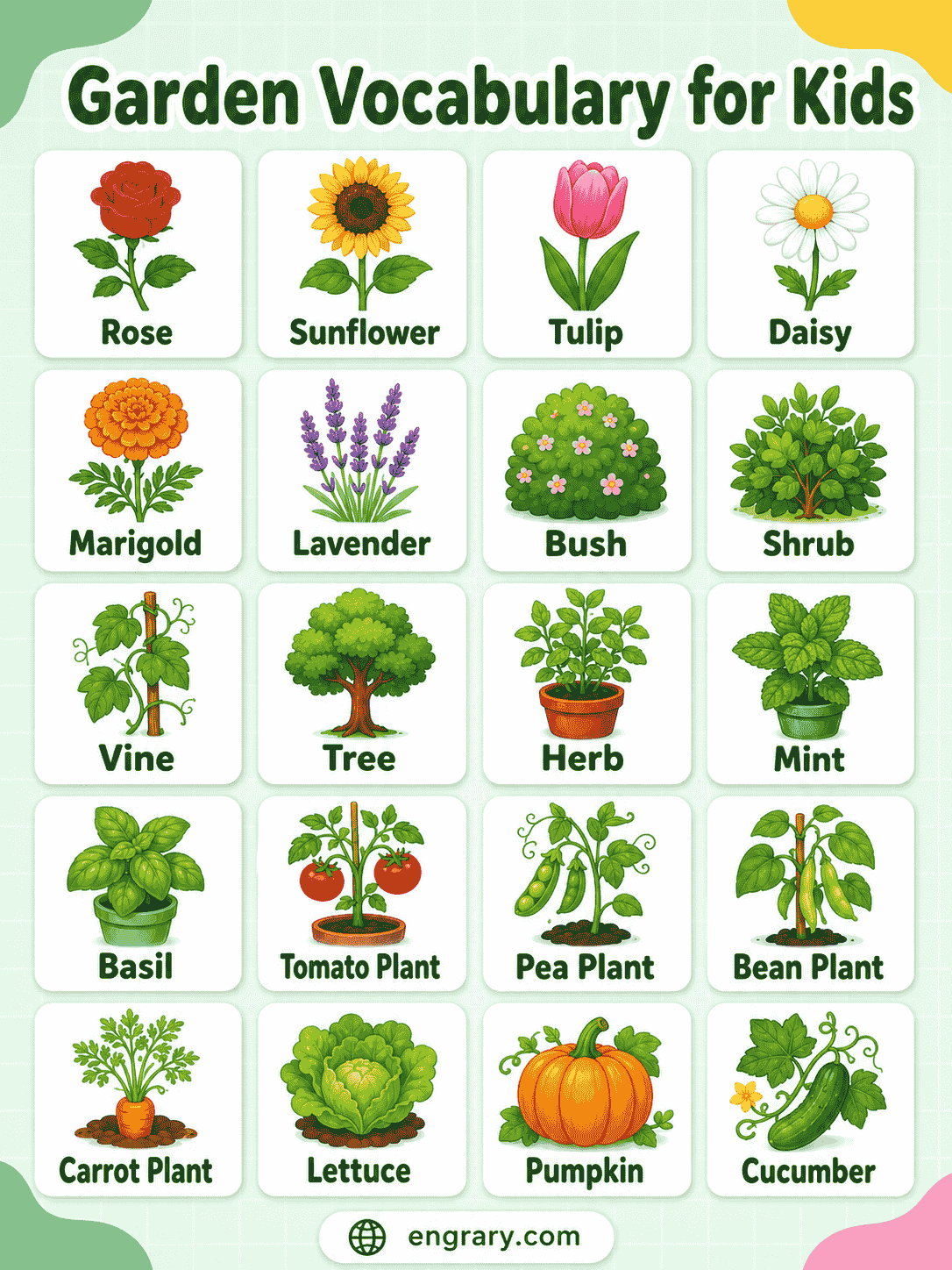
A garden looks alive when things are growing, moving, and changing. Children may see green leaves, bright flowers, soft grass, tiny insects, wet soil, and new plants coming out of the ground.
Garden scene words include:
- green leaves
- bright flowers
- soft grass
- wet soil
- small plants
- flower beds
- vegetables
- water drops
- butterflies
- bees
- worms
- weeds
Garden scene sentences:
- The leaves are green.
- The flowers are bright.
- The grass feels soft.
- A worm is in the soil.
- A butterfly is near the flowers.
- Vegetables can grow in a garden.
- Weeds can grow near plants.
Use insects only as small garden-scene words. The main focus should stay on garden vocabulary, not insect names.
Safety Words for Garden Activities
Gardens are fun, but children also need safety words. Some tools may be sharp, soil may be dirty, and some plants may have thorns.
Important garden safety words:
- safe
- careful
- gloves
- thorn
- sharp
- muddy
- dirty
- wash hands
- gentle
- adult help
- do not touch
- do not eat
Safety examples:
- Wear gloves in the garden.
- Be careful with tools.
- Do not touch thorns.
- Walk carefully on muddy ground.
- Wash your hands after gardening.
- Do not eat plants without asking an adult.
- Use sharp tools only with adult help.
- Be gentle with small plants.
Describing a Garden with Easy Words
Describing words help children say more about a garden. Instead of only naming objects, they can describe what the garden looks, feels, or smells like.
Garden describing words:
- green
- fresh
- colorful
- wet
- dry
- muddy
- sunny
- shady
- soft
- small
- tall
- bright
- clean
- dirty
- beautiful
Example sentences:
- The garden is green.
- The soil is wet.
- The flower is bright.
- The grass is soft.
- The path is muddy.
- The plant is small.
- The tree is tall.
- The garden is shady.
- The leaves look fresh.
Children can use this pattern:
The ________ is ________.
Examples:
- The flower is colorful.
- The pot is clean.
- The soil is dry.
- The garden is beautiful.
Simple Sentences with Garden Vocabulary
Children learn garden vocabulary better when they use the words in short sentences. These examples are useful for speaking, reading, and writing practice.
Useful garden sentences:
- I see a garden.
- The soil is brown.
- The seed is small.
- I plant a seed.
- I water the plant.
- The flower is red.
- The leaf is green.
- The pot has soil.
- The rake is on the grass.
- I wear gloves.
- The shovel is in the garden.
- A butterfly is near the flower.
- The plant needs sunlight.
- I wash my hands after gardening.
- The garden looks fresh.
Question practice:
- What do you plant in soil?
- What do you use to water plants?
- What protects your hands?
- What color is the leaf?
- What grows from a seed?
Short answers:
- I plant a seed.
- I use a watering can.
- Gloves protect my hands.
- The leaf is green.
- A plant grows from a seed.
Garden Word Mix-Ups Kids Often Make
Some garden words are easy to confuse. This simple table helps children understand the difference.
| Mix-up | Easy difference |
|---|---|
| Seed vs plant | A seed can grow into a plant. A plant has already started growing. |
| Soil vs mud | Soil is earth for plants. Mud is wet, messy soil. |
| Flower vs plant | A flower is one part of some plants. A plant is the whole living thing. |
| Rake vs shovel | A rake moves leaves or soil. A shovel is used for digging. |
| Pot vs watering can | A pot holds a plant. A watering can holds water for plants. |
| Garden vs yard | A garden has plants, flowers, or vegetables. A yard is open space near a home. |
| Weed vs plant | A weed is an unwanted plant. A plant is any growing living thing. |
Picture Cards, Sorting Games, and Hands-On Practice
Garden vocabulary works well with pictures and real objects. Children can match, sort, draw, say, and act out garden words.
Garden picture cards
Use picture cards for seed, soil, plant, flower, rake, shovel, gloves, watering can, and pot. Children say the word and match it to the picture.
Tool or garden thing sorting
Sort words into two groups: tools and garden things. For example, rake, shovel, and watering can are tools. Seed, flower, and leaf are garden things.
Seed-to-plant order
Show pictures of a seed, sprout, small plant, and flower. Children place them in the correct order.
Garden action game
Say a word like dig, plant, water, rake, or smell. Children act out the word safely.
Draw and label a garden
Children draw a small garden and label simple words such as flower, grass, pot, soil, leaf, and watering can.
Real garden talk
During a safe garden visit, children point to one thing and say a sentence: “I see a flower.” Older children can add a describing word: “I see a bright flower.”

Garden Vocabulary Practice Worksheet
Use this practice block for classwork, homework, or quick revision.
A. Circle the garden word
- soil / spoon / sock
- seed / chair / clock
- rake / pillow / cup
- flower / phone / shoe
- watering can / plate / pencil
B. Match the word
- Seed — ________
- Soil — ________
- Watering can — ________
- Gloves — ________
- Shovel — ________
Word bank: protect hands, used for digging, earth for plants, can grow into a plant, holds water for plants
C. Complete the sentences
- I plant a ________.
- The seed is in the ________.
- I water the ________.
- Gloves protect my ________.
- A shovel is used for ________.
D. Write tool, garden thing, action, or describing word
- Rake — ________
- Seed — ________
- Dig — ________
- Green — ________
- Flower — ________
Answer key:
- A1: soil
- A2: seed
- A3: rake
- A4: flower
- A5: watering can
- B1: can grow into a plant
- B2: earth for plants
- B3: holds water for plants
- B4: protect hands
- B5: used for digging
- C1: seed
- C2: soil
- C3: plant / flower
- C4: hands
- C5: digging
- D1: tool
- D2: garden thing
- D3: action
- D4: describing word
- D5: garden thing
Garden Vocabulary Quiz for Kids
Try the questions first, then check the answers below.
- What is the earth where plants grow called?
- What tiny thing can grow into a plant?
- What tool holds water for plants?
- What do gloves protect?
- Which tool is used for digging?
- Is a flower a garden tool or part of a plant?
- What should you do after touching soil?
- Which word means wet, messy soil?
- Name one garden action word.
- Name one thing you may see in a garden.
Answers:
- Soil
- Seed
- Watering can
- Hands
- Shovel
- Part of a plant
- Wash your hands
- Mud
- Dig, plant, water, rake, pick, grow, or smell
- Flower, grass, leaf, pot, seed, soil, plant, butterfly, worm, or watering can
FAQs
Garden vocabulary means words children use for things, tools, actions, and care in a garden. Examples include soil, seed, plant, flower, pot, rake, shovel, gloves, and watering can.
Children can start with simple garden words like garden, soil, seed, plant, flower, leaf, pot, water, rake, shovel, gloves, and watering can.
Common garden tool words include watering can, hose, rake, shovel, trowel, gloves, bucket, and wheelbarrow.
Kids can learn garden vocabulary with picture cards, real garden objects, tool sorting, seed-to-plant ordering, drawing activities, action games, and simple sentences like “I water the plant.”
Soil is earth where plants can grow. Mud is wet, messy soil.
You May Also Like