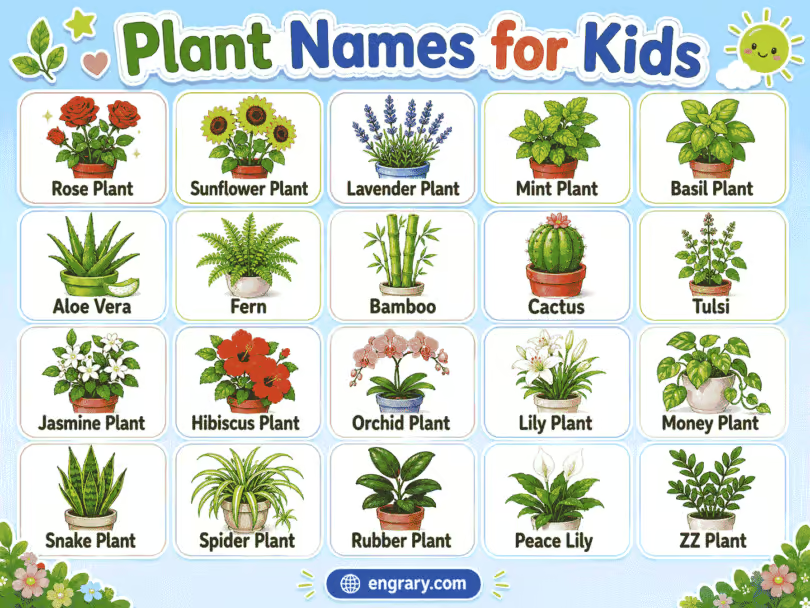
Children often notice plants before they know their names. They may touch soft grass, smell a flower, sit under a tree, see a cactus in a pot, or point to a mango tree in a picture book.
Learning plant names for kids helps children name the plants they see at home, in school, in gardens, in parks, and in daily life. Once they know simple names like rose, grass, sunflower, cactus, bamboo, and mango tree, they can talk about plants with more confidence.
What Makes Something a Plant?
A plant is a living thing that grows. Many plants grow in soil, while some grow in water, pots, farms, gardens, or dry places.
Most plants have parts such as roots, stems, leaves, flowers, or seeds. However, this article focuses on plant names, not plant parts. A plant name tells us what the whole plant is called.
Common plant names children may hear include:
- rose
- sunflower
- grass
- mango tree
- cactus
- bamboo
- mint
- fern
- aloe vera
- lotus
A simple teaching line is:
A plant is a living thing that grows. A plant name tells us what the plant is called.
First Plant Names Children Should Learn
Children should begin with plant names they can easily see, hear, or recognize in pictures. These names are useful because they connect to real plants in homes, gardens, parks, classrooms, farms, and books.
Good first plant names include:
- Rose — a flowering plant
- Sunflower — a tall plant with a large yellow flower
- Grass — a small green plant that covers the ground
- Tree — a tall plant with a trunk and branches
- Cactus — a plant that can grow in dry places
- Mint — a small plant with a fresh smell
- Bamboo — a tall plant with hard stems
- Aloe vera — a plant with thick green leaves
- Fern — a green plant with many soft-looking leaves
- Lotus — a plant that grows in water
These names give children a strong base before they learn harder plant words.
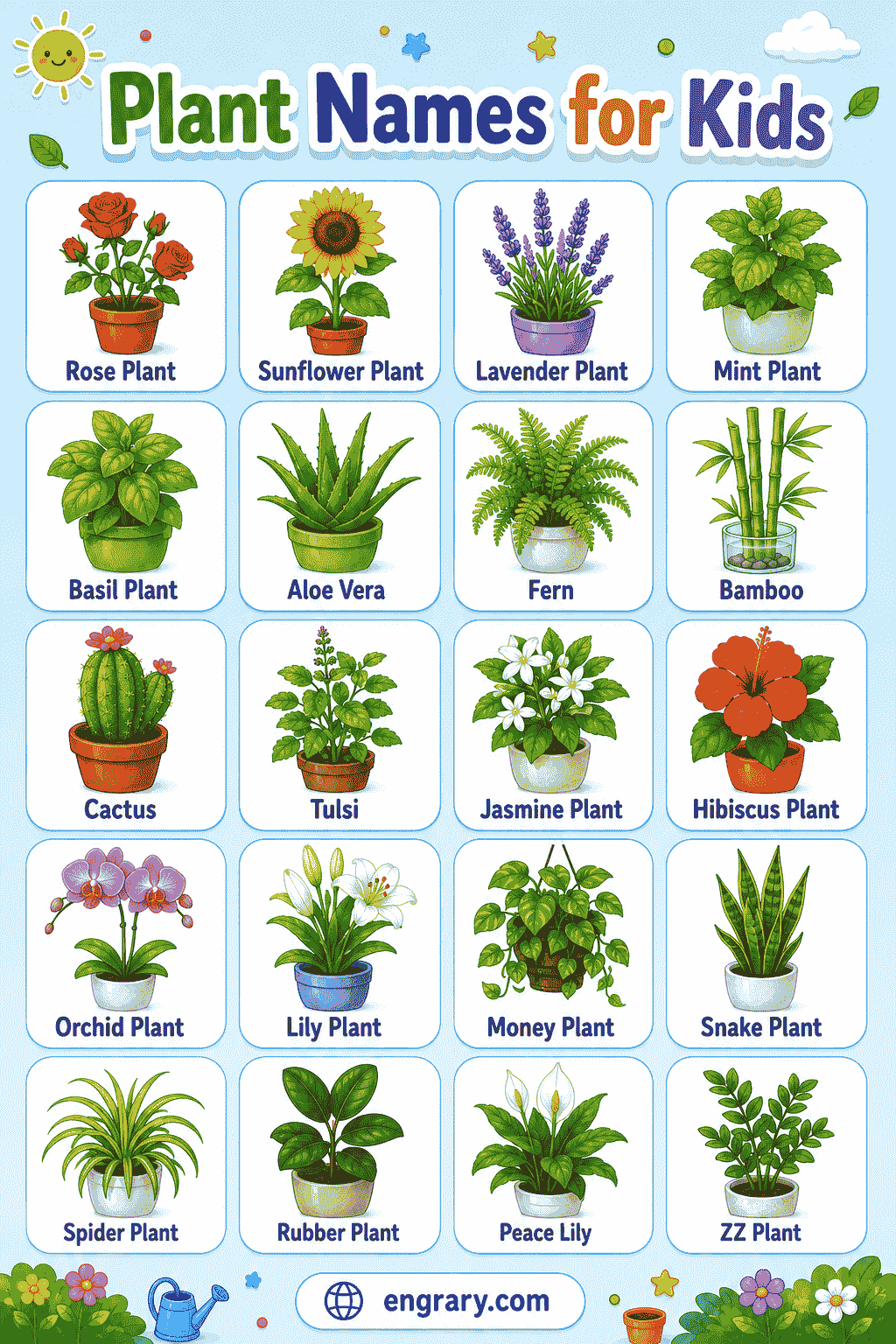
Garden and Park Plants Children Recognize
Gardens and parks are good places to teach plant names because children can see many plants together. They may notice flowers, grass, bushes, trees, vines, and small green plants near paths.
Children may see rose, sunflower, marigold, tulip, jasmine, grass, bush, fern, clover, or ivy in garden and park pictures.
Examples:
- A rose grows in the garden.
- Grass grows in the park.
- A sunflower can grow tall.
- A bush has many small branches.
- A fern has green leaves.
Try this question with a picture or real garden:
Which plant can you name?
Tall Trees and Their Names
A tree is a large plant with a trunk, branches, and leaves. Trees are easy for children to notice because they are tall, give shade, and often grow in parks, gardens, farms, and streets.
Common tree names for kids include:
- mango tree
- apple tree
- coconut tree
- pine tree
- palm tree
- neem tree
- oak tree
Some tree names are easy because they connect to fruits children already know. For example, a mango tree gives mangoes, and an apple tree gives apples.
Tree sentences:
- A mango tree gives mangoes.
- An apple tree gives apples.
- A coconut tree is tall.
- A pine tree has needle-like leaves.
- A palm tree grows in warm places.
Ask children:
Which tree name have you heard before?
Small Green Plants Near the Ground
Not every plant is tall. Many plants grow close to the ground, and children may see them while walking, playing, or looking at a garden.
Small plant names include:
- grass
- moss
- mint
- basil
- clover
- fern
- small bush
Grass grows in many lawns and parks. Moss is a tiny green plant that can grow on rocks, soil, or tree trunks. Mint has a fresh smell, and basil is often used in food.
Examples:
- Grass grows on the ground.
- Moss can grow on rocks.
- Mint has a fresh smell.
- A fern has many green leaves.
- Clover is a small plant.
Children can sort plant pictures into:
- tall plants
- small plants
- potted plants
- garden plants
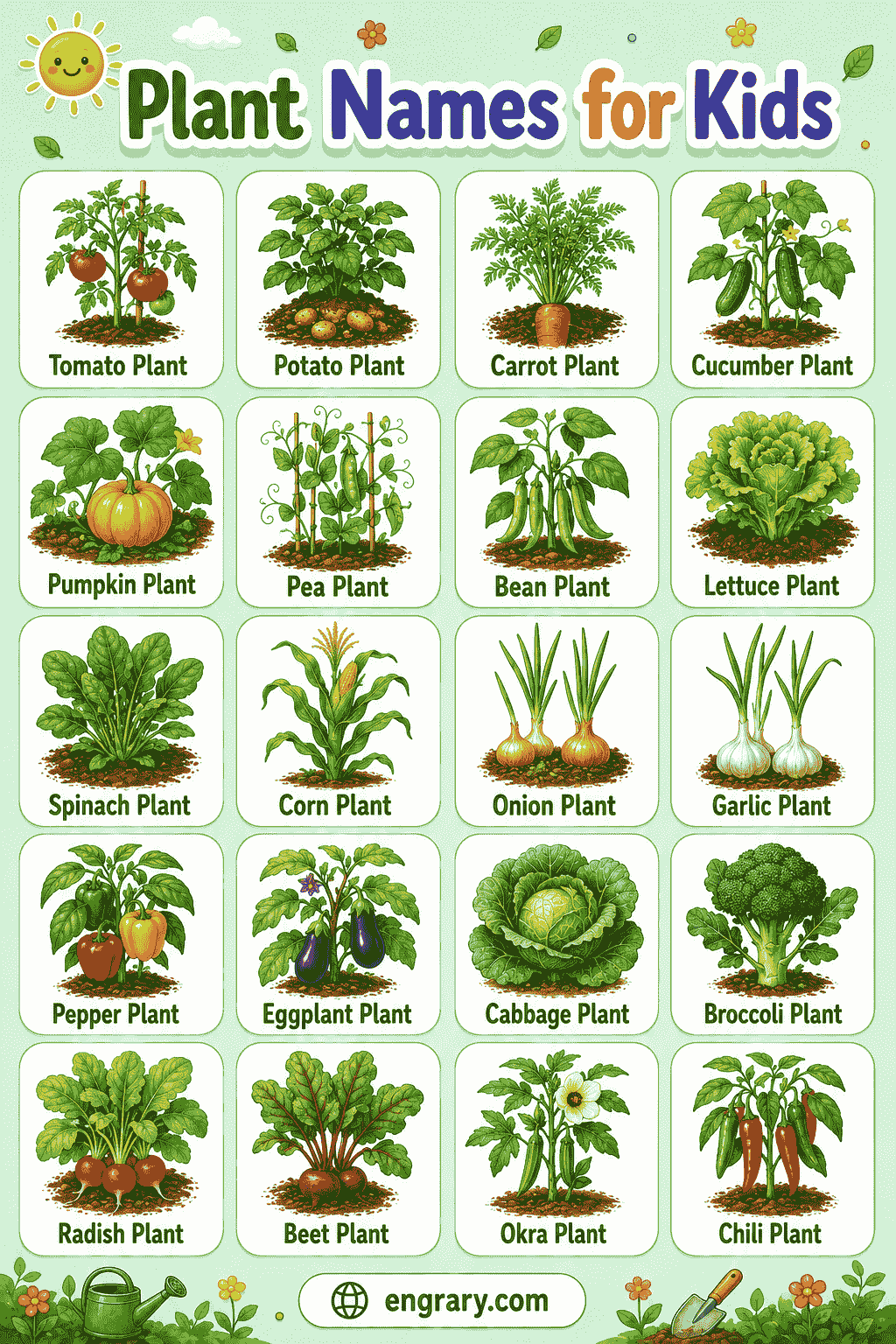
Plants That Give Us Food
Some plants give us fruits, vegetables, grains, herbs, or seeds. Keep this section focused on plant names, not a full food vocabulary lesson.
Food plant names children may know include:
- mango tree
- apple tree
- banana plant
- tomato plant
- potato plant
- corn plant
- wheat
- rice plant
- strawberry plant
- pumpkin vine
Useful examples:
- A tomato plant grows tomatoes.
- A mango tree gives mangoes.
- A banana plant grows bananas.
- Wheat can be used to make bread.
- A pumpkin vine grows pumpkins.
This helps children understand that many foods come from plants.
Potted Plants at Home and School
Children may see plants in pots at home, in classrooms, on windowsills, or near doors. These plants are useful for learning because children can observe them closely.
Common potted plants include:
- aloe vera
- money plant
- snake plant
- cactus
- bamboo
- mint
- fern
- rose plant
A potted plant is a plant growing in a pot. Some potted plants stay indoors, while others grow better outside.
Examples:
- Aloe vera has thick green leaves.
- A cactus can grow in a pot.
- A money plant can climb or hang.
- Mint can grow in a small pot.
- A fern looks soft and green.
Children can observe a potted plant and say:
This plant is called ________.
Plants That Grow in Different Places
Plants do not all grow in the same place. Some grow in gardens, some grow in water, some grow in dry areas, and some grow well indoors.
| Place | Easy Plant Examples |
|---|---|
| Garden | rose, sunflower, marigold |
| Water | lotus, water lily |
| Dry place | cactus, aloe vera |
| Farm | wheat, rice plant, corn plant |
| Home or classroom | money plant, snake plant, bamboo |
Examples:
- A lotus can grow in water.
- A cactus can grow in dry places.
- Wheat grows on farms.
- A money plant can grow indoors.
- A rose can grow in a garden.
This helps children connect plant names with real places.
Flowering and Non-Flowering Plants
Some plants grow flowers. Other plants do not have flowers that children easily notice. Keep this idea simple for young learners.
Flowering plants include plants like rose, sunflower, tulip, and marigold. These plants are easy for children to recognize because they have bright flowers.
Non-flowering plants can include simple examples like fern and moss. These plants are still plants, even if children do not see clear flowers on them.
Easy sentences:
- A rose has flowers.
- A sunflower has a big flower.
- A fern has green leaves.
- Moss is a small green plant.
Name or Part? Helping Kids Tell the Difference
Children often mix up plant names and plant parts. A plant name tells us the whole plant. A plant part tells us one piece of a plant.
| Plant Name | Plant Part |
|---|---|
| rose | leaf |
| sunflower | stem |
| cactus | root |
| grass | seed |
| mango tree | flower |
Clear examples:
- Rose is a plant name.
- Leaf is a plant part.
- Cactus is a plant name.
- Root is a plant part.
- Mango tree is a plant name.
- Flower can be a plant part, but it can also help describe flowering plants.
A helpful teaching line is:
A plant name tells the whole plant. A plant part tells one piece of the plant.
Simple Meanings of Common Plant Names
This chart gives short meanings for common plant names. It works well for quick revision, classroom display, or picture-card practice.
| Plant Name | Simple Meaning |
|---|---|
| Rose | A flowering plant with colorful flowers |
| Sunflower | A tall plant with a large yellow flower |
| Grass | Small green plants that cover the ground |
| Cactus | A plant that can grow in dry places |
| Bamboo | A tall plant with hard, hollow stems |
| Mint | A small plant with a fresh smell |
| Fern | A green plant with many soft-looking leaves |
| Aloe vera | A plant with thick green leaves |
| Lotus | A flowering plant that grows in water |
| Mango tree | A tree that gives mangoes |
| Coconut tree | A tall tree that gives coconuts |
| Tomato plant | A plant that grows tomatoes |
Describing Plants with Easy Words
After children learn plant names, they can describe plants with simple words. This helps them speak and write more clearly.
Useful describing words for plants include:
- green
- tall
- small
- soft
- hard
- fresh
- dry
- colorful
- thorny
- leafy
Plant description examples:
- The grass is green.
- The sunflower is tall.
- The cactus is thorny.
- The mint smells fresh.
- The rose is colorful.
- The bamboo is tall.
- The fern looks leafy.
Children can use this pattern:
The ________ is ________.
Examples:
- The rose is red.
- The cactus is thorny.
- The grass is soft.
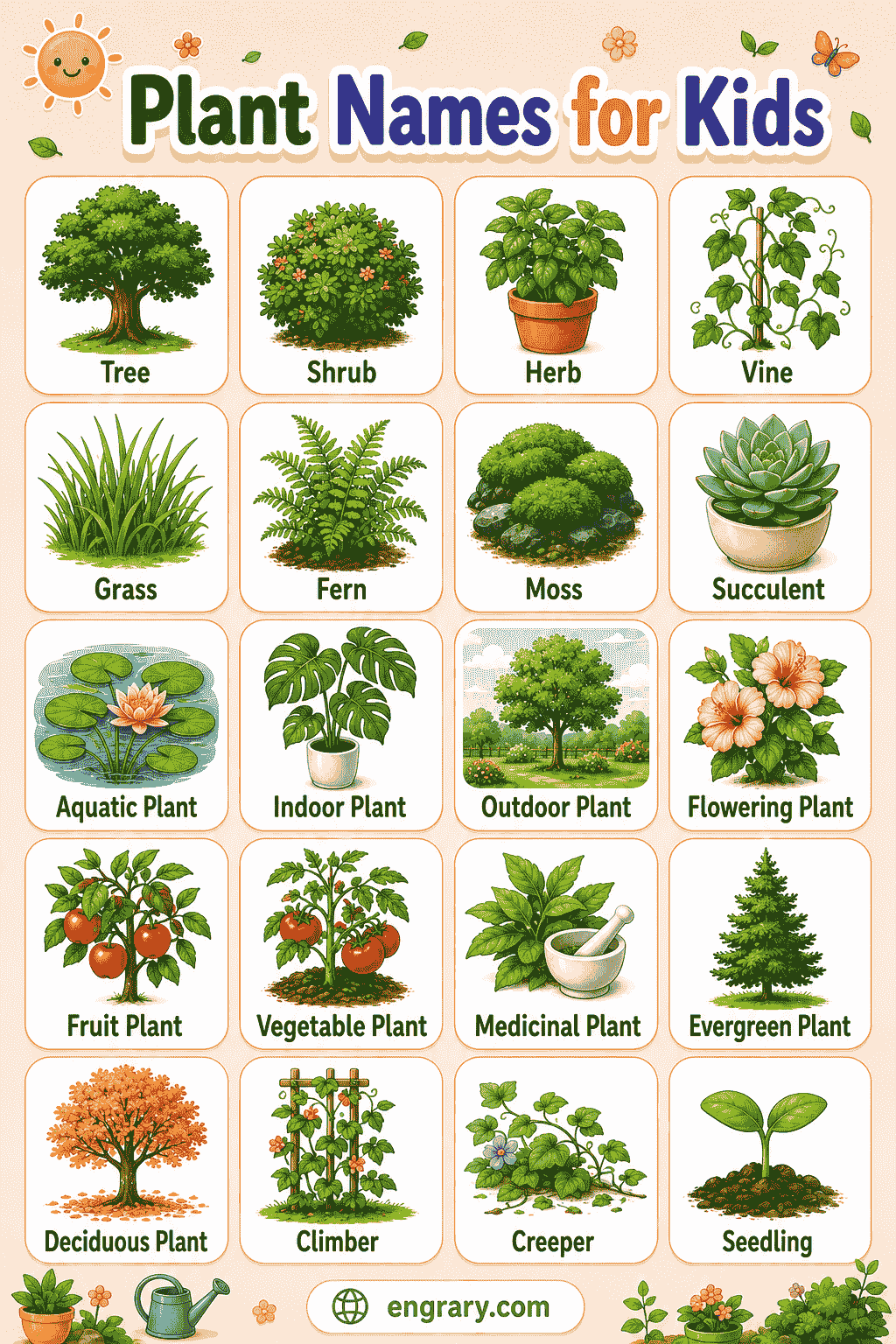
Picture Sorting and Real-Object Naming Games
Plant names are easier to learn with pictures, real plants, and simple sorting games. These activities work well at home, in class, or during a garden walk.
- Plant picture sorting
Sort pictures into flowers, trees, small plants, food plants, and potted plants. - Name or part game
Sort words like rose, leaf, cactus, root, mint, and stem into plant names and plant parts. - Garden naming walk
Walk in a garden or park and name any plants children can safely see. - Food plant matching
Match mango tree with mango, tomato plant with tomato, and wheat with flour. - Tall or small sort
Sort plants into tall plants and small plants. For example, tree is tall, while grass is small. - Draw and label
Children draw one plant and write or say its name. - Plant sentence cards
Use the pattern “A ____ is a plant.” Children choose a plant name and complete the sentence.
Common Mix-Ups Children Make with Plants
Some plant words can confuse children because they sound related or look similar. A compact comparison helps them understand the difference.
| Mix-Up | Simple Difference |
|---|---|
| Plant vs Tree | A tree is one kind of plant. Not every plant is a tree. |
| Plant Name vs Plant Part | Rose is a plant name. Leaf is a plant part. |
| Bush vs Tree | A bush is usually shorter and has branches near the ground. A tree is usually taller with a trunk. |
| Grass vs Plant | Grass is one kind of plant. |
| Cactus vs Flower | A cactus is a plant. Some cactus plants can grow flowers. |
| Banana Tree vs Banana Plant | People often say banana tree, but banana plant is more accurate because it is not a true woody tree. |
Quick examples:
- A tree is a plant, but a plant is not always a tree.
- A rose is a plant name, but a leaf is a plant part.
- Grass is a plant that grows close to the ground.
- A cactus can have flowers, but it is not only a flower.
Plant Names Practice Worksheet
Use this practice block for classwork, homework, or review.
A. Circle the plant name
- rose / leaf / root
- cactus / stem / seed
- mango tree / flower / soil
- mint / water / sunlight
- grass / branch / root
B. Match the plant
- Rose — ________
- Mango tree — ________
- Grass — ________
- Cactus — ________
- Mint — ________
Word bank: small plant, dry-place plant, fresh-smelling plant, flower plant, fruit tree
C. Complete the sentences
- A rose is a ________.
- Grass grows on the ________.
- A mango tree gives ________.
- A cactus can grow in ________ places.
- Mint has a ________ smell.
D. Write plant name or plant part
- Sunflower — ________
- Leaf — ________
- Root — ________
- Bamboo — ________
- Stem — ________
Answer key:
- A1: rose
- A2: cactus
- A3: mango tree
- A4: mint
- A5: grass
- B1: flower plant
- B2: fruit tree
- B3: small plant
- B4: dry-place plant
- B5: fresh-smelling plant
- C1: plant / flower plant
- C2: ground
- C3: mangoes
- C4: dry
- C5: fresh
- D1: plant name
- D2: plant part
- D3: plant part
- D4: plant name
- D5: plant part
Plant Names Quiz for Kids
Try the questions first, then check the answers below.
- What is a plant name?
- Is rose a plant name or a plant part?
- Which plant gives mangoes?
- Which plant can grow in dry places?
- Which plant grows close to the ground?
- Is leaf a plant name or a plant part?
- Which plant has a fresh smell?
- Which plant can grow tall and has a big yellow flower?
- Is grass a plant?
- What is the difference between a plant name and a plant part?
Answers:
- A plant name tells what a plant is called.
- Plant name
- Mango tree
- Cactus
- Grass
- Plant part
- Mint
- Sunflower
- Yes
- A plant name tells the whole plant, while a plant part tells one piece of a plant.
FAQs
Plant names are words that name plants children can see or learn about, such as rose, sunflower, grass, cactus, bamboo, mint, and mango tree.
Children can start with easy plant names like rose, grass, tree, sunflower, cactus, mint, bamboo, and aloe vera because these are simple to recognize in pictures or real life.
Yes. A tree is a kind of plant. Trees are usually tall and have a trunk, branches, and leaves.
No. A leaf is a plant part, not a whole plant name. Rose, grass, and cactus are plant names.
Kids can learn plant names by looking at real plants, using picture cards, sorting plants into groups, drawing plants, and saying simple sentences like “A rose is a plant.”
You May Also Like