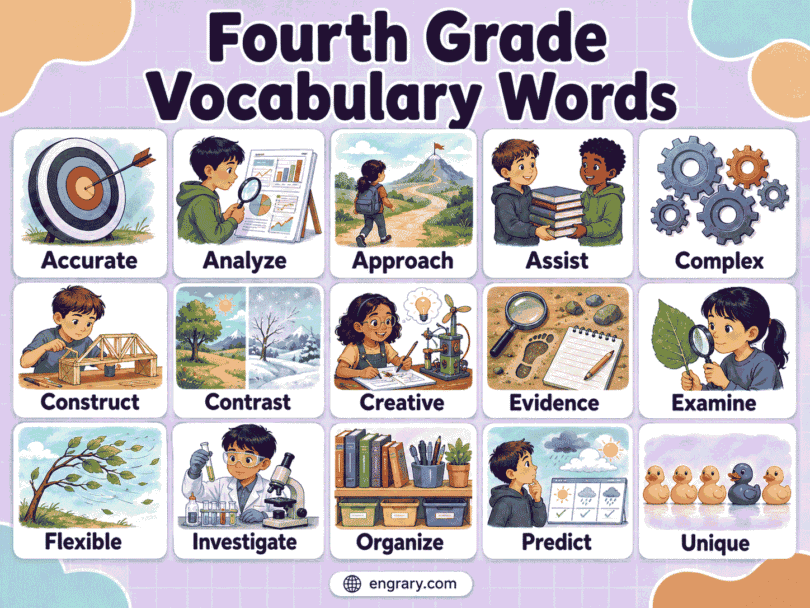
Fourth graders begin reading longer texts, writing organized responses, and using evidence to explain their ideas. As a result, they need vocabulary that supports research, reasoning, discussion, precise description, and subject learning.
The 140 fourth grade vocabulary words below include academic language, reading and research terms, action verbs, feelings, descriptive words, transitions, and common concepts from math, science, geography, history, and civics. Each word includes a clear meaning and a natural example sentence.
Vocabulary, Sight Words, and Spelling Words
These word groups support different language skills.
| Word group | Main purpose | Examples |
|---|---|---|
| Vocabulary words | Understand meanings and use words accurately | justify, reluctant, significant |
| Sight words | Recognize frequent words quickly | though, brought, several |
| Spelling words | Apply correct spelling patterns | necessary, separate, beginning |
| Academic words | Understand ideas across subjects | evaluate, relevant, establish |
| Subject words | Learn concepts from one field | erosion, denominator, democracy |
Vocabulary learning goes beyond recognizing or spelling a word. A student should understand its meaning, notice how it works in context, and use it accurately in discussion and writing.
Words Used at School
These words help students follow directions, work with others, and complete more complex assignments.
Accomplish — To finish something successfully. Maya worked steadily to accomplish her goal before Friday.
Acknowledge — To recognize that something is true or important. The speaker acknowledged everyone who helped with the project.
Adapt — To change in order to fit a new situation. We adapted the experiment after one material became unavailable.
Apply — To use a rule, skill, or idea in a particular situation. Students applied the formula to a new problem.
Appropriate — Suitable or correct for a certain purpose. Formal language was appropriate for the school report.
Clarify — To make an idea easier to understand. The teacher used a diagram to clarify the instructions.
Consult — To ask someone or check a source for information. Elena consulted a dictionary before choosing the final word.
Contribute — To give ideas, effort, or materials to a group. Each student contributed one fact to the class presentation.
Efficient — Working well without wasting time or effort. Using a checklist made the research process more efficient.
Establish — To create, prove, or set something firmly. The class established rules for respectful discussion.
Frequent — Happening often. Frequent review helped Noah remember the new vocabulary.
Maintain — To keep something in good condition or at the same level. We maintained a quiet workspace during independent reading.
Objective — A specific goal that someone plans to achieve. The lesson objective was to compare two sources.
Participate — To take part in an activity. Every student participated in the science discussion.
Precise — Exact and clearly stated. Ava used precise measurements when cutting the cardboard.
Priority — Something considered more important than other tasks. Finishing the safety check was our first priority.
Relevant — Closely connected with the topic or question. Only relevant facts belonged in the final paragraph.
Sufficient — Enough for a particular need or purpose. We collected sufficient evidence to support our conclusion.
Technique — A learned way of doing a task. The artist demonstrated a shading technique.
Temporary — Lasting for only a limited time. The library moved to a temporary room during repairs.
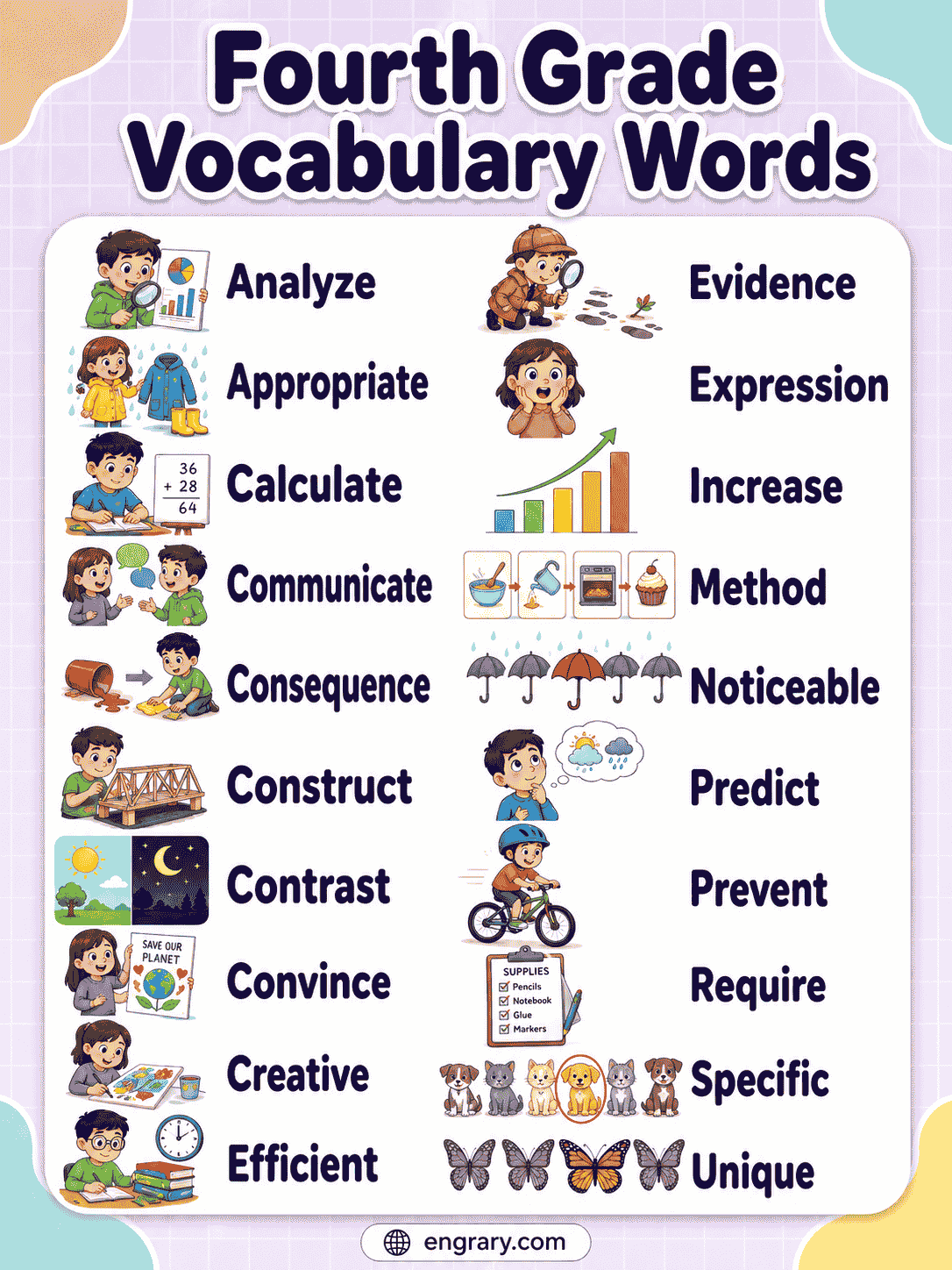
Reading and Research Words
These terms help fourth graders understand sources, organize information, and discuss how writers communicate ideas.
Argument — A position supported by reasons and evidence. The writer presented an argument for protecting local wetlands.
Bibliography — A list of sources used in research. Liam added three books to his bibliography.
Cite — To name the source of information or evidence. We cited the article after using one of its facts.
Claim — A statement or position that a writer wants readers to accept. Her claim was that the town needed more bike paths.
Context — The words, sentences, or situation surrounding an idea. The context helped us understand the unfamiliar phrase.
Credible — Trustworthy and likely to be accurate. The museum website was a credible source for the report.
Description — Words that explain what someone or something is like. The author’s description made the forest easy to picture.
Explanation — Information that makes an idea or event clear. Carlos gave a detailed explanation of the water cycle.
Figurative — Using imaginative language rather than only literal meaning. The poem included figurative comparisons.
Firsthand — Coming directly from someone who experienced an event. A soldier’s diary is a firsthand account.
Narrative — A story or an account of events. The narrative followed a family traveling west.
Paraphrase — To restate information in your own words without changing the meaning. Tessa paraphrased the paragraph instead of copying it.
Perspective — A particular way of understanding or viewing something. The story showed the event from a child’s perspective.
Reference — A source used to find or confirm information. The atlas served as a useful reference.
Secondhand — Learned from someone who did not experience the event directly. The textbook provided a secondhand account of the battle.
Source — A person, book, website, or document that provides information. We checked the date and author of each source.
Stanza — A grouped set of lines in a poem. The final stanza repeated the poem’s main image.
Structure — The way parts are arranged to form a whole. The article used a cause-and-effect structure.
Tone — The writer’s attitude toward a subject. The humorous tone made the article entertaining.
Viewpoint — A particular opinion or position on an issue. The two speakers expressed different viewpoints.
Reasoning and Evidence Words
These words help students examine information, test ideas, and support conclusions.
Assess — To examine something in order to judge its quality or value. We assessed each solution before choosing one.
Assume — To accept something as true without enough proof. Do not assume the website is accurate without checking it.
Classify — To sort things into groups based on shared features. Students classified rocks by color and texture.
Confirm — To check or show that something is true. A second measurement confirmed the first result.
Consequence — An event that happens because of an action or decision. Missing practice had the consequence of feeling unprepared.
Contradict — To state the opposite of something or show that it is false. The new evidence contradicted the earlier report.
Convince — To cause someone to believe or agree. Strong examples helped convince the audience.
Deduce — To reach a conclusion through evidence and reasoning. From the tracks, we deduced that two animals had crossed the path.
Distinguish — To recognize the difference between similar things. The class learned to distinguish weathering from erosion.
Evaluate — To judge something by examining its strengths, weaknesses, or evidence. We evaluated three sources before beginning the report.
Imply — To suggest something without stating it directly. The character’s silence implied that she disagreed.
Justify — To give reasons or evidence that support an answer or choice. Lena used two facts to justify her opinion.
Logical — Based on clear and sensible reasoning. His conclusion was logical because it matched the evidence.
Probable — Likely to happen or be true. Rain was probable because thick clouds covered the sky.
React — To respond to an event, action, or change. The metal reacted to the magnet.
Reveal — To make something known or visible. The final chapter revealed the character’s secret.
Significant — Important or large enough to matter. The experiment showed a significant change in temperature.
Valid — Reasonable, acceptable, or supported by sound evidence. Her argument was valid because every claim had support.
Claim, Reason, Evidence, and Conclusion
These terms work together in opinion and informational writing.
| Term | Function |
|---|---|
| Claim | The position a writer presents |
| Reason | Why the writer believes the claim |
| Evidence | Facts, examples, or quotations that support it |
| Conclusion | The final idea reached after reviewing the information |
For example, a writer may claim that the school needs more trees. Shade and cleaner air provide reasons, while temperature records can serve as evidence. The conclusion then restates what the evidence shows.
Fact, Opinion, Inference, and Assumption
| Term | Meaning |
|---|---|
| Fact | A statement that can be checked |
| Opinion | A personal belief or judgment |
| Inference | An idea formed from clues and prior knowledge |
| Assumption | Something accepted without enough proof |
An inference uses evidence. By contrast, an assumption may be made before enough evidence is available.
Action and Communication Words
These verbs help students describe speaking, movement, effort, and change more precisely.
Announce — To make information publicly known. The principal announced the contest winners.
Attempt — To try to do something, especially when success is uncertain. We attempted to build the tallest paper tower.
Communicate — To share information through speech, writing, signs, or actions. The team communicated through hand signals.
Declare — To state something clearly and formally. The captain declared that the area was safe.
Hesitate — To pause because of uncertainty or doubt. Jonah hesitated before answering the difficult question.
Illustrate — To explain with examples or create pictures for a text. The chart illustrated how rainfall changed each month.
Inspect — To examine something carefully for problems or details. The mechanic inspected the damaged wheel.
Interrupt — To stop someone or something before it is finished. Please do not interrupt while another student is speaking.
Persuade — To encourage someone to agree or take action. The advertisement tried to persuade families to recycle.
Proceed — To continue or move forward. After reading the directions, the class proceeded with the experiment.
Protest — To express strong disagreement. Residents protested the plan to remove the park.
Recall — To remember information from the past. I could not recall the exact date of the event.
Retreat — To move back or away from danger or difficulty. The hikers retreated when the storm became severe.
Respond — To answer or react to something. Maya responded to the question with a complete sentence.
Signal — To send a sign or message. A flashing light signaled that the bridge was closing.
Transform — To change greatly in form, appearance, or condition. Heat transformed the ice into water.
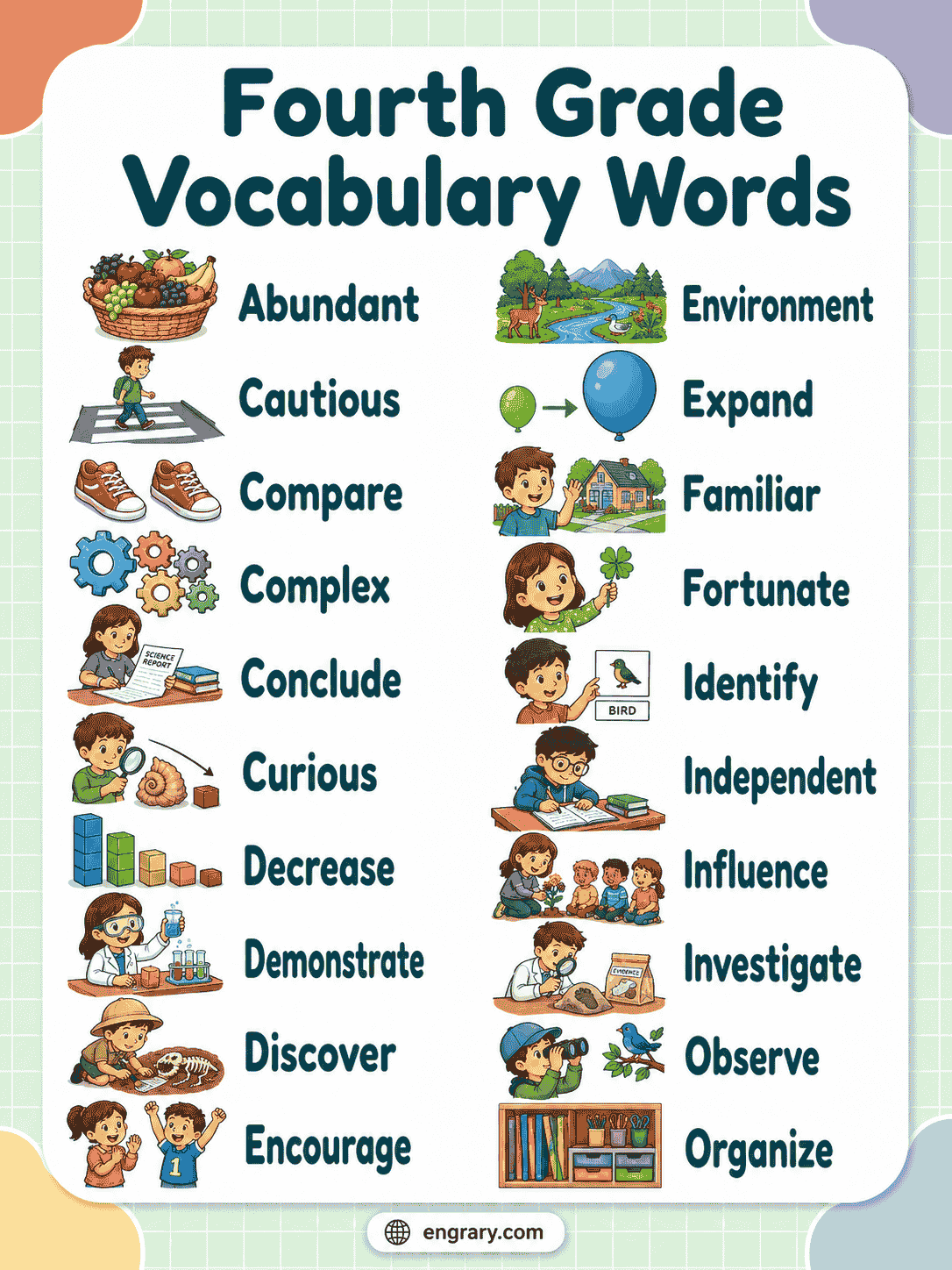
Feelings and Personal Qualities
These words describe emotions, attitudes, and traits that influence decisions and behavior.
Ambitious — Strongly determined to achieve something important. The ambitious student planned a detailed science project.
Cautious — Careful to avoid danger or mistakes. We were cautious while crossing the icy path.
Compassionate — Showing concern and kindness toward someone who is suffering. The compassionate neighbor brought food to the injured family.
Courageous — Willing to face danger or difficulty. The courageous firefighter entered the smoky building.
Dependable — Able to be trusted to do what is expected. Priya was dependable and always completed her duties.
Discouraged — Feeling less hopeful or confident after difficulty. I felt discouraged when the model collapsed again.
Enthusiastic — Showing strong excitement and interest. The class was enthusiastic about the field trip.
Frustrated — Upset because something is difficult or not working. Mateo became frustrated when the pieces would not fit.
Impatient — Unwilling to wait calmly. The impatient crowd began checking the time.
Modest — Not boasting about abilities or achievements. Although she won the award, Lina remained modest.
Optimistic — Expecting a positive result. We stayed optimistic even after the first plan failed.
Persistent — Continuing despite difficulty or delay. The persistent student revised the machine until it worked.
Reluctant — Uncertain or unwilling about doing something. Noah was reluctant to speak before the large audience.
Sincere — Honest and genuine in feeling or expression. Her apology sounded sincere.
Similar Traits with Different Meanings
| Words | Difference |
|---|---|
| Cautious and fearful | careful versus strongly afraid |
| Persistent and stubborn | continued effort versus refusal to change |
| Confident and arrogant | healthy assurance versus excessive self-importance |
| Reluctant and unwilling | uncertainty versus direct refusal |
| Sincere and polite | genuine feeling versus socially correct behavior |
| Optimistic and hopeful | expecting success versus wishing for it |
Describing Words
These adjectives help students describe amount, appearance, condition, intensity, and effect.
Abundant — Existing in large amounts. Wildflowers were abundant after the rainy spring.
Artificial — Made by people rather than occurring naturally. The aquarium used artificial rocks for decoration.
Beneficial — Producing a helpful or positive result. Regular exercise is beneficial for the body.
Concealed — Hidden from sight. A concealed door led into the small room.
Considerable — Large enough to be noticed or important. The project required considerable time and effort.
Dense — Closely packed together. Sunlight barely passed through the dense forest.
Elaborate — Detailed and carefully developed. The stage had an elaborate painted backdrop.
Flexible — Able to bend or change easily. The flexible wire curved around the frame.
Harsh — Unpleasantly rough, severe, or strong. The desert has a harsh climate.
Mature — Fully grown or developed. The mature tree produced hundreds of seeds.
Scarce — Difficult to find or available only in small amounts. Fresh water was scarce during the drought.
Severe — Very serious, intense, or damaging. A severe storm closed several roads.
Shallow — Not extending far downward. Small fish swam in the shallow water.
Transparent — Allowing light to pass through clearly. The transparent container made the roots visible.
Vast — Extremely large in area or amount. A vast plain stretched beyond the mountains.
Vivid — Bright, clear, or powerful in appearance or description. The author used vivid details to describe the festival.
Useful Opposites
| Word | Contrast |
|---|---|
| Abundant | scarce |
| Artificial | natural |
| Concealed | visible |
| Dense | sparse |
| Flexible | rigid |
| Harsh | gentle |
| Shallow | deep |
| Transparent | opaque |
| Temporary | permanent |
| Vivid | dull |

Math and Science Words
These terms support fourth-grade work in numbers, fractions, physical science, life science, and earth science.
Angle — A shape formed where two lines or rays meet. The square has four right angles.
Conductor — A material that allows heat or electricity to pass through it. Copper is a good conductor of electricity.
Decomposer — An organism that breaks down dead material. A mushroom can act as a decomposer in a forest.
Denominator — The bottom number in a fraction, showing the total number of equal parts. In three-fourths, four is the denominator.
Equivalent — Equal in value, amount, or meaning. One-half and two-fourths are equivalent fractions.
Erosion — The movement of soil or rock by water, wind, ice, or gravity. Flowing water caused erosion along the riverbank.
Factor — A number multiplied by another number to produce a product. In 4 × 6, both 4 and 6 are factors.
Fossil — Preserved remains or traces of a living thing from long ago. Scientists found a shell fossil inside the rock.
Magnetism — The force that attracts or repels certain materials. Magnetism pulled the paper clip toward the magnet.
Mineral — A naturally occurring solid with a specific chemical makeup and structure. Quartz is a common mineral.
Numerator — The top number in a fraction, showing how many equal parts are being considered. In three-fourths, three is the numerator.
Organism — A living thing. Every plant, animal, fungus, and bacterium is an organism.
Quotient — The answer to a division problem. The quotient of twenty divided by four is five.
Renewable — Able to be replaced naturally within a useful amount of time. Sunlight is a renewable energy source.
Sediment — Small particles of rock, soil, or organic material carried and deposited by water, wind, or ice. Sediment collected at the bottom of the stream.
Transfer — To move energy, matter, or information from one place to another. Heat transferred from the hot pan to the metal spoon.
Weathering — The breaking down of rock in the place where it is found. Ice caused weathering by expanding inside cracks.
Vibration — A rapid back-and-forth movement. Sound began when the guitar string produced a vibration.
Weathering and Erosion
These terms are related but different.
| Process | What happens |
|---|---|
| Weathering | Rock breaks down in place |
| Erosion | Broken material moves elsewhere |
| Deposition | Moved material settles in a new location |
Rain, ice, roots, and changing temperatures can cause weathering. Then water, wind, ice, or gravity may carry the broken material away through erosion.
Numerator and Denominator
In the fraction 3/4:
- the numerator, 3, shows how many parts are being counted;
- the denominator, 4, shows how many equal parts make the whole.
Geography, History, and Civics Words
These words help students understand communities, governments, human movement, and economic activity.
Agriculture — The work of growing crops and raising animals. Agriculture provides food and materials for many communities.
Colony — A place controlled by another country or government. The settlement became a colony under foreign rule.
Constitution — A document that explains the basic laws and structure of a government. The Constitution describes powers and rights.
Democracy — A system of government in which people help choose leaders or make decisions. Voting is an important part of democracy.
Economy — The system through which goods, services, work, and money are exchanged. New factories changed the local economy.
Election — A process in which people vote to choose a leader or decide an issue. The class held an election for student council.
Industry — Organized work that produces goods or services. Fishing is an important industry in many coastal towns.
Migration — Movement from one place to another, often for work, safety, or resources. Bird migration occurs during certain seasons.
Population — All the people or organisms living in a particular area. The city’s population increased over ten years.
Territory — An area of land controlled by a government or authority. The map showed the nation’s western territory.
Words That Connect Ideas
These words help students show contrast, sequence, cause, and importance.
Consequently — As a result of something. The river flooded; consequently, the road was closed.
Despite — Without being prevented by something difficult or unexpected. Despite the strong wind, the team finished the race.
Gradually — Slowly over time. The sky gradually became darker.
However — Used to introduce a different or contrasting idea. The first method was quick; however, it was less accurate.
Otherwise — In a different situation or if something does not happen. Wear your coat; otherwise, you may become cold.
Previous — Happening or existing earlier. We compared the current results with the previous experiment.
Primarily — Mainly or for the most important reason. The region is primarily known for agriculture.
Therefore — For that reason or as a logical result. The evidence was incomplete; therefore, we could not confirm the claim.
Greek and Latin Roots
Roots can help readers understand unfamiliar words. A root contributes a basic meaning that appears in several related words.
| Root | Meaning | Examples |
|---|---|---|
| aud | hear | audience, audible |
| auto | self | autograph, automatic |
| bio | life | biography, biology |
| geo | earth | geography, geology |
| graph | write or record | autograph, paragraph |
| port | carry | portable, transport |
| spect | look | inspect, spectator |
| struct | build | construct, structure |
| tele | far | telephone, telescope |
| therm | heat | thermometer, thermal |
For example, inspect contains the root spect, meaning “look.” Likewise, transport contains port, meaning “carry.”
A root does not always reveal the complete definition, but it gives readers a useful starting clue.

Context Clues
Fourth graders should recognize several kinds of context clues.
| Clue type | What to notice |
|---|---|
| Definition | The meaning appears directly |
| Example | Examples reveal the word’s category |
| Restatement | Easier wording repeats the meaning |
| Contrast | An opposite idea provides a clue |
| Cause and effect | Events reveal the meaning |
| Inference | Several details suggest the meaning |
Definition Clue
A decomposer, an organism that breaks down dead material, returns nutrients to the soil.
The phrase after the comma directly defines the word.
Example Clue
Renewable resources, such as sunlight, wind, and moving water, can be replaced naturally.
The examples help explain renewable resources.
Restatement Clue
Water was scarce; in other words, there was not enough for everyone.
The phrase not enough restates the meaning.
Contrast Clue
The first container was transparent, but the second was opaque.
The contrast shows that transparent and opaque have opposite meanings.
Inference Clue
Lena hesitated near the edge. She stepped back twice and avoided looking down.
These actions suggest that hesitated means paused because of uncertainty.
Shades of Meaning
Related words may share a basic meaning while creating different impressions.
| Word group | Difference |
|---|---|
| Confident, proud, arrogant | assurance, satisfaction, or excessive self-importance |
| Frugal, economical, stingy | careful spending with positive or negative tone |
| Curious, interested, nosy | desire to know with neutral or negative tone |
| Firm, persistent, stubborn | steadiness, continued effort, or refusal to change |
| Slender, skinny, scrawny | positive, informal, or negative descriptions of thinness |
| Cautious, hesitant, fearful | carefulness, uncertainty, or fear |
A thesaurus may list several words as synonyms, but their tone can differ. For example, persistent usually praises continued effort, while stubborn often criticizes someone who refuses to change.
Figurative Language
Figurative language creates meaning through comparison or familiar expressions.
Simile
A simile compares two things using like or as.
The lake was as smooth as glass.
Metaphor
A metaphor says one thing is another to create a comparison.
The classroom was a zoo.
The room was not literally a zoo. Instead, the metaphor suggests noise or disorder.
Idiom
An idiom has a meaning different from the literal meanings of its words.
Break the ice means to make people feel more comfortable.
Proverb
A proverb expresses familiar advice or wisdom.
Actions speak louder than words means behavior can reveal more than promises.
Adage
An adage is a familiar saying based on common experience.
Better late than never suggests that completing something late is better than not completing it at all.
Multiple-Meaning Words
Some words change meaning according to context and part of speech.
| Word | Meaning 1 | Meaning 2 |
|---|---|---|
| Conduct | behavior | lead or carry out |
| Current | happening now | flowing water or electricity |
| Issue | a topic or problem | distribute or release |
| Object | a physical thing | express disagreement |
| Project | a planned task | send outward |
| Reserve | save for later | protected land |
| Subject | a topic | a person being studied |
| Volume | amount of sound or space | one book in a set |
Examples:
- The scientist will conduct the experiment.
- Respectful conduct is expected in the laboratory.
- We discussed a current environmental issue.
- The library will issue new cards next week.
The surrounding words and sentence structure reveal the intended meaning.
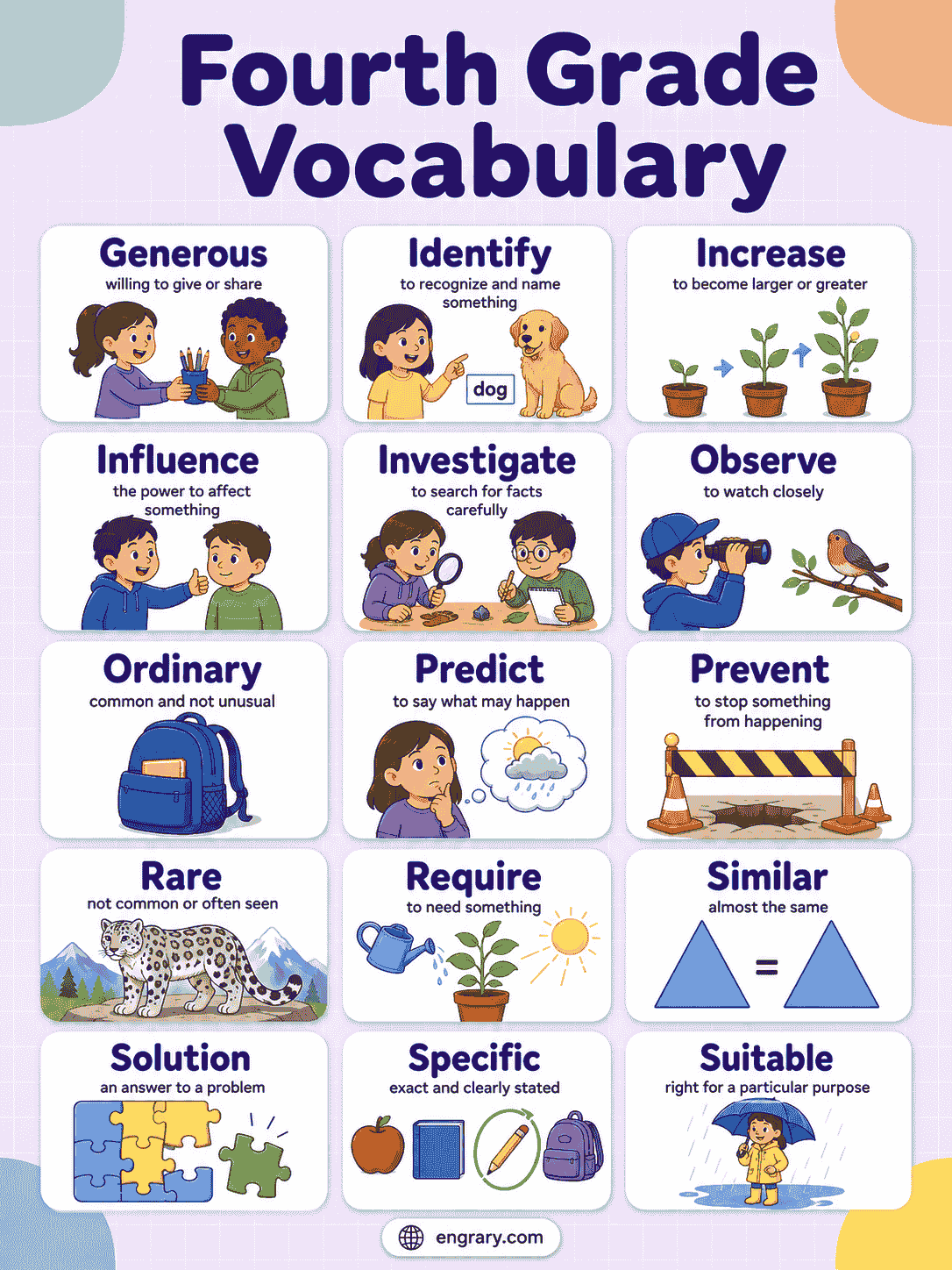
Using Dictionaries and Thesauruses
Reference tools help students confirm meaning and choose words carefully.
| Tool | Best use |
|---|---|
| Dictionary | Definitions, pronunciation, parts of speech, and example use |
| Glossary | Subject-specific terms from a book |
| Thesaurus | Related words and possible alternatives |
| Index | Locations of topics within a book |
| Guide words | Finding dictionary entries quickly |
A thesaurus may suggest words with similar meanings, but students should not replace words automatically. First, they should check whether the new word fits the sentence’s meaning and tone.
For example, persistent and stubborn are related, yet they do not create the same impression.
Choosing Precise Words in Writing
Fourth graders should choose vocabulary that fits the purpose and type of writing.
Narrative Writing
Basic:
The boy went toward the cave. He was scared, but he kept going.
Improved:
The cautious boy approached the concealed cave. Although he hesitated, he remained persistent and proceeded inside.
The revised version shows movement, setting, and character more precisely.
Informational Writing
Basic:
Wind helps make power. It is good because it does not run out quickly.
Improved:
Wind is a renewable resource that can generate electricity. Therefore, it provides a beneficial alternative to fuels that may become scarce.
The second paragraph uses subject vocabulary and a clear transition.
Opinion Writing
Basic:
I think the school needs a garden because it is good.
Improved:
The school should establish a garden because it would provide fresh produce, support science lessons, and contribute to a healthier environment.
Specific reasons make the opinion more convincing.
Fourth Grade Vocabulary Practice
Match Each Word with Its Meaning
- abundant
- clarify
- credible
- justify
- persistent
- reluctant
- scarce
- significant
a. unwilling or uncertain
b. important enough to matter
c. trustworthy
d. available in large amounts
e. make easier to understand
f. continuing despite difficulty
g. give reasons or evidence
h. difficult to find or limited
Choose the Best Academic Word
Use the words below.
confirm · credible · distinguish · justify · relevant · support
- The writer used a quotation to ___ the claim.
- We checked whether the source was ___.
- Please ___ your answer with two reasons.
- The diagram helped us ___ the two processes.
- A second experiment helped ___ the result.
- Only facts ___ to the topic belong in the report.
Identify the Context-Clue Type
Choose from:
definition · example · restatement · contrast · cause and effect · inference
- A mineral, a naturally occurring solid, can have a crystal structure.
- Renewable resources, including sunlight and wind, can be replaced naturally.
- The supply was scarce; that is, very little remained.
- The outside was transparent, but the inner layer was opaque.
- The severe storm knocked down trees and closed roads.
- Jonah hesitated at the doorway, stepped backward, and looked uncertain.
Match the Root with Its Meaning
- bio
- geo
- graph
- spect
- struct
- tele
a. look
b. earth
c. build
d. far
e. life
f. write or record
Compare Connotation
Choose the most suitable word.
- The student continued revising after several failures.
a. stubborn
b. persistent
c. arrogant - The reporter asked private questions that were unrelated to the interview.
a. curious
b. interested
c. nosy - The athlete believed she could perform well after months of practice.
a. confident
b. arrogant
c. scrawny - The family planned its spending carefully and avoided waste.
a. stingy
b. economical
c. nosy
Interpret Figurative Language
- “The classroom was a zoo” is a:
a. simile
b. metaphor
c. proverb - “As light as a feather” is a:
a. simile
b. idiom
c. adage - “Break the ice” means:
a. crack frozen water
b. make people feel comfortable
c. stop a conversation - “Actions speak louder than words” means:
a. people should shout
b. behavior can matter more than promises
c. speaking is unimportant
Choose the Correct Reference Tool
- To find the pronunciation and part of speech of reluctant: __________
- To find another word related to vivid: __________
- To locate the topic erosion in a science book: __________
- To find the meaning of a science term listed at the back of a textbook: __________
Choices:
- dictionary;
- glossary;
- thesaurus;
- index.
Improve the Writing
Rewrite each sentence using one or more words from the article.
- The storm was very bad.
- We used a good website for our report.
- The student kept trying after the model failed.
- The new fact did not agree with the old report.
- The writer gave reasons for the idea.
Answer Key
Match each word with its meaning
- abundant → d
- clarify → e
- credible → c
- justify → g
- persistent → f
- reluctant → a
- scarce → h
- significant → b
Choose the best academic word
- support
- credible
- justify
- distinguish
- confirm
- relevant
Identify the context-clue type
- definition
- example
- restatement
- contrast
- cause and effect
- inference
Match the root with its meaning
- bio → e
- geo → b
- graph → f
- spect → a
- struct → c
- tele → d
Compare connotation
- persistent
- nosy
- confident
- economical
Interpret figurative language
- b. metaphor
- a. simile
- b. make people feel comfortable
- b. behavior can matter more than promises
Choose the correct reference tool
- dictionary
- thesaurus
- index
- glossary
Improve the writing: possible answers
- The severe storm caused considerable damage.
- We used a credible website for our report.
- The persistent student continued after the model failed.
- The new fact contradicted the previous report.
- The writer justified the claim with relevant evidence.
FAQs
There is no single required number, but a focused list of about 130–150 high-value words can support reading, writing, research, and subject learning.
They should learn academic words, research terms, reasoning language, precise verbs and adjectives, transitions, and key vocabulary from math, science, history, geography, and civics.
Fourth-grade vocabulary includes more advanced reasoning, source evaluation, Greek and Latin roots, figurative language, connotation, and formal transition words.
Students remember words more effectively when they meet them in meaningful texts, examine roots and context, compare related terms, and use them in speaking and writing.
A dictionary helps confirm meaning, pronunciation, and usage, while a thesaurus suggests related words. Students should use both tools together to choose accurate vocabulary.
You May Also Like