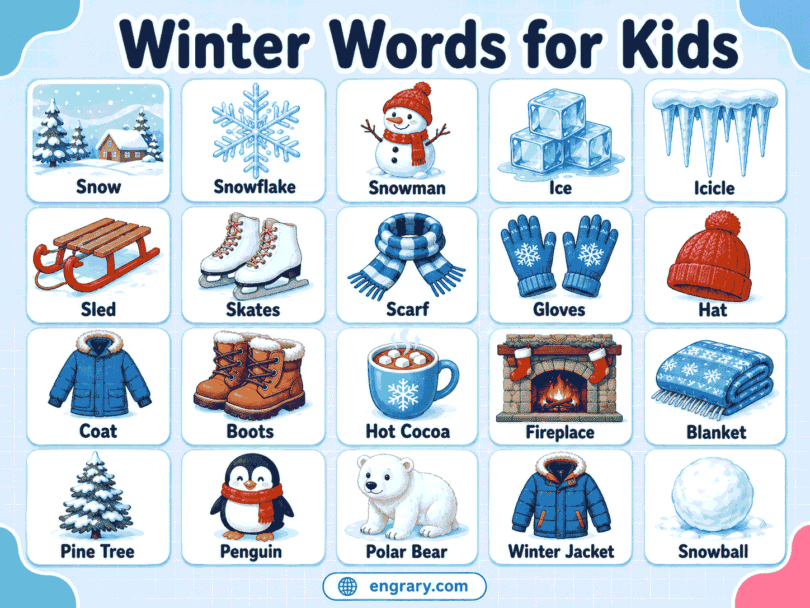
Snowflakes float past the window, frost shines on the grass, and warm mittens protect little hands from the cold. Winter brings its own weather, objects, clothing, activities, and changes in nature, so children can discover many useful seasonal words.
A winter word names or describes something connected with cold weather, snow, ice, clothing, nature, or winter activities. However, winter does not look the same everywhere. Some places receive deep snow, while other regions have cool rain, strong winds, frost, or mild temperatures.
Common Winter Words Children Recognize
Children often see, hear, wear, or use these familiar winter words:
- Winter
- Cold
- Snow
- Ice
- Snowflake
- Frost
- Winter coat
- Scarf
- Gloves
- Snow boots
- Sled
- Snowman
- Fireplace
- Hot chocolate
- Bare tree
Words for Cold and Freezing Weather
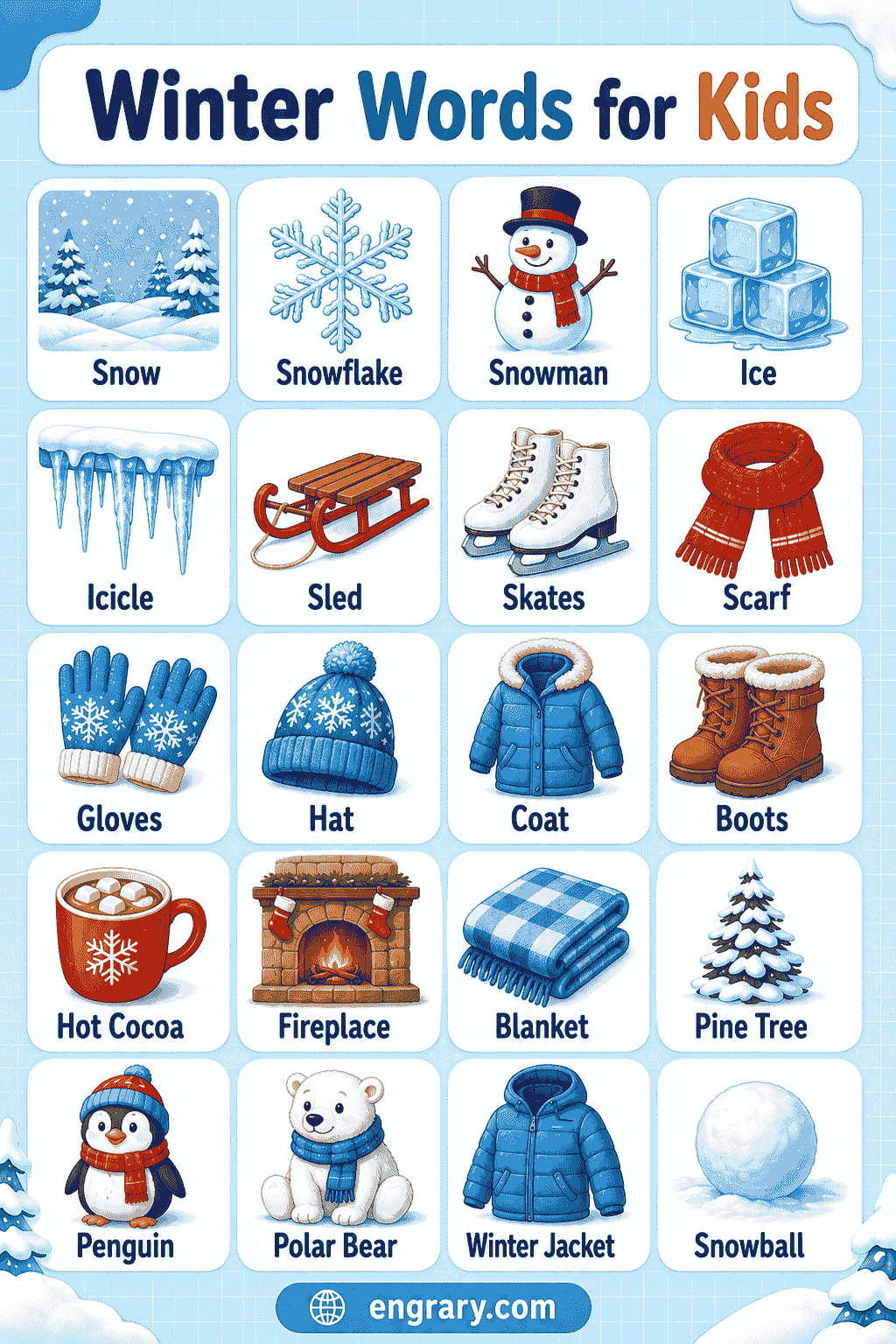
These words help children talk about low temperatures, frosty mornings, and especially cold periods.
Winter — The coldest season of the year, occurring between fall and spring. Winter months differ between the Northern and Southern Hemispheres.
Cold — A general word for a low temperature or a lack of warmth. For example, children may say, “The air feels cold.”
Chilly — Slightly or uncomfortably cold, but usually not extremely cold. A cool breeze can make a mild day feel chilly.
Freezing — Extremely cold or cold enough for water to turn into ice. In everyday speech, people may also use freezing to emphasize how cold they feel.
Below zero — A temperature lower than zero on the scale being used. Therefore, below-zero weather usually requires warm clothing.
Wind chill — The temperature people feel when wind causes the body to lose heat more quickly. Strong wind can make a cold day feel much colder.
Cold snap — A short period of unusually cold weather. Unlike the whole winter season, a cold snap may last only a few days.
Frost — Small ice crystals that form on cold grass, windows, plants, roofs, or cars. Frost often appears during clear, cold nights.
Bitter cold — Extremely cold weather that feels harsh and uncomfortable. People usually limit their time outdoors during bitter cold.
Wintry — Looking or feeling like winter because of snow, frost, cold wind, or gray skies. A wintry day can occur before or after the official season.
Snow, Ice, and Winter Storm Words
Winter moisture can appear as soft snow, hard ice, wet slush, hanging icicles, or powerful storms.
Snow — Frozen crystals that fall from clouds and may collect on the ground. Snow can feel dry and powdery or wet and heavy.
Ice — Water that has frozen into a solid. Ice can form on ponds, roads, sidewalks, windows, and other cold surfaces.
Snowflake — One ice crystal or a group of crystals that falls as snow. Each snowflake has a delicate frozen pattern.
Snowfall — Snow falling from the sky or the amount of snow that falls during a certain period. Heavy snowfall can cover roads and fields.
Flurry — A brief period of light snow. Unlike a snowstorm, a flurry usually produces little accumulation.
Snowstorm — A storm that brings steady or heavy snow. In addition, it may include wind and difficult travel conditions.
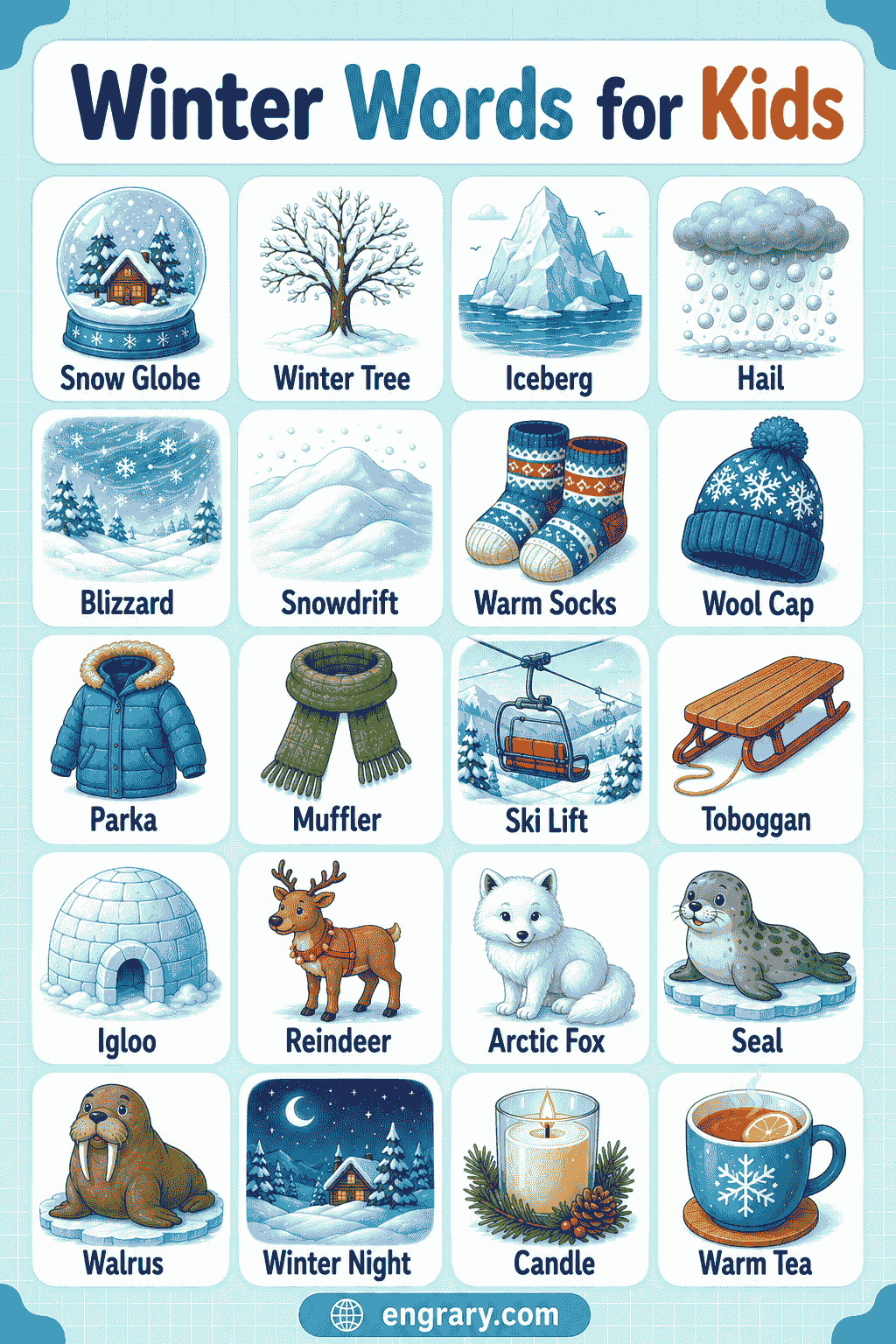
Blizzard — A severe winter storm with strong winds and greatly reduced visibility. A blizzard involves more than heavy snowfall alone.
Snowdrift — A mound of snow created when wind pushes loose snow into one place. Snowdrifts often form beside walls, fences, or buildings.
Snowbank — A pile or ridge of snow beside a road, sidewalk, driveway, or cleared area. Snowplows and shovels often create snowbanks.
Sleet — Small ice pellets that fall from the sky. In American English, sleet differs from freezing rain.
Freezing rain — Liquid rain that freezes when it touches a cold road, tree, car, or walkway. As a result, it can create a smooth layer of ice.
Icicle /ˈaɪsɪkəl/ 🔊 — A pointed piece of ice that hangs from a roof, branch, or other edge. Icicles form when dripping water freezes.
Black ice — A thin, clear layer of ice that can be difficult to see on roads and sidewalks. Its dark appearance usually comes from the surface beneath it.
Slush — Wet, partly melted snow mixed with water. Slush often collects beside roads and soaks through clothing that is not waterproof.
Names of Clothes Worn in Winter
Winter clothing helps protect the body from cold air, snow, and wet ground. The amount of clothing people need depends on their local weather.
Winter coat — A thick outer garment that helps keep the upper body warm. Many winter coats also block wind or resist water.
Scarf — A long piece of fabric worn around the neck. People may wrap it closely to keep out cold air.
Gloves — Hand coverings with a separate section for each finger. Gloves make it easier to hold and use small objects.
Mittens — Warm hand coverings that keep most fingers together. Because the fingers share warmth, mittens can feel warmer than gloves.
Beanie — A close-fitting knitted hat worn during cold weather. It covers the head and may also cover the ears.
Earmuffs — Two warm ear coverings connected by a band. Unlike a beanie, earmuffs do not cover the top of the head.
Snow boots — Warm, waterproof boots with gripping soles for snowy, wet, or slushy ground.
Snow pants — Thick or waterproof pants worn over regular clothing. They help keep the legs warm and dry during snowy activities.
Winter Objects for Warmth and Snowy Days
Some winter objects warm indoor spaces, measure temperature, clear snow, or make a cold day more comfortable.
Fireplace — A structure where a controlled fire provides heat indoors. Some fireplaces burn wood, while others use gas or electricity.
Blanket — A large, soft covering used for warmth on a bed, couch, or chair. A thick blanket can make a room feel cozier.
Heater — A device that raises the temperature of an indoor space. Different heaters use electricity, gas, hot water, or other energy sources.
Snow shovel — A shovel with a wide blade for moving snow from steps, sidewalks, or driveways.
Snowplow — A vehicle or large attached blade that pushes snow away from roads and other surfaces.
Thermometer /θərˈmɑːmɪtər/ 🔊 — A tool that measures temperature. An outdoor thermometer helps people check how cold the air is.
Hot chocolate — A warm drink made with cocoa and milk or water. Many people enjoy it after spending time outdoors in cold weather.
Firewood — Cut pieces of wood used as fuel in a wood-burning fireplace or stove. Dry firewood burns more effectively than wet wood.
Winter Play, Sports, and Snow Creations
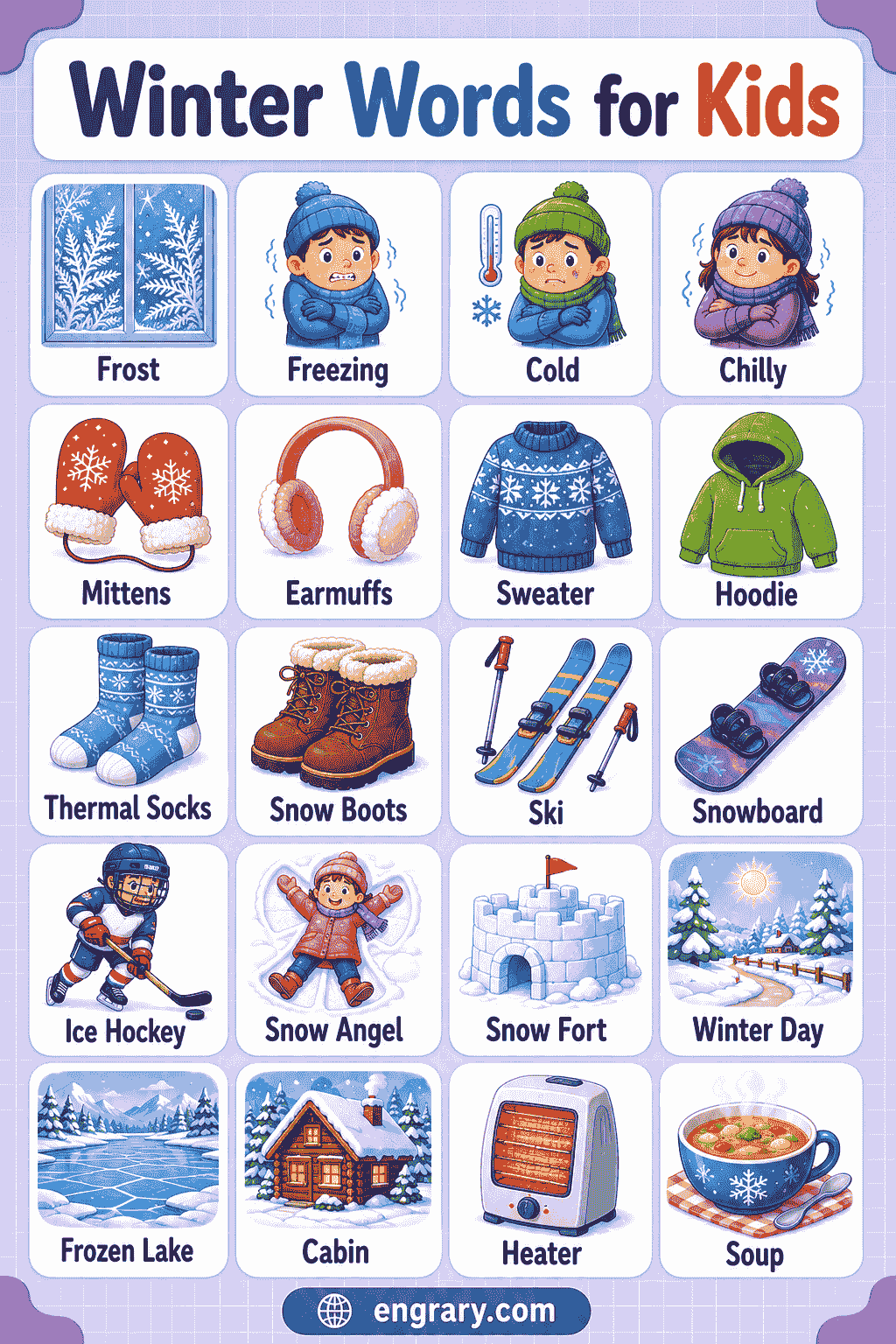
Some winter activities take place on snow or ice, while others involve making shapes and objects from snow.
Sled — A low vehicle with runners or a smooth bottom that slides over snow. A person can sit or lie on it.
Sledding — The activity of riding a sled over snow, often down a gentle hill. The sled is the object, while sledding is the activity.
Ice skating — Moving across an ice rink while wearing boots with metal blades. Skaters push with their legs and glide over the surface.
Skiing — Moving across snow or downhill while wearing one long ski on each foot.
Snowboarding — Riding over snow while standing sideways on one wide board. Unlike skiing, snowboarding does not use two separate skis.
Snowshoeing /ˈsnoʊˌʃuːɪŋ/ 🔊 — Walking over deep snow while wearing wide snowshoes. Their broad shape helps stop the feet from sinking deeply.
Snowman — A human-shaped figure made by stacking and decorating packed snow. Children may add sticks, stones, or a carrot.
Snow angel — A wing-like shape made by lying in soft snow and moving the arms and legs.
Snowball — A small ball made by pressing snow together. Soft, damp snow usually packs more easily than dry powder.
Warming up — Becoming warmer after spending time in cold conditions. People may warm up indoors, change wet clothes, or drink something warm.
Changes in Trees, Plants, and Animals During Winter
Winter affects daylight, soil, plants, and animal behavior. However, the exact changes depend on the climate and local environment.
Bare tree — A deciduous tree that has lost its leaves. Its branches remain visible until new leaves grow.
Evergreen — A tree or plant that keeps green leaves or needles throughout the year. Pine, fir, and spruce trees are familiar examples.
Pinecone — A hard, woody structure that carries the seeds of a pine tree. Pinecones may fall to the ground during different seasons.
Animal tracks — Footprints or marks left by animals in snow, mud, or soft ground. Tracks can show which direction an animal traveled.
Den — A protected shelter where an animal rests, hides, or raises its young. Some animals use dens during cold weather.
Hibernation /ˌhaɪbərˈneɪʃən/ 🔊 — A long period of deep rest or greatly reduced activity. Certain animals conserve energy this way during colder months.
Migration /maɪˈɡreɪʃən/ 🔊 — Seasonal movement from one region to another. Some birds migrate to places with warmer weather or more available food.
Dormant — Temporarily inactive or not growing. During winter, many plants remain alive even though their visible growth stops.
Shorter days — Winter days have fewer hours of daylight than summer days. Therefore, darkness often arrives earlier.
Frozen pond — A pond with ice covering part or all of its surface. Even when a pond looks solid, the ice may not support a person’s weight.
Words for Describing Winter Weather and Actions
These adjectives and verbs help children add detail to winter descriptions, stories, and conversations.
Snowy — Covered with snow or experiencing falling snow. A snowy field may look completely white.
Icy — Covered with ice or extremely cold. For example, an icy sidewalk may feel hard and slippery.
Frosty — Covered with frost or feeling sharply cold. Frosty grass often sparkles in early sunlight.
Slippery — Difficult to stand or walk on without sliding. Ice, water, and slush can make a surface slippery.
Slushy — Wet and partly melted like slush. Boots may become slushy after walking through melting snow.
Powdery — Soft, dry, light, and loose like fine powder. Fresh snow often feels powdery in very cold conditions.
Cozy — Warm, comfortable, and pleasant. A blanket, fireplace, and soft chair can create a cozy space.
Shiver — To shake slightly because of cold. The body shivers as it tries to produce warmth.
Freeze — To become solid because of cold. Water freezes and changes into ice.
Melt — To change from a solid into a liquid because of warmth. Snow melts when the temperature rises.
Winter Words That Are Easy to Confuse
Several winter terms describe related weather, objects, or activities. However, each word has its own meaning.
| Winter words | Main difference |
|---|---|
| Snow and ice | Snow falls as frozen crystals, while ice forms when water freezes into a solid. |
| Snowflake and snowfall | A snowflake is one crystal or cluster, while snowfall means falling snow or the amount that falls. |
| Flurry and snowstorm | A flurry is light and brief, whereas a snowstorm brings more sustained snow. |
| Snowstorm and blizzard | A blizzard includes strong winds and severely reduced visibility. |
| Snowbank and snowdrift | People or snow-clearing equipment often create a snowbank, while wind creates a snowdrift. |
| Sleet and freezing rain | Sleet falls as ice pellets, while freezing rain falls as liquid and freezes on contact. |
| Cold, chilly, and freezing | Chilly means slightly cold, cold is general, and freezing means extremely cold. |
| Gloves and mittens | Gloves separate the fingers, while mittens keep most fingers together. |
| Sled and sledding | A sled is the object, while sledding is the activity of riding it. |
| Hibernation and migration | Hibernation involves reduced activity, while migration involves moving to another region. |
Building Simple Sentences with Winter Words
Weather sentences often use it is followed by an adjective:
- Today is cold and windy.
- It is freezing outside.
- Snowy weather covered the town.
- This morning feels especially chilly.
Use there is with one object or an uncountable winter word:
- Frost covers the grass.
- There is snow on the roof.
- Black ice has formed on the road.
- A patch of slush lies beside the sidewalk.
Plural winter objects usually follow there are:
- Several icicles hang beneath the roof.
- There are snowbanks beside the road.
- Animal tracks cross the snowy yard.
- Many pinecones lie beneath the evergreen.
Winter adjectives add useful detail to descriptions:
- The sidewalk looks icy.
- Fresh snow feels soft and powdery.
- Our living room becomes cozy beside the fireplace.
- Wet boots turn slushy after a walk outside.
When talking about clothing, use verbs such as wear, put on, wrap, and take off:
- Mia wears a thick winter coat.
- Before going outside, the child puts on mittens.
- We wrap scarves around our necks.
- Ava takes off her beanie indoors.
Clear action verbs make winter activity sentences stronger:
- The children built a snowman.
- After the snowfall, we went sledding.
- Noah practices ice skating at the rink.
- Everyone warmed up beside the fireplace.
Nature sentences can describe seasonal changes:
- Bare trees have no leaves.
- Some animals enter hibernation during winter.
- As temperatures fall, many birds begin their migration.
- Plants may remain dormant until warmer weather returns.
| Incorrect sentence | Correct sentence |
|---|---|
| It is snow outside. | It is snowing outside. |
| The weather is freeze. | The weather is freezing. |
| I wear a scarf in my neck. | I wear a scarf around my neck. |
| There are frost on the grass. | There is frost on the grass. |
| We make a snowman yesterday. | We made a snowman yesterday. |
Guess, Match, and Sort the Winter Vocabulary
Guess the Winter Word
- This is one frozen crystal or cluster that falls as snow.
- It is a pointed piece of ice hanging from a roof or branch.
- People wear these hand coverings with most fingers together.
- This word means a brief period of light snow.
- Some animals enter this long period of reduced activity.
- This warm drink is commonly made with cocoa.
- Wind pushes snow into this deep mound.
- This vehicle clears snow from roads.
Sort the Winter Words
Place each word in the correct group:
- blizzard;
- flurry;
- mittens;
- earmuffs;
- fireplace;
- thermometer;
- sledding;
- snowboarding;
- evergreen;
- animal tracks;
- slippery;
- powdery;
- shiver;
- melt;
- snowflake;
- slush.
Groups:
- winter weather;
- winter clothing;
- winter objects;
- winter activities;
- winter nature;
- describing words;
- action words;
- snow and ice.
Match Each Word with Its Meaning
- frost;
- snowdrift;
- snowbank;
- freezing rain;
- beanie;
- migration;
- dormant;
- wind chill.
Meanings:
- small ice crystals on a surface;
- a mound of snow created by wind;
- a pile of cleared snow beside a road or path;
- liquid rain that freezes on contact;
- a close-fitting knitted winter hat;
- seasonal movement to another region;
- temporarily inactive or not growing;
- how cold the air feels because of wind.
Complete the Sentences
- The sidewalk is covered with ___.
- A ___ is one frozen crystal or cluster that falls as snow.
- We wear ___ around our necks.
- Some animals enter ___ during winter.
- The children made a ___.
- A snowplow clears snow from the ___.
- Fresh snow can feel soft and ___.
- Warm air causes snow to ___.
Answer Key
Guess the winter word
- snowflake
- icicle
- mittens
- flurry
- hibernation
- hot chocolate
- snowdrift
- snowplow
Sort the winter words
- winter weather: blizzard, flurry;
- winter clothing: mittens, earmuffs;
- winter objects: fireplace, thermometer;
- winter activities: sledding, snowboarding;
- winter nature: evergreen, animal tracks;
- describing words: slippery, powdery;
- action words: shiver, melt;
- snow and ice: snowflake, slush.
Match each word with its meaning
- frost → small ice crystals on a surface;
- snowdrift → a mound of snow created by wind;
- snowbank → a pile of cleared snow beside a road or path;
- freezing rain → liquid rain that freezes on contact;
- beanie → a close-fitting knitted winter hat;
- migration → seasonal movement to another region;
- dormant → temporarily inactive or not growing;
- wind chill → how cold the air feels because of wind.
Complete the sentences
- ice or frost
- snowflake
- scarves
- hibernation
- snowman
- road
- powdery
- melt
FAQs
Children can begin with winter, cold, snow, ice, snowflake, frost, coat, scarf, gloves, boots, sled, snowman, fireplace, and hot chocolate.
No. Some regions have snowy and freezing winters, while others experience cool rain, frost, wind, or mild temperatures.
Snow falls from clouds as frozen crystals. Ice forms when liquid water freezes into a solid.
No. Winter vocabulary describes a season, its weather, clothing, nature, and activities. Christmas vocabulary relates to a particular holiday.
Labeled pictures, word sorting, matching games, short clues, comparisons, and simple sentences help children connect each word with its meaning.
You May Also Like