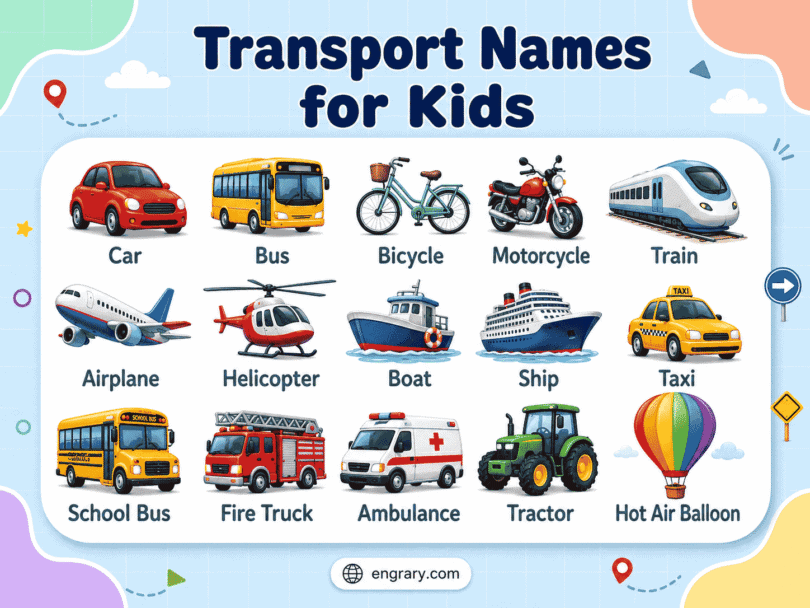
A yellow school bus rolls along the road, a train follows its tracks, and a helicopter circles above the city. Because each form of transport has a recognizable shape, purpose, and way of moving, labeled pictures can help children connect the correct name with the vehicle they see.
Transportation means moving people or goods from one place to another. A vehicle is a machine or object used for that movement; however, walking is also a form of transportation even though it does not involve a vehicle.
Vehicles Children See in Everyday Life
Children may notice these familiar forms of transport while going to school, visiting shops, traveling with family, or watching traffic from a safe place:
- Car
- Taxi
- Bus
- School bus
- Bicycle
- Scooter
- Motorcycle
- Train
- Subway
- Boat
- Ship
- Airplane
- Helicopter
- Ambulance
- Fire truck
Cars, Buses, and Other Road Vehicles
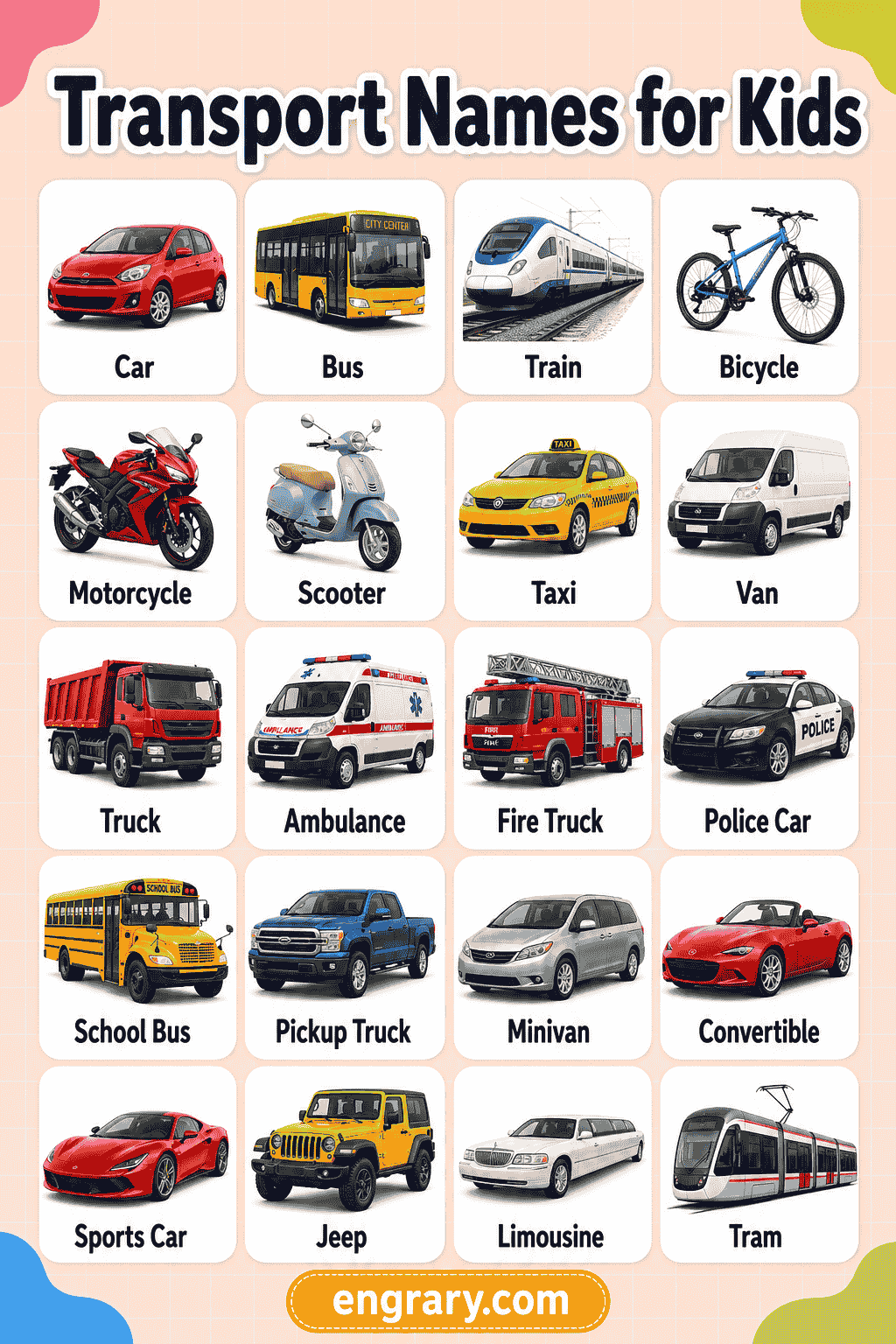
Road vehicles move along streets and highways. While some carry individual passengers or families, others transport larger groups, luggage, tools, equipment, or goods.
Car — A small enclosed road vehicle that usually carries a driver and several passengers. Four wheels, doors, windows, and a trunk make it easy to recognize.
Taxi — Unlike a private car, a taxi carries passengers who pay for each journey. A roof sign, meter, or company markings may identify it.
Bus — This large road vehicle carries many passengers along a planned route. It usually has several rows of seats, large windows, and one or more passenger doors.
School bus — Children use this specially marked bus to travel to and from school. In the United States, school buses are commonly yellow and display warning lights and a stop arm.
Coach — For longer journeys, a coach or motorcoach offers comfortable seating and luggage storage. It often carries tour groups, sports teams, or travelers between cities.
Van — A medium-sized road vehicle can carry people, tools, equipment, or goods. Compared with a car, it usually has a taller body and more space inside.
Minivan — Designed mainly for passengers, a minivan provides extra seats and flexible interior space. Sliding side doors are a common recognition clue.
Pickup truck — A passenger cab sits at the front, while an open cargo bed at the back holds tools, supplies, or other loads.
Recreational vehicle (RV) — This large road vehicle provides space for traveling, sleeping, and sometimes cooking. Families may use an RV for road trips or camping.
Trains and Vehicles That Run on Tracks
Rail transport follows fixed tracks instead of moving freely across a road. As a result, trains and city rail systems travel along set routes and stop at designated locations.
Train — A train consists of connected rail cars that carry passengers, goods, or both. An engine or powered unit pulls or moves the cars along tracks.
Subway — A subway is a city rail system that often travels underground and stops frequently in busy areas. British speakers commonly use underground.
Streetcar — This rail vehicle runs on tracks built into or beside city streets. British English usually uses tram.
Light rail — An urban rail system carries passengers through a city or nearby communities. Depending on the route, it may travel beside roads, through streets, or on separate tracks.
Commuter train — People use this passenger train to travel between residential areas and city centers. It usually becomes busiest before and after the workday.
High-speed train — Because it is designed for rapid travel, this train moves much faster than an ordinary passenger train. Its long, smooth shape reduces air resistance.
Freight train — Instead of regular passengers, a freight train carries containers, vehicles, fuel, food, and other goods.
Monorail /ˈmɑːnəreɪl/ 🔊 — A monorail travels along one supporting rail, which may stand above the ground. Its raised track often makes it visually distinct from an ordinary train.
Boats and Other Vehicles That Travel on Water
Water transport moves across rivers, lakes, seas, and oceans. However, each vessel has a different size, shape, power source, and purpose.
Boat — A general name for a smaller vehicle that carries people or goods across water. Boats may use motors, sails, oars, or paddles.
Ship — Larger than most boats, a ship can carry heavy cargo or many passengers over long distances. Ships commonly travel across seas and oceans.
Ferry — This vessel follows a regular route and carries passengers, vehicles, or both across water. Ferries often connect islands, coastal towns, or opposite sides of a river.
Sailboat — Wind fills the sails and helps this boat move forward. A tall mast and large fabric sails provide clear visual clues.
Rowboat — A person moves this small boat by pulling oars through the water. Unlike a canoe paddle, each oar normally rests against the side of the boat.
Canoe — Usually open at the top, a canoe moves with one or more single-bladed paddles. Riders often sit or kneel facing forward.
Kayak — By contrast, a kayak usually has a lower, more enclosed shape and uses a double-bladed paddle.
Raft — A raft is a flat floating structure used to carry people or materials. Some rafts float gently on calm water, while others travel through fast-moving rivers.
Speedboat — A powerful motor allows this small boat to travel quickly. Its narrow body and low shape help it move smoothly across the water.
Cruise ship — Passengers use this large ship for leisure journeys and vacations. In addition to cabins, it may contain restaurants, pools, shops, and entertainment areas.
Cargo ship — Containers, vehicles, fuel, and other goods travel across the sea on this working ship. Large cargo ships may carry thousands of containers.
Submarine — Unlike ordinary boats, a submarine can travel below the surface of the water. Its long enclosed body and upper tower help children recognize it.
Hovercraft /ˈhʌvərkræft/ 🔊 — A cushion of air lifts this vehicle slightly above the surface, allowing it to travel over water and some flat land.
Airplanes and Other Flying Vehicles
Flying vehicles carry passengers, goods, or equipment through the air. While most aircraft use engines, others rely on heated air, wind, or rising air currents.
Airplane — A fixed-wing aircraft carries people or goods through the air. British English uses aeroplane.
Jet — Powerful jet engines allow this airplane to fly quickly and reach high altitudes. Many large passenger airplanes are jets.
Helicopter — Unlike an airplane, a helicopter uses rotating blades to rise vertically, change direction, and hover above one place.
Seaplane — This airplane can take off from and land on water. Floats or a boat-shaped lower body help it remain on the surface.
Glider — A glider is a lightweight aircraft that flies without using an engine for most of its journey. Instead, it uses rising air to stay aloft.
Hot-air balloon — Heated air fills the large fabric balloon and lifts the passenger basket beneath it. Wind determines much of its direction.
Blimp — Special gas helps this long, rounded aircraft float through the sky. Unlike a hot-air balloon, a blimp usually has engines and steering controls.
Bicycles, Scooters, Sleds, and Carriages
These forms of transport usually carry one person or a small number of riders. Some use human or animal power, whereas others depend on a small engine or battery.
Bicycle — A bicycle has two wheels and moves when a rider turns the pedals. Handlebars control direction, while brakes help the rider slow down.
Tricycle — Because it has three wheels, a tricycle provides more balance than a bicycle. Young children often use it while learning to pedal and steer.
Scooter — A rider stands on a narrow platform, holds the handlebar, and pushes against the ground with one foot.
Electric scooter — A battery-powered motor moves this scooter without constant kicking. However, the rider still stands on a platform and uses handlebars to steer.
Motorcycle — An engine powers this two-wheeled road vehicle. British speakers may also say motorbike.
Skateboard — A rider stands on this short wheeled board and pushes against the ground to move. Shifting body weight controls direction.
Sled — Runners beneath this vehicle allow it to slide over snow or ice. A person may ride downhill or pull it with a rope.
Dog sled — A trained team of dogs pulls this sled across snowy land. The driver, called a musher, stands at the back and guides the team.
Horse-drawn carriage — One or more horses pull this wheeled passenger vehicle. Carriages were once common everyday transport but now mainly appear in tourism, ceremonies, or recreation.
Snowmobile — A motor, front skis, and a moving rear track help this vehicle travel across snow.

Emergency and Community Service Vehicles
Emergency and service vehicles perform important community jobs rather than providing ordinary passenger transport. During urgent situations, lights and sirens warn other road users to make space.
Ambulance — Medical teams use this emergency vehicle to carry sick or injured people to medical care. Medical equipment inside allows care to begin during the journey.
Fire truck — Firefighters use this vehicle to carry hoses, ladders, rescue tools, and sometimes water.
Police car — Officers use this vehicle for patrols, emergencies, traffic work, and community safety. Flashing lights and official markings make it easy to identify.
Tow truck — When another vehicle breaks down or cannot move safely, a tow truck pulls, lifts, or carries it away.
Delivery van — Drivers use this van to bring packages, food, and products to homes or businesses. Its enclosed storage area protects the items inside.
Garbage truck — A large container and lifting equipment help this vehicle collect and transport household waste.
Street sweeper — Rotating brushes remove dust, leaves, and litter as this service vehicle moves along roads and curbs.
Mail truck — Postal workers use this vehicle to collect and deliver letters and packages along a regular route.
Transport Names That Children Often Confuse
Several vehicles share similar shapes or purposes. Nevertheless, their size, route, power source, or main use helps children tell them apart.
| Transport names | Main difference |
|---|---|
| Car and taxi | A car may belong to its driver, while a taxi carries passengers who pay for the journey. |
| Bus and coach | A bus usually follows local routes, whereas a coach mainly serves longer journeys. |
| Van and minivan | A van may carry passengers or goods, while a minivan mainly carries people. |
| Bicycle and motorcycle | Pedaling powers a bicycle, whereas an engine powers a motorcycle. |
| Kick scooter and motorcycle | A kick scooter has a standing platform and uses foot power, while a seated motorcycle uses an engine. |
| Train and subway | Train is a broad rail term, while a subway is a city rail system that may run underground. |
| Streetcar and train | A streetcar often travels through city streets, whereas trains usually use separate railway lines. |
| Boat and ship | Boats are generally smaller, while ships carry larger loads or travel longer distances. |
| Canoe and kayak | A canoe is usually open and uses a single-bladed paddle; a kayak commonly uses a double-bladed paddle. |
| Ferry and cruise ship | A ferry provides transportation along a route, while a cruise ship offers a leisure journey. |

Talking About Transport in Simple Sentences
Use by when naming the general way someone travels and no article, possessive word, or number comes before the transport name.
- We travel by bus.
- Mia came by taxi.
- Our family went by train.
- They traveled by airplane.
However, verbs such as ride, take, catch, and drive usually need an article, possessive word, or specific vehicle name.
- I ride the school bus.
- We take a train to the city.
- Dad drives his car to work.
- She caught the last bus.
Use in with cars, taxis, vans, pickup trucks, and other smaller enclosed road vehicles.
- The children are in the car.
- We waited in a taxi.
- Several boxes are in the delivery van.
- The driver remained in the pickup truck.
By contrast, use on with buses, trains, airplanes, ferries, ships, bicycles, scooters, and motorcycles.
- The passengers are on the bus.
- We ate lunch on the train.
- She is on her bicycle.
- They traveled on a ferry.
Use get in or get into with smaller enclosed vehicles.
- Please get in the car.
- We got into a taxi outside the hotel.
- The driver climbed into the van.
Meanwhile, use get on with buses, trains, airplanes, ferries, ships, bicycles, scooters, and motorcycles.
- The children got on the school bus.
- Passengers are getting on the airplane.
- Ava got on her bicycle.
- We got on the ferry before noon.
Small boats follow a different pattern. Therefore, people normally get into a canoe, kayak, rowboat, or small speedboat.
- Liam got into the kayak.
- We carefully climbed into the rowboat.
- The paddlers stepped into the canoe.
Natural action verbs also make transport sentences clearer:
- People drive cars, taxis, buses, vans, and trucks.
- Riders pedal bicycles and tricycles.
- Passengers take buses, trains, ferries, and airplanes.
- Pilots fly airplanes and helicopters.
- Sailors sail sailboats.
- Rowers row rowboats.
- Paddlers paddle canoes and kayaks.
- A helicopter can hover above one place.
| Incorrect sentence | Correct sentence |
|---|---|
| We go by a bus. | We go by bus. |
| She rides on a car. | She rides in a car. |
| They got in the train. | They got on the train. |
| He drives a bicycle. | He rides a bicycle. |
| The airplane is sailing. | The airplane is flying. |
| I go to school with bus. | I go to school by bus. |
Name the Vehicle from Its Picture or Clue
Guess the Transport
- This large yellow vehicle carries children to school.
- It travels below the surface of the water.
- This rail vehicle runs along tracks in city streets.
- Rotating blades allow it to rise vertically and hover.
- It carries passengers and sometimes cars across water.
- A rider moves this two-wheeled vehicle by pedaling.
- Firefighters carry hoses and ladders in this vehicle.
- It transports containers and goods across the sea.
Sort the Vehicles
Place each name in the correct group:
- taxi;
- bus;
- subway;
- streetcar;
- kayak;
- ferry;
- jet;
- helicopter;
- sled;
- snowmobile;
- hovercraft;
- seaplane.
Groups:
- road;
- rail;
- water;
- air;
- snow;
- land and water;
- air and water.
Match Each Transport with Its Action
- car;
- bicycle;
- bus;
- helicopter;
- sailboat;
- rowboat;
- skateboard;
- canoe.
Actions:
- drive;
- pedal;
- take;
- hover;
- sail;
- row;
- ride;
- paddle.
Complete the Sentences
- We travel ___ bus.
- She rides ___ bicycle to the park.
- The passengers got ___ the train.
- Dad got ___ the car.
- A ferry travels ___ the water.
- The helicopter can ___.
- People ___ a rowboat with oars.
- The children are ___ the school bus.
Answer Key
Guess the transport
- school bus
- submarine
- streetcar
- helicopter
- ferry
- bicycle
- fire truck
- cargo ship
Sort the vehicles
- road → taxi, bus;
- rail → subway, streetcar;
- water → kayak, ferry;
- air → jet, helicopter;
- snow → sled, snowmobile;
- land and water → hovercraft;
- air and water → seaplane.
Match each transport with its action
- car → drive;
- bicycle → pedal;
- bus → take;
- helicopter → hover;
- sailboat → sail;
- rowboat → row;
- skateboard → ride;
- canoe → paddle.
Complete the sentences
- by
- a or her
- on
- into
- across
- hover
- row
- on
FAQs
First, children can learn car, bus, school bus, bicycle, train, boat, ship, airplane, helicopter, ambulance, and fire truck because these names appear often in everyday life.
Transportation means moving people or goods, while a vehicle is the machine or object used for that movement. For example, a bus is a vehicle, whereas bus travel is a form of transportation.
Yes. Although walking does not require a vehicle, it still moves a person from one place to another.
Use by bus when naming the general way of traveling. However, use a bus or the bus after verbs such as take, catch, ride, or board.
Pictures help children notice wheels, wings, tracks, sails, and other identifying features. In addition, learners can sort vehicles by where they move, connect each name with an action, and compare similar forms of transport.
You May Also Like