Compound nouns help children understand how English combines words to name people, places, things, animals, and ideas more precisely. Once children recognize these combinations, they can build vocabulary more easily, spell common compounds correctly, and understand how meaning changes when words work together.
You’ll learn what compound nouns are, how two or more words form one noun, and how closed, open, and hyphenated compound nouns differ. You’ll also see common examples, compare compound nouns with ordinary word combinations, learn basic plural forms, and practice identifying and using them correctly.

What Is a Compound Noun?
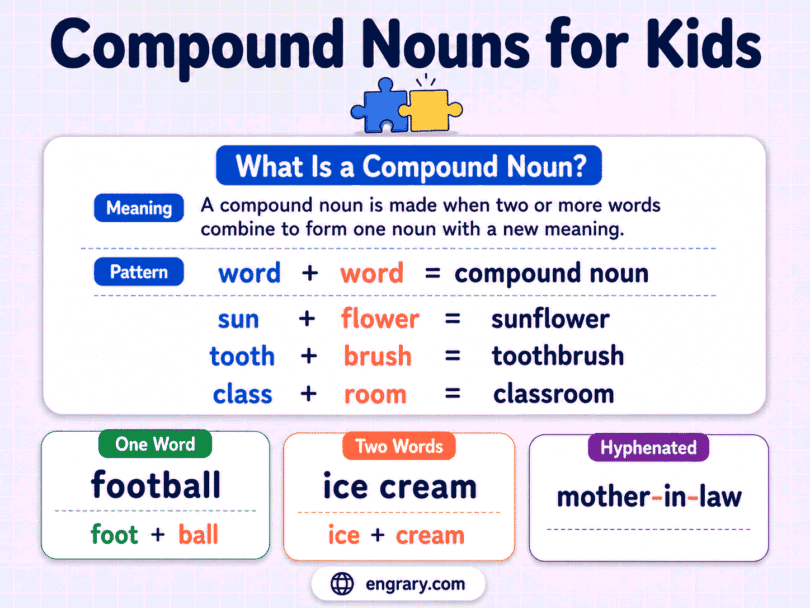
A compound noun is a noun made from two or more words that work together as one name.
For example:
- tooth + brush → toothbrush
- class + room → classroom
- bus + stop → bus stop
- mother + in + law → mother-in-law
Each compound names one person, place, thing, animal, or idea.
For example:
I packed my toothbrush.
The words tooth and brush combine to name one object.
Another example:
We waited at the bus stop.
The words bus and stop stay separate in writing, but together they name one place.
How Two Words Form One Noun
A compound noun often combines familiar words to create a more specific meaning.
Consider:
rain + coat → raincoat
A raincoat is a coat designed for rainy weather.
class + room → classroom
A classroom is a room where students learn.
book + shelf → bookshelf
A bookshelf is a shelf for books.
The two parts contribute meaning, but the complete compound functions as one noun.
Some compounds also develop meanings that are more specific than the separate words suggest.
For example:
green + house → greenhouse
A greenhouse is a structure used for growing plants. It does not simply mean any house that is green.
Three Main Types of Compound Nouns
Compound nouns can appear in three main written forms:
- closed;
- open;
- hyphenated.
These forms describe how the compound noun is written.
| Type | How It Is Written | Example |
|---|---|---|
| Closed | words join together | toothbrush |
| Open | words remain separate | bus stop |
| Hyphenated | words connect with hyphens | mother-in-law |
Closed Compound Nouns
A closed compound noun joins its parts together without spaces.
Examples include:
- toothbrush
- classroom
- notebook
- bedroom
- raincoat
- football
- sunflower
- bookshelf
- playground
- backpack
Look at:
Mia placed her books on the bookshelf.
The words book and shelf join to form one closed compound noun.
Another example:
Our classroom has large windows.
The word classroom names one place.
Open Compound Nouns
An open compound noun contains separate words that work together as one noun.
Examples include:
- bus stop
- post office
- swimming pool
- dining room
- ice cream
- coffee shop
- train station
- police officer
Look at:
We waited at the bus stop.
Although bus and stop have a space between them, together they name one place.
Another example:
The children swam in the swimming pool.
The two words form one compound noun.
Hyphenated Compound Nouns
A hyphenated compound noun connects its parts with one or more hyphens.
Examples include:
- mother-in-law
- father-in-law
- runner-up
- passer-by
- well-being
Look at:
Her mother-in-law visited on Sunday.
The hyphens connect the parts of the compound noun.
Another example:
Noah finished as the runner-up.
The entire expression functions as one noun.
Common Compound Noun Examples for Kids
Children encounter compound nouns every day at school, at home, outdoors, and in books.
School Compound Nouns
- classroom
- notebook
- schoolbag
- playground
- textbook
- bookshelf
- schoolyard
- lunchbox
Home Compound Nouns
- bedroom
- bathroom
- toothbrush
- toothpaste
- doormat
- dining room
- washing machine
- living room
Food and Drink Compound Nouns
- ice cream
- pancake
- popcorn
- cupcake
- fruit juice
- coffee shop
- breakfast
- watermelon
Nature and Weather Compound Nouns
- sunflower
- raindrop
- rainfall
- rainbow
- snowman
- moonlight
- sunlight
- thunderstorm
People Compound Nouns
- firefighter
- babysitter
- classmate
- police officer
- bus driver
- mother-in-law
- teammate
- shopkeeper
Place Compound Nouns
- bus stop
- post office
- swimming pool
- playground
- train station
- dining room
- airport
- bookstore
These examples show that compound nouns can use different spellings while still functioning as single nouns.
Common Ways Compound Nouns Are Formed
Closed, open, and hyphenated describe how a compound noun is written. Compound formation patterns describe what kinds of words combine to create it.
Children do not need to memorize many technical patterns, but a few common ones are useful.
Noun + Noun
Many compound nouns combine two nouns.
Examples:
- tooth + brush → toothbrush
- class + room → classroom
- rain + coat → raincoat
- bus + stop → bus stop
- book + shelf → bookshelf
- school + bag → schoolbag
In each example, the two nouns work together to name one thing or place.
Adjective + Noun
Some compound nouns combine an adjective with a noun.
Examples:
- black + board → blackboard
- green + house → greenhouse
These compounds can have a specific meaning that differs from an ordinary adjective + noun phrase.
For example:
a green house
means a house that is green.
a greenhouse
means a structure used for growing plants.
-ing Word + Noun
Some compound nouns begin with an -ing word followed by a noun.
Examples:
- swimming pool
- washing machine
- dining room
- walking stick
The complete expression functions as one noun.
For example:
The washing machine is running.
The words washing and machine together name one household appliance.
Compound Nouns vs. Compound Words
A compound word is a broad term for a word or expression made from two or more parts.
A compound noun is a compound that functions specifically as a noun.
For example:
- toothbrush → compound noun
- classroom → compound noun
- bus stop → compound noun
- mother-in-law → compound noun
A simple rule is:
Compound nouns are compounds that name people, places, things, animals, or ideas.
The term compound word can also include compounds that function as other parts of speech, so the two terms are related but not identical.
Compound Nouns vs. Ordinary Word Combinations
Not every pair of words forms a compound noun.
Sometimes two words simply work together as a normal description.
Compare:
black bird
This means any bird that is black.
blackbird
This names a particular kind of bird.
Another example:
green house
This means a house that has a green color.
greenhouse
This means a structure where people grow plants.
The spacing and meaning both matter.
A compound noun usually works as one recognized unit with one specific meaning.
How to Recognize a Compound Noun
Children can use a simple process to identify compound nouns.
First, look for two or more words or word parts working together.
Next, ask whether they name one person, place, thing, animal, or idea.
Then, check whether the combined expression has one recognized meaning.
Finally, notice whether the compound is closed, open, or hyphenated.
Consider:
We waited at the bus stop.
- bus + stop;
- names one place;
- written as two words;
- open compound noun.
Now look at:
I packed my toothbrush.
- tooth + brush;
- names one object;
- written as one word;
- closed compound noun.
And:
Her mother-in-law called yesterday.
- mother + in + law;
- names one person;
- connected with hyphens;
- hyphenated compound noun.
Singular and Plural Compound Nouns
Compound nouns can be singular or plural.
Many simple compound nouns form the plural by changing the final or main noun.
Closed Compound Nouns
- toothbrush → toothbrushes
- classroom → classrooms
- notebook → notebooks
- raincoat → raincoats
Example:
I bought two notebooks.
Open Compound Nouns
- bus stop → bus stops
- post office → post offices
- swimming pool → swimming pools
- train station → train stations
Example:
The town has three bus stops.
Hyphenated Compound Nouns
Some hyphenated compound nouns pluralize the main noun rather than the last word.
For example:
- mother-in-law → mothers-in-law
- father-in-law → fathers-in-law
Example:
Both mothers-in-law attended the event.
Children only need to remember common patterns first. Some compound nouns follow special plural rules, so dictionaries can help when the form is uncertain.
Common Compound Noun Mistakes
Children often make mistakes with spaces, hyphens, meaning, or plural forms.
| Incorrect | Correct | Why? |
|---|---|---|
| tooth brush | toothbrush | This common compound is written as one word. |
| busstop | bus stop | This compound is written as two words. |
| mother in law | mother-in-law | Hyphens connect the parts. |
| mother-in-laws | mothers-in-law | The main noun becomes plural. |
| green house = plant structure | greenhouse | The closed compound has the specific plant-growing meaning. |
| She can see a blackbird, meaning any black bird. | Use black bird for any bird that is black. | Blackbird names a specific kind of bird. |
Spelling matters because joining, separating, or hyphenating words can change meaning.
Compound Nouns Practice for Kids
Complete the activities before checking the answer key.
Build and Find Compound Nouns
Combine the words to make compound nouns.
- tooth + brush
- class + room
- rain + coat
- book + shelf
- sun + flower
Then find the compound noun in each sentence.
- We waited at the bus stop.
- Mia packed her toothbrush.
- Our classroom has twenty desks.
- Dad went to the post office.
- Her mother-in-law arrived early.
Closed, Open, or Hyphenated?
Classify each compound noun as closed, open, or hyphenated.
- toothbrush
- bus stop
- mother-in-law
- classroom
- swimming pool
- runner-up
- raincoat
- post office
Choose the Correct Compound Noun
Choose the correct form.
- I packed my (toothbrush / tooth brush).
- We waited at the (bus stop / busstop).
- Her (mother-in-law / mother in law) visited yesterday.
- The children played in the (playground / play ground).
- Dad went to the (post office / postoffice).
- Mia wore a (raincoat / rain coat).
Compound Noun or Ordinary Phrase?
Decide whether the bold expression is a compound noun or an ordinary phrase.
- We saw a black bird in the tree.
- A blackbird landed nearby.
- They painted the green house yesterday.
- Tomatoes grow inside the greenhouse.
- We waited at the bus stop.
- Mia carried a red bag.
Complete the Sentence and Make Plurals
Choose a suitable compound noun to complete each sentence.
- We swam in the ________.
swimming pool / swimmer pool - Dad mailed the package at the ________.
post office / postoffice - Mia put her books on the ________.
bookshelf / book shelf - Noah wore a ________ in the rain.
raincoat / rain coat
Now make these compound nouns plural:
- toothbrush
- classroom
- bus stop
- post office
- mother-in-law
Correct the Mistakes
Rewrite each compound noun correctly.
- tooth brush
- busstop
- mother in law
- play ground
- postoffice
- mother-in-laws
- book shelf
- class room
Write Compound Noun Sentences
Write:
- one sentence with a closed compound noun;
- one sentence with an open compound noun;
- one sentence with a hyphenated compound noun;
- one sentence using a school compound noun;
- one sentence using a home compound noun.
Answer Key
Build and Find Compound Nouns
Combined words:
- tooth + brush → toothbrush
- class + room → classroom
- rain + coat → raincoat
- book + shelf → bookshelf
- sun + flower → sunflower
Compound nouns in the sentences:
- bus stop
- toothbrush
- classroom
- post office
- mother-in-law
Closed, Open, or Hyphenated?
- toothbrush — closed
- bus stop — open
- mother-in-law — hyphenated
- classroom — closed
- swimming pool — open
- runner-up — hyphenated
- raincoat — closed
- post office — open
Choose the Correct Compound Noun
- toothbrush
- bus stop
- mother-in-law
- playground
- post office
- raincoat
Compound Noun or Ordinary Phrase?
- black bird — ordinary phrase
- blackbird — compound noun
- green house — ordinary phrase
- greenhouse — compound noun
- bus stop — compound noun
- red bag — ordinary phrase
Complete the Sentence and Make Plurals
Sentence answers:
- swimming pool
- post office
- bookshelf
- raincoat
Plural forms:
- toothbrush → toothbrushes
- classroom → classrooms
- bus stop → bus stops
- post office → post offices
- mother-in-law → mothers-in-law
Correct the Mistakes
- tooth brush → toothbrush
- busstop → bus stop
- mother in law → mother-in-law
- play ground → playground
- postoffice → post office
- mother-in-laws → mothers-in-law
- book shelf → bookshelf
- class room → classroom
Write Compound Noun Sentences
Answers will vary. Possible answers include:
- I packed my toothbrush.
- We waited at the bus stop.
- Her mother-in-law visited on Sunday.
- Our classroom has large windows.
- The washing machine is running.
FAQs About Compound Nouns
What is a compound noun?
A compound noun is a noun made from two or more words that work together as one name. Examples include toothbrush, bus stop, and mother-in-law.
What are the three types of compound nouns?
The three main written forms are closed, open, and hyphenated compound nouns. Examples are classroom, post office, and runner-up.
What is the difference between a compound noun and a compound word?
A compound word is a broader type of word made from multiple parts. A compound noun is a compound that functions specifically as a noun.
How can children identify a compound noun?
Look for two or more words or word parts that work together to name one person, place, thing, animal, or idea. Then check whether the expression has one recognized meaning and whether it appears in closed, open, or hyphenated form.
How do you make compound nouns plural?
Many compounds pluralize the main noun. For example, toothbrush becomes toothbrushes, bus stop becomes bus stops, and mother-in-law becomes mothers-in-law.
You May Also Like