Nouns can name one person, place, animal, thing, or idea. They can also name more than one. Learning the difference between singular and plural nouns helps children spell words correctly and build clear sentences.
Most plural nouns follow common spelling patterns, but some change in special ways or do not change at all. This guide explains the main rules, important exceptions, sentence clues, common mistakes, and practice activities with answers.
What Are Singular and Plural Nouns?
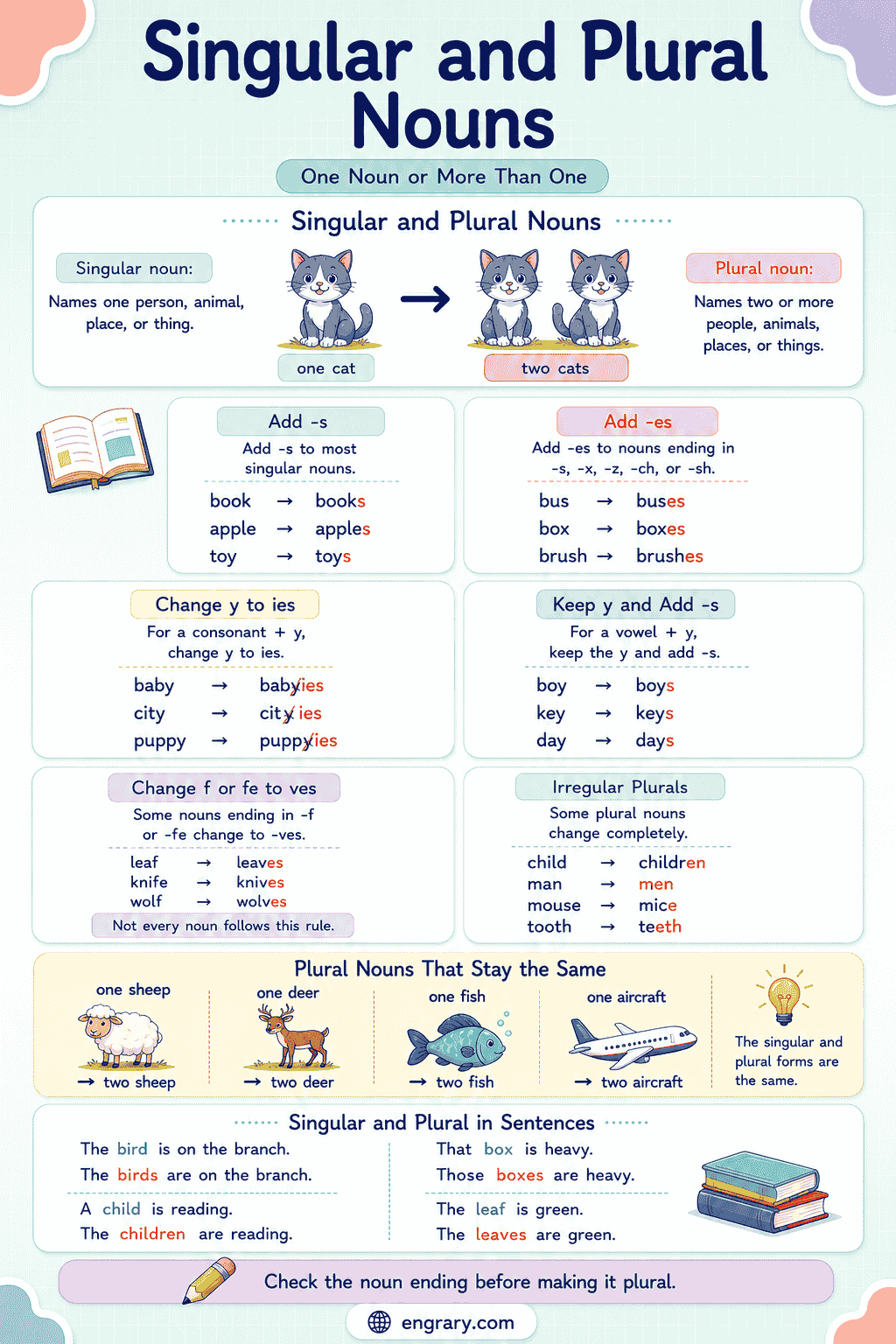
A singular noun names one person, place, animal, thing, or idea. A plural noun usually names more than one.
Compare:
- one cat → two cats;
- one box → three boxes;
- one baby → four babies;
- one child → several children;
- one sheep → many sheep.
These examples show that plural nouns do not all change in the same way.
A Quick Review of Nouns
A noun is a word that names a:
- person;
- place;
- animal;
- thing;
- idea.
| Noun Type | Example |
|---|---|
| person | teacher |
| place | library |
| animal | rabbit |
| thing | pencil |
| idea | hope |
The number of a noun tells whether it names one or more than one.
Singular Nouns Name One
A singular noun names one.
Examples include:
- one teacher;
- one park;
- one fox;
- one chair;
- one dream.
Singular nouns often appear with:
- a;
- an;
- one;
- this;
- that;
- each;
- every.
Examples in sentences:
- A bird is sitting on the fence.
- An apple is in the bowl.
- This book belongs to Mia.
- One student is absent.
- That chair is broken.
Plural Nouns Usually Name More Than One
A plural noun commonly names two or more.
Examples include:
- two teachers;
- several parks;
- three foxes;
- many chairs;
- different dreams.
Plural nouns often appear with:
- two or another number;
- many;
- several;
- few;
- these;
- those;
- both.
Examples:
- Three birds are sitting on the fence.
- These books belong to Mia.
- Several students are absent.
- Those chairs are broken.
- Both puppies are sleeping.
Words such as many, few, and several show that a noun is plural even when the exact number is unknown.
How to Tell if a Noun Is Singular or Plural
Start by checking the meaning:
- Does the noun name one?
- Does it name more than one?
Next, look at nearby words:
- a, an, one, this, and that usually point to a singular noun;
- two, many, several, these, and those usually point to a plural noun.
Finally, check the noun’s spelling and the verb in the sentence.
Compare:
This child is reading.
These children are reading.
The words this and is support the singular noun child. By contrast, these and are support the plural noun children.
Singular and Plural Nouns at a Glance
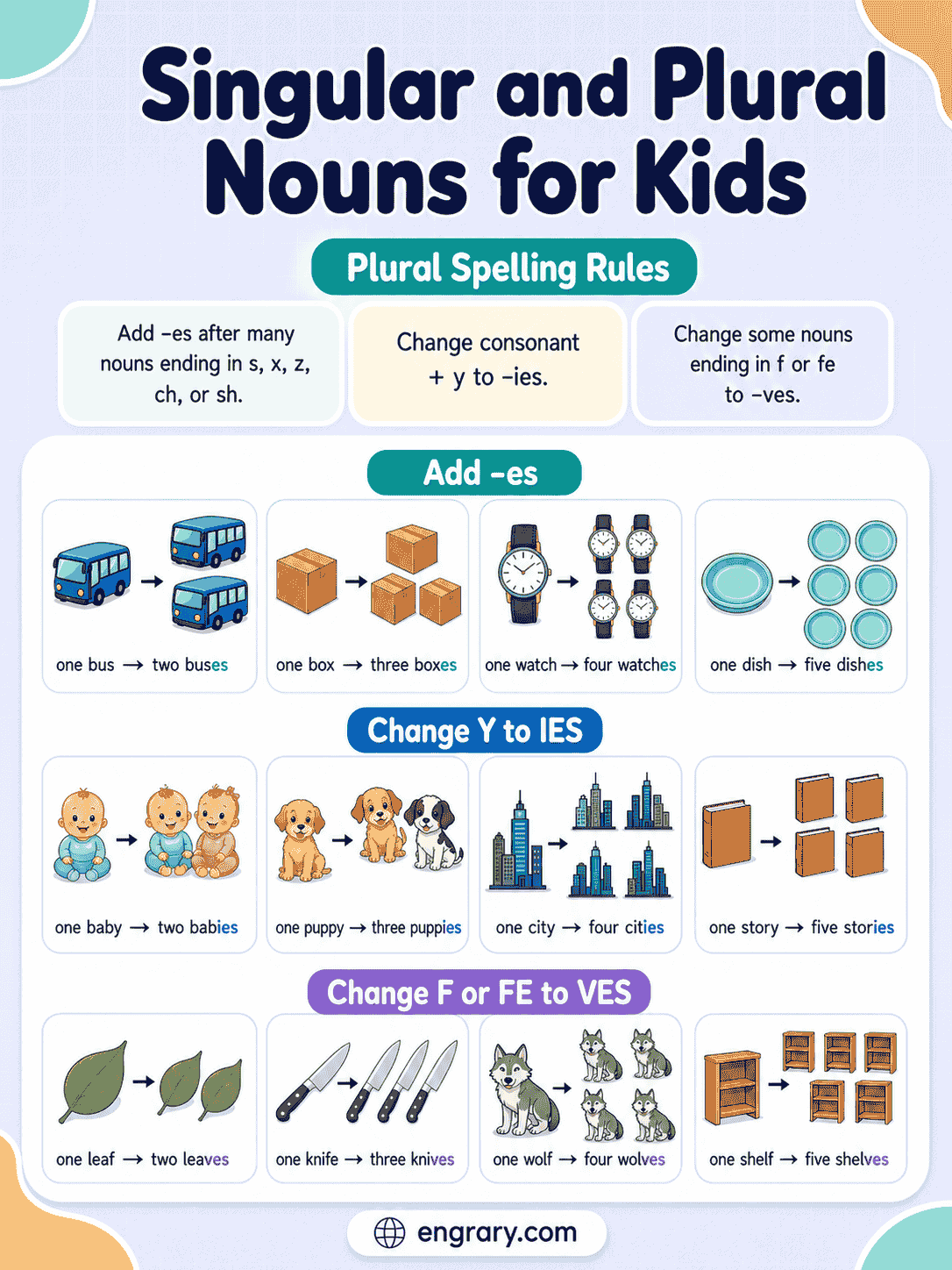
The following chart introduces several common plural patterns.
| Singular | Plural | Pattern |
|---|---|---|
| book | books | add -s |
| box | boxes | add -es |
| baby | babies | change y to i, add -es |
| toy | toys | add -s |
| leaf | leaves | change f to ves |
| child | children | irregular change |
| sheep | sheep | no spelling change |
Plural Noun Rules at a Glance
| Noun Ending or Type | Plural Rule | Example |
|---|---|---|
| most nouns | add -s | cat → cats |
| s, x, z, ch, sh | add -es | dish → dishes |
| consonant + y | change y to i, add -es | city → cities |
| vowel + y | add -s | key → keys |
| some f or fe nouns | change to -ves | knife → knives |
| some o nouns | add -es | tomato → tomatoes |
| irregular nouns | change in a special way | mouse → mice |
| unchanged nouns | keep the same form | deer → deer |
These patterns are useful, but some groups include exceptions. Therefore, children should learn the main rule and pay attention to common special forms.
Regular Plural Nouns
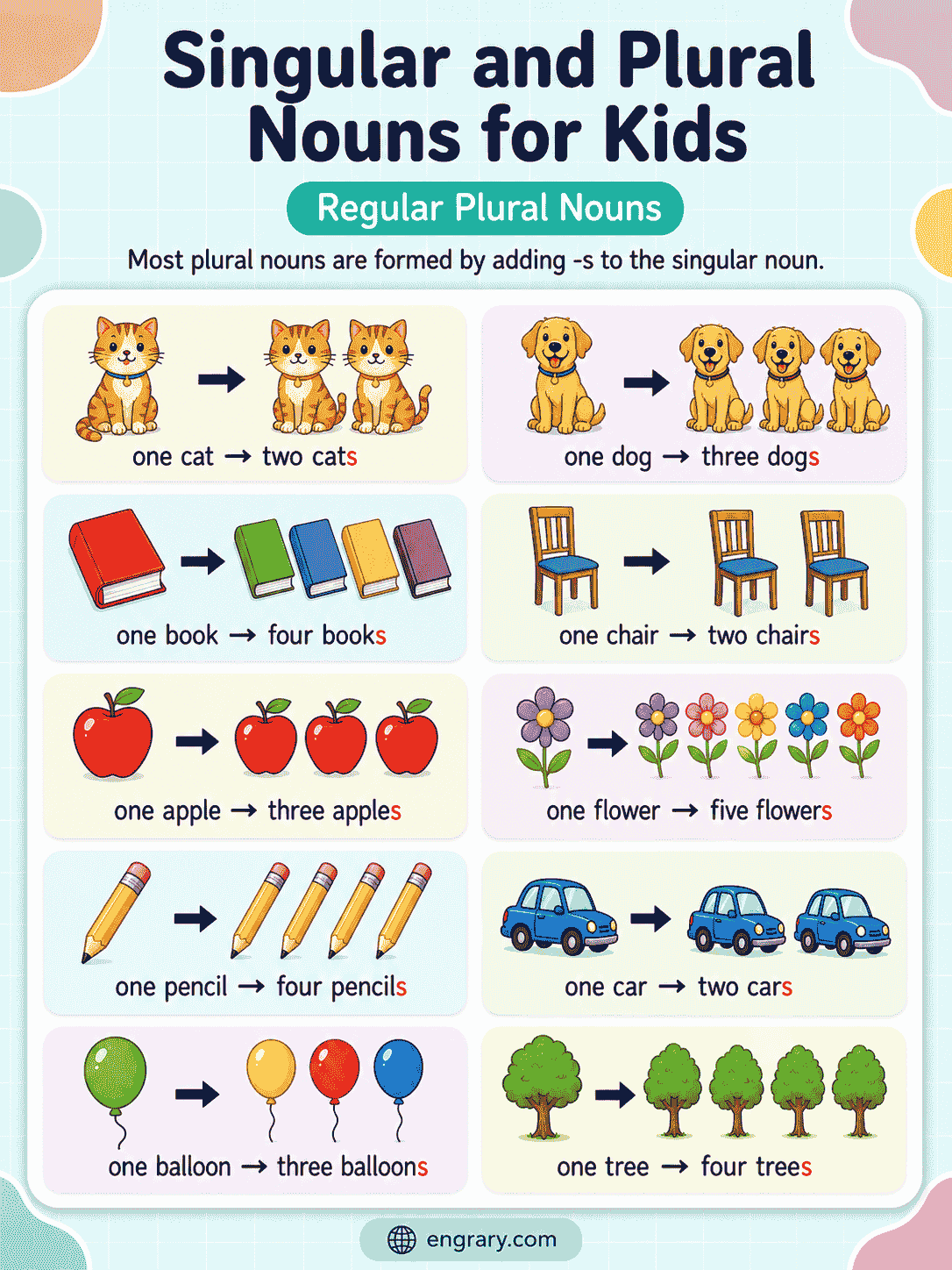
A regular plural noun follows a common spelling pattern. Most regular plurals use -s, -es, -ies, or another familiar ending.
Add -s to Most Nouns
For most nouns, simply add -s.
| Singular | Plural |
|---|---|
| cat | cats |
| book | books |
| chair | chairs |
| tree | trees |
| teacher | teachers |
| idea | ideas |
Sentence examples:
One cat sleeps on the couch.
Two cats sleep on the couch.
Another pair is:
The teacher reads a story.
The teachers read stories.
This is the most common plural rule.
Add -es After s, x, z, ch, and sh
Nouns ending in s, x, z, ch, or sh usually take -es.
| Singular | Plural |
|---|---|
| bus | buses |
| box | boxes |
| quiz | quizzes |
| watch | watches |
| dish | dishes |
| brush | brushes |
The extra ending often creates another spoken syllable:
- box → boxes;
- dish → dishes;
- watch → watches.
The word quiz doubles its final z before adding -es:
quiz → quizzes
Examples in sentences:
- One bus is waiting.
- Three buses are waiting.
- This dish is clean.
- These dishes are clean.
Nouns Ending in Consonant + Y
When a noun ends in a consonant followed by y, change the y to i and add -es.
| Singular | Plural |
|---|---|
| baby | babies |
| city | cities |
| puppy | puppies |
| story | stories |
| lady | ladies |
A simple memory rule is:
Consonant + y: change the y to i and add es.
Examples:
- The baby is smiling.
- The babies are smiling.
- Ava read one story.
- Ava read three stories.
Nouns Ending in Vowel + Y
When a vowel comes before y, keep the y and add -s.
| Singular | Plural |
|---|---|
| toy | toys |
| key | keys |
| boy | boys |
| day | days |
| monkey | monkeys |
Compare the two patterns:
| Consonant + Y | Vowel + Y |
|---|---|
| baby → babies | toy → toys |
| city → cities | key → keys |
| puppy → puppies | boy → boys |
Children should not write toies or keies. The correct forms are toys and keys.
Nouns Ending in F or FE
Some nouns ending in f or fe change to -ves.
| Singular | Plural |
|---|---|
| leaf | leaves |
| wolf | wolves |
| knife | knives |
| wife | wives |
| life | lives |
However, other nouns simply add -s.
| Singular | Plural |
|---|---|
| roof | roofs |
| chef | chefs |
| belief | beliefs |
| cliff | cliffs |
Because this pattern has exceptions, many common f and fe plurals must be learned word by word.
Examples:
- One leaf fell from the tree.
- Several leaves covered the ground.
- The chef prepared lunch.
- Two chefs prepared lunch.
Nouns Ending in O
Some nouns ending in o add -es.
| Singular | Plural |
|---|---|
| tomato | tomatoes |
| potato | potatoes |
| hero | heroes |
| echo | echoes |
Others add only -s.
| Singular | Plural |
|---|---|
| piano | pianos |
| photo | photos |
| radio | radios |
| zoo | zoos |
No single beginner rule works for every noun ending in o. Learning familiar examples is the safest approach.
Irregular Plural Nouns
An irregular plural noun does not follow the ordinary -s or -es patterns.
Some irregular plurals change vowels, while others use a special ending or a different form.
| Singular | Plural | Type of Change |
|---|---|---|
| man | men | vowel change |
| woman | women | vowel change |
| tooth | teeth | vowel change |
| foot | feet | vowel change |
| goose | geese | vowel change |
| mouse | mice | special vowel change |
| child | children | special ending |
| ox | oxen | special ending |
| person | people | different everyday form |
Irregular Plurals With Vowel Changes
Several irregular nouns change one or more vowels.
Examples include:
- man → men;
- woman → women;
- tooth → teeth;
- foot → feet;
- goose → geese;
- mouse → mice.
Sentence examples:
- One man is waiting outside.
- Two men are waiting outside.
- The child lost one tooth.
- The children lost two teeth.
The spelling and pronunciation of woman also change in the plural form women.
Irregular Plurals With Special Forms
Some nouns use a special ending or a different plural form.
Examples:
- child → children;
- ox → oxen;
- person → people.
In everyday English, people is the usual plural of person.
One person is waiting.
Several people are waiting.
The form persons is also valid, but it mainly appears in formal, legal, or official language.
Incorrect beginner forms include:
- childs;
- tooths;
- mouses.
These should be replaced with:
- children;
- teeth;
- mice.

Nouns That Stay the Same
Some nouns have the same spelling in singular and plural forms.
| Singular | Plural |
|---|---|
| one sheep | two sheep |
| one deer | several deer |
| one fish | many fish |
| one aircraft | three aircraft |
| one species | several species |
Examples:
- One sheep is near the fence.
- Five sheep are near the fence.
- A deer crossed the road.
- Two deer crossed the road.
Children should not usually write:
- sheeps;
- deers;
- aircrafts.
The noun fish commonly remains unchanged when referring to more than one fish in ordinary language.
Special Noun Forms
Some nouns follow other number patterns. These forms are useful to recognize, but they should remain a small part of a beginner lesson.
Nouns Usually Used in Plural Form
Some nouns are normally used in plural form, including names for paired objects and grouped items.
Examples include:
- scissors;
- pants;
- shorts;
- glasses;
- pajamas;
- clothes.
These nouns usually take plural verbs.
- The scissors are sharp.
- These pants are new.
- My glasses are on the desk.
- The clothes are dry.
To count some of these objects, use pair:
- one pair of scissors;
- two pairs of pants;
- three pairs of glasses.
A Brief Note About Non-Count Nouns
Some nouns are not normally counted directly.
Examples include:
- water;
- rice;
- milk;
- information;
- furniture;
- advice.
Instead of adding a plural ending, use a quantity phrase.
Correct:
- some water;
- two bottles of water;
- some furniture;
- three pieces of furniture;
- some advice;
- two pieces of advice.
Incorrect:
- informations;
- furnitures;
- advices.
These words belong to the broader topic of count and non-count nouns.
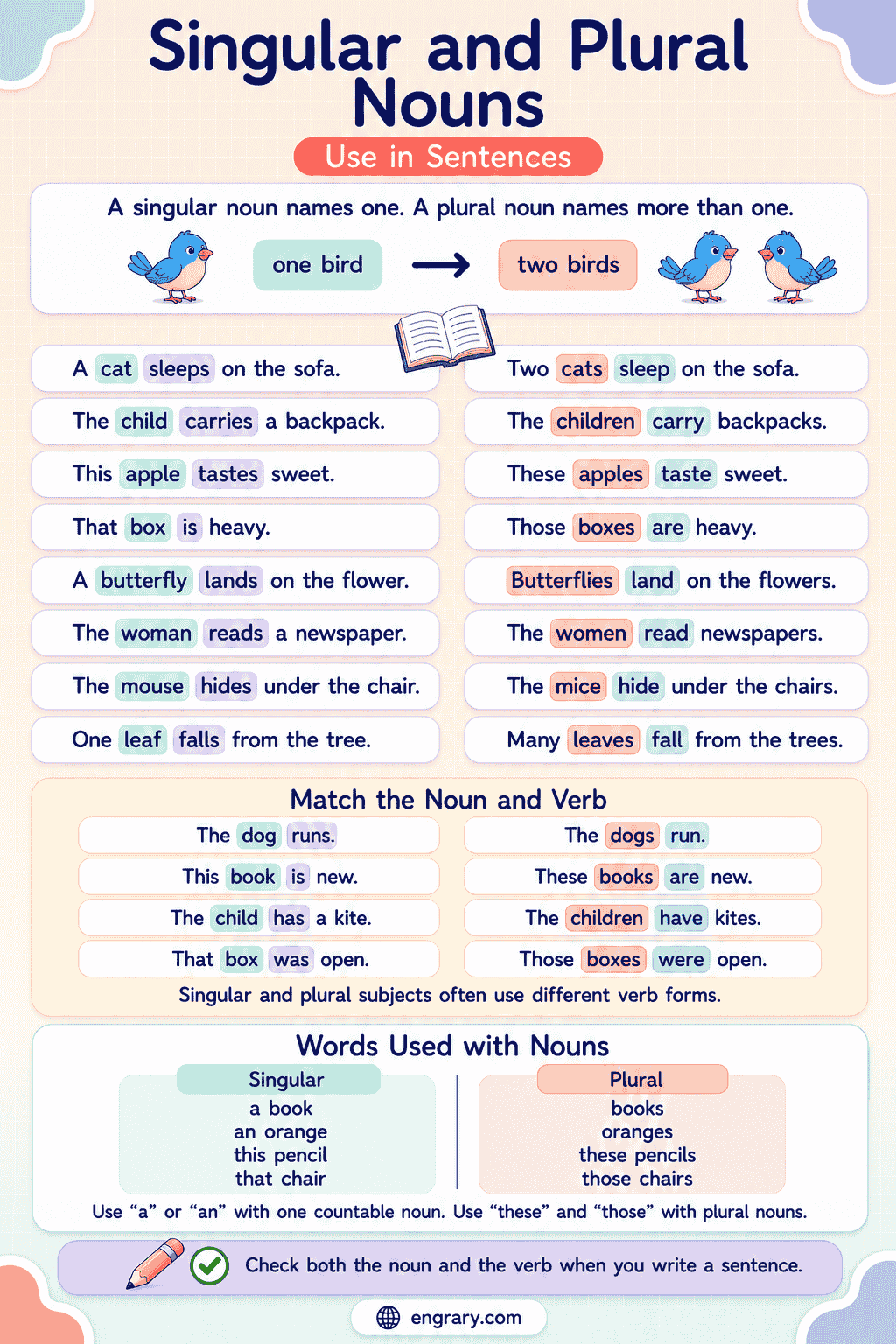
Singular and Plural Nouns in Sentences
Changing a noun from singular to plural may also change nearby words and verbs.
Compare:
This child has a book.
These children have books.
The noun changes, but so do this, has, and book.
Singular and Plural Clues in Sentences
Common singular clues include:
- a;
- an;
- one;
- this;
- that;
- is;
- has.
Common plural clues include:
- two or another number;
- many;
- several;
- these;
- those;
- are;
- have.
| Singular Sentence | Plural Sentence |
|---|---|
| This apple is fresh. | These apples are fresh. |
| That child has a kite. | Those children have kites. |
| One dog is barking. | Three dogs are barking. |
| A box is open. | Several boxes are open. |
This and That Versus These and Those
Use this and that with singular nouns.
- this book;
- that chair;
- this puppy;
- that house.
Use these and those with plural nouns.
- these books;
- those chairs;
- these puppies;
- those houses.
Compare:
This toy is broken.
These toys are broken.
Another pair is:
That child is laughing.
Those children are laughing.
Incorrect combinations include:
- this books;
- these book;
- that shoes;
- those chair.
Singular and Plural Verb Agreement
A singular noun usually takes a singular verb, while a plural noun takes a plural verb.
| Singular | Plural |
|---|---|
| The child plays. | The children play. |
| The box is open. | The boxes are open. |
| The dog has a collar. | The dogs have collars. |
| The bird flies. | The birds fly. |
Present-tense verbs often behave differently from nouns.
A plural noun may end in -s:
dogs
However, the plural verb often does not:
dogs run
Compare:
- The dog runs.
- The dogs run.
- The student writes.
- The students write.
This section covers only the agreement needed for basic singular and plural sentences.
Changing a Whole Sentence From Singular to Plural
When changing an entire sentence, children may need to change:
- the noun;
- a number word;
- this or that;
- is or are;
- has or have;
- the main verb;
- another noun in the sentence.
Example:
The child is holding a toy.
Plural:
The children are holding toys.
Another example:
This puppy has a blue collar.
Plural:
These puppies have blue collars.
A third pair is:
That bird flies over the tree.
Those birds fly over the trees.
Changing only the noun is not always enough. Every related word must agree with the new number.
Changing Plural Nouns Back to Singular
Children should also practice changing plural nouns back to singular.
| Plural | Singular |
|---|---|
| cats | cat |
| boxes | box |
| babies | baby |
| leaves | leaf |
| children | child |
| teeth | tooth |
| sheep | sheep |
The reverse change can reveal the original spelling.
Examples:
- stories → story;
- knives → knife;
- tomatoes → tomato;
- mice → mouse;
- people → person.
When changing a whole sentence, remember to change the determiner and verb as well.
Plural:
These children are reading books.
Singular:
This child is reading a book.
Common Singular and Plural Noun Mistakes
| Incorrect | Correct | Explanation |
|---|---|---|
| two cat | two cats | a plural noun is needed |
| boxs | boxes | add -es after x |
| babys | babies | consonant + y changes to -ies |
| toies | toys | vowel + y only takes -s |
| childs | children | irregular plural |
| sheeps | sheep | singular and plural are the same |
| this books | these books | use these with plural nouns |
| the dogs is | the dogs are | plural noun needs a plural verb |
| informations | information | normally non-count |
| three dog’s | three dogs | ordinary plurals do not use apostrophes |
Plural Nouns Do Not Usually Need Apostrophes
An apostrophe does not normally make a noun plural.
Correct plural:
three dogs
Incorrect plural:
three dog’s
An apostrophe often shows possession.
Compare:
- dogs — more than one dog;
- dog’s bowl — the bowl belonging to one dog.
Another comparison is:
- apples — more than one apple;
- apple’s skin — the skin belonging to one apple.
Possessive nouns have separate rules, so children should not add apostrophes when they only mean more than one.
Singular and Plural Nouns Practice for Kids
Complete the activities before checking the answer key.

Identify Singular and Plural Nouns
Write singular or plural.
- apple
- books
- child
- mice
- sheep in the phrase “one sheep”
- sheep in the phrase “five sheep”
- boxes
- teacher
Choose the Correct Plural Spelling
Choose the correct plural form.
- cat
a. cats
b. cates - box
a. boxs
b. boxes - baby
a. babys
b. babies - toy
a. toys
b. toies - knife
a. knives
b. knifes - child
a. childs
b. children
Apply the Y Rules
Write the plural form.
- city
- key
- puppy
- boy
- story
- monkey
Complete Tricky Plural Spellings
Write the correct plural form.
- leaf
- roof
- tomato
- photo
- wolf
- piano
Match Irregular Plural Nouns
Match each singular noun with its plural form.
- child
- tooth
- mouse
- person
- goose
- foot
a. feet
b. people
c. geese
d. children
e. mice
f. teeth
Sort Regular, Irregular, and Unchanged Plurals
Sort these words into three groups:
- cats;
- children;
- sheep;
- boxes;
- mice;
- deer;
- babies;
- teeth;
- aircraft.
Groups:
- regular plurals;
- irregular plurals;
- unchanged plurals.
Complete Singular and Plural Sentences
Choose the correct word.
- This / These books are new.
- That / Those chair is broken.
- The child is / are reading.
- The children is / are reading.
- One dog has / have a collar.
- Three dogs has / have collars.
- This / These puppy is sleeping.
- Those box / boxes are heavy.
Change Singular Nouns to Plural
Write the plural form.
- bird
- dish
- lady
- toy
- child
- sheep
Change Plural Nouns to Singular
Write the singular form.
- books
- watches
- cities
- leaves
- children
- teeth
Change Sentences Between Singular and Plural
Change each singular sentence to plural.
- This child is reading a book.
- The puppy has a toy.
- That bird flies over the tree.
Change each plural sentence to singular.
- These boxes are open.
- The children have red backpacks.
- Those sheep are near the fence.
Correct Singular and Plural Noun Mistakes
Rewrite each sentence correctly.
- Two childs are playing.
- These puppy is sleeping.
- Three boxs are on the shelf.
- The dogs is barking.
- I saw two deers.
- Ava bought four apple’s.
Edit a Singular-and-Plural Paragraph
Correct the noun, determiner, and verb mistakes.
This children has three toy. One toys is a red truck, and two toy are small cars. The childs plays with them near the boxs.
Write Singular and Plural Sentences
Write:
- one sentence with a singular noun;
- one sentence with a regular plural noun;
- one sentence with an irregular plural noun;
- one sentence with a noun that stays the same;
- one singular sentence and its plural version.
Singular and Plural Nouns Practice Answer Key
Identify Singular and Plural Nouns
- singular
- plural
- singular
- plural
- singular
- plural
- plural
- singular
Choose the Correct Plural Spelling
- a. cats
- b. boxes
- b. babies
- a. toys
- a. knives
- b. children
Apply the Y Rules
- cities
- keys
- puppies
- boys
- stories
- monkeys
Complete Tricky Plural Spellings
- leaves
- roofs
- tomatoes
- photos
- wolves
- pianos
Match Irregular Plural Nouns
- child — d. children
- tooth — f. teeth
- mouse — e. mice
- person — b. people
- goose — c. geese
- foot — a. feet
Sort Regular, Irregular, and Unchanged Plurals
Regular plurals
- cats;
- boxes;
- babies.
Irregular plurals
- children;
- mice;
- teeth.
Unchanged plurals
- sheep;
- deer;
- aircraft.
Complete Singular and Plural Sentences
- These books are new.
- That chair is broken.
- The child is reading.
- The children are reading.
- One dog has a collar.
- Three dogs have collars.
- This puppy is sleeping.
- Those boxes are heavy.
Change Singular Nouns to Plural
- birds
- dishes
- ladies
- toys
- children
- sheep
Change Plural Nouns to Singular
- book
- watch
- city
- leaf
- child
- tooth
Change Sentences Between Singular and Plural
- These children are reading books.
- The puppies have toys.
- Those birds fly over the trees.
- This box is open.
- The child has a red backpack.
- That sheep is near the fence.
Correct Singular and Plural Noun Mistakes
- Two children are playing.
- This puppy is sleeping.
- Three boxes are on the shelf.
- The dogs are barking.
- I saw two deer.
- Ava bought four apples.
Edit a Singular-and-Plural Paragraph
Corrected paragraph:
These children have three toys. One toy is a red truck, and two toys are small cars. The children play with them near the boxes.
Write Singular and Plural Sentences
Sample answers:
- The rabbit is eating.
- The rabbits are eating.
- The children are reading.
- Three sheep are near the barn.
- This child has a kite.
These children have kites.
Other answers are acceptable when the nouns and related words agree correctly.
FAQs
A singular noun names one person, place, animal, thing, or idea, while a plural noun usually names more than one. For example, book is singular and books is plural.
Most nouns become plural by adding -s. Nouns ending in s, x, z, ch, or sh usually take -es. Some nouns ending in consonant + y change the y to i and add -es, as in baby → babies.
Some nouns have irregular plural forms that developed differently over time. These words must usually be learned individually, such as child → children, mouse → mice, tooth → teeth, and person → people.
Some nouns do not change when they become plural. Common examples include sheep, deer, fish, aircraft, and species. The surrounding words and verbs show whether the noun is singular or plural.
Changing a noun from singular to plural may also require changes to determiners and verbs. For example, This child has a book becomes These children have books. All related words should agree with the noun’s number.
You May Also Like
- Nouns for Kids
- Common and Proper Nouns
- Regular and Irregular Plural Nouns
- Countable and Uncountable Nouns
- Subject-Verb Agreement
- Articles A, An, and The
- This, That, These, and Those
- Possessive Nouns
- Collective Nouns
- Noun Worksheets for Kids