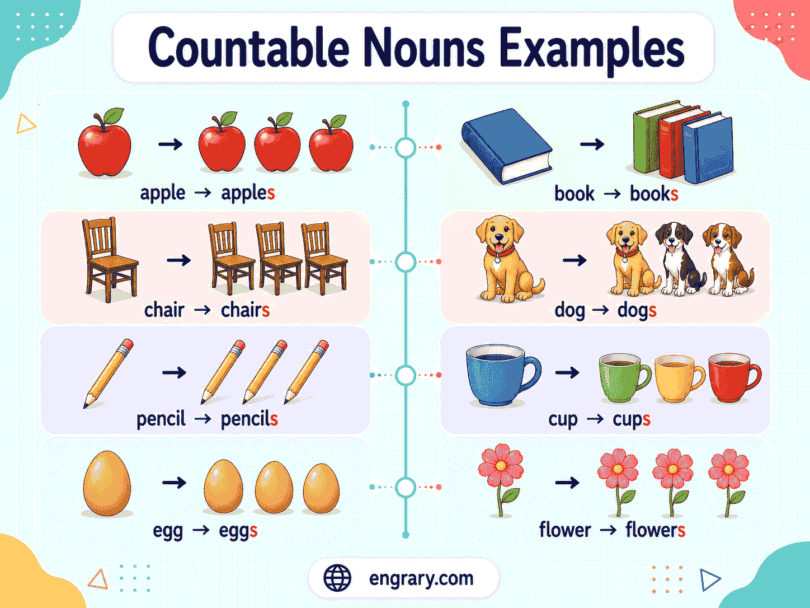
Countable nouns help children recognize people, animals, places, objects, foods, and other things that English treats as separate units. Because these nouns can usually be counted directly, learning them also makes singular and plural forms easier to understand.
You’ll see exactly 100 countable noun examples with singular and plural forms, followed by clear examples by type. In addition, you’ll learn how countable nouns work with a/an, numbers, many, a few, and how many. Finally, the article explains how countable nouns differ from uncountable nouns and highlights common mistakes to avoid.
What Is a Countable Noun?
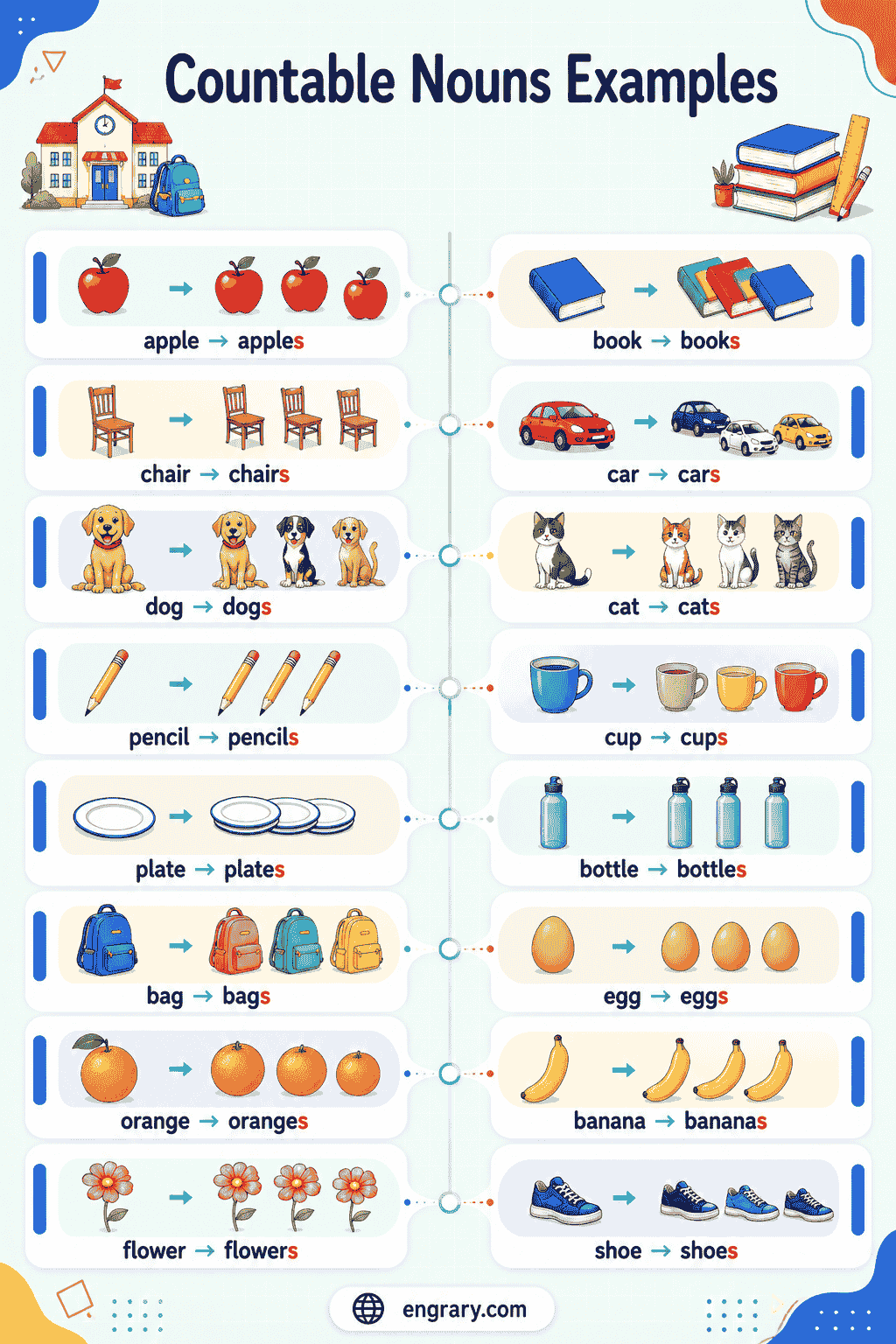
A countable noun names something that English treats as a separate unit that can be counted.
For example:
one book → two books
one apple → three apples
one child → four children
one chair → five chairs
Usually, countable nouns have both singular and plural forms. Therefore, they can refer to one item or several separate items.
The basic idea is:
singular countable noun → one
plural countable noun → more than one
Examples include:
- teacher
- dog
- city
- book
- apple
- car
- flower
Because each noun refers to separate units, we can count them directly:
two teachers
three dogs
four cities
five books
six apples
100 Countable Nouns Examples
The following table contains exactly 100 unique countable nouns with their plural forms and categories.
| Singular | Plural | Category |
|---|---|---|
| teacher | teachers | person |
| doctor | doctors | person |
| student | students | person |
| child | children | person |
| parent | parents | person |
| farmer | farmers | person |
| driver | drivers | person |
| artist | artists | person |
| singer | singers | person |
| friend | friends | person |
| nurse | nurses | person |
| pilot | pilots | person |
| chef | chefs | person |
| worker | workers | person |
| player | players | person |
| dog | dogs | animal |
| cat | cats | animal |
| bird | birds | animal |
| rabbit | rabbits | animal |
| horse | horses | animal |
| cow | cows | animal |
| goat | goats | animal |
| elephant | elephants | animal |
| tiger | tigers | animal |
| lion | lions | animal |
| frog | frogs | animal |
| butterfly | butterflies | animal |
| parrot | parrots | animal |
| turtle | turtles | animal |
| monkey | monkeys | animal |
| city | cities | place |
| school | schools | place |
| park | parks | place |
| house | houses | place |
| room | rooms | place |
| shop | shops | place |
| village | villages | place |
| street | streets | place |
| hospital | hospitals | place |
| library | libraries | place |
| garden | gardens | place |
| market | markets | place |
| office | offices | place |
| farm | farms | place |
| beach | beaches | place |
| book | books | object |
| chair | chairs | object |
| pencil | pencils | object |
| phone | phones | object |
| bag | bags | object |
| table | tables | object |
| bottle | bottles | object |
| cup | cups | object |
| clock | clocks | object |
| toy | toys | object |
| computer | computers | object |
| camera | cameras | object |
| key | keys | object |
| box | boxes | object |
| plate | plates | object |
| spoon | spoons | object |
| door | doors | object |
| window | windows | object |
| lamp | lamps | object |
| basket | baskets | object |
| apple | apples | food |
| banana | bananas | food |
| orange | oranges | food |
| egg | eggs | food |
| cookie | cookies | food |
| sandwich | sandwiches | food |
| tomato | tomatoes | food |
| potato | potatoes | food |
| carrot | carrots | food |
| grape | grapes | food |
| lemon | lemons | food |
| mango | mangoes | food |
| peach | peaches | food |
| strawberry | strawberries | food |
| burger | burgers | food |
| cake | cakes | food |
| car | cars | vehicle |
| bus | buses | vehicle |
| bicycle | bicycles | vehicle |
| train | trains | vehicle |
| airplane | airplanes | vehicle |
| boat | boats | vehicle |
| truck | trucks | vehicle |
| motorcycle | motorcycles | vehicle |
| flower | flowers | plant |
| tree | trees | plant |
| plant | plants | plant |
| seed | seeds | plant |
| leaf | leaves | plant |
| branch | branches | plant |
| rose | roses | plant |
| tulip | tulips | plant |
| question | questions | communication |
| answer | answers | communication |
| idea | ideas | concept |
Each noun in the table can refer to one separate unit or multiple separate units. As a result, every item can be counted directly in its usual meaning.
Singular and Plural Countable Nouns
Countable nouns normally appear in both singular and plural forms. Although many nouns simply add -s, others use spelling changes or irregular plural forms.
| Singular | Plural |
|---|---|
| cat | cats |
| book | books |
| chair | chairs |
| apple | apples |
| box | boxes |
| city | cities |
| child | children |
| mouse | mice |
For example:
one cat
three cats
one city
several cities
one child
four children
Even when the plural form changes irregularly, the noun remains countable. In other words, what matters is whether separate units can be counted, not how the plural is spelled.
Types of Countable Nouns
Countable nouns appear in many everyday categories. Therefore, grouping them by type can make them easier to recognize.
People
Examples include:
- nurse
- pilot
- chef
- artist
- driver
- farmer
- parent
- friend
For example, one pilot entered the aircraft, while three nurses worked in the clinic. Similarly, several artists displayed their paintings.
Animals
Examples include:
- rabbit
- horse
- elephant
- tiger
- frog
- parrot
- turtle
- monkey
For instance, one rabbit crossed the garden. Meanwhile, two horses stood near the fence, and several parrots sat in the tree.
Places
Examples include:
- school
- park
- village
- hospital
- library
- office
- farm
- beach
For example, the town has three parks. In addition, two libraries serve the area, while several villages surround the city.
Objects
Examples include:
- pencil
- phone
- bottle
- cup
- camera
- box
- lamp
- basket
For instance, Mia bought three pencils. Also, there are four cups on the table, and two cameras were inside the bag.
Food
Examples include:
- banana
- egg
- cookie
- sandwich
- tomato
- carrot
- peach
- strawberry
For example, she ate two cookies. Later, we bought four tomatoes, while six strawberries remained in the bowl.
Some food nouns, however, can be uncountable when they refer to food or substances generally. Therefore, meaning still matters.
Vehicles
Examples include:
- car
- bus
- bicycle
- train
- airplane
- boat
- truck
- motorcycle
For example, two buses stopped near the school. Meanwhile, three boats crossed the lake, and several motorcycles were parked outside.
Plants
Examples include:
- flower
- tree
- seed
- leaf
- branch
- rose
- tulip
- plant
For instance, five trees grow beside the road. In addition, the garden has six roses, while several leaves fell from the branch.
Countable Nouns With A and An
Singular countable nouns can normally appear with a or an.
Use a before a consonant sound:
- a book
- a teacher
- a chair
- a dog
- a car
By contrast, use an before a vowel sound:
- an apple
- an egg
- an orange
- an artist
- an elephant
The basic pattern is:
a/an + singular countable noun
Correct:
a chair
an apple
Incorrect:
a chairs
an apples
Because a and an refer to one item, they normally appear with singular countable nouns rather than plural forms.
Countable Nouns With Numbers
Numbers can directly count countable nouns.
Examples include:
- one book
- two books
- three chairs
- four apples
- five students
- six dogs
- seven pencils
- eight houses
For example, Mia bought three books. Likewise, there are four chairs around the table, while five students joined the group.
After numbers greater than one, the noun usually takes a plural form.
Compare:
one apple
two apples
one child
three children
Therefore, numbers provide one of the clearest ways to identify countable nouns.
Countable Nouns With Many, A Few, and How Many
Plural countable nouns can also work with quantity expressions such as many and a few.
Examples include:
many books
several students
a few houses
some apples
a few chairs
many friends
In addition, how many can be used when asking about the number of countable items.
For example, you might ask How many books do you have?
To ask about students, you could say How many students are in the room?
When talking about animals, a suitable question is How many dogs are outside?
Because countable nouns refer to separate units, quantity expressions and number questions work naturally with them.
Countable Nouns in Sentences
Countable nouns appear naturally in everyday sentences.
The teacher entered the classroom.
Three students opened their books.
I bought two apples.
Several birds sat in the tree.
There are four chairs in the room.
Mia has a phone.
Nearby, the town has three parks.
Later, two buses stopped near the school.
We planted five trees.
She bought an orange.
Finally, a doctor entered the office.
There are two windows in the room.
Each highlighted noun can refer to one separate unit or several separate units. Therefore, every example functions as a countable noun in that sentence.
Countable vs. Uncountable Nouns
Countable and uncountable nouns differ in how English treats quantity.
A countable noun can normally be counted as separate units. An uncountable noun, however, is usually treated as a mass, substance, or general concept rather than as separate individual units.
| Countable Noun | Uncountable Noun |
|---|---|
| apple | rice |
| chair | furniture |
| book | information |
| coin | money |
| suitcase | luggage |
| bottle | water |
| idea | advice |
For example, we can say:
three chairs
However, we do not normally say:
three furnitures
Instead, a natural form is:
three pieces of furniture
Similarly, we can say:
two books
but not:
two informations
Instead, use:
two pieces of information
Therefore, whether a noun is countable or uncountable depends on how English normally treats it in that meaning.
Nouns That Can Be Countable or Uncountable
Some nouns can be countable in one meaning and uncountable in another.
Glass
a glass means one drinking container, whereas glass can refer to the material.
For example:
I bought two glasses.
The window is made of glass.
Chocolate
a chocolate can mean one individual piece. By contrast, chocolate can refer to the food generally.
For example:
She ate two chocolates.
I like chocolate.
Paper
a paper can mean a document or written work, while paper can refer to the material.
For example:
The students submitted three papers.
The box contains paper.
Experience
an experience refers to one particular event. However, experience can refer to knowledge gained through doing something.
For example:
The trip was an interesting experience.
She has years of teaching experience.
These examples show that countability can change when meaning changes.
Common Countable Noun Mistakes
Countable noun mistakes often involve incorrect singular or plural forms. In addition, learners sometimes confuse countable nouns with uncountable ones.
| Incorrect | Correct | Explanation |
|---|---|---|
| one books | one book | one requires the singular form |
| two book | two books | numbers above one normally take a plural countable noun |
| an chairs | a chair / some chairs | a/an works with a singular countable noun |
| many furniture | much furniture / many pieces of furniture | furniture is uncountable |
| two informations | two pieces of information | information is uncountable |
| an advice | a piece of advice | advice is uncountable |
| three child | three children | child has an irregular plural |
For example:
Incorrect:
three book
Correct:
three books
Similarly:
Incorrect:
one apples
Correct:
one apple
Another common error is:
two informations
A natural form is:
two pieces of information
The key question, therefore, is whether the noun refers to separate units that English normally counts individually.
FAQs
Common countable noun examples include teacher, student, dog, cat, city, school, book, chair, apple, egg, car, bus, flower, tree, and idea. Because these nouns can refer to separate units, they can usually appear in singular and plural forms.
A noun is usually countable if it can refer to separate units that can be counted directly. For example, we can say one book, two books, or five books.
Yes. Countable nouns normally have singular and plural forms, such as chair → chairs, apple → apples, city → cities, and child → children. However, the plural spelling pattern can vary.
Yes. Singular countable nouns can normally use a or an, as in a book, a teacher, an apple, and an egg. In contrast, plural countable nouns do not normally use a or an.
Countable nouns can normally be counted as separate units, such as three chairs or five apples. Uncountable nouns, however, are usually treated as masses, substances, or general concepts, such as furniture, information, rice, and water.
You May Also Like