Regular and irregular plural nouns show two different ways English changes a noun from one to more than one. Regular plurals follow predictable patterns, while irregular plurals change in less predictable ways or sometimes stay exactly the same.
You’ll learn how to tell regular and irregular plurals apart, which spelling changes still count as regular, which forms must be learned separately, and how to avoid common plural mistakes.

Regular or Irregular? The Core Difference
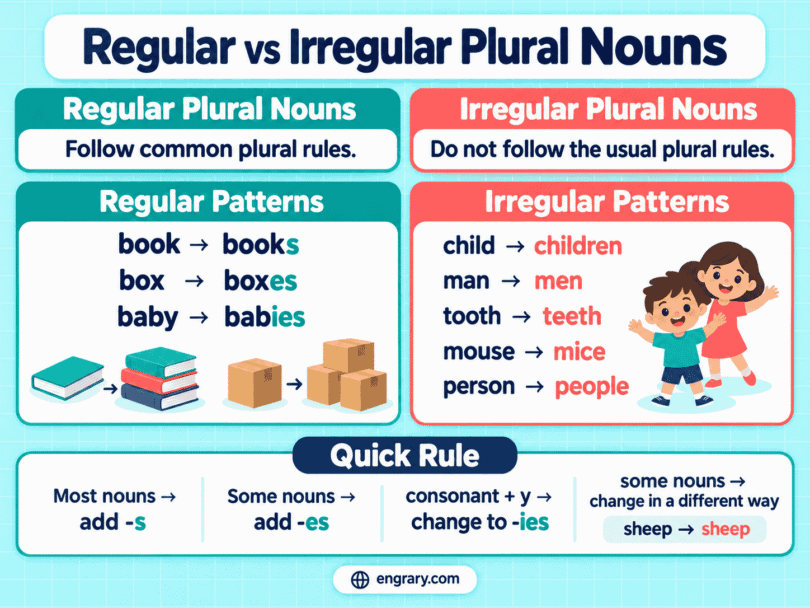
A regular plural noun follows a standard plural formation pattern.
Examples:
cat → cats
box → boxes
city → cities
An irregular plural noun does not follow the usual predictable plural rules.
Examples:
child → children
mouse → mice
person → people
The basic contrast is:
predictable plural rule → regular
unexpected or unchanged plural form → irregular
Quick Regular vs Irregular Plural Examples
| Singular | Plural | Type |
|---|---|---|
| cat | cats | regular |
| book | books | regular |
| box | boxes | regular |
| city | cities | regular |
| baby | babies | regular |
| boy | boys | regular |
| child | children | irregular |
| person | people | irregular |
| man | men | irregular |
| mouse | mice | irregular |
| tooth | teeth | irregular |
| sheep | sheep | irregular/unchanged |
This table shows an important point: a spelling change does not automatically make a plural irregular.
For example, city → cities is still regular because it follows a predictable rule.
Plurals That Follow Predictable Rules
Regular plurals can form in several standard ways.
Add -s
Many nouns form the plural by adding -s.
| Singular | Plural |
|---|---|
| cat | cats |
| book | books |
| chair | chairs |
| apple | apples |
| teacher | teachers |
| car | cars |
For example:
one book
three books
Add -es
Many nouns ending in s, x, ch, or sh take -es.
| Singular | Plural |
|---|---|
| bus | buses |
| box | boxes |
| watch | watches |
| dish | dishes |
| class | classes |
| brush | brushes |
For instance:
one box
two boxes
Consonant + Y → IES
When a noun ends in a consonant + y, change y to ies.
| Singular | Plural |
|---|---|
| baby | babies |
| city | cities |
| story | stories |
| family | families |
| party | parties |
However, if a vowel comes before y, usually add -s.
| Singular | Plural |
|---|---|
| boy | boys |
| toy | toys |
| key | keys |
| day | days |
Therefore, city → cities is regular because the change follows a standard spelling pattern.
When the Spelling Changes but the Plural Is Still Regular
Regular plurals do not always look as simple as cat → cats.
These examples still follow predictable rules:
box → boxes
baby → babies
city → cities
watch → watches
The spelling changes, but the plural remains regular because learners can apply a known pattern.
By contrast:
child → children
cannot be formed by a normal -s, -es, or -ies rule.
That makes children irregular.
Special Plural Forms With F, FE, and O
Some nouns ending in -f or -fe change to -ves.
| Singular | Plural |
|---|---|
| leaf | leaves |
| knife | knives |
| wife | wives |
| wolf | wolves |
However, many others simply add -s.
| Singular | Plural |
|---|---|
| roof | roofs |
| chef | chefs |
| chief | chiefs |
Similarly, some nouns ending in -o take -es.
| Singular | Plural |
|---|---|
| tomato | tomatoes |
| potato | potatoes |
| hero | heroes |
Others take only -s.
| Singular | Plural |
|---|---|
| photo | photos |
| piano | pianos |
| radio | radios |
Because these endings contain exceptions, it is better to learn common forms individually rather than treat them as universal rules.
Plurals That Break the Usual Rules
Irregular plural nouns do not follow the standard plural patterns.
Common examples include:
| Singular | Plural |
|---|---|
| child | children |
| person | people |
| man | men |
| woman | women |
| mouse | mice |
| goose | geese |
| tooth | teeth |
| foot | feet |
For example:
one child
three children
Similarly:
one mouse
four mice
You cannot produce these forms by simply adding -s or -es.
Common Irregular Plural Patterns
Irregular plurals can change in several ways.
| Pattern | Examples |
|---|---|
| vowel change | man → men, foot → feet, tooth → teeth |
| major spelling change | mouse → mice, goose → geese |
| different ending | child → children |
| different common form | person → people |
| unchanged plural | sheep → sheep, deer → deer |
These groups help learners notice patterns, but irregular forms still need more memorization than regular plurals.
Plurals That Stay the Same
Some irregular nouns use the same form for singular and plural.
| Singular | Plural |
|---|---|
| sheep | sheep |
| deer | deer |
| fish | fish |
| species | species |
| series | series |
For example:
The sheep is eating.
The sheep are eating.
The first sentence refers to one sheep, while the second refers to more than one.
Therefore, an unchanged plural still has a plural meaning even though its spelling does not change.
Similar Words With Different Plural Forms
Similar-looking nouns do not always form plurals in the same way.
Compare:
house → houses
but:
mouse → mice
Similarly:
goose → geese
but:
moose → moose
Another contrast is:
roof → roofs
but:
leaf → leaves
These examples show why spelling similarity alone cannot always predict the plural form.
Regular and Irregular Plurals in Sentences
| Sentence | Plural Noun | Type |
|---|---|---|
| The cats are sleeping. | cats | regular |
| Two boxes are on the floor. | boxes | regular |
| Several cities grew quickly. | cities | regular |
| The children are reading. | children | irregular |
| Three mice ran away. | mice | irregular |
| The sheep are grazing. | sheep | irregular/unchanged |
| Five teachers entered the room. | teachers | regular |
| The women waited outside. | women | irregular |
In each sentence, the plural noun refers to more than one.
However, regular forms follow a predictable pattern, while irregular forms do not.
How to Tell if a Plural Is Regular or Irregular
A simple check can help.
First, ask:
Does the plural follow a standard rule?
Examples:
cat → cats
box → boxes
city → cities
If yes, the plural is regular.
Next, ask:
Does the noun change unexpectedly or stay unchanged?
Examples:
child → children
mouse → mice
sheep → sheep
If yes, the plural is irregular.
The easiest rule to remember is:
predictable → regular
not predictable by the usual rules → irregular
Common Regular and Irregular Plural Mistakes
| Incorrect | Correct | Reason |
|---|---|---|
| childs | children | irregular plural |
| mouses | mice | irregular plural |
| womans | women | irregular vowel change |
| gooses | geese | irregular plural |
| sheeps | sheep | unchanged plural |
| boxs | boxes | regular -es pattern |
| babys | babies | consonant + y → ies |
| citys | cities | consonant + y → ies |
| dishs | dishes | regular -es pattern |
| persons | people | people is the usual general plural |
For example, citys is incorrect, but cities is not irregular. It follows the regular consonant + y → ies pattern.
By contrast, childs cannot be corrected by applying a regular plural rule. The correct irregular form is children.
Similarly, sheeps is incorrect because sheep keeps the same form in both singular and plural use.
FAQs
Regular plurals follow predictable formation rules, such as cat → cats or city → cities. Irregular plurals do not follow the usual rules, as in child → children or mouse → mice.
Examples include book → books, box → boxes, city → cities, baby → babies, and watch → watches.
Common examples include child → children, person → people, man → men, woman → women, mouse → mice, and tooth → teeth.
Forms such as city → cities and baby → babies are regular because they follow the predictable consonant + y → ies rule.
Common examples include sheep, deer, fish, species, and series.
You May Also Like