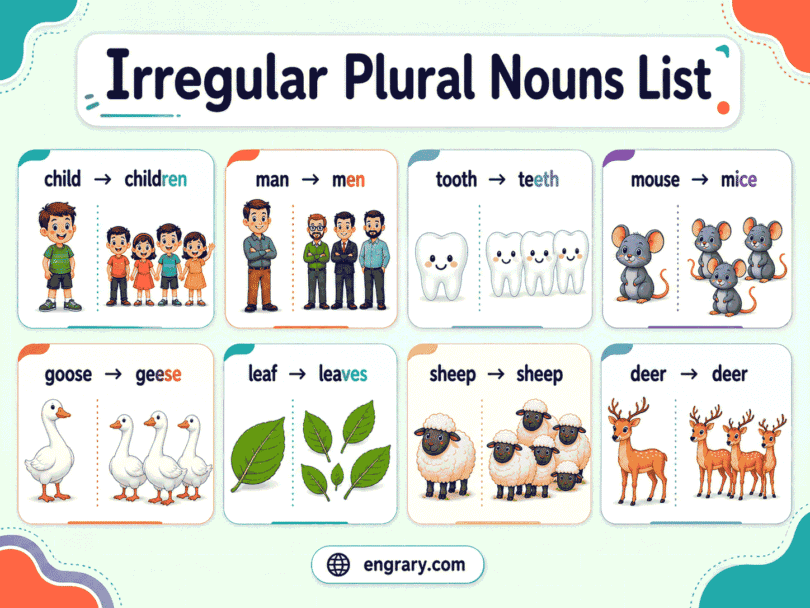
Irregular plural nouns help learners recognize nouns that do not form their plurals with the usual -s or -es endings. A clear irregular plural nouns list makes it easier to compare singular and plural forms, notice common patterns, and avoid frequent spelling mistakes.
You’ll find common irregular plural nouns, vowel-changing forms, unchanged plurals, common f/fe changes, borrowed and classical plurals, alternative accepted forms, and sentence examples. The list stays reference-focused so readers can quickly find the correct plural form without working through a full grammar lesson.

What Are Irregular Plural Nouns?
An irregular plural noun forms its plural in a way that does not simply follow the usual -s or -es pattern.
The noun may:
- change letters inside the word;
- use a special plural form;
- remain unchanged;
- follow an older or borrowed plural pattern.
Examples include:
- child → children
- man → men
- mouse → mice
- person → people
- sheep → sheep
These forms are best learned as complete singular-plural pairs.
Common Irregular Plural Nouns List
The following table gives useful irregular and commonly grouped nonstandard plural forms for quick reference.
| Singular Noun | Plural Form | Type |
|---|---|---|
| child | children | special form |
| person | people | different form |
| man | men | vowel change |
| woman | women | internal change |
| foot | feet | vowel change |
| tooth | teeth | vowel change |
| goose | geese | vowel change |
| mouse | mice | internal change |
| louse | lice | internal change |
| ox | oxen | special ending |
| sheep | sheep | unchanged |
| deer | deer | unchanged |
| fish | fish | usually unchanged |
| moose | moose | unchanged |
| aircraft | aircraft | unchanged |
| spacecraft | spacecraft | unchanged |
| species | species | unchanged |
| series | series | unchanged |
| salmon | salmon | often unchanged |
| trout | trout | often unchanged |
| leaf | leaves | f → ves change |
| knife | knives | fe → ves change |
| wife | wives | fe → ves change |
| life | lives | fe → ves change |
| wolf | wolves | f → ves change |
| loaf | loaves | f → ves change |
| thief | thieves | f → ves change |
| half | halves | f → ves change |
| calf | calves | f → ves change |
| shelf | shelves | f → ves change |
| self | selves | f → ves change |
| analysis | analyses | borrowed/classical |
| basis | bases | borrowed/classical |
| crisis | crises | borrowed/classical |
| thesis | theses | borrowed/classical |
| phenomenon | phenomena | borrowed/classical |
| criterion | criteria | borrowed/classical |
| nucleus | nuclei | borrowed/classical |
| stimulus | stimuli | borrowed/classical |
| alumnus | alumni | borrowed/classical |
| bacterium | bacteria | borrowed/classical |
| medium | media | borrowed/classical |
| curriculum | curricula / curriculums | alternative forms |
| appendix | appendices / appendixes | alternative forms |
| index | indices / indexes | alternative forms |
| cactus | cacti / cactuses | alternative forms |
| fungus | fungi / funguses | alternative forms |
| hoof | hoofs / hooves | alternative forms |
| scarf | scarfs / scarves | alternative forms |
| dwarf | dwarfs / dwarves | alternative forms |
| fish | fish / fishes | context-dependent alternative |
The list includes strong irregular forms, unchanged plurals, common spelling-change forms, and borrowed plurals because these groups often appear together in irregular plural references. The later sections separate them more precisely.
Irregular Plurals With Vowel Changes
Some irregular plural nouns change letters inside the word instead of adding a regular plural ending.
| Singular | Plural |
|---|---|
| man | men |
| woman | women |
| foot | feet |
| tooth | teeth |
| goose | geese |
| mouse | mice |
| louse | lice |
These forms belong to a small group of high-frequency irregular plurals.
For example:
man → men
foot → feet
tooth → teeth
mouse → mice
The internal change is part of the established plural form, so forms such as mans, foots, tooths, and mouses are incorrect in ordinary use.
Other Irregular Plural Forms
Some nouns use irregular forms that do not fit the main vowel-change group.
| Singular | Plural | Change |
|---|---|---|
| child | children | special form |
| ox | oxen | special ending |
| person | people | different form |
Child → Children
The plural of child is children, not childs.
Ox → Oxen
The plural of ox is oxen.
Person → People
The normal everyday plural of person is people.
These forms need to be learned individually because one shared spelling rule does not produce them.
Nouns With the Same Singular and Plural Form
Some nouns keep the same form whether they refer to one or more than one.
| Singular | Plural |
|---|---|
| sheep | sheep |
| deer | deer |
| fish | fish |
| moose | moose |
| aircraft | aircraft |
| spacecraft | spacecraft |
| species | species |
| series | series |
| salmon | salmon |
| trout | trout |
For example:
one sheep → five sheep
one deer → three deer
one aircraft → several aircraft
one species → several species
The surrounding number, determiner, or verb usually shows whether the noun is singular or plural.
The plural fish works in most everyday contexts. Fishes can also occur when referring to different kinds or species of fish.
Common F and FE Plural Changes
Some nouns ending in f or fe change to -ves in the plural. Many irregular-plural lists include these forms, although they are also commonly taught as a separate spelling-change pattern.
| Singular | Plural |
|---|---|
| leaf | leaves |
| knife | knives |
| wife | wives |
| life | lives |
| wolf | wolves |
| loaf | loaves |
| thief | thieves |
| half | halves |
| calf | calves |
| shelf | shelves |
| self | selves |
For example:
leaf → leaves
knife → knives
wolf → wolves
However, not every noun ending in f or fe follows this pattern.
| Singular | Plural |
|---|---|
| roof | roofs |
| chief | chiefs |
| belief | beliefs |
| cliff | cliffs |
| proof | proofs |
Therefore, f/fe → ves should not be treated as a universal rule.
Advanced Borrowed and Classical Plurals
English includes many nouns borrowed from Latin, Greek, and other languages. Some retain older plural forms, especially in academic, scientific, or formal writing.
| Singular | Traditional Plural |
|---|---|
| analysis | analyses |
| basis | bases |
| crisis | crises |
| thesis | theses |
| hypothesis | hypotheses |
| phenomenon | phenomena |
| criterion | criteria |
| nucleus | nuclei |
| stimulus | stimuli |
| alumnus | alumni |
| bacterium | bacteria |
| medium | media |
| memorandum | memoranda |
| datum | data |
| vertebra | vertebrae |
Examples:
one analysis → several analyses
one criterion → several criteria
one phenomenon → several phenomena
one bacterium → many bacteria
These forms are more advanced than everyday irregular plurals such as children or mice, so they belong later in a reference list.
Irregular Nouns With Alternative Plural Forms
Some nouns have more than one accepted plural form. The preferred choice can depend on meaning, field, context, or style.
| Singular | Accepted Plural Forms |
|---|---|
| cactus | cacti, cactuses |
| fungus | fungi, funguses |
| index | indexes, indices |
| appendix | appendixes, appendices |
| curriculum | curriculums, curricula |
| hoof | hoofs, hooves |
| scarf | scarfs, scarves |
| dwarf | dwarfs, dwarves |
| fish | fish, fishes |
Cactus
Both cacti and cactuses can function as plurals of cactus.
Index
Indexes is common in general contexts, while indices often appears in mathematical, scientific, or technical contexts.
Appendix
Both appendixes and appendices are accepted, although usage can vary by context.
Fish
Fish is the usual everyday plural. Fishes can refer to different species or kinds.
A high-quality irregular plural list should not mark an accepted alternative as incorrect simply because another form is more traditional.
Irregular Plural Nouns in Sentences
The following sentences show common irregular plurals in natural use.
Children
The children played outside.
Men
Two men carried the table.
Women
Several women waited near the entrance.
Feet
My feet were cold.
Teeth
The child brushed her teeth.
Mice
Two mice ran behind the cupboard.
Geese
Several geese crossed the field.
People
Many people attended the event.
Sheep
Five sheep stood near the fence.
Deer
Three deer crossed the road.
These examples show vowel-changing forms, different plural forms, and unchanged plurals in complete sentences.
Common Irregular Plural Noun Mistakes
Many errors happen when a regular -s or -es rule is applied to an irregular noun.
| Incorrect | Correct | Explanation |
|---|---|---|
| childs | children | Child has a special plural form. |
| mans | men | Man changes internally. |
| womans | women | Woman has an irregular plural. |
| foots | feet | Foot changes to feet. |
| tooths | teeth | Tooth changes to teeth. |
| mouses | mice | Mouse changes to mice. |
| gooses | geese | Goose changes to geese. |
| deers | deer | Deer stays unchanged. |
| sheeps | sheep | Sheep stays unchanged. |
| oxes | oxen | Ox takes the special plural oxen. |
The safest approach is to learn frequent irregular nouns as complete pairs:
child → children
man → men
tooth → teeth
mouse → mice
deer → deer
This prevents regular plural rules from being applied where they do not belong.
FAQs About Irregular Plural Nouns
What are irregular plural nouns?
Irregular plural nouns form their plurals without simply following the usual -s or -es pattern. Examples include child → children, man → men, mouse → mice, person → people, and sheep → sheep.
What are the most common irregular plural nouns?
Common forms include children, people, men, women, feet, teeth, mice, geese, oxen, sheep, deer, and fish.
Which nouns have the same singular and plural form?
Common examples include sheep, deer, fish, moose, aircraft, species, and series. Context usually shows whether the noun refers to one or more than one.
Can irregular nouns have more than one accepted plural?
Yes. Some nouns allow alternative plurals. Examples include cactus → cacti/cactuses, index → indexes/indices, appendix → appendixes/appendices, and hoof → hoofs/hooves.
Are leaves and knives irregular plurals?
Some grammar resources group leaf → leaves and knife → knives with irregular plurals because they do not simply add -s. Other resources teach them separately as f/fe → ves spelling changes. Treating them as a distinct spelling-change group keeps the classification clearer.
You May Also Like