

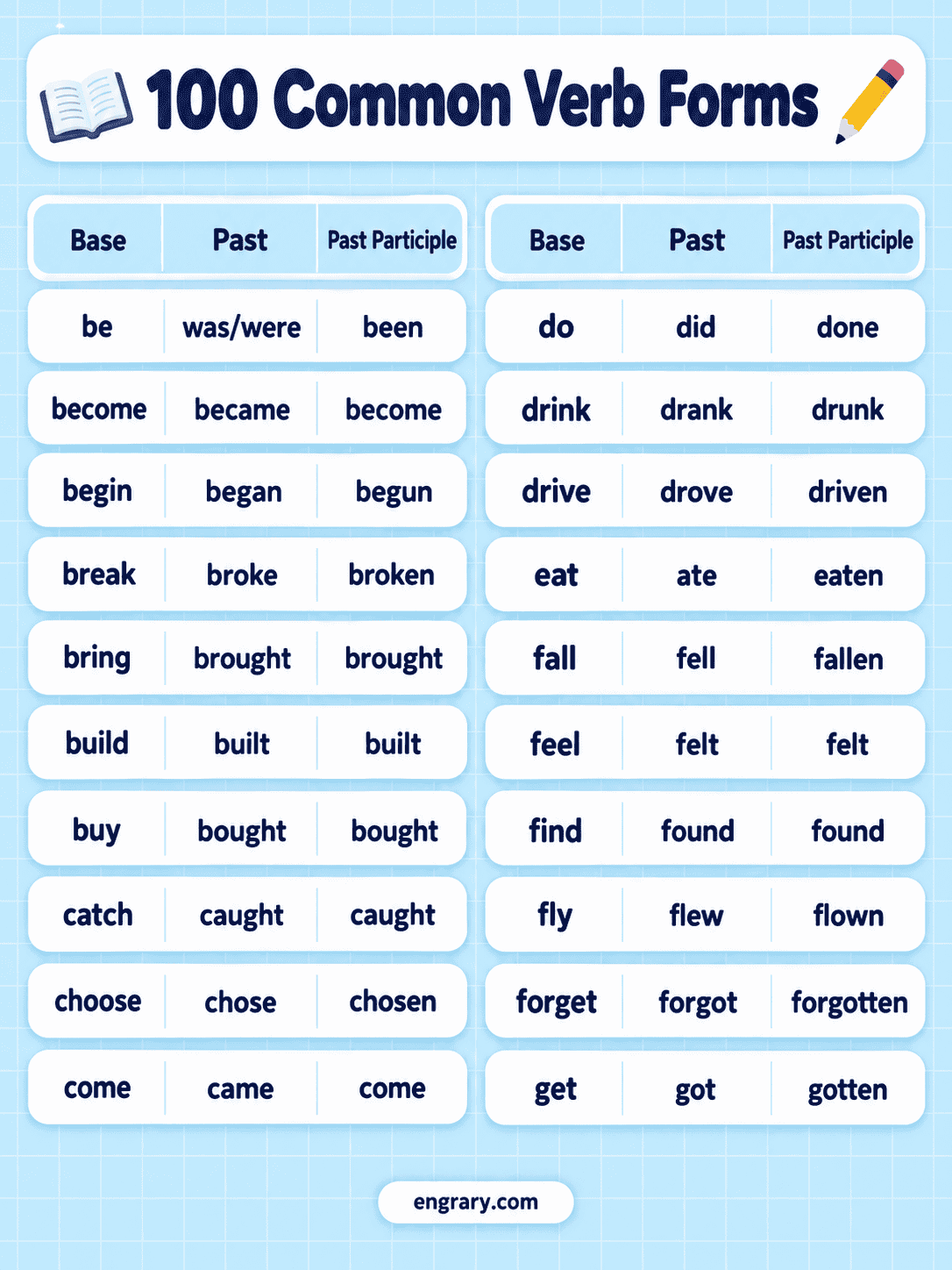
Learning the most common verb forms makes everyday English much easier to understand and use. Verbs such as go, write, take, eat, and speak change in different ways, so seeing their forms together helps learners recognize the correct pattern.
This list covers 100 common English verbs with V1, V2, V3, V4, and V5 forms. It also explains regular and irregular patterns, common spelling changes, useful form groups, and mistakes that learners often make.
What Are V1, V2, V3, V4, and V5?
The labels V1, V2, V3, V4, and V5 are often used in English-learning materials to show the main forms of a verb.
| Label | Verb Form | Example: Write |
|---|---|---|
| V1 | Base form | write |
| V2 | Past form | wrote |
| V3 | Past participle | written |
| V4 | -ing form | writing |
| V5 | Third-person singular | writes |
So:
write → wrote → written → writing → writes
This article uses V4 for the -ing form and V5 for the third-person singular form. Some learning resources reverse those labels, so the form names are more reliable than the numbers alone.
How to Use the 100 Verb Forms List
Start with the verb you know in the V1 column, then move across the row to check its other forms. V2 shows the simple past, V3 gives the past participle, V4 shows the -ing form, and V5 gives the form commonly used with he, she, or it in the present simple.
This is especially useful with irregular verbs. For example:
go → went → gone → going → goes
and:
write → wrote → written → writing → writes
Regular verbs are usually easier because V2 and V3 often follow the same -ed pattern.
100 Verb Forms List With V1 V2 V3 V4 V5
The table below contains exactly 100 common English verbs. The selection focuses on everyday verbs and important irregular forms that learners are likely to use often.
| No. | V1 | V2 | V3 | V4 | V5 |
|---|---|---|---|---|---|
| 1 | be | was/were | been | being | am/is/are |
| 2 | have | had | had | having | has |
| 3 | do | did | done | doing | does |
| 4 | say | said | said | saying | says |
| 5 | go | went | gone | going | goes |
| 6 | get | got | got/gotten | getting | gets |
| 7 | make | made | made | making | makes |
| 8 | know | knew | known | knowing | knows |
| 9 | think | thought | thought | thinking | thinks |
| 10 | take | took | taken | taking | takes |
| 11 | see | saw | seen | seeing | sees |
| 12 | come | came | come | coming | comes |
| 13 | want | wanted | wanted | wanting | wants |
| 14 | use | used | used | using | uses |
| 15 | find | found | found | finding | finds |
| 16 | give | gave | given | giving | gives |
| 17 | tell | told | told | telling | tells |
| 18 | work | worked | worked | working | works |
| 19 | call | called | called | calling | calls |
| 20 | try | tried | tried | trying | tries |
| 21 | ask | asked | asked | asking | asks |
| 22 | need | needed | needed | needing | needs |
| 23 | feel | felt | felt | feeling | feels |
| 24 | become | became | become | becoming | becomes |
| 25 | leave | left | left | leaving | leaves |
| 26 | put | put | put | putting | puts |
| 27 | mean | meant | meant | meaning | means |
| 28 | keep | kept | kept | keeping | keeps |
| 29 | let | let | let | letting | lets |
| 30 | begin | began | begun | beginning | begins |
| 31 | seem | seemed | seemed | seeming | seems |
| 32 | help | helped | helped | helping | helps |
| 33 | talk | talked | talked | talking | talks |
| 34 | turn | turned | turned | turning | turns |
| 35 | start | started | started | starting | starts |
| 36 | show | showed | shown | showing | shows |
| 37 | hear | heard | heard | hearing | hears |
| 38 | play | played | played | playing | plays |
| 39 | run | ran | run | running | runs |
| 40 | move | moved | moved | moving | moves |
| 41 | live | lived | lived | living | lives |
| 42 | believe | believed | believed | believing | believes |
| 43 | bring | brought | brought | bringing | brings |
| 44 | happen | happened | happened | happening | happens |
| 45 | write | wrote | written | writing | writes |
| 46 | sit | sat | sat | sitting | sits |
| 47 | stand | stood | stood | standing | stands |
| 48 | lose | lost | lost | losing | loses |
| 49 | pay | paid | paid | paying | pays |
| 50 | meet | met | met | meeting | meets |
| 51 | learn | learned | learned | learning | learns |
| 52 | change | changed | changed | changing | changes |
| 53 | lead | led | led | leading | leads |
| 54 | understand | understood | understood | understanding | understands |
| 55 | watch | watched | watched | watching | watches |
| 56 | follow | followed | followed | following | follows |
| 57 | stop | stopped | stopped | stopping | stops |
| 58 | create | created | created | creating | creates |
| 59 | speak | spoke | spoken | speaking | speaks |
| 60 | read | read | read | reading | reads |
| 61 | allow | allowed | allowed | allowing | allows |
| 62 | add | added | added | adding | adds |
| 63 | spend | spent | spent | spending | spends |
| 64 | grow | grew | grown | growing | grows |
| 65 | open | opened | opened | opening | opens |
| 66 | walk | walked | walked | walking | walks |
| 67 | win | won | won | winning | wins |
| 68 | offer | offered | offered | offering | offers |
| 69 | remember | remembered | remembered | remembering | remembers |
| 70 | love | loved | loved | loving | loves |
| 71 | buy | bought | bought | buying | buys |
| 72 | wait | waited | waited | waiting | waits |
| 73 | die | died | died | dying | dies |
| 74 | send | sent | sent | sending | sends |
| 75 | expect | expected | expected | expecting | expects |
| 76 | build | built | built | building | builds |
| 77 | stay | stayed | stayed | staying | stays |
| 78 | fall | fell | fallen | falling | falls |
| 79 | cut | cut | cut | cutting | cuts |
| 80 | reach | reached | reached | reaching | reaches |
| 81 | raise | raised | raised | raising | raises |
| 82 | pass | passed | passed | passing | passes |
| 83 | sell | sold | sold | selling | sells |
| 84 | decide | decided | decided | deciding | decides |
| 85 | pull | pulled | pulled | pulling | pulls |
| 86 | return | returned | returned | returning | returns |
| 87 | explain | explained | explained | explaining | explains |
| 88 | hope | hoped | hoped | hoping | hopes |
| 89 | carry | carried | carried | carrying | carries |
| 90 | break | broke | broken | breaking | breaks |
| 91 | receive | received | received | receiving | receives |
| 92 | agree | agreed | agreed | agreeing | agrees |
| 93 | support | supported | supported | supporting | supports |
| 94 | hit | hit | hit | hitting | hits |
| 95 | eat | ate | eaten | eating | eats |
| 96 | drink | drank | drunk | drinking | drinks |
| 97 | sleep | slept | slept | sleeping | sleeps |
| 98 | drive | drove | driven | driving | drives |
| 99 | choose | chose | chosen | choosing | chooses |
| 100 | teach | taught | taught | teaching | teaches |
Regular and Irregular Verb Forms
The 100 verbs include both regular and irregular patterns.
Regular verbs usually form V2 and V3 by adding -ed:
| V1 | V2 | V3 |
|---|---|---|
| play | played | played |
| work | worked | worked |
| help | helped | helped |
| walk | walked | walked |
Irregular verbs may change in several different ways:
| V1 | V2 | V3 |
|---|---|---|
| go | went | gone |
| write | wrote | written |
| eat | ate | eaten |
| speak | spoke | spoken |
Because irregular verbs do not follow one fixed rule, learning their V2 and V3 forms together is usually the easiest approach.
Verbs With the Same V1, V2, and V3 Forms
A few common irregular verbs keep the same form in V1, V2, and V3.
| V1 | V2 | V3 |
|---|---|---|
| cut | cut | cut |
| hit | hit | hit |
| let | let | let |
| put | put | put |
These verbs are easy to recognize because the spelling does not change across the three forms.
Verbs With the Same V2 and V3 Forms
Many irregular verbs change from V1 but use the same word for V2 and V3.
| V1 | V2 | V3 |
|---|---|---|
| bring | brought | brought |
| buy | bought | bought |
| feel | felt | felt |
| find | found | found |
| keep | kept | kept |
| make | made | made |
| meet | met | met |
| send | sent | sent |
| think | thought | thought |
| teach | taught | taught |
This pattern is common and worth learning as a group.
Verbs With Different V2 and V3 Forms
Some irregular verbs use different words for the past and past participle.
| V1 | V2 | V3 |
|---|---|---|
| begin | began | begun |
| break | broke | broken |
| choose | chose | chosen |
| drink | drank | drunk |
| drive | drove | driven |
| eat | ate | eaten |
| fall | fell | fallen |
| go | went | gone |
| see | saw | seen |
| speak | spoke | spoken |
| take | took | taken |
| write | wrote | written |
These forms need extra attention because V2 and V3 cannot be used interchangeably.
Common Spelling Changes in Verb Forms
Some regular forms also change their spelling when an ending is added.
| Pattern | Example |
|---|---|
| Add -es | watch → watches |
| Change consonant + y to i | try → tried / tries |
| Double the final consonant | stop → stopped / stopping |
| Drop final e before -ing | use → using |
| Change ie to y before -ing | die → dying |
These spelling changes explain forms such as tries, running, stopping, using, and dying in the main table.
Special Verb Forms to Notice
A few common verbs need extra attention because they do not fit neatly into ordinary patterns.
Be
The verb be has several present and past forms.
be → was/were → been → being → am/is/are
It is more irregular than the other verbs in the list.
Get
The past form of get is got.
Its past participle may appear as:
British English: got
American English: got or gotten
So the list shows:
get → got → got/gotten → getting → gets
Read
The forms of read keep the same spelling:
read → read → read → reading → reads
However, V2 and V3 are pronounced differently from the base form.
Common Verb Form Mistakes
Learners often make mistakes when they apply a regular pattern to an irregular verb or confuse V2 with V3.
| Incorrect | Correct | Reason |
|---|---|---|
| He goed home. | He went home. | The V2 form of go is went. |
| She has wrote a letter. | She has written a letter. | Written is V3. |
| They eated lunch. | They ate lunch. | Ate is the V2 form of eat. |
| He has went outside. | He has gone outside. | Gone is V3. |
| She is runing. | She is running. | The final consonant doubles before -ing. |
| He trys hard. | He tries hard. | Consonant + y changes to ies. |
Checking the full verb row is often the quickest way to avoid these errors.
FAQs
What are the five main verb forms?
They are the base form, past form, past participle, -ing form, and third-person singular form.
What do V1, V2, V3, V4, and V5 mean?
In this article, V1 means base form, V2 means past form, V3 means past participle, V4 means -ing form, and V5 means third-person singular.
Why are V2 and V3 sometimes the same?
Regular verbs usually use the same -ed form for V2 and V3. Some irregular verbs also share the same forms, such as think → thought → thought.
Are all 100 verbs irregular?
No. The list contains both regular and irregular verbs because learners need both types in everyday English.
Are V4 and V5 always labeled in the same order?
No. Some learning resources reverse them. Checking the form names is more reliable than relying only on the numbers.
You May Also Like



Leave a Comment