
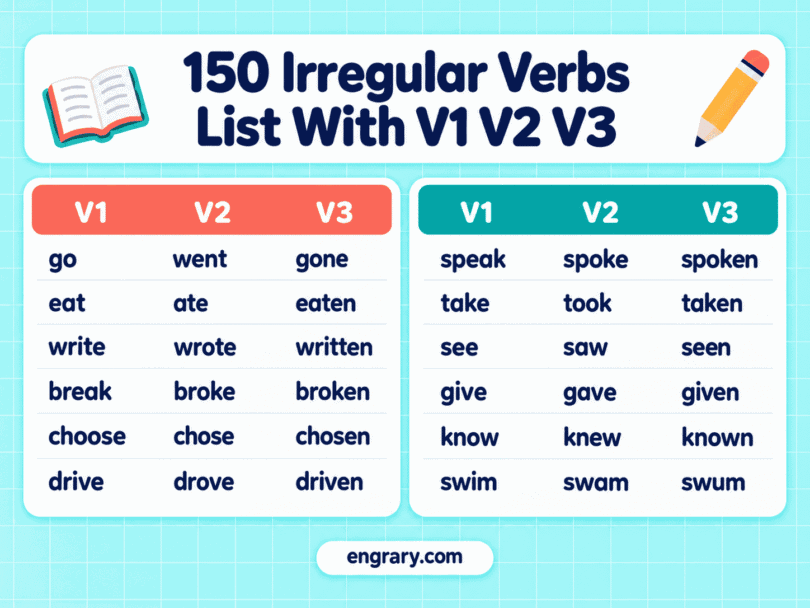
Irregular verbs do not form their past tense and past participle with the usual -ed pattern. Instead, they may change completely, change only part of the word, or keep the same form. For example, go becomes went and gone, while cut stays cut in all three main forms.
This article gives a complete irregular verbs list with V1, V2, and V3, followed by useful patterns that make the forms easier to compare and remember. You will also find accepted variants, special forms such as got/gotten and borne/born, common mistakes, and a short comparison with regular verbs.
What Are Irregular Verbs?
An irregular verb forms its past tense or past participle without following the normal regular -ed pattern.
For example:
go → went → gone
write → wrote → written
buy → bought → bought
cut → cut → cut
In a V1–V2–V3 list:
- V1 is the base form.
- V2 is the simple past.
- V3 is the past participle.
Irregular verbs do not follow one single rule. Some change in both V2 and V3, some use the same V2 and V3, and others do not change at all.
Common Irregular Verbs
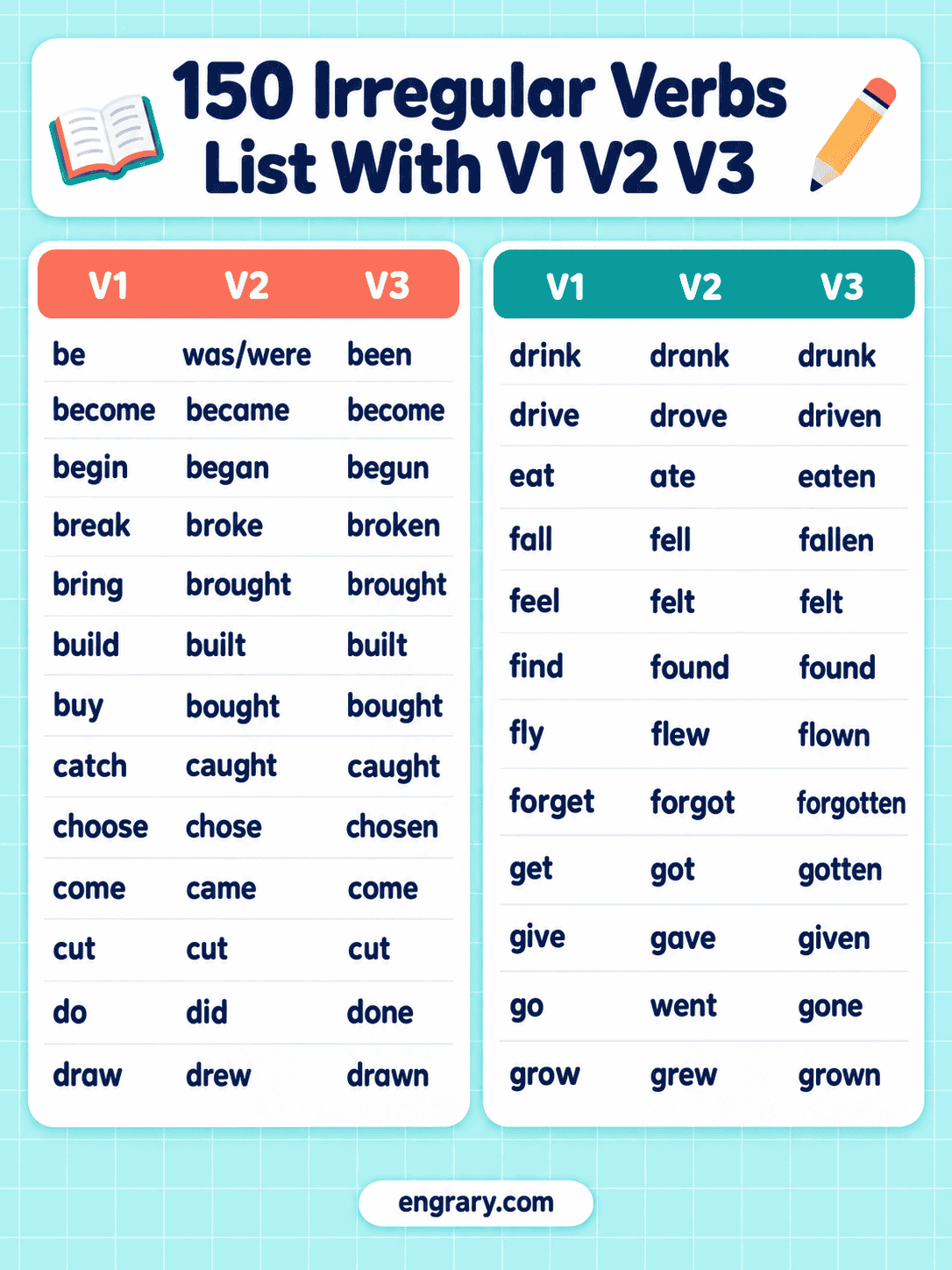
Some irregular verbs appear constantly in everyday English. Learning these first gives you a strong base before moving to the complete list.
| V1 | V2 | V3 |
|---|---|---|
| be | was/were | been |
| begin | began | begun |
| bring | brought | brought |
| buy | bought | bought |
| come | came | come |
| do | did | done |
| eat | ate | eaten |
| get | got | got/gotten |
| give | gave | given |
| go | went | gone |
| know | knew | known |
| make | made | made |
| see | saw | seen |
| take | took | taken |
| write | wrote | written |
These verbs show several common irregular patterns. Some, such as buy, keep the same V2 and V3, while others, such as write, use three different forms.

How to Use the Irregular Verbs List
Start with the base verb in the V1 column, then move across the row to find its past and past-participle forms.
For example:
write → wrote → written
Here, wrote is used for the simple past:
She wrote a letter yesterday.
The V3 form written is commonly used after have, has, or had:
She has written a letter.
Looking at V2 and V3 together is especially useful because these forms are often confused.
150 Irregular Verbs List With V1 V2 V3
The table below contains exactly 150 irregular English verbs. It includes common everyday verbs, useful compound forms, and accepted modern variants.
A–C
The first group includes several high-frequency irregular verbs, from arise and be to catch, choose, and come.
| No. | V1 | V2 | V3 |
|---|---|---|---|
| 1 | arise | arose | arisen |
| 2 | awake | awoke | awoken |
| 3 | be | was/were | been |
| 4 | bear | bore | borne |
| 5 | beat | beat | beaten |
| 6 | become | became | become |
| 7 | begin | began | begun |
| 8 | bend | bent | bent |
| 9 | bet | bet | bet |
| 10 | bind | bound | bound |
| 11 | bite | bit | bitten |
| 12 | bleed | bled | bled |
| 13 | blow | blew | blown |
| 14 | break | broke | broken |
| 15 | breed | bred | bred |
| 16 | bring | brought | brought |
| 17 | broadcast | broadcast | broadcast |
| 18 | build | built | built |
| 19 | burn | burned/burnt | burned/burnt |
| 20 | burst | burst | burst |
| 21 | buy | bought | bought |
| 22 | catch | caught | caught |
| 23 | choose | chose | chosen |
| 24 | come | came | come |
| 25 | cost | cost | cost |
| 26 | creep | crept | crept |
| 27 | cut | cut | cut |
D–F
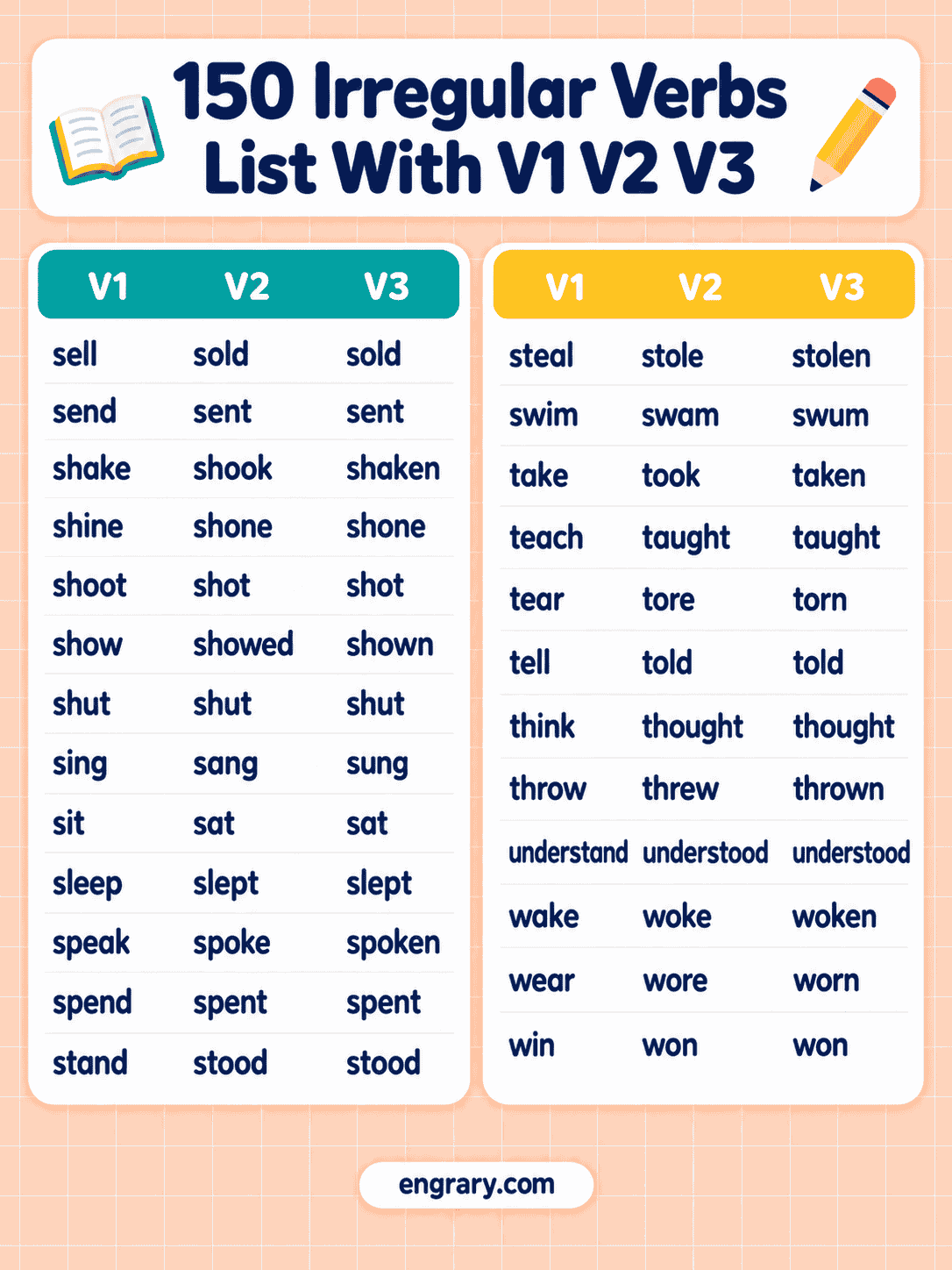
This group contains many familiar verbs with strong form changes, including do, drink, drive, eat, fall, fly, forget, and freeze.
| No. | V1 | V2 | V3 |
|---|---|---|---|
| 28 | deal | dealt | dealt |
| 29 | dig | dug | dug |
| 30 | do | did | done |
| 31 | draw | drew | drawn |
| 32 | dream | dreamed/dreamt | dreamed/dreamt |
| 33 | drink | drank | drunk |
| 34 | drive | drove | driven |
| 35 | eat | ate | eaten |
| 36 | fall | fell | fallen |
| 37 | feed | fed | fed |
| 38 | feel | felt | felt |
| 39 | fight | fought | fought |
| 40 | find | found | found |
| 41 | flee | fled | fled |
| 42 | fly | flew | flown |
| 43 | forbid | forbade | forbidden |
| 44 | foretell | foretold | foretold |
| 45 | forget | forgot | forgotten |
| 46 | forgive | forgave | forgiven |
| 47 | forsake | forsook | forsaken |
| 48 | freeze | froze | frozen |

G–I
Several very common verbs appear here, including get, give, go, grow, have, hear, hide, hold, and hurt.
| No. | V1 | V2 | V3 |
|---|---|---|---|
| 49 | get | got | got/gotten |
| 50 | give | gave | given |
| 51 | go | went | gone |
| 52 | grind | ground | ground |
| 53 | grow | grew | grown |
| 54 | hang | hung | hung |
| 55 | have | had | had |
| 56 | hear | heard | heard |
| 57 | hide | hid | hidden |
| 58 | hit | hit | hit |
| 59 | hold | held | held |
| 60 | hurt | hurt | hurt |
J–L
This group includes verbs with unchanged forms, shared V2/V3 forms, and several accepted variants.
| No. | V1 | V2 | V3 |
|---|---|---|---|
| 61 | keep | kept | kept |
| 62 | kneel | knelt/kneeled | knelt/kneeled |
| 63 | knit | knit/knitted | knit/knitted |
| 64 | know | knew | known |
| 65 | lay | laid | laid |
| 66 | lead | led | led |
| 67 | lean | leaned/leant | leaned/leant |
| 68 | leap | leaped/leapt | leaped/leapt |
| 69 | learn | learned/learnt | learned/learnt |
| 70 | leave | left | left |
| 71 | lend | lent | lent |
| 72 | let | let | let |
| 73 | lie | lay | lain |
| 74 | light | lit/lighted | lit/lighted |
| 75 | lose | lost | lost |
M–O
This shorter group contains several very common irregular verbs and two useful compound forms.
| No. | V1 | V2 | V3 |
|---|---|---|---|
| 76 | make | made | made |
| 77 | mean | meant | meant |
| 78 | meet | met | met |
| 79 | overcome | overcame | overcome |
| 80 | overtake | overtook | overtaken |
P–R
The P–R group includes several useful verbs with matching V2/V3 forms as well as verbs whose past and participle forms differ.
| No. | V1 | V2 | V3 |
|---|---|---|---|
| 81 | pay | paid | paid |
| 82 | prove | proved | proven/proved |
| 83 | put | put | put |
| 84 | read | read | read |
| 85 | redo | redid | redone |
| 86 | repay | repaid | repaid |
| 87 | retell | retold | retold |
| 88 | rewrite | rewrote | rewritten |
| 89 | ride | rode | ridden |
| 90 | ring | rang | rung |
| 91 | rise | rose | risen |
| 92 | run | ran | run |
S–U
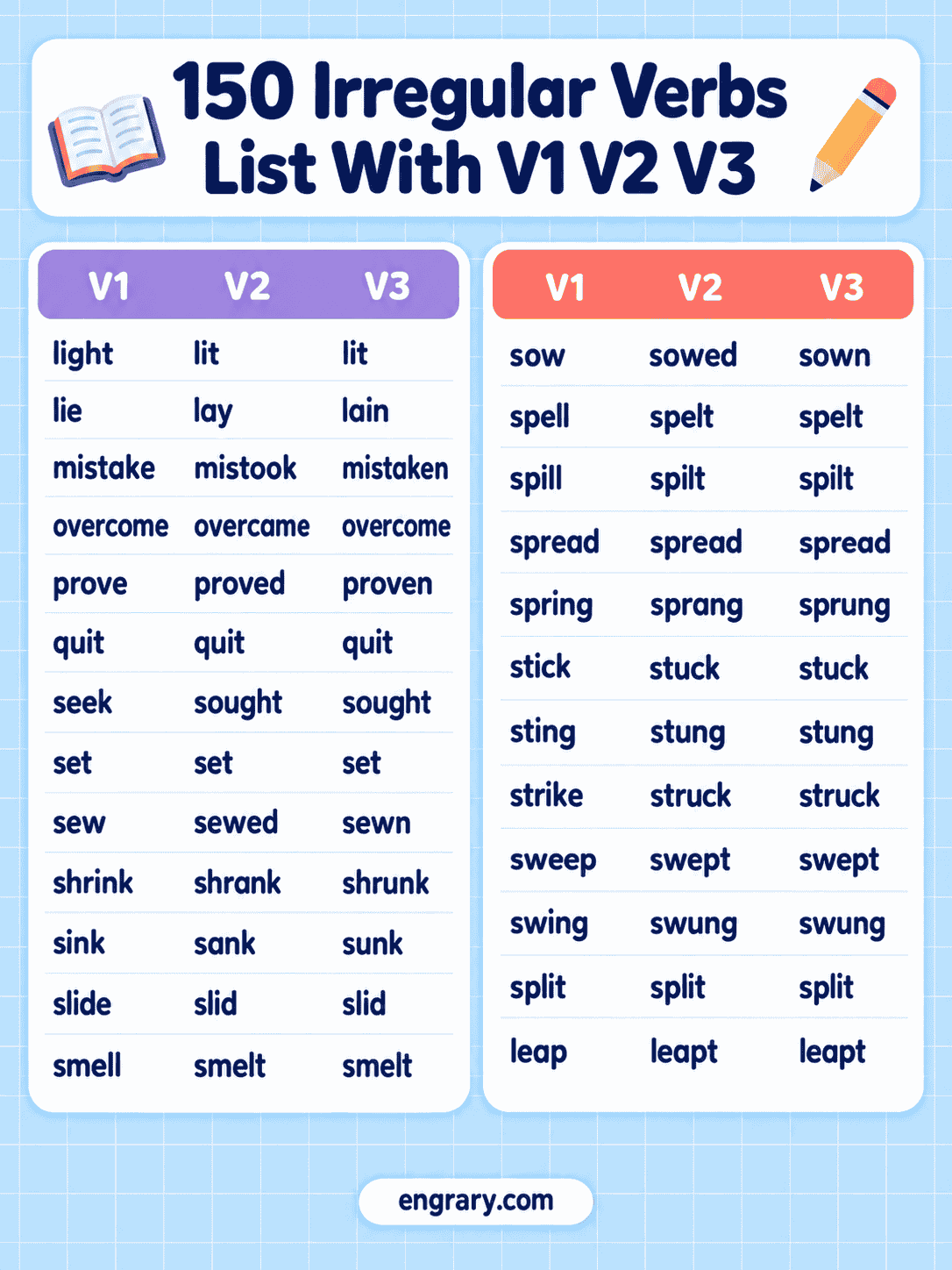
This is the largest group and contains many of the best-known irregular patterns in English.
| No. | V1 | V2 | V3 |
|---|---|---|---|
| 93 | say | said | said |
| 94 | see | saw | seen |
| 95 | seek | sought | sought |
| 96 | sell | sold | sold |
| 97 | send | sent | sent |
| 98 | set | set | set |
| 99 | sew | sewed | sewn/sewed |
| 100 | shake | shook | shaken |
| 101 | shine | shone | shone |
| 102 | shoot | shot | shot |
| 103 | show | showed | shown/showed |
| 104 | shrink | shrank | shrunk |
| 105 | shut | shut | shut |
| 106 | sing | sang | sung |
| 107 | sink | sank | sunk |
| 108 | sit | sat | sat |
| 109 | sleep | slept | slept |
| 110 | slide | slid | slid |
| 111 | smell | smelled/smelt | smelled/smelt |
| 112 | sow | sowed | sown/sowed |
| 113 | speak | spoke | spoken |
| 114 | speed | sped/speeded | sped/speeded |
| 115 | spell | spelled/spelt | spelled/spelt |
| 116 | spend | spent | spent |
| 117 | spill | spilled/spilt | spilled/spilt |
| 118 | spin | spun | spun |
| 119 | split | split | split |
| 120 | spoil | spoiled/spoilt | spoiled/spoilt |
| 121 | spread | spread | spread |
| 122 | spring | sprang | sprung |
| 123 | stand | stood | stood |
| 124 | steal | stole | stolen |
| 125 | stick | stuck | stuck |
| 126 | sting | stung | stung |
| 127 | stink | stank | stunk |
| 128 | stride | strode | stridden |
| 129 | strike | struck | struck/stricken |
| 130 | strive | strove/strived | striven/strived |
| 131 | swear | swore | sworn |
| 132 | sweep | swept | swept |
| 133 | swim | swam | swum |
| 134 | swing | swung | swung |
| 135 | take | took | taken |
| 136 | teach | taught | taught |
| 137 | tear | tore | torn |
| 138 | tell | told | told |
| 139 | think | thought | thought |
| 140 | throw | threw | thrown |
| 141 | undergo | underwent | undergone |
| 142 | understand | understood | understood |
| 143 | undertake | undertook | undertaken |
V–Z
The final group contains several common verbs with clearly different V2 and V3 forms.
| No. | V1 | V2 | V3 |
|---|---|---|---|
| 144 | wake | woke | woken |
| 145 | wear | wore | worn |
| 146 | weep | wept | wept |
| 147 | win | won | won |
| 148 | wind | wound | wound |
| 149 | withdraw | withdrew | withdrawn |
| 150 | write | wrote | written |

Common Patterns in Irregular Verbs
Irregular verbs do not follow one universal rule, but many can still be grouped by the way their forms change. These patterns make a long list easier to learn.
Same V1, V2, and V3
Some verbs keep exactly the same spelling in all three forms.
| V1 | V2 | V3 |
|---|---|---|
| bet | bet | bet |
| broadcast | broadcast | broadcast |
| burst | burst | burst |
| cost | cost | cost |
| cut | cut | cut |
| hit | hit | hit |
| hurt | hurt | hurt |
| let | let | let |
| put | put | put |
| set | set | set |
| shut | shut | shut |
| split | split | split |
| spread | spread | spread |
Their grammatical job changes even though their spelling does not.
Same V2 and V3
Many irregular verbs change from V1 but use the same form for both V2 and V3.
| V1 | V2 | V3 |
|---|---|---|
| bring | brought | brought |
| buy | bought | bought |
| catch | caught | caught |
| deal | dealt | dealt |
| feel | felt | felt |
| find | found | found |
| keep | kept | kept |
| make | made | made |
| meet | met | met |
| send | sent | sent |
| teach | taught | taught |
| think | thought | thought |
Learning these as pairs can make the forms easier to remember.
Different V2 and V3
Some irregular verbs use a different form for the simple past and past participle.
| V1 | V2 | V3 |
|---|---|---|
| begin | began | begun |
| break | broke | broken |
| drink | drank | drunk |
| drive | drove | driven |
| eat | ate | eaten |
| fly | flew | flown |
| go | went | gone |
| see | saw | seen |
| speak | spoke | spoken |
| take | took | taken |
| throw | threw | thrown |
| write | wrote | written |
These verbs need particular attention because V2 and V3 cannot be used interchangeably.
Vowel-Change Patterns
Several irregular verbs change their internal vowel.
sing → sang → sung
ring → rang → rung
drink → drank → drunk
swim → swam → swum
begin → began → begun
A similar pattern can help with memorization, but it should not be treated as a rule that applies to every verb.
Similar -ought and -aught Forms
Another recognizable group uses -ought or -aught in V2 and V3.
bring → brought → brought
buy → bought → bought
think → thought → thought
catch → caught → caught
teach → taught → taught
The spelling changes differently from regular verbs, but the repeated pattern makes these forms easier to group.
Irregular Verbs With Variant Forms
Some English verbs have more than one accepted past or past-participle form. The preferred form may depend on dialect, style, or context.
| Verb | Accepted Forms |
|---|---|
| burn | burned / burnt |
| dream | dreamed / dreamt |
| kneel | kneeled / knelt |
| lean | leaned / leant |
| leap | leaped / leapt |
| learn | learned / learnt |
| smell | smelled / smelt |
| spell | spelled / spelt |
| spill | spilled / spilt |
| spoil | spoiled / spoilt |
Neither form should automatically be treated as an error. American English often favors several -ed forms, while British English uses some shorter alternatives more often.
Irregular Verb Forms to Notice
A few verbs deserve separate attention because their forms depend on dialect, meaning, or pronunciation.
Get: Got and Gotten
The simple past of get is got.
Its past participle can appear as:
get → got → got
or:
get → got → gotten
Got is common as the past participle in British English. Gotten is widely used in American English for several meanings.
Bear: Borne and Born
The main pattern is:
bear → bore → borne
However, born is used when referring to birth.
She was born in July.
The cost was borne by the company.
So borne and born are related forms, but they are used differently.
Read
The verb read keeps the same spelling in V1, V2, and V3:
read → read → read
The pronunciation changes, however. The base form rhymes with need, while V2 and V3 rhyme with bed.
Regular Verbs vs Irregular Verbs
Regular and irregular verbs differ mainly in how they form V2 and V3.
| Regular Verbs | Irregular Verbs |
|---|---|
| play → played → played | go → went → gone |
| work → worked → worked | write → wrote → written |
| clean → cleaned → cleaned | see → saw → seen |
| help → helped → helped | eat → ate → eaten |
Common Mistakes With Irregular Verbs
Many mistakes happen when a regular -ed ending is added to an irregular verb or when V2 is used where V3 is required.
| Incorrect | Correct | Why |
|---|---|---|
| goed | went | V2 of go is went |
| buyed | bought | buy is irregular |
| writed | wrote | V2 of write is wrote |
| has went | has gone | gone is V3 |
| has saw | has seen | seen is V3 |
| has ate | has eaten | eaten is V3 |
| taked | took | V2 of take is took |
| catched | caught | V2 of catch is caught |
A useful check is to remember that the simple past normally uses V2, while structures with have, has, or had normally require V3.
FAQs
Irregular verbs form their past or past participle without following the standard regular -ed pattern. Examples include go → went → gone and write → wrote → written.
Common examples include be, begin, bring, buy, come, do, eat, get, give, go, know, make, see, take, and write.
The exact number depends on which rare, historical, compound, and variant forms are counted. For everyday learning, mastering the most common modern irregular verbs is more useful than trying to memorize every possible form.
Some irregular verbs use the same form for the past and past participle, as in buy → bought → bought and feel → felt → felt.
Regular verbs follow predictable past-form patterns such as play → played → played. Irregular verbs use other patterns, such as go → went → gone.
You May Also Like



Leave a Comment