
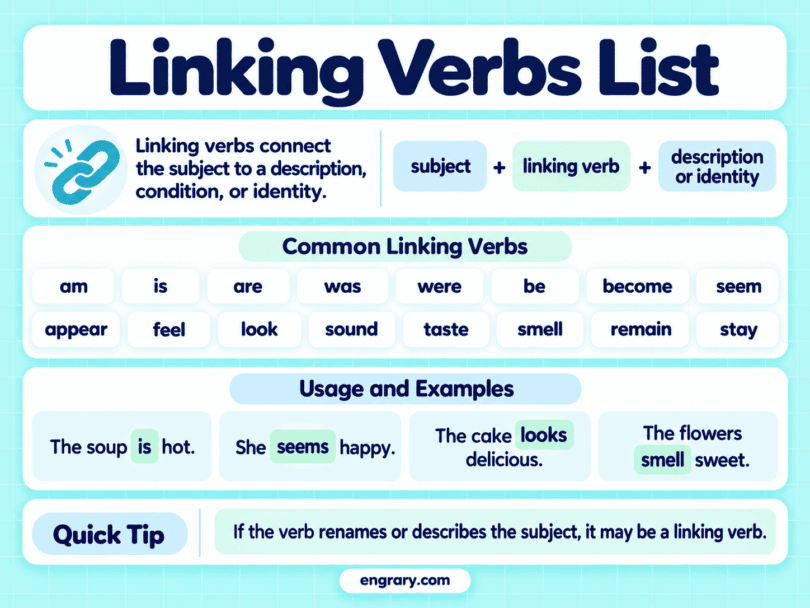
Linking verbs connect the subject of a sentence to a word or phrase that describes, identifies, or explains it. Words such as is, seem, become, feel, look, and taste can work as linking verbs when they connect the subject to a subject complement.
This article gives a clear linking verbs list, groups common linking verbs by type, and shows how they work in sentences. You will also learn how linking verbs differ from action, helping, and stative verbs, along with simple ways to identify them correctly.
What Are Linking Verbs?
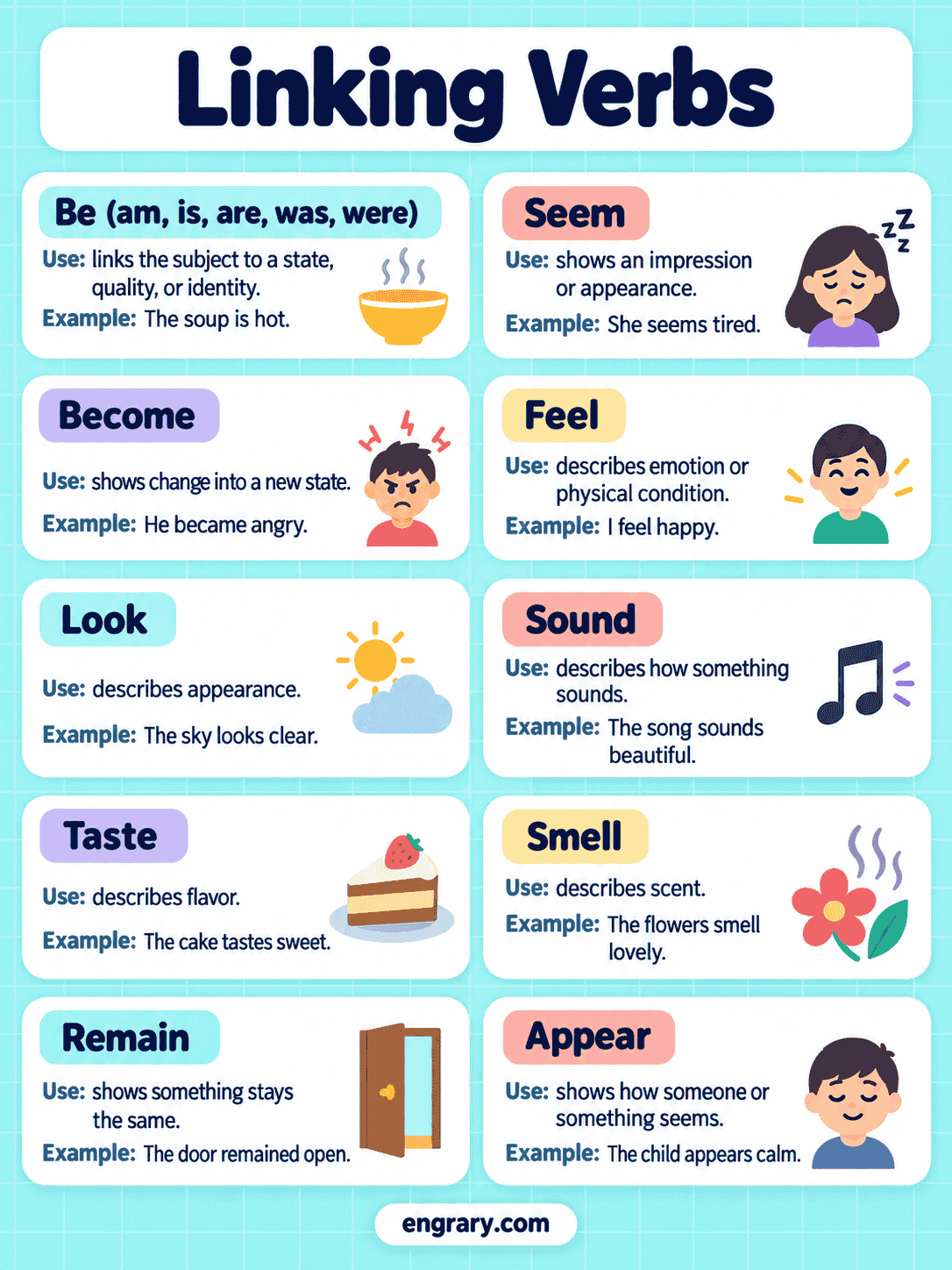
A linking verb connects the subject of a sentence to a word or phrase that describes or identifies the subject.
For example:
Mia is tired.
The soup tastes salty.
He became a teacher.
In these sentences:
- is connects Mia to tired
- tastes connects soup to salty
- became connects he to a teacher
A common pattern is:
subject + linking verb + subject complement
The subject complement may describe the subject or identify what the subject is.
Common Linking Verbs List
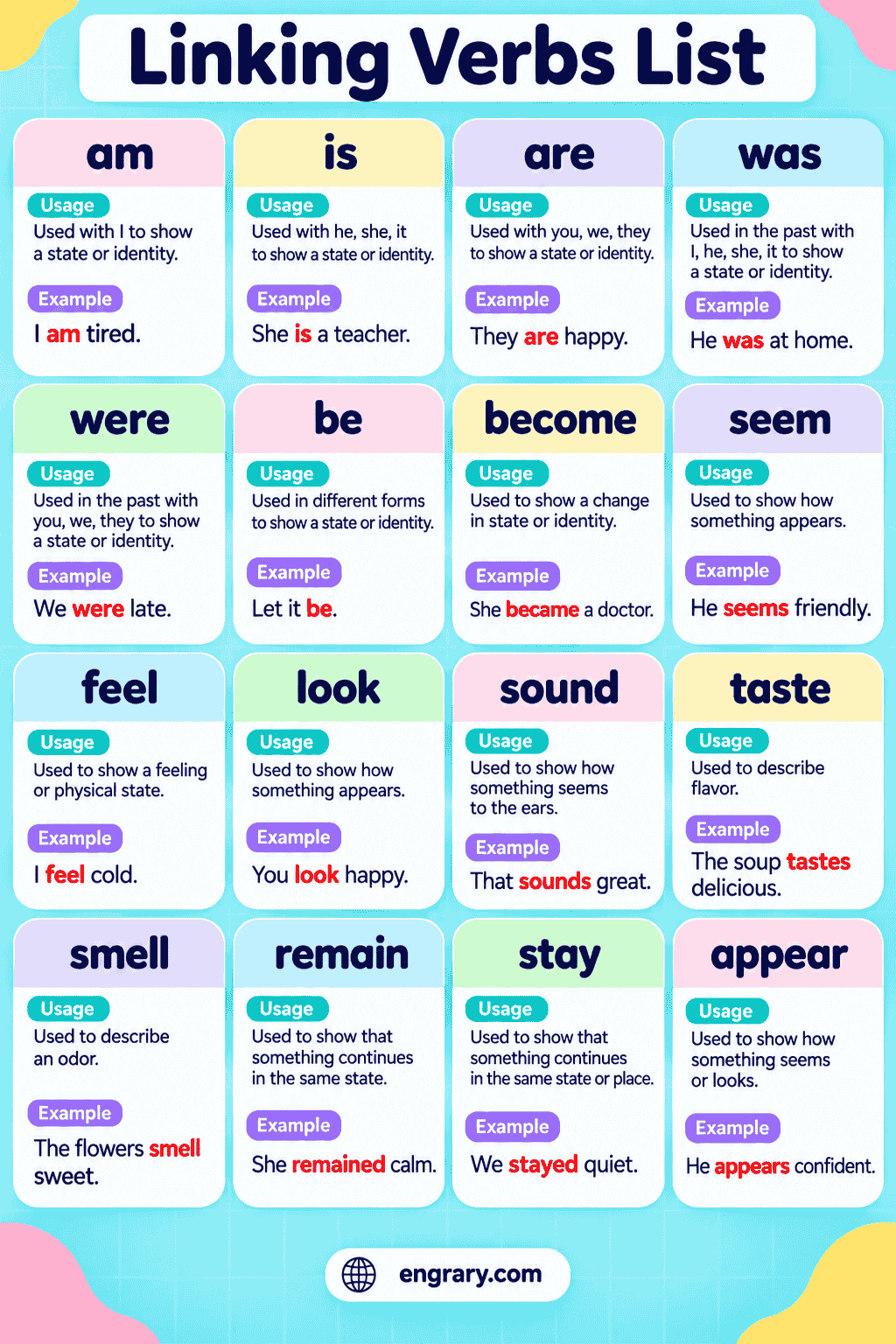
The following verbs commonly function as linking verbs.
| Linking Verb | Example |
|---|---|
| am | I am ready. |
| is | She is happy. |
| are | They are tired. |
| was | He was quiet. |
| were | We were prepared. |
| be | Try to be calm. |
| being | He is being polite. |
| been | She has been sick. |
| appear | The plan appears reasonable. |
| become | He became angry. |
| feel | The blanket feels soft. |
| get | The weather got colder. |
| grow | The sky grew dark. |
| look | She looks tired. |
| remain | The room remained quiet. |
| seem | He seems nervous. |
| smell | The flowers smell fresh. |
| sound | The music sounds beautiful. |
| stay | The child stayed calm. |
| taste | The soup tastes delicious. |
| turn | The leaves turned yellow. |
Many of these verbs can perform other grammatical jobs too, so their function depends on the sentence.
Linking Verbs by Type
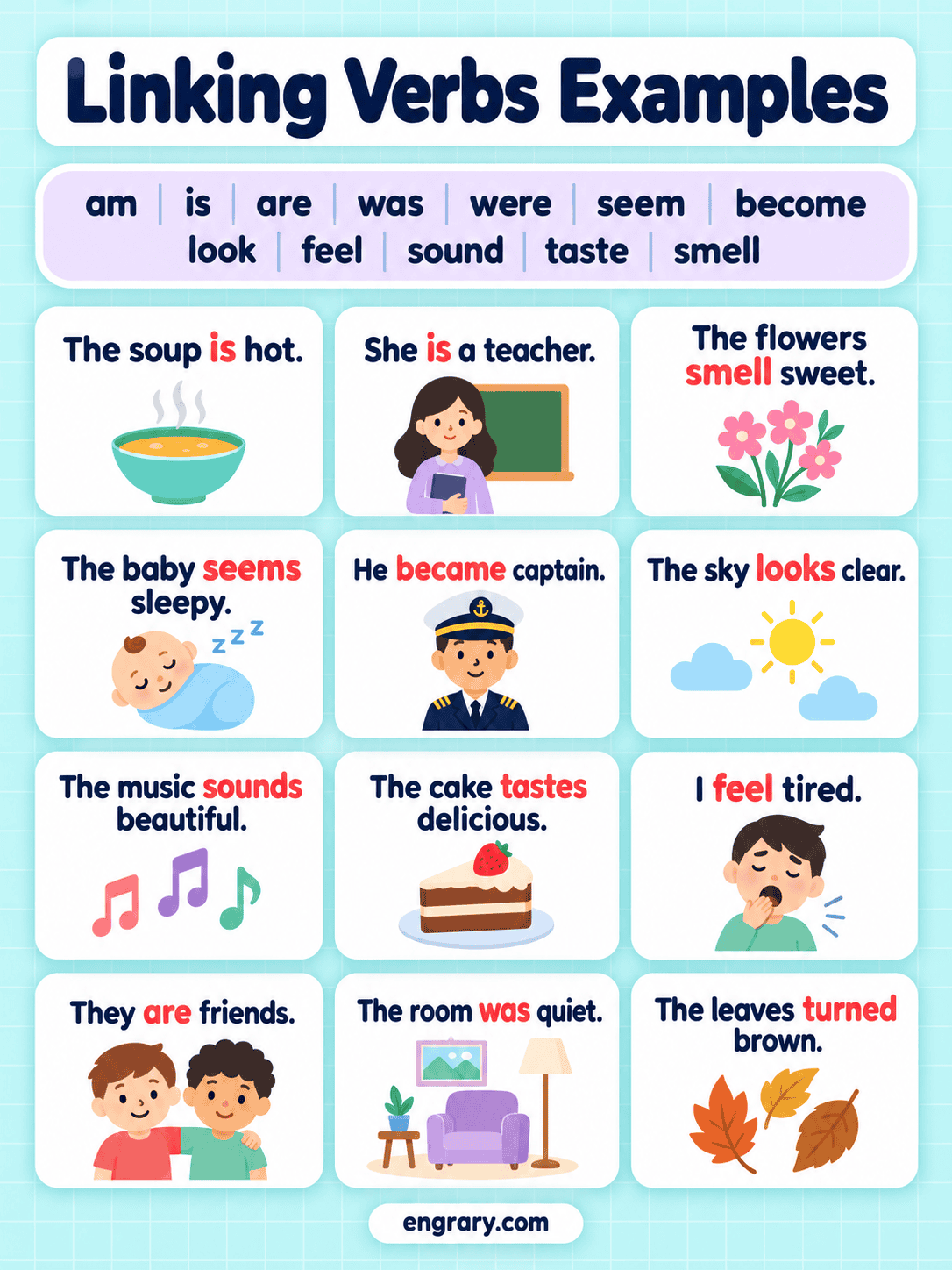
Grouping linking verbs by meaning makes the list easier to understand.
Forms of Be
Forms of be are the most common linking verbs.
They include:
- am
- is
- are
- was
- were
- be
- being
- been
Examples:
I am tired.
She is a teacher.
They are ready.
He was quiet.
We were happy.
The purpose of be in these sentences is to connect the subject to a description or identity.
Compare:
She is happy.
Here, is links she with happy.
Sense Linking Verbs
Some verbs connected with the senses can function as linking verbs.
Common examples include:
- feel
- look
- smell
- sound
- taste
Examples:
The blanket feels soft.
She looks tired.
The flowers smell fresh.
The music sounds beautiful.
The soup tastes salty.
In each sentence, the verb connects the subject to a description.
However, these verbs are not always linking verbs. Their function depends on how they are used.
Verbs Showing Change
Some linking verbs show that the subject changes from one state to another.
Common examples include:
- become
- get
- grow
- turn
Examples:
He became angry.
The weather got colder.
The sky grew dark.
The leaves turned yellow.
These verbs connect the subject to its new state or condition.
Verbs Showing State or Continuation
Some linking verbs show that a condition appears, continues, or remains.
Common examples include:
- appear
- remain
- seem
- stay
Examples:
The plan appears reasonable.
The room remained quiet.
Mia seems tired.
The child stayed calm.
These verbs connect the subject to a continuing or perceived state.
Linking Verb Examples in Sentences
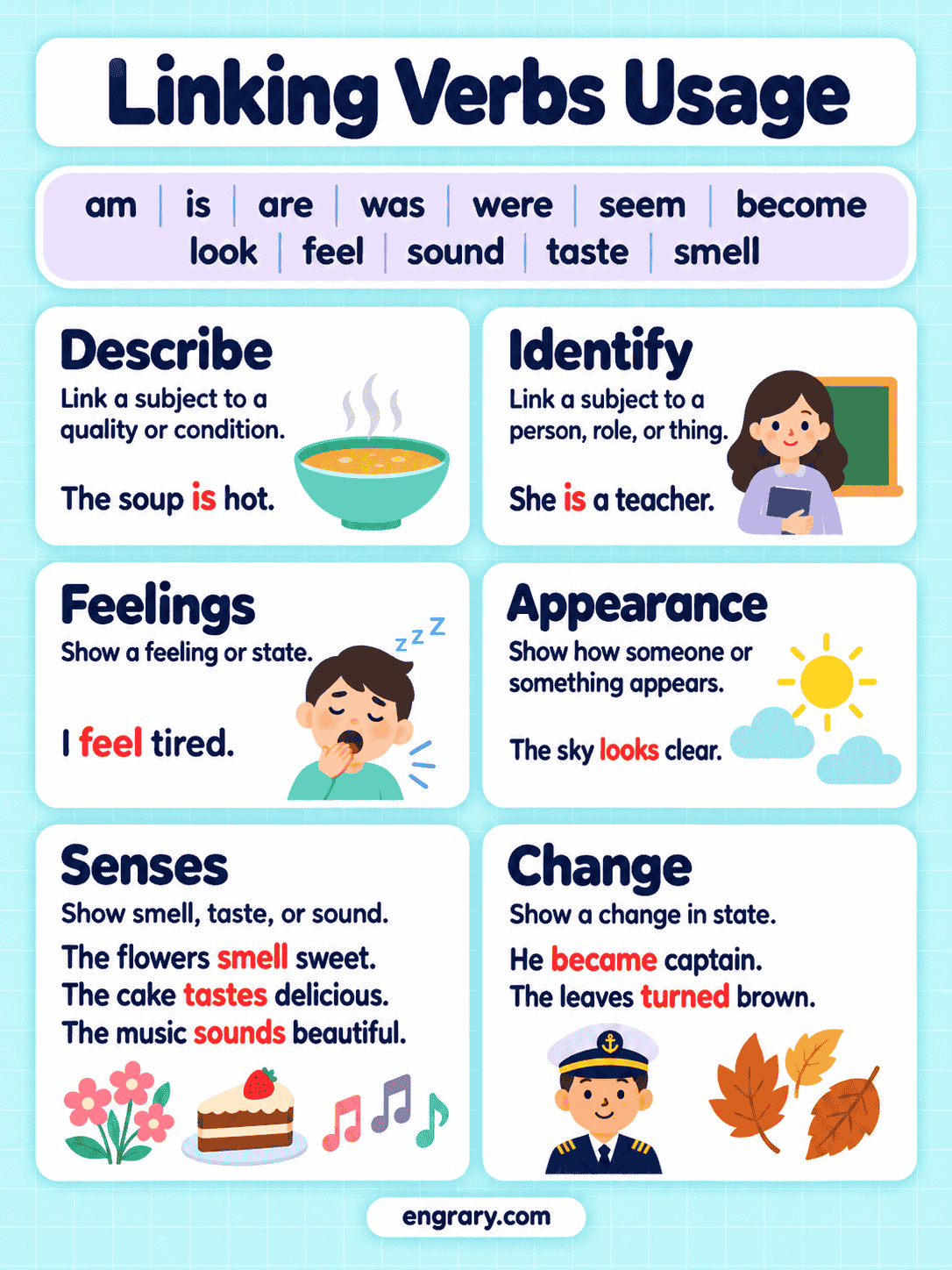
The examples below show linking verbs in different contexts.
She is happy.
He became captain.
The flowers smell sweet.
The cake tastes delicious.
The music sounds loud.
Mia seems tired.
The sky grew dark.
The water turned cold.
The room remained quiet.
The child stayed calm.
The blanket feels soft.
The plan appears reasonable.
They are ready.
He was nervous.
I am hungry.
The weather got warmer.
She looks upset.
The soup smells wonderful.
The idea sounds interesting.
The fruit tastes fresh.
In every example, the linking verb connects the subject to information about the subject.
Linking Verbs and Subject Complements
A linking verb connects the subject with a subject complement.
The complement may describe the subject or identify it.
| Subject | Linking Verb | Subject Complement |
|---|---|---|
| Mia | is | happy |
| He | became | captain |
| Soup | tastes | salty |
| Flowers | smell | fresh |
| Sky | grew | dark |
| Child | stayed | calm |
| Plan | appears | reasonable |
| Music | sounds | beautiful |
In:
Mia is happy.
happy describes Mia.
In:
He became captain.
captain identifies what he became.
The complement refers back to the subject rather than receiving an action from the verb.
Linking Verbs vs Action Verbs
Some verbs can function as linking verbs in one sentence and action verbs in another.
| Linking Use | Action Use |
|---|---|
| The soup tastes good. | I tasted the soup. |
| She looks tired. | She looks at the clock. |
| The flowers smell sweet. | He smells the flowers. |
| The fabric feels soft. | She feels the fabric. |
| The sky grew dark. | They grow tomatoes. |
In the linking examples, the verb connects the subject to a description.
In the action examples, the verb expresses something the subject does.
This distinction shows why a verb should not be classified by the word alone. Its function depends on the sentence.
Linking Verbs vs Helping Verbs
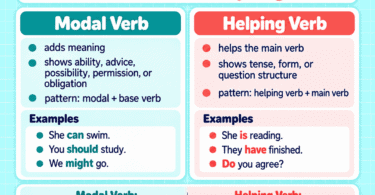
Forms of be can function as either linking verbs or helping verbs.
| Linking Verb | Helping Verb |
|---|---|
| She is tired. | She is reading. |
| They are ready. | They are working. |
| He was quiet. | He was sleeping. |
In:
She is tired.
is connects she to tired, so it is a linking verb.
In:
She is reading.
is helps the main verb reading, so it is a helping verb.
A useful distinction is:
linking verb → connects subject to a complement
helping verb → works with another verb
Linking Verbs vs Stative Verbs
Linking verbs and stative verbs can overlap, but the two categories are not the same.
Compare:
She seems tired.
seems is both stative and linking because it connects the subject to the description tired.
I know the answer.
know is stative, but it is not linking because the answer does not describe or identify the subject I.
So not every stative verb is a linking verb.
How to Identify a Linking Verb
One useful method is to ask whether the verb connects the subject to information that describes or identifies it.
For example:
The soup tastes salty.
salty describes the soup.
She seems nervous.
nervous describes she.
He became a teacher.
a teacher identifies he.
Another helpful test is to replace the possible linking verb with a form of be.
The soup tastes salty.
The soup is salty.
The basic meaning still works, which suggests that tastes is functioning as a linking verb.
Compare:
She smells the flower.
Replacing smells with is does not preserve the meaning:
She is the flower.
So smells is an action verb in that sentence.
This replacement test is useful, but context should always determine the final classification.
Common Mistakes With Linking Verbs
Linking verbs can be confusing because many of them can perform other roles.
| Incorrect Understanding | Correct Understanding |
|---|---|
| Every form of be is a helping verb. | Forms of be can be linking or helping. |
| Every sense verb is a linking verb. | Sense verbs depend on context. |
| A linking verb takes a direct object. | It connects the subject to a subject complement. |
| Linking verbs always show action. | They commonly show state, identity, appearance, or change. |
| Every stative verb is linking. | Some stative verbs are not linking. |
Another common problem involves adjectives and adverbs.
Correct:
The soup tastes good.
The blanket feels soft.
She looks tired.
These adjectives describe the subject.
Using an adverb may change the meaning.
Compare:
She looks carefully at the picture.
Here, looks describes an action, and carefully describes how she looks.
FAQs
Linking verbs connect the subject of a sentence to a word or phrase that describes or identifies the subject.
Common examples include am, is, are, was, were, seem, become, appear, feel, look, smell, sound, taste, remain, stay, grow, get, and turn.
No. In She is tired, is is a linking verb. In She is reading, is is a helping verb.
Yes. For example, smells is linking in The flower smells sweet, but it shows action in He smells the flower.
Check whether the verb connects the subject to a word that describes or identifies it. Replacing the verb with a form of be can also provide a useful clue.
No. Linking verbs connect the subject to a subject complement rather than transferring an action to a direct object.
You May Also Like



Leave a Comment