

Helping verbs work with main verbs to express meanings such as time, possibility, ability, necessity, emphasis, questions, negatives, and voice. Words such as is, have, do, can, should, and will often appear inside verb phrases and support the main verb.
This article gives exactly 100 helping verbs examples in sentences and shows how helping verbs work with main verbs. You will also learn what form follows different helping verbs, how multiple auxiliaries work together, and how helping verbs differ from main and linking verbs.
What Is a Helping Verb in a Sentence?
A helping verb, also called an auxiliary verb, works with a main verb in the same verb phrase.
For example:
She is reading.
They have finished.
He can swim.
We will leave.
Here, is, have, can, and will support the main verbs reading, finished, swim, and leave.
Common Helping Verb Sentences
Helping verbs appear in continuous forms, perfect forms, questions, negatives, modal structures, passive sentences, and longer verb phrases.
Common combinations include:
is reading
are working
have finished
has written
do know
did call
can swim
might come
should rest
will leave
The role of each helping verb depends on the sentence structure and the main verb that follows it.
100 Helping Verbs Examples in Sentences
The following collection contains exactly 100 complete sentences. The helping verb or helping-verb phrase appears in bold.
Sentences With Be
Forms of be commonly help form continuous structures and passive constructions.
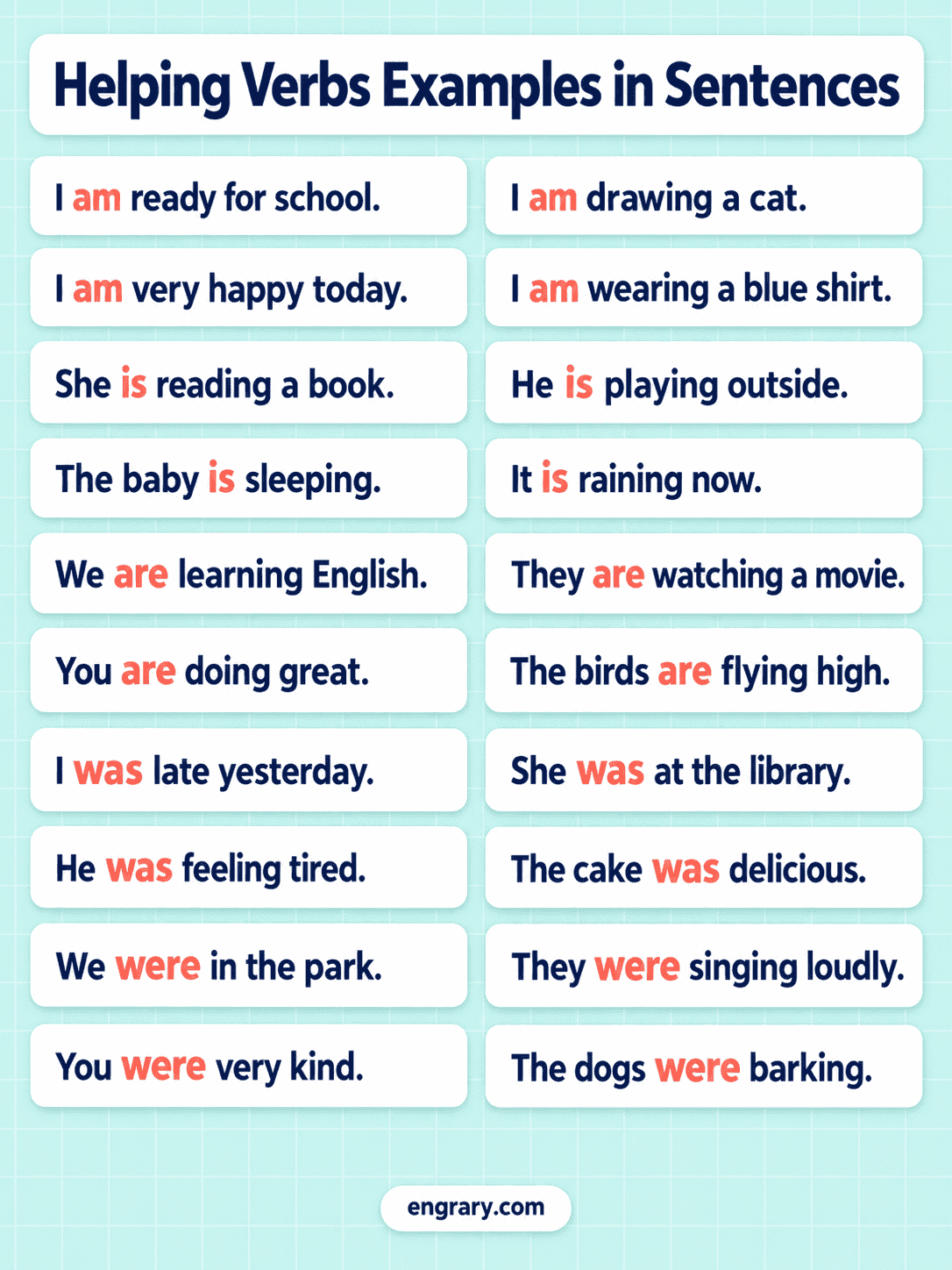
- I am learning English.
- I am writing an email.
- She is reading a novel.
- He is cooking dinner.
- The car is being repaired today.
- They are playing football.
- We are studying together.
- The students are preparing for the test.
- He was sleeping when I called.
- It was raining this morning.
- The wall was being painted yesterday.
- We were waiting outside.
- They were talking quietly.
- The documents were being checked carefully.
- The classroom is cleaned every afternoon.
- The packages are delivered each morning.
- The letter was written last night.
- The guests were invited to dinner.
- The road was closed because of the storm.
- The doors were locked before sunset.
Sentences With Have
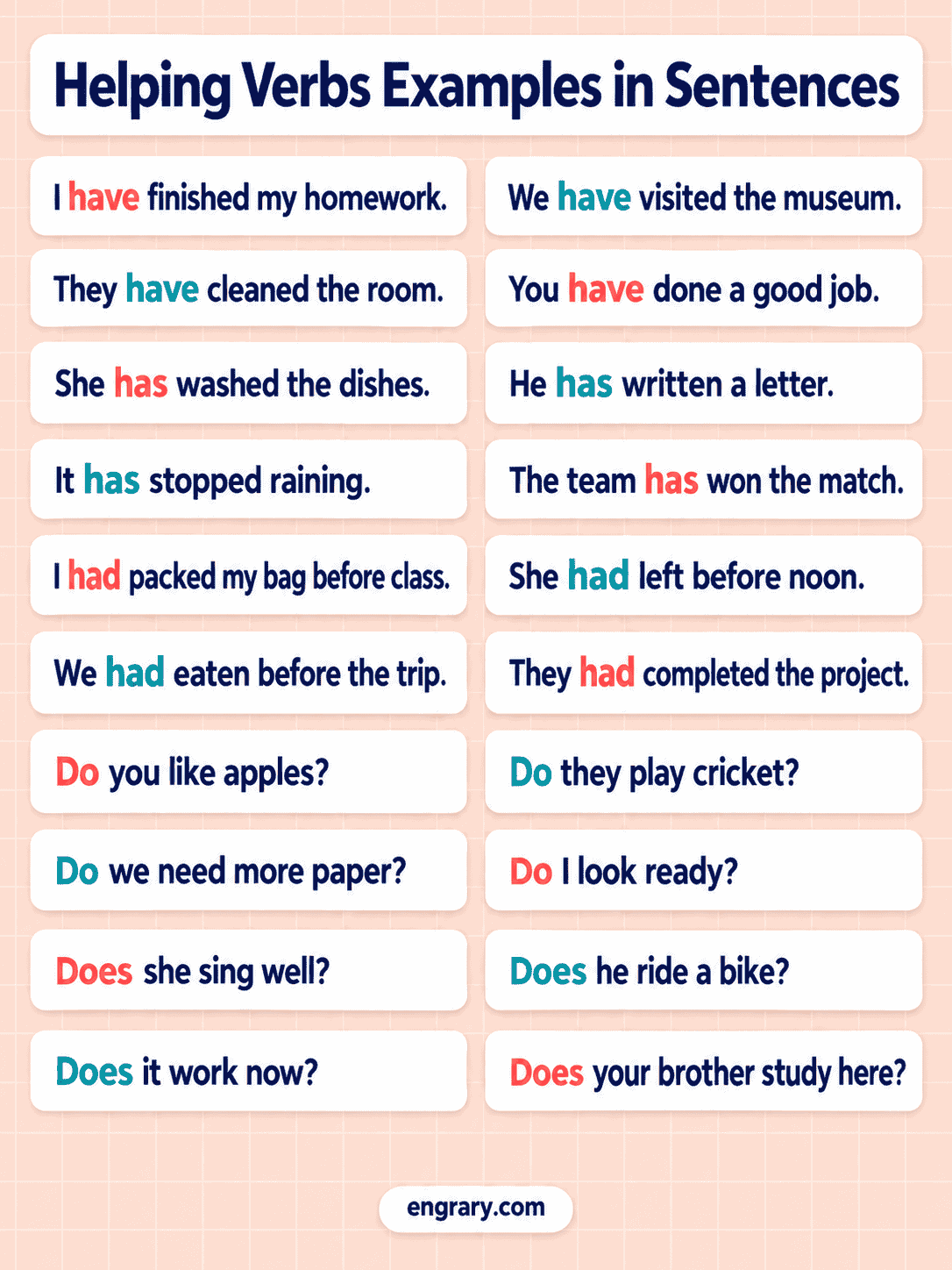
Forms of have commonly help form perfect verb phrases.
- I have finished my homework.
- We have seen that movie before.
- They have completed the project.
- She has arrived at school.
- He has written three pages.
- Mia has eaten breakfast.
- They had left before noon.
- We had finished dinner before the guests arrived.
- She had forgotten her notebook.
- I have visited that museum twice.
- He has taken the final test.
- The machine had broken down before the technician arrived.
- We have known each other for years.
- She has chosen the blue dress.
- He had spoken to the manager earlier.
Sentences With Do
Forms of do help form questions, negatives, and emphatic statements.
- Do you like tea?
- Does she work here?
- Did they call yesterday?
- Do we need more time?
- Does he understand the question?
- I do not agree with that answer.
- She does not drive to work.
- They did not leave early.
- We do not know the result.
- He does not remember my name.
- I do understand your point.
- She does care about the problem.
- He did finish the assignment.
- We do need more chairs.
- They did try to help.
Sentences With Modal Helping Verbs
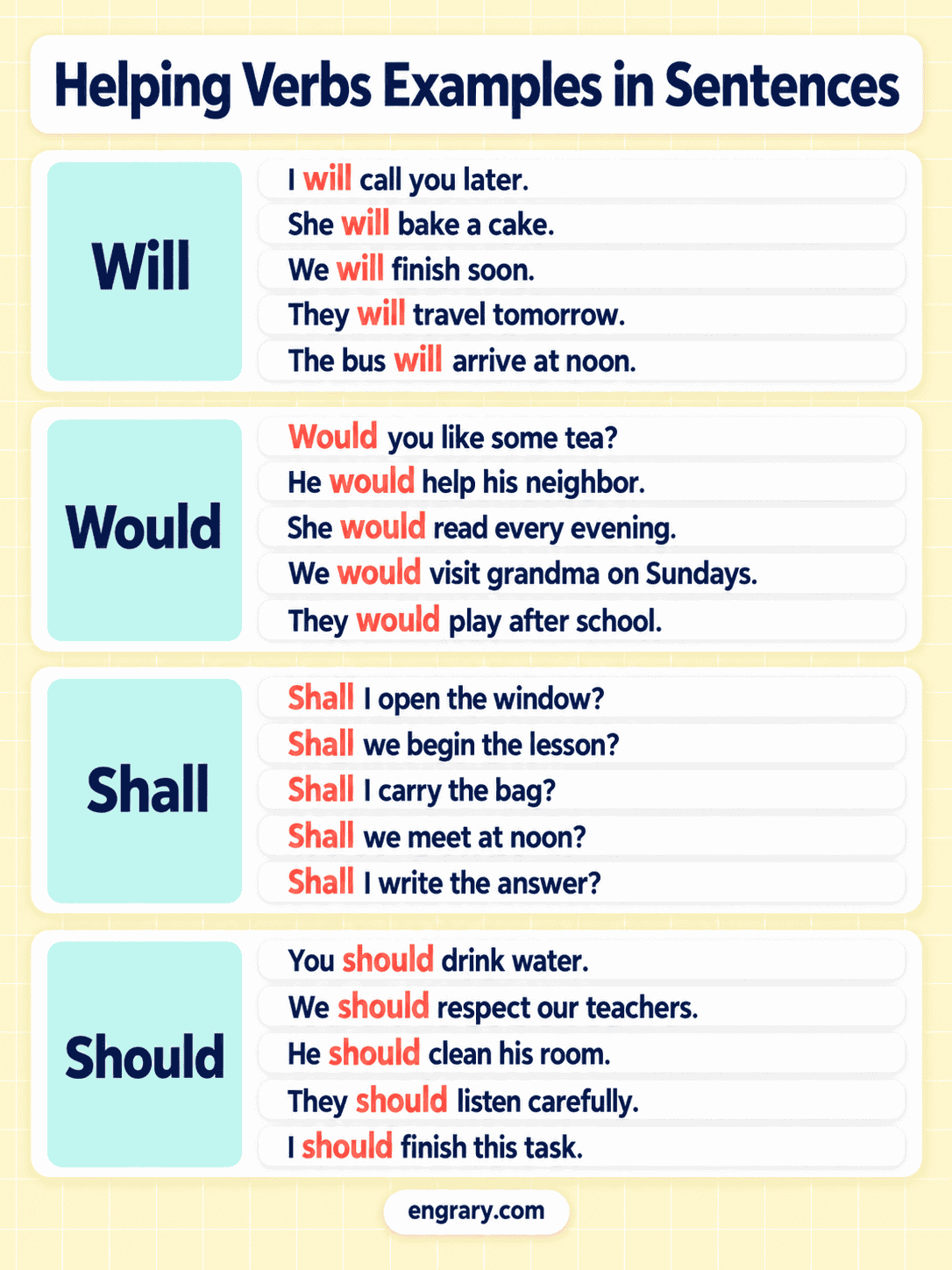
Modal helping verbs express meanings such as ability, possibility, necessity, advice, prediction, and willingness.
- She can swim very well.
- I can help you with the bags.
- They can finish the work today.
- He could read when he was four.
- We could try another route.
- She could solve the problem.
- You may leave after lunch.
- It may rain this evening.
- She might come to the party.
- They might need more time.
- He might know the answer.
- We must hurry.
- You must wear a seat belt.
- Students must complete the form.
- You should rest today.
- She should call her teacher.
- We should check the details.
- They will arrive tomorrow.
- I will call you tonight.
- The meeting will begin at nine.
- I would help if I had time.
- She would choose the smaller room.
- We would stay longer if we could.
- We shall continue after the break.
- I shall return tomorrow.
Questions
Helping verbs often appear before the subject when forming questions.
- Have you finished your homework?
- Has she arrived yet?
- Were they waiting outside?
- Is he working today?
- Can you open the window?
- Will they join us later?
- Should we call the doctor?
- Could you explain the answer again?
Negative Sentences
Helping verbs commonly carry not in negative structures.
- She has not finished her work.
- They were not listening.
- He cannot drive yet.
- We will not wait much longer.
- I have not seen that film.
- She should not worry about it.
- They might not come tonight.
Emphasis
Forms of do can strengthen affirmative statements.
- I do remember your name.
- She does know the answer.
- He did call me yesterday.
- We do appreciate your help.
- They did complete the task on time.
Sentences With More Than One Helping Verb
A verb phrase can contain two or more helping verbs before the main verb.
- She has been studying all morning.
- They will be leaving soon.
- He might have forgotten the meeting.
- We should have finished by now.
- They will have been waiting for three hours.

Helping Verb and Main Verb Examples
A helping verb supports the main verb, while the main verb carries the central action or meaning.
| Sentence | Helping Verb | Main Verb |
|---|---|---|
| She is reading. | is | reading |
| They have finished. | have | finished |
| He can swim. | can | swim |
| We will leave. | will | leave |
| Mia might come. | might | come |
| I did call. | did | call |
| They were playing. | were | playing |
| She has written a letter. | has | written |
| We should wait. | should | wait |
| He must leave. | must | leave |
The helping verb and main verb work together as one verb phrase.
What Comes After a Helping Verb?
Different helping verbs require different forms of the main verb.
| Helping Pattern | Main Verb Form | Example |
|---|---|---|
| modal + base verb | base form | She can swim. |
| do/does/did + base verb | base form | She did go. |
| have/has/had + V3 | past participle | He has eaten. |
| be + -ing form | present participle | She is running. |
| be + V3 | past participle | It was written yesterday. |
Modal verbs such as can, could, may, might, must, should, will, and would normally take the base form.
Correct:
She can swim.
Incorrect:
She can swims.
Likewise, do, does, and did take the base form when they work as helping verbs.
Correct:
Did she go?
Incorrect:
Did she went?
Forms of have normally take a past participle:
She has written the letter.
He had eaten already.
Forms of be combine with an -ing form in continuous structures:
They are working.
They can also combine with a past participle in passive structures:
The room was cleaned.

Helping Verbs vs Main Verbs
Some words function as helping verbs in one sentence and as main verbs in another.
| Helping Verb Use | Main Verb Use |
|---|---|
| He has finished. | He has a bicycle. |
| She does understand. | She does her homework. |
| They did complete the work. | They did the task. |
In:
He has finished.
has supports finished, so it functions as a helping verb.
In:
He has a bicycle.
has carries the central meaning itself, so it functions as the main verb.
Helping Verbs vs Linking Verbs
Forms of be can function as helping verbs or linking verbs depending on the sentence.
| Helping Verb | Linking Verb |
|---|---|
| She is running. | She is tired. |
| They are working. | They are ready. |
| He was sleeping. | He was quiet. |
In:
She is running.
is supports the main verb running.
In:
She is tired.
is connects the subject she with the description tired.
A helping verb supports another verb, while a linking verb connects the subject to a description or identity.
How to Identify Helping Verbs in Sentences
To identify a helping verb, look for a verb that supports another verb in the same verb phrase.
She is reading.
is helps reading.
They have finished.
have helps finished.
He can swim.
can helps swim.
Longer verb phrases may contain more than one helping verb.
She has been studying.
Helping verbs: has, been
Main verb: studying
However, a word should not be classified as a helping verb simply because it appears on a memorized list.
Compare:
She is happy.
Here, is does not support another verb. Instead, it functions as a linking verb.
A useful question is:
Is this verb working with another verb in the same verb phrase?
If yes, it is functioning as a helping verb.
Common Mistakes in Helping Verb Sentences
Helping-verb errors often happen when the wrong auxiliary or main-verb form is used.
| Incorrect | Correct | Why |
|---|---|---|
| She reading. | She is reading. | Continuous form needs a form of be |
| He have finished. | He has finished. | Singular subject takes has |
| They does not know. | They do not know. | Plural subject takes do |
| She can swims. | She can swim. | Modal takes the base verb |
| He will goes. | He will go. | Will takes the base verb |
| Did she went? | Did she go? | Did takes the base verb |
| He has ate. | He has eaten. | Has takes the past participle |
| She is write. | She is writing. | Continuous form requires -ing |
| They has arrived. | They have arrived. | Plural subject takes have |
| He may comes. | He may come. | May takes the base verb |
Checking both the helping verb and the form of the main verb that follows it prevents most of these errors.
FAQs
Examples include She is reading, They have finished, He can swim, We will leave, and I did call.
Look for a verb that supports another verb in the same verb phrase. In She has written a letter, has is the helping verb and written is the main verb.
Yes. In She has been studying, both has and been are helping verbs, while studying is the main verb.
Yes. In She is running, is is a helping verb. In She is tired, is is a linking verb.
The helping verbs are has and been. The main verb is studying.
You May Also Like


Leave a Comment