
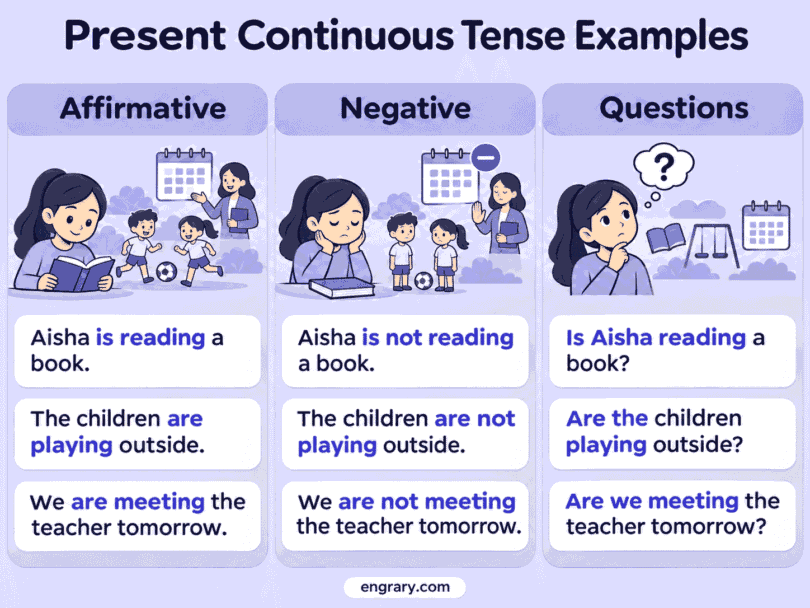
Present continuous tense examples show how English describes actions happening now, activities continuing around the present, temporary situations, developing changes, and definite future arrangements. The tense follows subject + am/is/are + verb-ing, as in I am reading, She is working, and They are waiting.
Below are 100 present continuous tense examples divided into affirmative sentences, negative sentences, questions, short answers, uses, dialogues, and passive forms. In addition, concise tables explain sentence structures, time expressions, stative verbs, spelling patterns, and common mistakes.
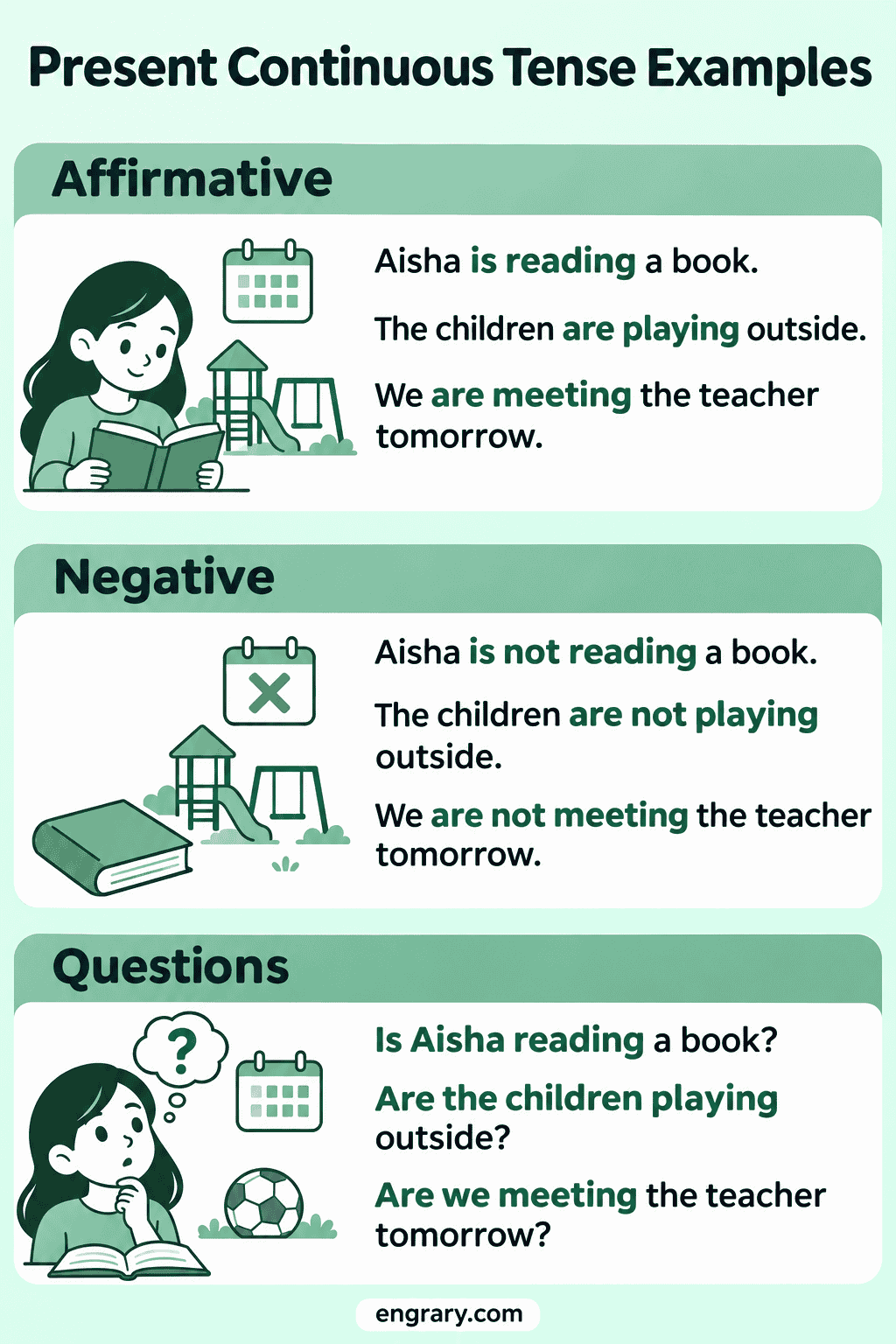
Present Continuous Tense Examples at a Glance
The present continuous, also called the present progressive, uses a present form of be followed by the -ing form of the main verb.
| Form | Structure | Supporting Example |
|---|---|---|
| Affirmative | Subject + am/is/are + verb-ing | She is studying. |
| Negative | Subject + am/is/are + not + verb-ing | She is not studying. |
| Yes-or-no question | Am/Is/Are + subject + verb-ing? | Is she studying? |
| Wh-question | Wh-word + am/is/are + subject + verb-ing? | What is she studying? |
| Subject question | Who/What + is + verb-ing? | Who is studying? |
| Short answer | Yes, subject + am/is/are. | Yes, she is. |
Use am after I, is after a singular third-person subject, and are after you, we, they, or a plural noun. Meanwhile, the main verb keeps the same -ing form with every subject.
25 Affirmative Present Continuous Tense Examples
Affirmative sentences follow subject + am/is/are + verb-ing. The examples below balance the three forms of be and cover current actions, temporary activities, changes, and arrangements.
Examples with I Am
- I am reading the instructions carefully.
- I’m preparing lunch for the children.
- I am learning how to use the new software.
- I’m staying with my cousins this week.
- I am meeting the dentist tomorrow morning.
Examples with He, She, and It Is
- He is repairing his bicycle in the garage.
- She is speaking to a customer on the phone.
- It is raining heavily outside.
- Ayesha is writing an email to her manager.
- The baby is sleeping peacefully.
- My brother is looking for a new apartment.
- The company is developing a mobile application.
- The dog is waiting beside the gate.
- Our teacher is explaining the final assignment.
- The weather is becoming warmer.
Examples with You, We, and They Are
- You are making excellent progress.
- We are discussing the travel arrangements.
- They are building a new health centre nearby.
- The children are drawing pictures in the classroom.
- My parents are visiting relatives this weekend.
- Ali and Sana are preparing for their presentation.
- The workers are installing new windows.
- We’re using the smaller meeting room today.
- You’re standing in the wrong queue.
- Several passengers are waiting for the next bus.
15 Negative Present Continuous Tense Examples
Place not after am, is, or are to make a negative sentence. In informal English, is not commonly becomes isn’t, while are not becomes aren’t.
- I am not watching television right now.
- I’m not using the office computer today.
- She is not attending the workshop.
- He isn’t wearing his glasses.
- The shop is not accepting card payments at the moment.
- We are not changing the schedule again.
- They aren’t travelling during the school holidays.
- The students are not taking an examination today.
- My sister isn’t staying with us this month.
- The children aren’t playing outside because it is raining.
- I’m not meeting the client tomorrow.
- The buses are not operating on this route today.
- Sara isn’t answering her phone.
- We aren’t using that system anymore.
- The neighbours are not making as much noise now.
15 Present Continuous Question Examples
To form a question, place am, is, or are before the subject. For a Wh-question, put the question word first.
Yes-or-No Questions
- Are you waiting for someone?
- Is Ahmed working from home today?
- Are the children sleeping?
- Is the train approaching the station?
- Are we meeting the right person?
- Is your sister studying medicine?
- Are they bringing their own equipment?
Wh-Questions
- What are you cooking for dinner?
- Where is Nadia staying this week?
- When are the guests arriving?
- Why is the baby crying?
- How are the students preparing for the competition?
Subject Questions
- Who is knocking at the door?
- What is causing the delay?
- Which student is presenting first?
In a subject question, who, what, or which student performs the action. Therefore, no separate subject appears after is.
10 Short Answers, Negative Questions, and Question Tags
Short answers repeat the correct form of be. Negative questions often express surprise, concern, or expectation, while question tags ask for confirmation.
Short Answers
- “Are you listening?” “Yes, I am.”
- “Is Hina working today?” “No, she isn’t.”
- “Are the children getting ready?” “Yes, they are.”
- “Is the printer working?” “No, it isn’t.”
Negative Questions
- Aren’t you coming with us?
- Isn’t she feeling well today?
- Aren’t they waiting outside?
Question Tags
- You’re working today, aren’t you?
- She isn’t joining us, is she?
- I’m speaking clearly, aren’t I?
Standard English normally uses aren’t I? as the question tag after I am.
15 Present Continuous Examples by Use
The present continuous expresses several related meanings. Context and time expressions help readers identify the intended use.
Actions Happening Now
- The doctor is examining a patient now.
- I am answering your question at the moment.
- Listen! Someone is calling your name.
Actions Happening Around Now
- She is reading a book about South Asian history.
- We are researching new ways to reduce waste.
These activities remain unfinished within the current period, although they may not be occurring at the exact second of speaking.
Temporary Situations and Habits
- My family is living in Lahore during the renovation.
- I am walking to work this week.
- The team is using a temporary office for now.
Changing and Developing Situations
- The city is becoming increasingly crowded.
- Her pronunciation is improving steadily.
- More businesses are offering remote work.
Definite Future Arrangements
- We are meeting the architect at three tomorrow.
- My parents are flying to Dubai next Friday.
Repeated Behavior with Emotional Emphasis
- He is always leaving his books on the floor.
- You are constantly helping people in need.
With words such as always and constantly, the present continuous can express annoyance, criticism, affection, surprise, or praise.
10 Present Continuous Examples in Short Dialogues
Context makes the purpose of the tense clearer. In each dialogue, the bold sentence is the numbered target example.
- “Where is Hamza?” “He is waiting outside.”
- “Why are you carrying an umbrella?” “It is raining.”
- “Can I speak to Amina?” “She is taking a short break.”
- “Why is the room so quiet?” “The students are taking a test.”
- “Are you free this afternoon?” “I’m meeting a client at two.”
- “Why can’t we use the main entrance?” “Workers are repairing the steps.”
- “Is Bilal coming to the conference?” “No, he is not attending this year.”
- “Why does your brother look tired?” “He is working night shifts this month.”
- “Why are food bills higher?” “Prices are rising quickly.”
- “Has Sara lost her keys again?” “Yes, she is always forgetting where she puts them.”
10 Passive and Advanced Present Continuous Examples
These examples demonstrate the continuous passive, temporary behavior with being, natural adverb placement, scene description, and coordinated actions.
Present Continuous Passive Examples
- The damaged road is being repaired.
- The applications are being reviewed by the committee.
- New safety equipment is being installed in the factory.
Temporary Behavior with Being
- You are being unusually quiet today.
- The children are being very patient.
Adverb Placement Examples
- She is still working on the report.
- They are constantly changing their plans.
Scene and Compound-Action Examples
- A woman is standing near the window and speaking on the phone.
- Two children are laughing and playing beside the fountain.
- The sun is setting behind the hills while birds are flying across the sky.
Present Continuous Examples by Meaning
The following supporting examples summarize the tense’s main uses. They do not form part of the numbered collection.
| Use | Supporting Example | Meaning |
|---|---|---|
| Happening now | She is talking on the phone. | The action is occurring now. |
| Around now | I am reading a historical novel. | The activity remains unfinished. |
| Temporary situation | We are staying with relatives. | The situation has a limited duration. |
| Temporary habit | I am taking the bus this week. | The repeated action is temporary. |
| Developing change | The weather is getting warmer. | A change is in progress. |
| Future arrangement | I am meeting Ali tomorrow. | The event has already been organized. |
| Emotional repetition | He is always losing his keys. | The speaker expresses an attitude. |
| Temporary behavior | She is being unusually patient. | The behavior differs from her usual character. |
Present Continuous Examples with Time Expressions
Time expressions help establish context. Nevertheless, they do not automatically determine the tense.
| Time Expression | Supporting Example |
|---|---|
| now | I am working now. |
| right now | She is speaking to the manager right now. |
| at the moment | They are waiting at the moment. |
| currently | We are currently reviewing the plan. |
| today | He is working from home today. |
| this week | I am taking the bus this week. |
| these days | More people are shopping online these days. |
| still | She is still studying. |
| tonight | We are meeting tonight. |
| tomorrow | They are flying tomorrow. |
Adverbs such as still, always, currently, probably, and definitely normally follow am, is, or are:
| Adverb | Natural Position | Supporting Example |
|---|---|---|
| still | after be | She is still working. |
| always | after be | He is always complaining. |
| constantly | after be | They are constantly arguing. |
| currently | after be or initially | She is currently studying abroad. |
| probably | after be | We are probably leaving early. |
| definitely | after be | I am definitely attending. |
Present Continuous Contractions
Contractions appear frequently in conversation and informal writing.
| Full Form | Contraction |
|---|---|
| I am | I’m |
| you are | you’re |
| he is | he’s |
| she is | she’s |
| it is | it’s |
| we are | we’re |
| they are | they’re |
| is not | isn’t |
| are not | aren’t |
Positive short answers normally retain the full auxiliary: Yes, she is sounds complete, whereas Yes, she’s does not.
Present-Participle Spelling Rules
Most verbs simply take -ing. However, several spelling patterns require a change.
| Pattern | Rule | Example |
|---|---|---|
| Most verbs | Add -ing | work → working |
| Final silent e | Remove e | write → writing |
| Final -ee | Keep both letters | see → seeing |
| Final -ie | Change ie to y | lie → lying |
| Short vowel + consonant | Double the final consonant | run → running |
| Final -c | Add k | panic → panicking |
| Unstressed final syllable | Do not normally double | open → opening |
Additional forms include die → dying, dye → dyeing, singe → singeing, and ski → skiing. British English commonly uses travelling, while American English usually uses traveling.
Subject Agreement in Present Continuous Sentences
The subject determines the correct auxiliary.
| Subject | Supporting Example |
|---|---|
| everyone | Everyone is waiting. |
| nobody | Nobody is listening. |
| each student | Each student is working. |
| one of the players | One of the players is leaving. |
| Ali and Hamza | Ali and Hamza are studying. |
| the people | The people are gathering outside. |
| the police | The police are investigating the case. |
Indefinite pronouns such as everyone, somebody, nobody, and each normally take is. In contrast, coordinated and plural subjects take are.
Present Continuous and Stative Verbs
Stative verbs describe knowledge, possession, preference, perception, or another state. Therefore, verbs such as know, understand, believe, want, need, prefer, own, and belong do not normally take continuous forms.
However, some verbs become dynamic when their meanings change.
| Stative Meaning | Dynamic Continuous Meaning |
|---|---|
| I think the idea is useful. | I am thinking about the idea. |
| She has a car. | She is having lunch. |
| The soup tastes salty. | The chef is tasting the soup. |
| He looks tired. | He is looking at the screen. |
| The parcel weighs two kilograms. | The assistant is weighing the parcel. |
Sense verbs also depend on meaning:
| Perception or State | Deliberate Action |
|---|---|
| I can see a bird. | I am seeing the dentist tomorrow. |
| I can smell smoke. | She is smelling the flowers. |
| The soup tastes salty. | The chef is tasting the soup. |
| The fabric feels soft. | The tailor is feeling the fabric. |
Present Continuous with Being
The form am/is/are being usually describes temporary or controllable behavior rather than a general characteristic.
| General Characteristic | Temporary Behavior |
|---|---|
| He is rude. | He is being rude today. |
| You are careless. | You are being careless. |
| Sara is helpful. | Sara is being especially helpful. |
| The children are quiet. | The children are being unusually quiet. |
Therefore, expressions such as I am being tall are normally incorrect because height is not temporary behavior.
Present Continuous and Present Simple Examples
| Present Simple | Present Continuous |
|---|---|
| She works at a bank. | She is working from home today. |
| I read before bed. | I am reading a new novel. |
| They live in Lahore. | They are staying in Lahore this month. |
| He is rude. | He is being rude today. |
| The train leaves at nine. | We are leaving at nine. |
| I think you are right. | I am thinking about your suggestion. |
The present simple generally describes habits, facts, permanent situations, and states. In contrast, the present continuous presents an activity or situation as ongoing, temporary, changing, or arranged.
Present Continuous for Future Arrangements
The present continuous can describe a definite personal arrangement with an agreed time, place, appointment, booking, or another person’s involvement. However, it does not express every type of future meaning.
| Future Form | Main Meaning | Supporting Example |
|---|---|---|
| Present continuous | Definite arrangement | I am meeting Ali at six. |
| Be going to | Prior intention | I am going to visit Ali soon. |
| Present simple | Fixed schedule | The train leaves at six. |
| Will | Spontaneous decision or prediction | I’ll call Ali now. |
The sequence am/is/are going to also requires careful interpretation:
| Sentence | Construction | Meaning |
|---|---|---|
| They are going to school now. | Present continuous of go | They are travelling to school. |
| They are going to study tonight. | Be going to future | They intend to study. |
| We are going to the market. | Present continuous of go | We are travelling to the market. |
| We are going to buy a car. | Be going to future | We intend to buy a car. |
Present Continuous Passive Examples
The present continuous passive uses am/is/are + being + past participle.
| Form | Structure | Supporting Example |
|---|---|---|
| Affirmative | Subject + am/is/are being + past participle | The road is being repaired. |
| Negative | Subject + am/is/are not being + past participle | The hall is not being used. |
| Question | Am/Is/Are + subject + being + past participle? | Is the equipment being tested? |
| Wh-question | Wh-word + am/is/are + subject + being + past participle? | Why is the road being closed? |
Similar-looking forms can have different meanings:
| Form | Supporting Example | Meaning |
|---|---|---|
| State or adjective | The shop is closed. | It is not open. |
| Simple passive | The shop is closed at nine. | Someone closes it regularly. |
| Present continuous passive | The shop is being closed now. | The closing action is in progress. |
Present Participle, Gerund, and Adjective Forms
Every -ing word is not part of the present continuous.
| Form | Function | Supporting Example |
|---|---|---|
| Present participle | Forms a continuous verb construction | She is swimming. |
| Gerund | Functions as a noun | Swimming is good exercise. |
| Adjective | Describes a person or thing | The lesson is confusing. |
| Modal continuous | Follows a modal and be | She may be working. |
Compare the action and adjective meanings:
| Present Continuous Action | Adjective |
|---|---|
| The teacher is boring the students. | The teacher is boring. |
| The film is frightening the children. | The film is frightening. |
| The lesson is confusing the class. | The lesson is confusing. |
Modal continuous forms such as may be working and could be waiting are useful supporting constructions, but they are not counted among the 100 standard present continuous examples.
Common Mistakes with Present Continuous Examples
| Incorrect | Correct | Explanation |
|---|---|---|
| She working now. | She is working now. | Add a form of be. |
| They is waiting. | They are waiting. | Use are with a plural subject. |
| Everyone are leaving. | Everyone is leaving. | Everyone takes singular agreement. |
| I am work today. | I am working today. | Use the -ing form. |
| He is runing. | He is running. | Double the final consonant. |
| She is writeing. | She is writing. | Remove the final silent e. |
| He is lieing down. | He is lying down. | Change final ie to y. |
| She is knowing the answer. | She knows the answer. | Know is normally stative. |
| Where you are going? | Where are you going? | Invert the auxiliary and subject. |
| Do they are working? | Are they working? | Do not add do. |
| The road is repairing. | The road is being repaired. | Use the continuous passive structure. |
| She may is working. | She may be working. | Use be after a modal. |
| I am meet Sara tomorrow. | I am meeting Sara tomorrow. | Use the present participle. |
Tips for Learning from the Examples
- Identify the subject and its matching form of be.
- Notice how each main verb changes to its -ing form.
- Compare full forms with contractions.
- Observe where not appears in negative sentences.
- Notice the word order in questions.
- Identify the meaning expressed by each example.
- Compare temporary situations with permanent facts.
- Pay attention to definite future arrangements.
- Distinguish dynamic verbs from stative verbs.
- Separate genuine present continuous forms from gerunds, adjectives, and modal continuous constructions.
- Use the dialogues to understand why the tense fits the context.
FAQs
Examples include I am reading a book, She is preparing dinner, They are waiting outside, and We are meeting the manager tomorrow. These sentences describe an action happening now, a current unfinished activity, a temporary situation, or a definite future arrangement.
Use subject + am/is/are + verb-ing. Choose am after I, is after a singular third-person subject, and are after you, we, they, or a plural noun. For example, compare I am working, Sara is working, and The students are working.
Add not after am, is, or are to make a negative sentence, as in She is not working. To make a question, place the auxiliary before the subject: Is she working? The main verb remains in its -ing form in both structures.
Yes. The present continuous can describe a definite future arrangement that has already been organized, especially when the sentence includes a specific time, place, appointment, booking, or agreement. For example, We are meeting the designer at three tomorrow describes an arranged event.
Stative verbs such as know, understand, believe, want, need, prefer, own, and belong do not normally take continuous forms. However, some verbs can take the present continuous when their meanings become dynamic. For example, I think you are right expresses an opinion, while I am thinking about the problem describes an active process.
You May Also Like
- Present Tense in English
- Present Tense Examples
- Past Tense in English
- Past Tense Examples in Sentences
- Future Tense in English
- Future Tense Examples in Sentences
- Simple Tenses in English
- Simple Tenses Examples
- Continuous Tenses in English
- Continuous Tenses Examples
- Perfect Tenses in English
- Perfect Tenses Examples


Leave a Comment