
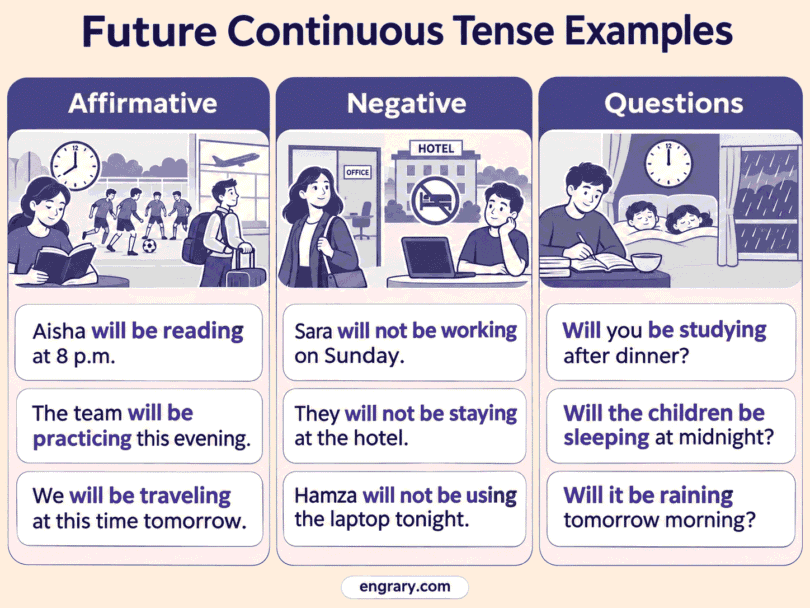
The future continuous tense describes an action or situation that will be in progress at a particular time in the future. It uses will be followed by the -ing form of the main verb, as in I will be working, she will be travelling, and they will be waiting. The tense presents an activity as it will be unfolding rather than as a complete future event.
Below are 125 future continuous tense examples organized by sentence form and use. They include affirmative sentences, negatives, questions, time clauses, simultaneous activities, temporary situations, expected events, polite inquiries, formal announcements, present assumptions, and repeated behavior. In addition, concise tables explain structures, spelling rules, comparisons, and common mistakes.
Common Future Continuous Tense Examples
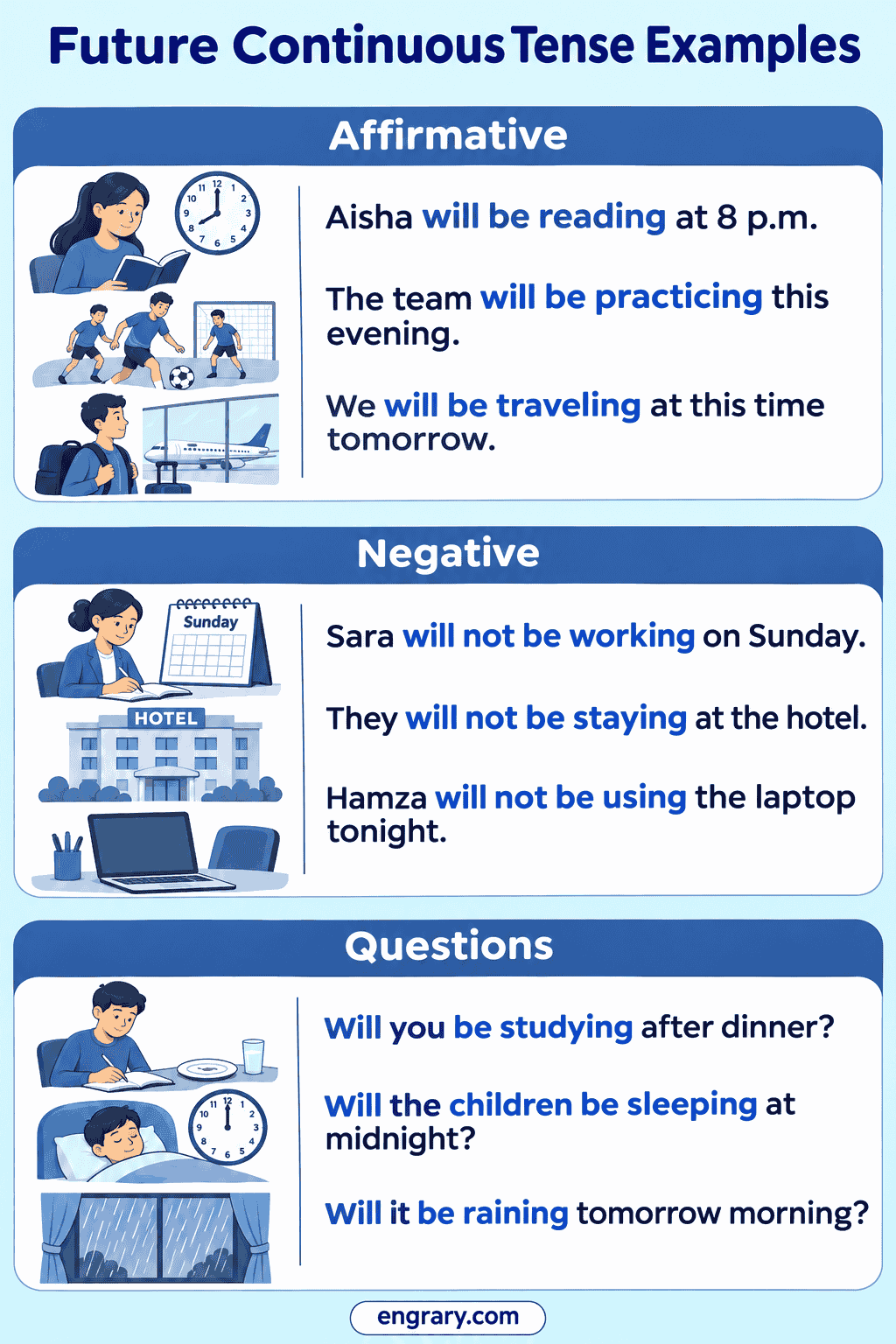
These familiar examples show the tense in everyday contexts. Each bold phrase contains will be + verb-ing or its contracted form.
- I will be working from home tomorrow.
- She will be travelling this time next week.
- They will be waiting near the main entrance.
- We will be having dinner at eight.
- Ali will be studying in the library this afternoon.
- The children will be sleeping when we return.
- My phone will be charging beside the desk.
- The team will be practising after school.
- It will be raining throughout the evening.
- You will be using the new computer tomorrow.
- I won’t be driving to work next week.
- Sara won’t be attending the meeting.
- The shops will not be opening early tomorrow.
- Will you be staying for dinner?
- Will they be joining us at the restaurant?
- What will you be doing at noon?
- Where will she be working next month?
- I will be preparing lunch when you arrive.
- While we are travelling, the guide will be answering our questions.
- This time tomorrow, the plane will be crossing the Arabian Sea.
Future Continuous Structure
The future continuous, also called the future progressive, combines the modal will, the base form be, and a present participle.
| Form | Structure | Example |
|---|---|---|
| Affirmative | Subject + will be + verb-ing | She will be studying. |
| Negative | Subject + will not be + verb-ing | She will not be studying. |
| Yes-or-no question | Will + subject + be + verb-ing? | Will she be studying? |
| Wh-question | Wh-word + will + subject + be + verb-ing? | Where will she be studying? |
Because will is a modal verb, it remains the same with every subject. Traditional grammar sometimes uses shall be with I and we, but will be is now more common in everyday English.
A useful extended pattern is:
Subject + will + adverb + be + verb-ing + object + place + time
For example, She will probably be meeting the client at the office tomorrow morning.
Contractions with Will and Won’t
| Full form | Contraction |
|---|---|
| I will | I’ll |
| you will | you’ll |
| he will | he’ll |
| she will | she’ll |
| we will | we’ll |
| they will | they’ll |
| will not | won’t |
Use ’ll with affirmative forms and won’t for will not: I’ll be working and I won’t be working.
Present-Participle Spelling Rules
| Rule | Base verb | Present participle |
|---|---|---|
| Add -ing | work | working |
| Remove final silent e | write | writing |
| Keep e in -ee verbs | see | seeing |
| Change -ie to -y | lie | lying |
| Double the final consonant when required | run | running |
| Do not normally double w, x, or y | snow | snowing |
British English commonly uses travelling, whereas American English commonly uses traveling. Both forms are correct within their respective spelling systems.
Affirmative Future Continuous Examples
Affirmative sentences show an activity expected to be in progress at a future time.
- I will be writing the monthly report tomorrow morning.
- Amina will be making tea for the visitors.
- Bilal will be running in the city marathon on Sunday.
- The manager will be explaining the new policy at noon.
- We will be discussing the budget after lunch.
- The mechanic will be checking the engine this afternoon.
- My cousins will be staying with us during the holidays.
- The train will be moving through the mountains at sunrise.
- I will be listening to the lecture online.
- The chef will be tasting each dish before service.
- Several customers will be browsing the new collection.
- She will be lying beside the pool this time tomorrow.
- The wind will be blowing strongly near the coast.
- Our players will be training at the stadium all morning.
- More families will be choosing digital payment methods.
The tense does not require a long activity. Even a brief event can appear in the future continuous when the speaker views it as ongoing at a future moment.
Negative Future Continuous Examples
Place not between will and be. In everyday English, won’t be usually sounds more natural than will not be.
- I will not be expecting any visitors tomorrow.
- She won’t be wearing her uniform on Saturday.
- The printer won’t be producing copies during maintenance.
- We will not be using the conference room this week.
- They won’t be waiting at the old bus stop.
- You won’t be driving during the night.
- The children will not be sleeping when the fireworks begin.
- He won’t be carrying much luggage.
- My laptop will not be downloading updates during the presentation.
- The players won’t be following their usual training schedule.
- I won’t be looking for another apartment next month.
- The company will not be hiring additional staff this winter.
- Fatima won’t be travelling with the group.
- The birds won’t be nesting here after the trees are removed.
- Our neighbours will not be holding their annual celebration this year.
The form will be not working is unnatural in standard English. Use will not be working instead.
Yes-or-No Question Examples
Place will before the subject.
- Will your brother be working at the shop tomorrow?
- Will the teacher be explaining the final assignment?
- Will it be snowing when the flight lands?
- Will Mariam be waiting outside the clinic?
- Will the machine be making that noise after the repair?
- Will you be watching the match tonight?
- Will the guests be enjoying live music during dinner?
- Will we be travelling in the same vehicle?
- Will the technicians be testing the software overnight?
- Will those children be playing in the tournament?
Short answers repeat will, not be or the main verb.
| Question | Affirmative answer | Negative answer |
|---|---|---|
| Will Aisha be studying? | Yes, she will. | No, she won’t. |
| Will they be travelling? | Yes, they will. | No, they won’t. |
Negative questions and question tags provide additional conversational patterns:
- Won’t you be attending the ceremony?
- You will be attending, won’t you?
- She won’t be driving, will she?
Wh-Question Examples
For most information questions, place the Wh-word before will. When who or what asks about the subject, no additional subject appears.
- What will you be reading on the flight?
- Where will the driver be taking the visitors?
- Why will your sister be leaving the event early?
- When will they be returning from Lahore?
- Who will be leading the training session?
- Who will you be travelling with?
- What will be causing the temporary road closure?
- What will he be looking for in the archive?
- Which company will they be working with?
- How will the patient be receiving treatment at home?
| Question type | Supporting example | Requested information |
|---|---|---|
| Subject question | Who will be leading the meeting? | The person performing the action |
| Object question | Who will you be meeting? | The person receiving the action |
Questions can naturally end in prepositions: Which hotel will they be staying at? and What project will she be working on?
Future Time-Clause Examples
After when, while, before, after, until, and as soon as, English normally uses a present form rather than will in the dependent clause.
- I will be working when you arrive.
- She will be sleeping while we are travelling.
- They will be waiting until the office opens.
- We will be eating after the guests arrive.
- The staff will be preparing the hall before the ceremony begins.
- As soon as the store opens, customers will be entering through the main doors.
- The children will be playing outside while their parents prepare lunch.
- When the sun rises, the climbers will be approaching the summit.
- Before you call, I will be attending a workshop.
- After the match ends, supporters will be leaving the stadium.
The reference event does not necessarily interrupt the continuing activity. In I will be working when you arrive, the arrival simply identifies a point during the work.
Punctuation depends on clause order:
- When you arrive, I will be working.
- I will be working when you arrive.
Use a comma when the dependent clause comes first. Usually, no comma is needed when it follows the main clause.
Conditional clauses follow a similar future-reference pattern:
- If you arrive at six, I will be working.
- Unless she calls first, we will be waiting outside.
Simultaneous Future Action Examples
These sentences show activities that will overlap during the same future period.
- While I am cooking, my brother will be setting the table.
- The children will be drawing while their teacher reads a story.
- I will be taking notes while the trainer demonstrates the equipment.
- While customers are shopping, assistants will be arranging new displays.
- The band will be performing as the audience enters the hall.
- We will be discussing the route while the driver checks the map.
- As the sun rises, fishermen will be returning to the shore.
- My parents will be preparing dinner while I help my younger brother.
The actions only need to overlap; they do not need to start or finish at exactly the same time.
Expected Event and Routine Examples
The future continuous can describe an event expected as part of a routine, schedule, arrangement, or normal process.
- The manager will be meeting clients throughout the morning.
- New employees will be completing their training next week.
- Our technicians will be checking the servers every night.
- The delivery team will be calling customers before arrival.
- Teachers will be reviewing examination papers during the break.
- Security officers will be monitoring the entrance throughout the event.
- The maintenance crew will be inspecting the lifts on Monday.
- Each department will be submitting its report at the end of the month.
This use sounds neutral because it presents the activity as expected rather than as a new decision.
Temporary Situation and Future-Trend Examples
The future continuous can describe a temporary future arrangement or a predicted development.
- I will be living with my aunt while my apartment is renovated.
- She will be working at a bookshop during the summer.
- The company will be using a rented office for three months.
- He will be taking the bus while his car is repaired.
- Temperatures will be rising throughout the week.
- More employees will be working remotely in the coming years.
- Businesses will be adopting automated systems more widely.
Expressions such as all morning and throughout the week emphasize duration, but they do not prove that an activity will remain unfinished.
Polite Question Examples
The future continuous often asks about an existing plan without directly requesting willingness.
- Will you be using the car tonight?
- Will you be staying for dinner?
- Will you be visiting the office tomorrow?
- Will you be bringing anyone with you?
- Will your family be joining us for lunch?
- Will the director be attending the reception?
| Future continuous | Future simple |
|---|---|
| Will you be using the car? | Will you use the car? |
| Asks about an expected plan | Can ask about willingness |
| Will you be staying for dinner? | Will you stay for dinner? |
| Neutral inquiry | Can sound like an invitation |
Announcement and Service Examples
Organizations often use the future continuous for events that form part of an organized process.
- Passengers will be boarding through Gate 7 shortly.
- The train will be arriving at Platform 4 in five minutes.
- You will be receiving a confirmation email within 24 hours.
- A representative will be contacting you tomorrow.
- Our engineers will be performing scheduled maintenance tonight.
- The courier will be delivering your order between two and four.
This usage often sounds professional and reassuring in announcements, customer service, and business communication.
Present-Assumption Examples
The form can express a confident assumption about an activity probably happening now.
- Don’t call Sara now; she’ll be sleeping.
- Ahmed will be travelling home at the moment.
- The children will be having lunch now.
- The manager will be speaking to the new employees.
- Our guests will be waiting in the hotel lobby by now.
Here, will expresses probability or confident expectation, while the continuous form presents the assumed activity as ongoing.
Repeated Future Behavior Examples
With always, constantly, or continually, the future continuous can add annoyance, criticism, affection, or admiration.
- He will always be forgetting his password.
- They will constantly be asking for progress reports.
- She will always be helping new employees.
- The children will continually be looking for new games.
- My grandfather will forever be telling us stories about his travels.
| Sentence | Effect |
|---|---|
| He will forget his password again. | Prediction about one event |
| He will always be forgetting his password. | Repeated behavior with emotional emphasis |
Adverb Placement
Adverbs of probability, continuation, and frequency commonly appear after will and before be.
| Adverb | Supporting example |
|---|---|
| still | She will still be working. |
| probably | They will probably be waiting. |
| always | He will always be complaining. |
| just | We will just be finishing dinner. |
| definitely | I will definitely be attending. |
Manner adverbs usually follow the main verb or its object: She will be working quietly and They will be checking the figures carefully.
Stative and Dynamic Verb Examples
Stative meanings usually avoid continuous forms. Therefore, I will know the result sounds more natural than I will be knowing the result.
However, some verbs can appear in the future continuous when their meanings become dynamic.
| Stative meaning | Dynamic meaning |
|---|---|
| I will think the plan is sensible. | I will be thinking about the plan. |
| She will have enough time. | She will be having lunch. |
| He will see the mountains. | He will be seeing a specialist. |
| The parcel will weigh five kilograms. | The assistant will be weighing the parcel. |
Informal speech and advertising sometimes use continuous stative forms for emphasis, but learners should master the standard patterns first.
Completion and Ongoing Viewpoint
The future continuous does not confirm completion. It focuses on an activity in progress at a future reference point.
| Future continuous | Future perfect |
|---|---|
| I will be reading the report at eight. | I will have read the report by eight. |
| Reading will be in progress | Reading will be complete |
| She will be writing the article. | She will have written the article. |
| Focuses on the activity | Focuses on the result |
The distinction between at and by is therefore important:
| Expression | Meaning | Example |
|---|---|---|
| at eight | At that exact time | I will be working at eight. |
| by eight | Before or no later than eight | I will have finished by eight. |
Future Continuous and Present Continuous
| Future continuous | Present continuous |
|---|---|
| I will be meeting the director tomorrow. | I am meeting the director tomorrow. |
| Expected activity | Firm arrangement |
| She will be flying next week. | She is flying next week. |
| Neutral expectation | Organized personal plan |
Future Continuous and Present Simple
| Future continuous | Present simple |
|---|---|
| The train will be arriving at six. | The train arrives at six. |
| Expected event or announcement | Official timetable |
| The conference will be starting shortly. | The conference starts at nine. |
| Focuses on the approaching event | States the scheduled time |
Future Continuous and Going To
| Future continuous | Going to |
|---|---|
| We will be staying near the beach. | We are going to stay near the beach. |
| Neutral or expected activity | Existing plan or intention |
| It will be raining later. | It is going to rain. |
| Predicted activity in progress | Prediction based on present evidence |
English also uses am/is/are going to be + verb-ing, but those forms are not part of the 125 standard will be + verb-ing examples.
Future Continuous and Future Perfect Continuous
| Future continuous | Future perfect continuous |
|---|---|
| At noon, she will be working. | At noon, she will have been working for four hours. |
| Activity at a future point | Duration leading to that point |
| They will be waiting at ten. | They will have been waiting for two hours by ten. |
| Shows what will be happening | Shows how long it will have continued |
Related Continuous Constructions
Forms with other modal verbs can describe possible ongoing future activities, but they are not standard future continuous forms with will.
| Form | Example | Meaning |
|---|---|---|
| Future continuous | She will be working tomorrow. | Expected activity |
| Modal continuous | She may be working tomorrow. | Possible activity |
| Modal continuous | They might be travelling tonight. | Uncertain activity |
Reported speech commonly changes will be doing to would be doing:
| Direct statement | Reported statement |
|---|---|
| “I will be working late.” | She said that she would be working late. |
| “We will be travelling tomorrow.” | They said that they would be travelling the next day. |
These related constructions remain outside the numbered total.
Future Continuous Passive
The passive form follows this structure:
will be being + past participle
Although grammatical, it often sounds cumbersome.
| Awkward continuous passive | Natural alternative |
|---|---|
| The road will be being repaired. | Workers will be repairing the road. |
| The hall will be being decorated. | Staff will be decorating the hall. |
| The building will be being renovated. | The building will be under renovation. |
Therefore, the article’s 125 core examples use natural active constructions.
Common Mistakes with Future Continuous Sentences
| Incorrect | Correct | Explanation |
|---|---|---|
| She will be work tomorrow. | She will be working tomorrow. | Use the -ing form after be. |
| They will working at eight. | They will be working at eight. | Include be after will. |
| Will be you travelling? | Will you be travelling? | Place the subject after will. |
| I won’t working tonight. | I won’t be working tonight. | Keep be in the negative form. |
| When you will arrive, I will be sleeping. | When you arrive, I will be sleeping. | Use a present form in the time clause. |
| If she will call, I will be waiting. | If she calls, I will be waiting. | Use a present form for a normal condition. |
| I will be knowing the answer. | I will know the answer. | Know is normally stative. |
| She will be writeing. | She will be writing. | Remove the final silent e. |
| He will be lieing down. | He will be lying down. | Change -ie to -y. |
Practical Tips for Using the Examples
- First, locate will, be, and the following -ing verb.
- Next, identify the future reference point or surrounding context.
- Use will be + verb-ing with every subject.
- Place not between will and be.
- Move will before the subject in questions.
- Use a present form after future time conjunctions.
- Avoid continuous forms with stative meanings.
- Use the future continuous for neutral inquiries about expected plans.
- Choose the future perfect when completion matters.
- Finally, keep modal and reported constructions separate from standard future continuous examples.
FAQs
Examples include I will be working at eight, she will be travelling tomorrow, and they will be waiting outside. Every standard future continuous construction contains will be followed by a present participle. The tense presents the activity as ongoing or expected at a future reference time.
Use subject + will be + verb-ing for an affirmative sentence. Place not after will for a negative sentence: She will not be working. To form a question, move will before the subject: Will she be working? The modal will remains unchanged with every subject.
Examples include I won’t be driving tomorrow, she will not be attending the meeting, and they won’t be waiting outside. In every negative sentence, not appears between will and be, while the main verb stays in its -ing form.
Examples include Will you be working tomorrow?, Where will she be staying?, and Who will be leading the meeting? Yes-or-no questions place will before the subject. Most Wh-questions begin with a question word, although subject questions do not add another subject.
Time clauses beginning with when, while, before, after, until, and as soon as normally use a present form even when they refer to the future. For example, write I will be working when you arrive, not when you will arrive. The main clause can still use the future continuous.
You May Also Like

Leave a Comment