
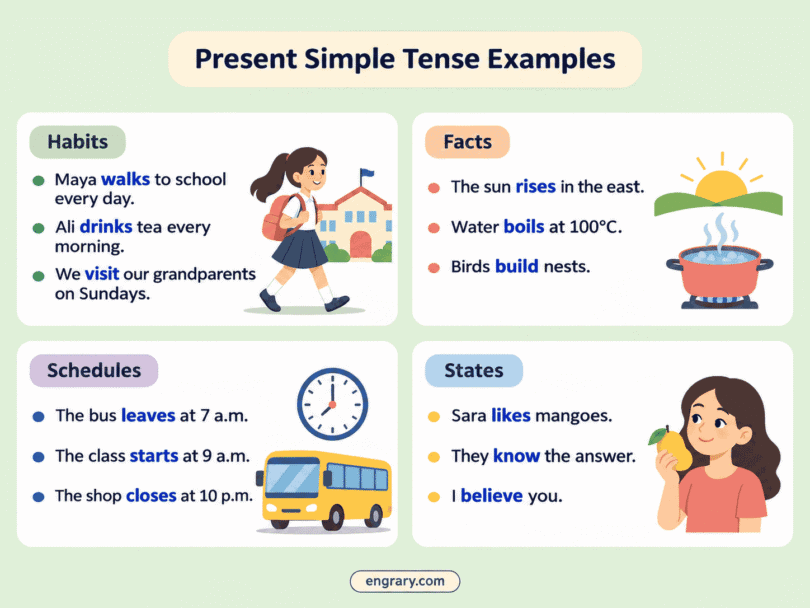
Present simple tense examples show how English describes habits, routines, repeated actions, facts, states, and fixed schedules. Most sentences use the base form of the verb. However, verbs with he, she, it, and singular noun subjects usually take an -s or -es ending.
Below are 150 present simple examples divided into affirmative sentences, negative sentences, questions, forms with am, is, and are, and examples for common uses. In addition, comparison and correction tables explain third-person agreement, stative verbs, future time clauses, passive forms, and other important patterns.
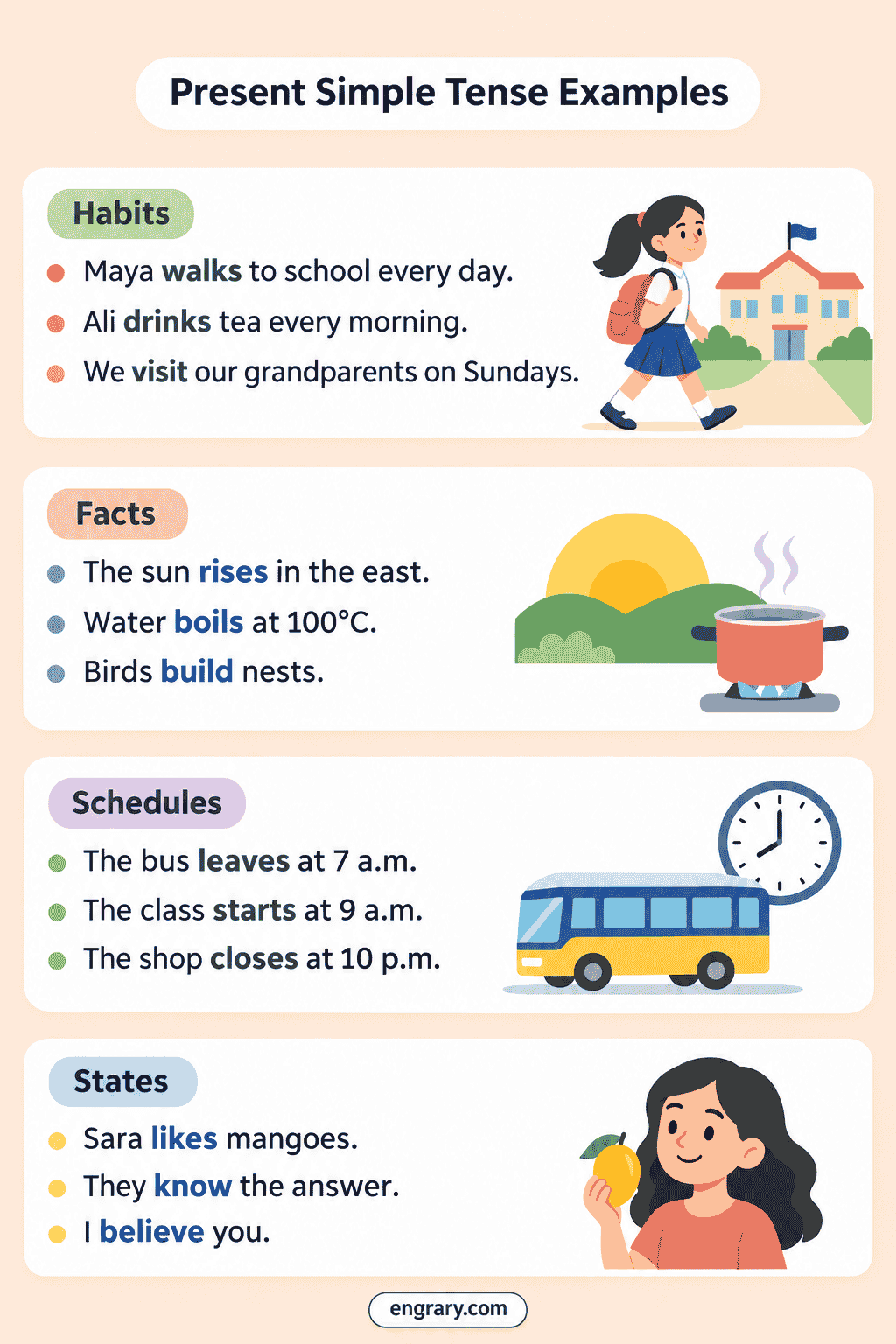
Present Simple Tense Examples at a Glance
The present simple, also called the simple present, places an action or situation in the general present. Some learners also call it the present indefinite tense. The following table previews its main forms.
| Sentence form | Structure | Example |
|---|---|---|
| Affirmative | Subject + base verb/verb-s | She walks to school. |
| Negative | Subject + don’t/doesn’t + base verb | She doesn’t walk to school. |
| Question | Do/Does + subject + base verb? | Does she walk to school? |
| Affirmative with be | Subject + am/is/are | She is at school. |
| Negative with be | Subject + am/is/are not | She isn’t at school. |
| Question with be | Am/Is/Are + subject? | Is she at school? |
The auxiliary does already carries the third-person singular marker. Therefore, the main verb stays in its base form after does or doesn’t: Does she walk? and She doesn’t walk.
Affirmative Present Simple Tense Examples
Affirmative sentences use the base verb with I, you, we, and they. However, they normally add -s or -es when the subject is he, she, it, or a singular noun.
- I check my email after breakfast.
- You speak English with confidence.
- We share an office near the station.
- They grow fresh vegetables in their garden.
- My parents visit us every weekend.
- In addition, our teachers prepare detailed lesson plans.
- I prefer tea without sugar.
- You look happy today.
- We need more chairs for the meeting.
- The children play in the park after school.
- Hamza drives to work each morning.
- Moreover, Ayesha teaches science at a local school.
- My brother watches the evening news.
- The mechanic fixes bicycles and motorcycles.
- Sana studies computer science at university.
- This company supplies equipment to hospitals.
- The baby cries when she feels hungry.
- My cousin enjoys historical novels.
- Bilal plays cricket on Friday afternoons.
- The road goes through three small villages.
- Our manager has an office on the second floor.
- Farah does the accounts every Thursday; meanwhile, her assistant files the receipts.
- This key opens the side entrance.
- The bakery sells fresh bread throughout the day.
- My phone connects to the network automatically.
- The river flows past the old fort before it reaches the sea.
- Although the shop is small, it offers a wide range of products.
- The new system saves time, so the staff finish their work earlier.
- I do appreciate your honest advice.
- She does understand the importance of the decision.
Third-Person Singular Spelling
Third-person spelling depends on the final letters of the base verb.
| Rule | Verb change | Example |
|---|---|---|
| Add -s to most verbs | work → works | Hamza works nearby. |
| Add -es after -s, -ss, -sh, -ch, -x, or -o | watch → watches | She watches the news. |
| Change consonant + y to -ies | study → studies | Amina studies biology. |
| Add -s after vowel + y | play → plays | He plays cricket. |
| Use an irregular form | have → has | The room has two windows. |
The ending has three common pronunciations: /s/ in works, /z/ in plays, and /ɪz/ in watches. In addition, does sounds like /dʌz/, while says sounds like /sez/.
Negative Present Simple Tense Examples
Use do not or don’t with I, you, we, and they. Use does not or doesn’t with he, she, it, and singular noun subjects. Most importantly, use the base verb after doesn’t.
- I don’t drink coffee after dinner.
- You do not need an appointment today.
- The card reader works reliably; therefore, we don’t accept cash at this counter.
- They don’t watch television during meals.
- My friends do not live in this neighborhood.
- We often exchange messages; however, I don’t remember his new address.
- We don’t usually order food during the week.
- The children don’t walk home when it rains.
- She doesn’t drive to work because the bus is more convenient.
- Ahmed does not speak French.
- My sister doesn’t like spicy food.
- The printer doesn’t make much noise.
- This road does not lead to the airport.
- The library doesn’t open on public holidays.
- He doesn’t have a driving licence; therefore, he takes the bus.
- Mariam doesn’t do the shopping on weekdays.
- The medicine doesn’t contain added sugar.
- Our teacher doesn’t give homework on Fridays.
- I never arrive late for an interview.
- Nobody understands why the machine stops.
Words such as never, nobody, and nothing already express a negative meaning. Therefore, standard English does not normally add another negative.
| Incorrect | Correct |
|---|---|
| I don’t never arrive late. | I never arrive late. |
| She doesn’t rarely complain. | She rarely complains. |
| Nobody doesn’t understand. | Nobody understands. |
Present Simple Tense Question Examples
Most present simple questions place do or does before the subject. Nevertheless, subject questions use the main verb directly because the question word acts as the subject.
- Do you work near the city centre?
- Do they deliver orders on weekends?
- Do we have enough time to catch the train?
- Does your brother play a musical instrument?
- Does Hina know the answer?
- Does this bus stop near the railway station?
- Where do your parents live?
- When does the supermarket close?
- Why do these lights flash at night?
- How does this application protect user data?
- How often do you exercise?
- Which language does your teacher speak at home?
- What time does the first lesson begin?
- Who teaches the afternoon class?
- What causes this error message?
- Which bus goes to the airport?
- Who does the manager meet every Monday?
- What do the students need for the experiment?
- Don’t you recognize that building?
- Doesn’t Ali work with your cousin?
- Do you enjoy classical music? — Yes, I do.
- Do they own this apartment? — No, they don’t.
- Does she drive to college? — Yes, she does.
- Does the hotel serve breakfast? — No, it doesn’t.
- You live nearby, don’t you?
Subject and Object Questions
Subject questions do not normally use do or does. By contrast, object questions require an auxiliary.
| Question type | Example | Explanation |
|---|---|---|
| Subject question | Who teaches this class? | Who performs the action. |
| Object question | Who does the teacher help? | The teacher performs the action. |
| Subject question | What causes the problem? | What is the subject. |
| Object question | What does the problem affect? | The problem is the subject. |
Present Simple Examples with Am, Is, and Are
The verb be forms negatives and questions without do or does. Instead, use am, is, or are directly.
- I prepare carefully; therefore, I am ready for the presentation.
- You are very patient with new learners.
- She is a skilled graphic designer.
- The weather is pleasant this morning.
- We are responsible for customer support.
- They are in the conference room.
- I am not available after six.
- He isn’t at home right now.
- This seat is not free.
- The shops aren’t open on Sundays.
- Am I in the correct classroom?
- Is your sister a doctor?
- Are the children ready for school?
- There is a pharmacy beside the hospital.
- There are three messages for you.
Common contractions include I’m, you’re, he’s, she’s, it’s, we’re, and they’re. Negative forms include isn’t and aren’t. However, standard English uses I’m not rather than amn’t.
Present Simple Examples for Habits and Routines
Frequency adverbs and repeated-time expressions commonly accompany habits. Usually, the adverb comes before a main verb but after the verb be.
- I wake up at six every weekday.
- Sara usually walks to college; however, she takes the bus when it rains.
- We eat dinner together every evening.
- My father often reads before bed.
- They clean the office twice a week.
- Hassan sometimes takes the early bus.
- Our family visits the countryside once a month.
- She rarely misses a class because she plans her mornings carefully.
- The children are always hungry after football practice.
- From time to time, I work at the public library instead.
Position of Frequency Adverbs
| Pattern | Example |
|---|---|
| Before a main verb | She usually walks to work. |
| After be | She is usually punctual. |
| After don’t or doesn’t | He doesn’t often travel. |
| After the subject in questions | Do you often cook at home? |
Present Simple Examples for Facts, Truths, and States
The present simple describes scientific facts, generally accepted truths, opinions, feelings, possession, and stable situations. It also appears with stative verbs such as know, believe, prefer, belong, and seem.
- The Earth moves around the Sun.
- Water boils at 100°C at sea level.
- Similarly, a triangle has three sides in every standard geometric example.
- Plants need light and water to grow.
- I believe your explanation because the evidence is clear.
- This blue bag belongs to my sister.
- Everyone needs encouragement sometimes.
- One of my closest friends lives in Islamabad.
- The information seems accurate; therefore, we can use it in the report.
- The news sounds encouraging, although the final decision remains uncertain.
Difficult Subject–Verb Agreement Patterns
| Subject pattern | Correct example |
|---|---|
| Indefinite pronoun | Nobody knows the answer. |
| Each + singular noun | Each student receives a certificate. |
| One of + plural noun | One of the windows needs repair. |
| Uncountable noun | The equipment costs a lot. |
| Plural-looking singular noun | Mathematics requires careful thinking. |
| Compound subject | Ali and Sana work together. |
| Amount viewed as one unit | Ten dollars is enough. |
Present Simple Examples for Schedules and Future Clauses
Use the present simple for events controlled by a timetable or official program. In addition, use it after future time conjunctions such as when, before, after, until, and as soon as.
- The first train leaves at 6:15 tomorrow morning.
- Our flight lands shortly before midnight.
- The new semester begins next Monday.
- The gallery remains open until six; meanwhile, the museum closes at five this afternoon.
- The conference starts on 12 December.
- I will message you when I arrive.
- We will eat after Dad comes home.
- Please submit the form before the office closes.
- She will wait until the rain stops.
- We will begin as soon as everyone is ready.
The future meaning comes from the whole sentence, not from a future verb inside the time clause. Therefore, write I will call when I arrive, not I will call when I will arrive.
Present Simple Examples for Other Important Uses
The present simple also appears in instructions, zero conditionals, stories, sports commentaries, headlines, formal reports, and speech acts.
- First, you open the settings menu.
- Next, you select your account and enter the verification code.
- Then, the application checks your information automatically.
- Finally, you press the green button to confirm the payment.
- You turn left at the traffic lights, and the road continues toward the station.
- If you heat ice, it melts.
- Plants die if they do not receive enough water.
- If I drink coffee late, I sleep badly.
- When the alarm rings, the doors lock automatically.
- The detective enters the room and notices the broken window.
- In the final chapter, the hero returns to his village.
- Khan passes the ball, Ali shoots, and the crowd cheers.
- Local Company Opens New Research Centre.
- The report states that demand remains strong.
- I apologize for the delay, and I promise to review your request today.
In directions, a sentence such as You turn left at the lights uses the present simple. By contrast, the direct command Turn left at the lights uses the imperative.
Present Simple Passive Voice Examples
The present simple passive uses am, is, or are followed by a past participle. Use it when the action, process, or result deserves more attention than the performer.
- English is spoken in many countries.
- Fresh bread is baked here every morning.
- The office is cleaned after working hours.
- Customer information is stored on secure servers.
- These bottles are made from recycled plastic.
- All applications are reviewed by the admissions team.
- The bills are paid online at the end of each month.
- Lunch is not served after three o’clock.
- This medicine isn’t recommended for young children.
- Personal devices aren’t allowed inside the laboratory.
- Is the building inspected every year?
- Is breakfast included in the room price?
- Are the orders checked before delivery?
- Are these rooms used for evening classes?
- Why is this door kept locked during the day?
| Passive form | Structure | Example |
|---|---|---|
| Affirmative | Subject + am/is/are + past participle | The office is cleaned daily. |
| Negative | Subject + am/is/are not + past participle | The office isn’t cleaned on Sundays. |
| Question | Am/Is/Are + subject + past participle? | Is the office cleaned daily? |
Present Simple and Present Continuous Examples
The present simple normally describes routines, states, facts, and stable situations. By contrast, the present continuous describes temporary actions, developing situations, and activities happening around now.
| Present simple | Present continuous | Difference |
|---|---|---|
| I work from home every Friday. | I am working from home today. | Routine versus temporary situation |
| She reads before bed. | She is reading now. | Habit versus action in progress |
| They live in Lahore. | They are staying in Lahore this month. | Stable situation versus temporary stay |
| The bus leaves at eight. | We are leaving at eight. | Official schedule versus personal arrangement |
| He thinks the plan is risky. | He is thinking about the plan. | Opinion versus mental activity |
Stative Verbs with Changing Meanings
Some verbs can describe either a state or an activity. Consequently, their meaning determines which tense fits.
| Present simple state | Present continuous activity |
|---|---|
| I think the plan is useful. | I am thinking about the plan. |
| She has a new laptop. | She is having lunch. |
| This soup tastes salty. | The chef is tasting the soup. |
| I see your point. | I am seeing the dentist tomorrow. |
| The box weighs five kilograms. | The clerk is weighing the box. |
| He appears confident. | He is appearing in a new play. |
Common Errors in Present Simple Sentences
Many mistakes occur because learners add two third-person markers or use the wrong auxiliary. The following table shows the correct patterns.
| Incorrect | Correct | Explanation |
|---|---|---|
| She work here. | She works here. | Add -s with a third-person singular subject. |
| He don’t drive. | He doesn’t drive. | Use doesn’t with he, she, and it. |
| She doesn’t likes tea. | She doesn’t like tea. | Use the base verb after doesn’t. |
| Does he works here? | Does he work here? | Use the base verb after does. |
| Do she know you? | Does she know you? | Match the auxiliary to the subject. |
| Does she has a car? | Does she have a car? | Use have after does. |
| I am agree with you. | I agree with you. | Agree functions as a main verb. |
| I am knowing the answer. | I know the answer. | Know normally describes a state. |
| Everyone need help. | Everyone needs help. | Everyone takes a singular verb. |
| The information seem correct. | The information seems correct. | Information is uncountable and singular. |
| One of my friends live here. | One of my friends lives here. | The grammatical subject is one. |
| The news are surprising. | The news is surprising. | News takes a singular verb. |
| He study English. | He studies English. | Change consonant + y to -ies. |
| Where you work? | Where do you work? | Most present simple questions need an auxiliary. |
| I don’t never arrive late. | I never arrive late. | Avoid a double negative. |
| I will call when I will arrive. | I will call when I arrive. | Use the present simple in a future time clause. |
Tips for Writing Present Simple Sentences
- Identify the subject before choosing the verb form.
- Use the base verb with I, you, we, and they.
- Add -s or -es in affirmative sentences with third-person singular subjects.
- After do, does, don’t, and doesn’t, always use the base form of the main verb.
- Form negatives and questions with be directly instead of adding do or does.
- Place frequency adverbs before most main verbs but after be.
- Use the present simple for fixed schedules, but use the present continuous for many personal arrangements.
- Check whether verbs such as think, have, see, and taste express a state or an activity.
- Use the present simple after future time conjunctions such as when, before, until, and as soon as.
- Avoid double negatives with words such as never, nobody, and nothing.
- Read examples aloud so that third-person endings become easier to recognize and pronounce.
FAQs
Present simple examples include I walk to work every day, She enjoys classical music, Water freezes at 0°C, and The train leaves at seven. These sentences express a routine, a preference, a scientific fact, and a fixed schedule.
Use the base verb with I, you, we, and they, as in They work nearby. With he, she, it, or a singular noun, add -s or -es when required, as in She works nearby and The bus goes downtown. Some forms are irregular, including have → has and be → is.
Use do not or don’t with I, you, we, and they. Use does not or doesn’t with he, she, it, and singular noun subjects. The main verb remains in its base form, as in He doesn’t work on Sundays. With be, use am not, isn’t, or aren’t without do.
Place do or does before the subject, as in Do they live here? and Does she know you? However, questions with be place am, is, or are before the subject, as in Is she ready? Subject questions such as Who lives here? do not normally use do or does.
The present simple describes future events controlled by a timetable, as in The flight leaves tomorrow morning. It also appears after future time conjunctions, as in I will call when I arrive and We will begin as soon as everyone is ready.
You May Also Like

Leave a Comment