
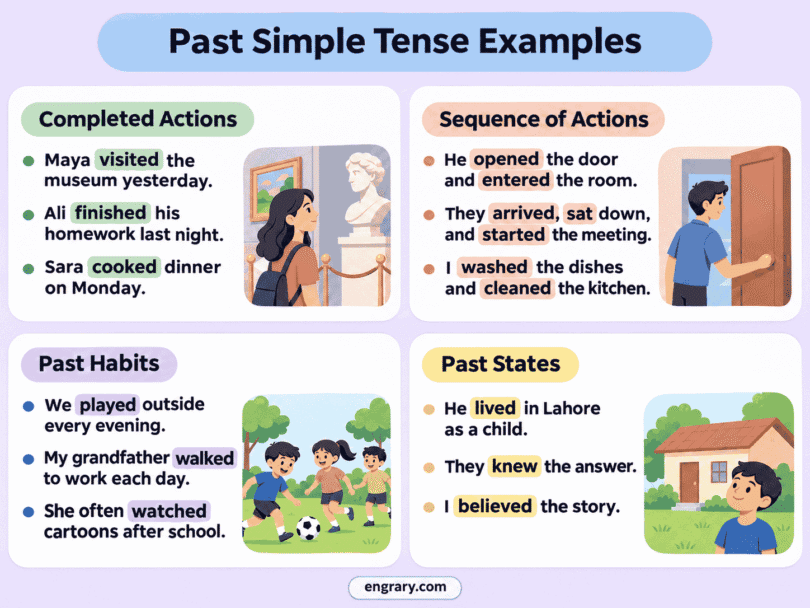
Past simple tense examples show how English describes completed actions, events, habits, and situations from a finished past period. Regular verbs usually take an -ed ending, whereas irregular verbs use special forms such as went, saw, bought, and wrote.
Below are 150 past simple examples divided into affirmative sentences, negative sentences, questions, forms with was and were, and sentences showing different uses. In addition, reference and correction tables explain important patterns without interrupting the continuously numbered example lists.
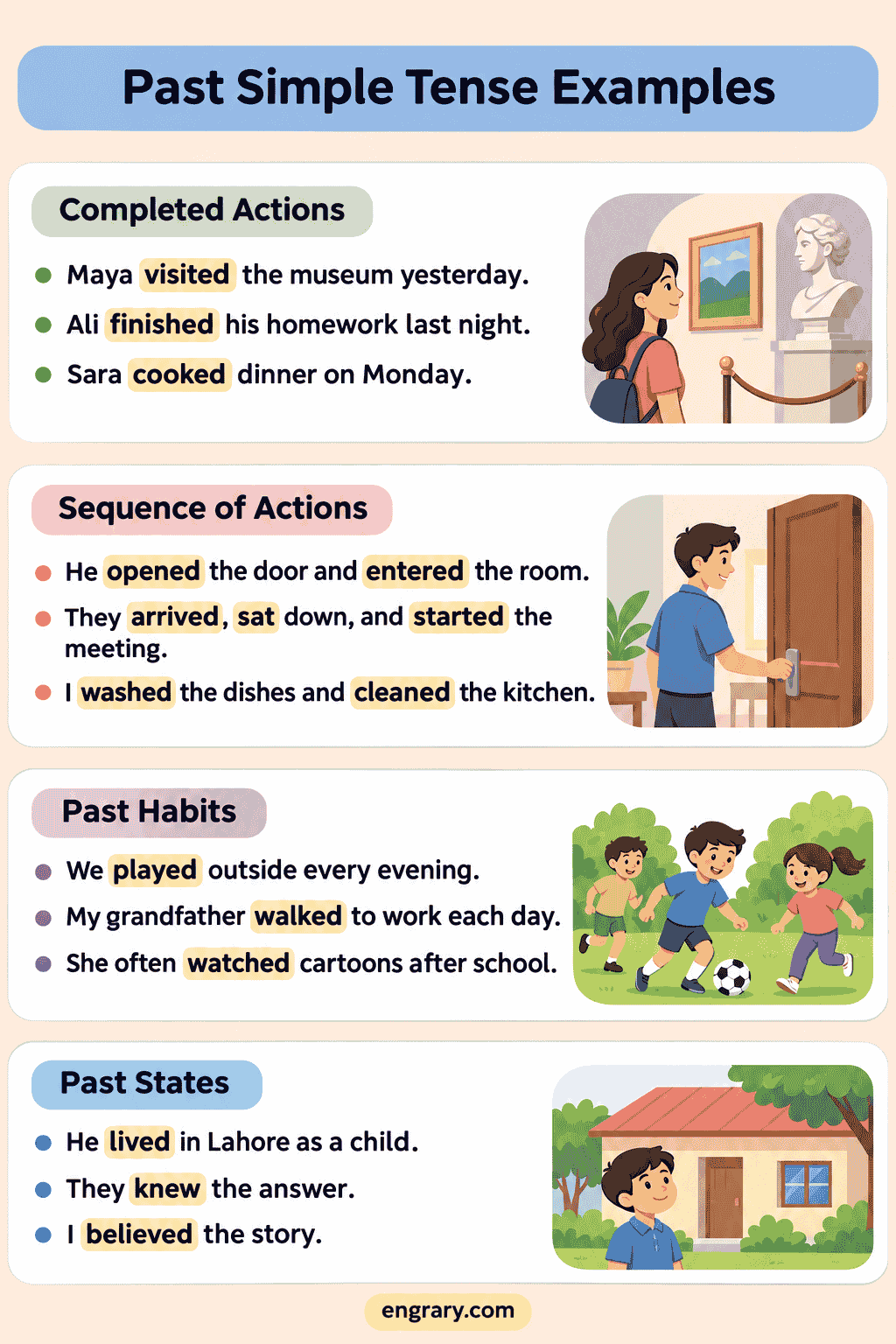
Past Simple Tense Examples at a Glance
The past simple, also called the simple past, places an action or situation in a finished past period. Some learners also call it the past indefinite tense. Although the names vary, the structures remain the same.
| Sentence form | Structure | Example |
|---|---|---|
| Affirmative | Subject + past verb | She visited her aunt. |
| Negative | Subject + didn’t + base verb | She didn’t visit her aunt. |
| Question | Did + subject + base verb? | Did she visit her aunt? |
| Affirmative with be | Subject + was/were | She was at home. |
| Negative with be | Subject + wasn’t/weren’t | She wasn’t at home. |
| Question with be | Was/Were + subject? | Was she at home? |
Affirmative sentences use a regular or irregular past form. However, ordinary negatives and questions use did or didn’t followed by the base verb. The verb be follows its own pattern with was and were.
Affirmative Past Simple Examples with Regular Verbs
Regular verbs usually add -ed or -d. However, spelling changes may occur with verbs ending in -y, a short vowel plus a consonant, or final -c.
- I worked from home yesterday.
- Sara visited her aunt last weekend.
- We watched a documentary after dinner.
- The mechanic repaired our car in two hours.
- They moved to Islamabad in 2022.
- My mother baked fresh bread on Sunday.
- The children played quietly while their parents talked.
- I cleaned my desk before the meeting began.
- Adeel finished the report, so he left the office early.
- We opened the windows because the room felt warm.
- Hina studied all evening for her examination.
- The baby cried until her mother returned.
- They carried the boxes upstairs before lunch.
- I stopped at the pharmacy on my way home.
- We planned the journey carefully; therefore, everything went smoothly.
- The company preferred the second design because it cost less.
- She travelled across northern Pakistan during the holidays.
- The audience clapped when the performance ended.
- He panicked briefly, but he quickly regained control.
- Finally, the workers completed the repairs before sunset.
Affirmative Past Simple Examples with Irregular Verbs
Irregular verbs use special past forms instead of adding -ed. Therefore, learners need to recognize frequent forms such as went, had, made, saw, and took.
- Ali went to the market before breakfast.
- I saw an old friend at the railway station.
- We ate lunch outside because the weather was pleasant.
- She drank a glass of water after the race.
- They came home shortly before midnight.
- My brother bought a new backpack last week.
- Fatima brought homemade biscuits to the meeting.
- We took several photographs while we explored the old town.
- He wrote a detailed message and sent it to the manager.
- The students spoke confidently during the presentation.
- I gave her the documents as soon as she arrived.
- They made a careful decision after reviewing the evidence.
- She found her keys beneath the sofa.
- We knew the road was closed, so we chose another route.
- Ahmed thought about the proposal throughout the weekend.
- My teacher told us an interesting story about her childhood.
- The driver drove slowly because thick fog covered the road.
- I felt much better after I rested for an hour.
- They left the restaurant when the rain stopped.
- We met our guide outside the museum.
- She paid the electricity bill online yesterday.
- The child read the entire book in one afternoon.
- Our team won the final, and the crowd celebrated loudly.
- The company grew rapidly during its first three years.
- He chose the blue jacket instead because it fitted him better.
Negative Past Simple Tense Examples
Use did not or didn’t followed by the base form of an ordinary verb. Words such as never, nobody, and nothing already express negative meaning, so they do not normally require didn’t.
- I didn’t hear the alarm this morning.
- We did not finish the report yesterday.
- Ahmed didn’t bring his notebook to class.
- The guests didn’t arrive on time because their train was delayed.
- She did not understand the instructions at first.
- They didn’t buy anything at the market.
- I didn’t see your message until the evening.
- My sister didn’t take the bus because I drove her.
- The shop did not open on Monday.
- We didn’t know about the schedule change.
- He didn’t have enough money for the ticket.
- They did not do the final task correctly.
- I didn’t make a copy before I deleted the file.
- She didn’t tell anyone where she went.
- The children didn’t sleep well because the storm was noisy.
- I never saw him after he moved abroad.
- Nobody answered the door when we knocked.
- Nothing happened while you were away.
- We didn’t use to live near the city centre.
- However, the manager didn’t cancel the meeting despite the heavy rain.
Negative Words and Double Negatives
| Incorrect | Correct |
|---|---|
| I didn’t never see him. | I never saw him. |
| Nobody didn’t answer. | Nobody answered. |
| She didn’t say nothing. | She didn’t say anything. |
Past Simple Tense Question Examples
Most past simple questions place did before the subject and use the base verb. However, questions with be use was or were, while subject questions use the past verb directly.
- Did you lock the front door?
- Did Adeel submit his application yesterday?
- Did the children enjoy the school trip?
- Did she buy the blue dress or the green one?
- Did they have enough time to finish?
- What did you do over the weekend?
- Where did your family stay during the holiday?
- When did the meeting end?
- Why did Hina leave early?
- How did the glass break?
- Which route did the driver choose?
- How long did you work at the hospital?
- Who called you last night?
- What caused the power failure?
- Which team won the competition?
- Who did you call after the accident?
- What did the delay affect?
- Didn’t you see the warning sign?
- Didn’t she tell you about the change?
- Did he arrive before noon? — Yes, he did.
- Did they finish the work? — No, they didn’t.
- Did you understand the lesson? — Yes, I did.
- Did Mariam bring her passport? — No, she didn’t.
- You met him yesterday, didn’t you?
- They didn’t complain, did they?
Subject and Object Questions
| Question type | Example | Explanation |
|---|---|---|
| Subject question | Who called you? | Who performed the action, so did is unnecessary. |
| Object question | Who did you call? | You performed the action, so the question uses did. |
| Subject question | What caused the delay? | What is the subject. |
| Object question | What did the delay affect? | The delay is the subject. |
Emphatic Did
Affirmative did can add emphasis or correct a misunderstanding. The main verb remains in its base form.
- I did send the email.
- She did warn us.
- They did complete the work.
Past Simple Examples with Was and Were
The verb be forms its own negatives and questions without did. Use was with I, he, she, and it, but use were with you, we, and they.
- I was tired after the long journey.
- Hina was nervous before her interview.
- The weather was cold and windy yesterday.
- You were very helpful during the event.
- We were ready before the guests arrived.
- The roads were quiet after midnight.
- I wasn’t angry with you.
- The office wasn’t open on Friday.
- The players weren’t ready for the match.
- We were not aware of the problem.
- Was the room comfortable?
- Was your brother at work yesterday?
- Were your parents at the ceremony?
- Were the shops busy during the sale?
- Was she at home? — Yes, she was.
- Were they late? — No, they weren’t.
- There was a message on my desk.
- There were several witnesses outside the building.
- She was born in Karachi in 2001.
- You were surprised, weren’t you?
Past Simple Examples for Habits, States, and Event Sequences
The past simple can describe repeated actions, former routines, past states, finished duration, historical events, and sequences that move a story forward.
- We visited our grandparents every summer.
- My father walked to work when he was young.
- After school, the children usually played cricket in the street.
- She often carried a notebook wherever she went.
- I knew the answer, but I remained silent.
- They owned a small bookshop near the university.
- We wanted more time; however, the office closed at five.
- The plan seemed reasonable when the manager explained it.
- She worked at the hospital for ten years.
- They stayed with us for two weeks before moving into their apartment.
- The first modern Olympic Games took place in 1896.
- Marie Curie won two Nobel Prizes during her lifetime.
- First, he opened the door and checked the hallway.
- Next, he entered the room and switched on the light.
- Then, he noticed an envelope on the desk.
- Suddenly, the telephone rang, so he turned around.
- When the bell rang, the students left the classroom.
- After she finished work, she went home.
- We waited until the rain stopped.
- Finally, the train arrived, and everyone boarded quickly.
Past Simple Passive and Advanced Examples
The past simple passive uses was or were followed by a past participle. In addition, past forms can express hypothetical situations, wishes, polite distance, and reported speech rather than literal past time.
- The office was cleaned yesterday evening.
- The windows were repaired by a local company.
- The final decision was announced at noon.
- The packages weren’t delivered on Monday.
- The documents were not signed before the deadline.
- Was the payment received yesterday?
- Were the invitations sent on time?
- The novel was written by George Orwell.
- If I knew the answer, I would tell you.
- If she lived closer, we would visit her more often.
- I wish I had more free time.
- She wishes she lived nearer the office.
- If I were you, I would apologize.
- I wish he were here with us.
- It’s time we left for the station.
- I would rather you stayed until tomorrow.
- Suppose you lost your passport while travelling abroad.
- Did you want to speak to the manager?
- She said that she needed more time.
- The guide explained that the museum closed at five.
Regular Past-Verb Spelling Patterns
The numbered examples show several regular endings. The following table summarizes the main spelling rules.
| Verb ending | Rule | Examples |
|---|---|---|
| Most verbs | Add -ed | work → worked, clean → cleaned |
| Final -e | Add -d | live → lived, close → closed |
| Consonant + y | Change y to i and add -ed | carry → carried, study → studied |
| Vowel + y | Add -ed | play → played, enjoy → enjoyed |
| Short vowel + consonant | Double the final consonant | stop → stopped, plan → planned |
| Stressed final syllable | Double the final consonant | prefer → preferred, admit → admitted |
| Unstressed final syllable | Do not double | visit → visited, open → opened |
| Final w, x, or y | Do not double | snow → snowed, fix → fixed, play → played |
| Final -c | Add k before -ed | panic → panicked, picnic → picnicked |
British and American Spelling
| British English | American English |
|---|---|
| travelled | traveled |
| cancelled | canceled |
| labelled | labeled |
| modelled | modeled |
Both versions are correct within their respective spelling systems. Therefore, writers should choose one variety and use it consistently.
Pronunciation of -ed
The spelling remains -ed, but the ending has three possible pronunciations.
| Sound | Used after | Examples |
|---|---|---|
| /t/ | Voiceless sounds except /t/ | worked, watched, laughed, fixed |
| /d/ | Vowels and voiced sounds except /d/ | played, cleaned, called, lived |
| /ɪd/ | /t/ and /d/ | wanted, needed, decided, started |
Only /ɪd/ adds another syllable. For example, wanted has two syllables, whereas worked has one.
Common Irregular Past Forms
| Base form | Past simple | Past participle |
|---|---|---|
| go | went | gone |
| see | saw | seen |
| write | wrote | written |
| drink | drank | drunk |
| begin | began | begun |
| choose | chose | chosen |
| take | took | taken |
| speak | spoke | spoken |
| eat | ate | eaten |
| drive | drove | driven |
| give | gave | given |
| know | knew | known |
The past simple can serve as the sentence’s main verb, as in She wrote a letter. By contrast, the past participle normally needs an auxiliary, as in She has written a letter.
Irregular Verbs with Alternative Forms
| Base verb | Accepted variants | Note |
|---|---|---|
| learn | learned/learnt | Learnt is especially common in British English. |
| dream | dreamed/dreamt | Both forms are standard. |
| burn | burned/burnt | Both forms occur. |
| spell | spelled/spelt | Spelt is especially common in British English. |
| get | got | Gotten is mainly an American past participle. |
| prove | proved | Proven commonly serves as an alternative participle. |
Commonly Confused Irregular Verbs
| Verb | Past simple | Important distinction |
|---|---|---|
| fall | fell | Feel becomes felt. |
| lie down | lay | Lay meaning “put” becomes laid. |
| lose | lost | Loose is usually an adjective. |
| leave | left | Live becomes lived. |
| read | read /red/ | The spelling stays the same. |
| hang | hung | Hanged usually refers to execution. |
Difficult pronunciations include read /red/, said /sed/, bought /bɔːt/, and thought /θɔːt/. Moreover, was and were often have weaker pronunciations in unstressed speech.
Past Simple Time Expressions
Past-time expressions place an action in a finished moment or period.
| Time expression | Example |
|---|---|
| yesterday | I saw her yesterday. |
| last night | We stayed home last night. |
| two days ago | They arrived two days ago. |
| in 2020 | She graduated in 2020. |
| on Monday | He called on Monday. |
| when I was young | I played outside when I was young. |
| earlier that day | We discussed it earlier that day. |
| during the holidays | They travelled during the holidays. |
Ago and Before
| Expression | Reference point | Example |
|---|---|---|
| Ago | Counts back from now | We moved here three years ago. |
| Before | Counts back from another past point | She said they had moved three years before. |
Place ago after the period of time: three years ago, not ago three years.
Last and The Last
| Expression | Meaning | Example |
|---|---|---|
| last year | A finished calendar period | I worked in Lahore last year. |
| for the last year | A period continuing to now | I have worked here for the last year. |
Finished and Unfinished Time Periods
Expressions such as today and this morning can take different tenses depending on whether the speaker views the period as finished.
| Finished viewpoint | Unfinished viewpoint |
|---|---|
| I saw her this morning. | I have seen her twice this morning. |
| The morning is over. | The morning is still continuing. |
Past Simple with Have and Do
The main verbs have and do become had and did in affirmative statements. However, negatives and questions use auxiliary did followed by the base forms have and do.
| Function | Example |
|---|---|
| Had as a main verb | We had enough time. |
| Negative with have | They didn’t have a reservation. |
| Question with have | Did he have any difficulty? |
| Did as a main verb | She did her homework. |
| Auxiliary and main verb | What did you do yesterday? |
Past Simple and Related Forms
Past Simple and Past Continuous
| Past simple | Past continuous | Difference |
|---|---|---|
| The phone rang. | I was cooking. | Completed event versus action in progress |
| She entered the room. | Everyone was talking. | Main event versus background activity |
| The lights went out. | We were watching television. | Interruption versus ongoing action |
Past Simple and Present Perfect
| Past simple | Present perfect | Difference |
|---|---|---|
| I visited Lahore last year. | I have visited Lahore several times. | Finished time versus life experience |
| She finished the report yesterday. | She has finished the report. | Stated time versus present result |
| We lived there for five years. | We have lived here for five years. | Finished versus continuing situation |
Past Simple and Past Perfect
| Past simple | Past perfect | Difference |
|---|---|---|
| We arrived at the station. | The train had already left. | Later event versus earlier event |
| She opened the parcel. | She had received it that morning. | Main event versus prior event |
Past Simple and Used To
| Past simple | Used to or would | Difference |
|---|---|---|
| I walked to school every day. | I used to walk to school. | Used to emphasizes a former habit. |
| She lived near us. | She used to live near us. | Used to works with past states. |
| He called every Friday. | He would call every Friday. | Would describes repeated actions. |
In formal edited English, questions and negatives normally use use to after did: Did you use to live here? and I didn’t use to like coffee. Moreover, would describes repeated actions but not ordinary states. Therefore, I used to own a house sounds natural, whereas I would own a house does not normally carry the same meaning.
Reported Speech and Embedded Questions
Reported Speech Backshift
| Direct speech | Reported speech |
|---|---|
| “I need help.” | She said that she needed help. |
| “We live nearby.” | They explained that they lived nearby. |
| “I know the answer.” | He said that he knew the answer. |
Backshift is not always necessary when the information remains true or the speaker emphasizes its present relevance.
Embedded Question Word Order
| Incorrect | Correct |
|---|---|
| She asked where did I live. | She asked where I lived. |
| I wondered why did he leave. | I wondered why he left. |
| Did you know where was she? | Did you know where she was? |
An embedded question uses statement word order rather than direct-question order.
Past Simple Narrative with Analysis
Last Saturday, Amina woke up early, prepared breakfast, and packed a small bag. Then, she left home at eight and met her friends outside the railway station. They bought their tickets, boarded the train, and found seats near a window. During the journey, they talked, shared snacks, and took photographs. They reached their destination before noon and spent the afternoon exploring the old town. Finally, they returned home after sunset.
| Example from the paragraph | Feature |
|---|---|
| woke up | Irregular past verb |
| prepared and packed | Regular past verbs |
| left and met | Sequence of irregular actions |
| bought, boarded, and found | Ordered past events |
| talked and shared | Regular past verbs |
| took and spent | Irregular past verbs |
| Last Saturday | Finished past-time expression |
| Then and Finally | Narrative connectors |
Common Errors in Past Simple Sentences
| Incorrect | Correct | Explanation |
|---|---|---|
| She didn’t went home. | She didn’t go home. | Use the base verb after didn’t. |
| Did he played football? | Did he play football? | Use the base verb after did. |
| I goed to school. | I went to school. | Go has the irregular past form went. |
| They was tired. | They were tired. | Use were with plural subjects. |
| He were late. | He was late. | Use was with he, she, and it. |
| The film begun at eight. | The film began at eight. | Began is the past simple form. |
| She writed a letter. | She wrote a letter. | Do not add -ed to an irregular verb. |
| I have seen him yesterday. | I saw him yesterday. | Use the past simple with finished time. |
| Did she had a ticket? | Did she have a ticket? | Use the base verb after did. |
| They didn’t finished the work. | They didn’t finish the work. | Use the base form after didn’t. |
| I met her ago three years. | I met her three years ago. | Place ago after the time period. |
| She asked where did I live. | She asked where I lived. | Use statement order in an embedded question. |
| I was borned in 2001. | I was born in 2001. | Use the fixed form was/were born. |
Tips for Writing Past Simple Sentences
- Use the past form of the main verb in affirmative sentences.
- Use the base verb after did and didn’t.
- Form negatives and questions with was and were directly.
- Learn frequent irregular verbs in related pattern groups.
- Distinguish the past simple from the past participle.
- Check the verb’s ending and stress pattern before adding -ed.
- Practise the /t/, /d/, and /ɪd/ pronunciations.
- Use the past simple with finished past-time expressions.
- Place ago after the period of time.
- Avoid double negatives with never, nobody, and nothing.
- Use statement word order inside embedded questions.
- Use hypothetical were in careful formal writing.
FAQs
Past simple examples include I worked from home yesterday, She bought a new laptop, They were at the station, and We visited our grandparents every summer. These sentences express a regular past action, an irregular past action, a past state, and a repeated past habit.
Use the past form of the main verb after the subject. Regular verbs usually add -ed, as in work → worked, while irregular verbs use special forms, such as go → went. The verb be changes to was or were.
Use did not or didn’t followed by the base form of the main verb, as in She didn’t go. With the verb be, use was not, wasn’t, were not, or weren’t without did. Words such as never and nobody already carry negative meaning.
Place did before the subject and use the base verb, as in Did they arrive? Questions with be begin with was or were, as in Were they ready? Subject questions such as Who called you? do not normally use did.
Use was with I, he, she, and it. Use were with you, we, and they. These forms create their own negatives and questions without did. Formal hypothetical statements may use were with every subject, as in If I were you.
You May Also Like

Leave a Comment