
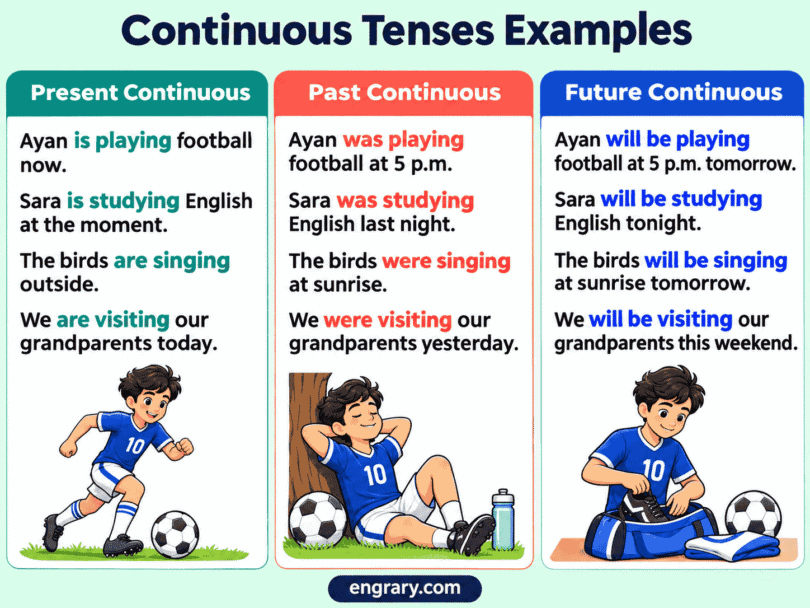
Continuous tenses present actions and situations as ongoing, temporary, changing, or developing around a particular time. The present continuous connects an activity with now, the past continuous places it around a past reference point, and the future continuous shows it in progress around a future time.
This guide provides 120 continuous tense examples in sentences. It separates the present, past, and future continuous forms while covering affirmative statements, negative sentences, questions, short answers, structures, comparisons, time expressions, spelling patterns, and common mistakes.
Everyday Continuous Tense Examples Across Three Time Frames
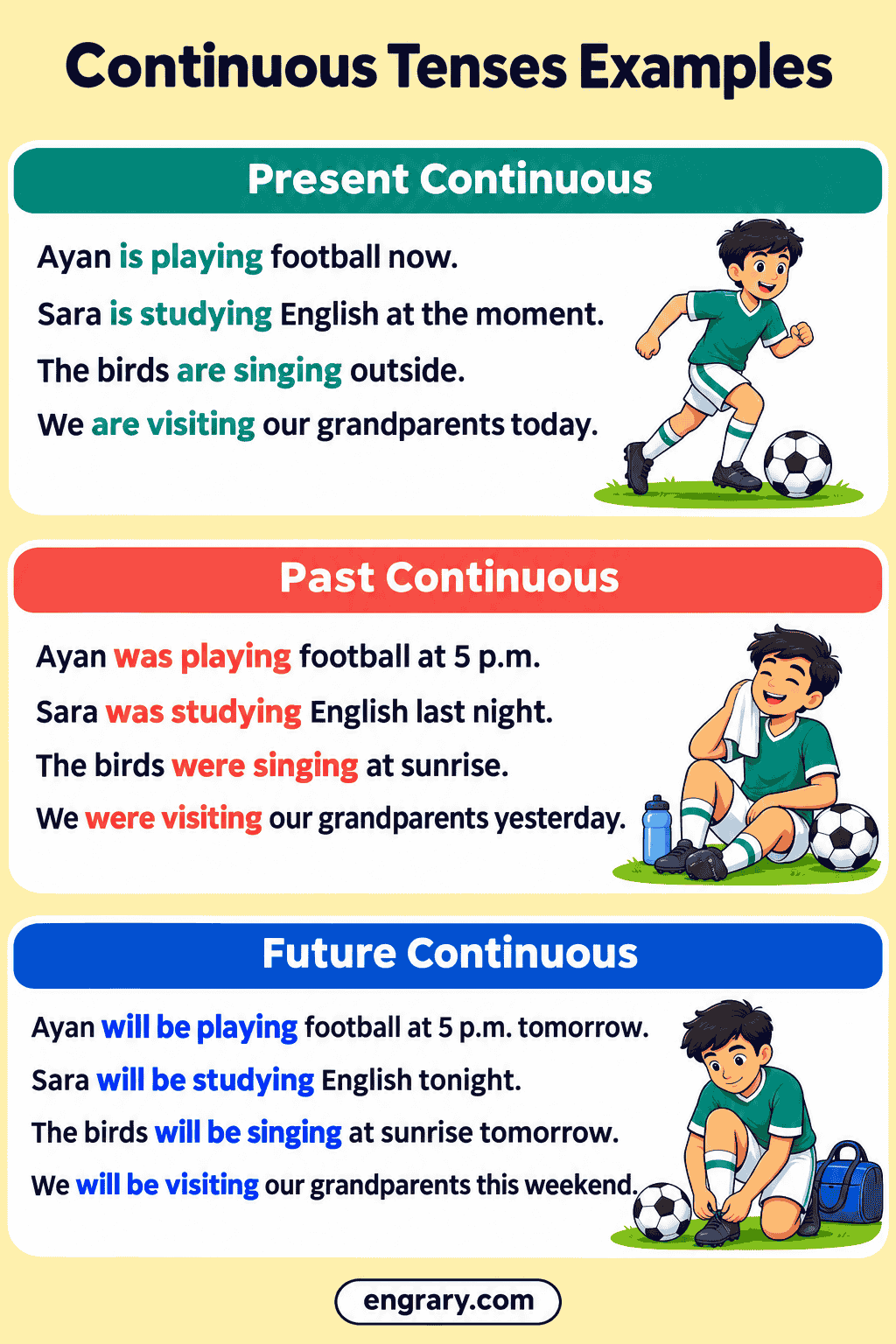
The three continuous tenses can present the same activity from different time perspectives. Notice how the form of be changes while the main verb keeps its -ing form:
- Ayesha is preparing a presentation now. — The activity is in progress in the present.
- Ayesha was preparing a presentation at this time yesterday. — The activity was in progress around a past reference point.
- Ayesha will be preparing a presentation at this time tomorrow. — The activity will be in progress around a future reference point.
| Continuous tense | Structure | Time reference | Example |
|---|---|---|---|
| Present continuous | am/is/are + verb-ing | Now or around now | He is studying. |
| Past continuous | was/were + verb-ing | A particular past time | He was studying at eight. |
| Future continuous | will be + verb-ing | A particular future time | He will be studying at eight tomorrow. |
The terms continuous and progressive usually describe the same grammatical aspect. Therefore, past continuous and past progressive, for example, name the same form.
Continuous Tense Structures
Every continuous tense uses a form of be followed by the -ing form of the main verb.
| Tense | Affirmative | Negative | Question |
|---|---|---|---|
| Present continuous | She is working. | She is not working. | Is she working? |
| Past continuous | She was working. | She was not working. | Was she working? |
| Future continuous | She will be working. | She will not be working. | Will she be working? |
Short answers repeat the first auxiliary rather than the main verb:
| Tense | Positive answer | Negative answer |
|---|---|---|
| Present continuous | Yes, she is. | No, she isn’t. |
| Past continuous | Yes, she was. | No, she wasn’t. |
| Future continuous | Yes, she will. | No, she won’t. |
Present Continuous Tense Examples in Sentences
The present continuous describes actions happening now or around now. In addition, it can express temporary situations, developing conditions, confirmed future arrangements, and repeated behavior that causes a reaction.
Affirmative Present Continuous Examples
The following examples demonstrate the main affirmative uses of am, is, and are + verb-ing:
- I am writing an email to my manager. — The action is happening now.
- The children are playing in the garden. — The activity is in progress at the moment.
- Sara is talking to a customer on the phone. — Sara is in the middle of the conversation.
- We are waiting for the bus. — The waiting is happening now.
- The dog is sleeping under the table. — The sentence describes a current activity.
- It is raining heavily outside. — The weather event is occurring now.
- I am reading a book about space. — The activity belongs to the current period, although it may not be happening at this exact second.
- Hamza is learning to drive. — His learning process is underway around now.
- The company is developing a new mobile application. — The project is currently in progress.
- We are staying with our relatives this week. — The situation is temporary.
- Mariam is working from home this month. — Her current arrangement has a limited duration.
- They are living in Islamabad until June. — The living situation is not presented as permanent.
- Food prices are rising quickly. — The sentence describes a developing trend.
- Your English is improving every day. — The skill is changing gradually.
- The days are becoming warmer. — The condition is developing over time.
- I am meeting the dentist at three tomorrow. — The sentence describes a confirmed future appointment.
- We are having dinner with Ali tonight. — The speakers have arranged the future meal.
- The students are visiting the museum next Tuesday. — The future visit has already been organized.
- He is always losing his keys. — The continuous form emphasizes the speaker’s annoyance.
- They are constantly interrupting the teacher. — The repeated behavior causes a negative reaction.
- She is always helping her classmates. — Here, the same pattern expresses praise.
Negative Present Continuous Examples
Add not after am, is, or are to form a negative present continuous sentence. Contractions such as isn’t and aren’t are common in speech and informal writing.
- I am not using my phone right now. — The action is not happening at this moment.
- The baby is not sleeping. — The expected activity is not in progress.
- We aren’t watching television tonight. — The sentence denies a current or arranged activity.
- Ahmed isn’t working from the office this week. — His temporary situation differs from his normal routine.
- They are not staying at the hotel anymore. — The temporary arrangement has ended.
- The weather isn’t improving. — The expected change is not developing.
- I am not meeting the client tomorrow. — The speaker does not have that future arrangement.
- The children aren’t playing outside because it is raining. — The activity is not happening now.
- Our neighbors are not moving this month. — The sentence denies a planned future event.
Present Continuous Questions
Place am, is, or are before the subject in most present continuous questions. In an information question, place the question word first.
- Are you waiting for someone? — Yes, I am.
- Is Hina working today? — No, she isn’t.
- Are the children studying in their room? — Yes, they are.
- Is it raining outside? — No, it isn’t.
- What are you reading at the moment? — I am reading a history book.
- Where is your family staying this week? — They are staying with my aunt.
- Why is the baby crying? — He is feeling hungry.
- When are you meeting the manager? — I am meeting her tomorrow morning.
- Who is using the computer? — Bilal is using it.
In Example 42, who is the subject, so another subject does not appear before is using.
Past Continuous Tense Examples in Sentences
The past continuous describes an action that was in progress around a particular past time. It also establishes story backgrounds, presents simultaneous activities, and shows a longer action during which another event occurred.
Affirmative Past Continuous Examples
Use was + verb-ing with I, he, she, it, and singular nouns. Meanwhile, use were + verb-ing with you, we, they, and plural nouns.
- I was studying at nine last night. — The activity was in progress at a specific past time.
- She was driving home at six o’clock. — The driving surrounded the stated time.
- They were traveling through Punjab that afternoon. — The activity continued during a past period.
- We were discussing the budget during lunch. — The discussion was underway during another period.
- The workers were repairing the road all morning. — The activity filled much of the stated past period.
- The sun was shining over the hills. — The past continuous establishes part of a scene.
- Birds were singing in the trees. — The activity adds background detail.
- People were walking through the busy market. — The sentence helps describe an earlier scene.
- A cold wind was blowing across the field. — The continuous form creates atmosphere.
- I was sleeping when the phone rang. — The simple past event occurred during the longer activity.
- We were eating dinner when the lights went out. — The power failure interrupted the scene.
- Sara was walking home when it started to rain. — The rain began during her walk.
- The team was practicing when the coach arrived. — The practice was already in progress.
- I was cooking while Ahmed was setting the table. — Two activities were happening simultaneously.
- The children were playing while their parents were talking. — Both activities continued at the same time.
- Hina was taking notes while the teacher was explaining the lesson. — The actions occurred together.
- I was living with my uncle that summer. — The sentence describes a temporary past situation.
- She was working at a café during the holidays. — The job belonged to a limited past period.
- He was always borrowing my books. — The repeated behavior annoyed or affected the speaker.
- They were constantly arguing about money. — The continuous form emphasizes repeated irritation.
- I was wondering if you could help me. — The past continuous softens a present request.
Negative Past Continuous Examples
Add not after was or were. The contractions wasn’t and weren’t make the sentences more natural in conversation.
- I was not sleeping when you called. — The activity was not in progress at that time.
- Sana wasn’t working yesterday afternoon. — The sentence denies an activity during a past period.
- We were not waiting outside at eight. — The group was not engaged in the stated action.
- The children weren’t playing when the rain began. — The simple past event did not interrupt that activity.
- Ahmed was not driving during the journey. — Someone else may have been driving.
- They weren’t living in Karachi at the time. — The temporary past situation did not apply to them.
- The wind wasn’t blowing when we left the house. — That background condition was absent.
- I was not listening while the instructions were being explained. — The speaker admits that the activity was not happening.
- The workers weren’t repairing the road last week. — The project was not in progress during that period.
Past Continuous Questions
Place was or were before the subject. In a short answer, repeat the same auxiliary.
- Were you sleeping when I called? — No, I wasn’t.
- Was Sana studying at eight? — Yes, she was.
- Were the children playing outside? — No, they weren’t.
- Was the driver waiting near the gate? — Yes, he was.
- What were they discussing during the meeting? — They were discussing the budget.
- Where was Ahmed going when you saw him? — He was going to the bank.
- Why were the students laughing? — They were watching a funny video.
- What were you doing at this time yesterday? — I was traveling home.
- Who was waiting outside the office? — The new assistant was waiting there.
Example 81 is a subject question. Therefore, it does not need an additional subject between was and waiting.
Future Continuous Tense Examples in Sentences
The future continuous describes an activity that will be in progress around a future time. Furthermore, it can express expected events, future routines, activities that will occur as a matter of course, and neutral questions about plans.
Affirmative Future Continuous Examples
Use will be + verb-ing with every subject. Unlike the present and past forms, the auxiliary does not change.
- This time tomorrow, I will be flying to Istanbul. — The journey will be in progress around a future time.
- At eight tonight, we will be watching the match. — The activity will surround eight o’clock.
- She will be taking her exam on Monday morning. — The exam will be underway during that period.
- The engineers will be testing the system at noon. — The test will be in progress at a stated future time.
- They will be traveling all day tomorrow. — The journey will continue through the future period.
- I will be working when you arrive. — The work will already be in progress.
- At this hour next week, the team will be presenting its proposal. — The presentation will surround the future reference point.
- The guests will be arriving soon. — Their arrival forms part of the expected future situation.
- The manager will be joining us later. — The speaker expects this event.
- The children will be returning from school at three. — Their return belongs to the expected course of events.
- More customers will be shopping online during the sale. — The sentence predicts ongoing future behavior.
- I will be checking my email every morning while I am away. — The activity will form part of a future routine.
- She will be attending classes on weekdays. — The sentence describes a repeated future schedule.
- They will be practicing after school throughout the month. — The practice will occur regularly during a future period.
- I will be seeing Hamza at work, so I can give him the message. — The meeting will happen as part of an existing routine.
- The delivery driver will be passing our street tomorrow. — The event belongs to the driver’s expected route.
- Our representative will be visiting your office next week. — The visit is part of an arranged course of events.
- While I am preparing dinner, the children will be doing their homework. — Two activities will occur at the same future time.
- At noon tomorrow, we will be traveling while our friends will be working. — The sentence contrasts simultaneous future activities.
- More people will be working remotely in the coming years. — The sentence describes a developing future trend.
- The city will be growing rapidly over the next decade. — The development will continue through a future period.
Negative Future Continuous Examples
Use will not be or won’t be before the -ing form of the main verb.
- I will not be working tomorrow morning. — The activity will not be in progress then.
- Sana won’t be attending the meeting. — She will be absent from the expected event.
- We will not be staying at the hotel next week. — The group will not have that temporary arrangement.
- The children won’t be using the classroom this afternoon. — The activity will not occur during the stated period.
- Ahmed will not be traveling with us. — He will not take part in the journey.
- The shop won’t be opening early tomorrow. — The expected opening will not happen early.
- They will not be waiting when we arrive. — The waiting will not be in progress at that future moment.
- I won’t be checking messages during the exam. — The speaker rules out an activity during a future period.
- The company will not be hiring new staff this month. — The process will not occur during the stated future period.
Future Continuous Questions
Place will before the subject, while be + verb-ing remains after it. Short answers repeat will, not be.
- Will you be using the car tonight? — No, I won’t.
- Will Sana be joining us for dinner? — Yes, she will.
- Will the technicians be working tomorrow? — Yes, they will.
- Will your family be staying for the weekend? — No, they won’t.
- What will you be doing this time tomorrow? — I will be taking an exam.
- Where will they be staying during the conference? — They will be staying near the venue.
- When will the team be presenting its proposal? — It will be presenting on Monday.
- Why will Ahmed be traveling alone? — His colleagues will be arriving later.
- Who will be leading the meeting tomorrow? — Ms. Khan will be leading it.
Example 120 is a subject question. In addition, notice that the correct short answer to Will Sana be joining us? is Yes, she will, not Yes, she will be.
Differences Between Continuous Tenses
The continuous form keeps its focus on an activity in progress. However, the auxiliary identifies whether the reference point belongs to the present, past, or future.
| Verb | Present continuous | Past continuous | Future continuous |
|---|---|---|---|
| work | I am working now. | I was working at eight yesterday. | I will be working at eight tomorrow. |
| travel | They are traveling today. | They were traveling yesterday. | They will be traveling tomorrow. |
| study | She is studying now. | She was studying last night. | She will be studying tonight. |
| wait | We are waiting outside. | We were waiting outside. | We will be waiting outside. |
| rain | It is raining now. | It was raining this morning. | It will be raining later. |
| Point | Present continuous | Past continuous | Future continuous |
|---|---|---|---|
| Reference time | Now or around now | A past time | A future time |
| Auxiliary | am/is/are | was/were | will be |
| Main focus | Current activity | Previous activity in progress | Expected future activity |
Simple and Continuous Tense Examples
Simple tenses often describe habits, facts, completed events, or whole situations. By contrast, continuous tenses emphasize temporary conditions, development, or activities in progress.
Simple Present and Present Continuous
| Simple present | Present continuous | Difference |
|---|---|---|
| I work from home. | I am working from home this week. | Regular versus temporary situation |
| She reads every evening. | She is reading now. | Habit versus current action |
| They live in Lahore. | They are living in Lahore temporarily. | Stable versus temporary situation |
| He always loses his keys. | He is always losing his keys. | Neutral frequency versus emotional emphasis |
Simple Past and Past Continuous
| Simple past | Past continuous | Difference |
|---|---|---|
| She cooked dinner. | She was cooking dinner. | Completed event versus activity in progress |
| The telephone rang. | The telephone was ringing. | Single event versus ongoing activity |
| He entered the room. | We were talking when he entered. | New event versus background activity |
Simple Future and Future Continuous
| Simple future | Future continuous | Difference |
|---|---|---|
| I will call Ahmed. | I will be calling Ahmed later. | Decision or promise versus expected activity |
| Will you use the car? | Will you be using the car? | Direct question versus neutral inquiry |
| She will work tomorrow. | She will be working at noon tomorrow. | Future fact versus activity in progress |
Present Continuous Examples for Future Arrangements
The present continuous can describe an organized future arrangement. A future time expression generally makes the intended meaning clear.
| Present continuous example | Meaning |
|---|---|
| I am meeting the dentist at three. | An appointment exists. |
| We are having dinner with Ali tonight. | The social arrangement is settled. |
| They are flying to Doha on Friday. | Their travel has been arranged. |
Other future forms present a different viewpoint:
| Form | Main purpose | Example |
|---|---|---|
| Present continuous | Confirmed arrangement | We are meeting the client tomorrow. |
| Going to | Prior intention | We are going to expand the business. |
| Will | Instant decision, offer, promise, or prediction | I will answer the phone. |
| Simple present | Official timetable or schedule | The meeting starts at ten. |
Past Continuous Examples with When and While
When often introduces a shorter event, whereas while often introduces an activity in progress. Nevertheless, these are common tendencies rather than absolute rules.
| Pattern | Example |
|---|---|
Continuous action + when + simple action | I was sleeping when the phone rang. |
While + continuous action + simple action | While I was sleeping, the phone rang. |
| Two continuous actions | I was cooking while Sara was washing the dishes. |
| Background + story event | The wind was blowing when the window opened. |
The shorter event does not always stop the longer activity. Instead, it simply occurs during that activity.
Future Continuous Examples for Polite Questions
The future continuous can make a question sound like a neutral inquiry about an expected plan rather than a request for a decision.
| Direct question | Neutral continuous question |
|---|---|
| Will you use the car tonight? | Will you be using the car tonight? |
| Will you stay for dinner? | Will you be staying for dinner? |
| Will you attend the meeting? | Will you be attending the meeting? |
| Will you visit the office? | Will you be visiting the office? |
However, context and tone still determine whether a question sounds polite, direct, or demanding.
Stative Verbs and Continuous Forms
Stative verbs usually describe knowledge, possession, preference, emotion, appearance, or relationship. Therefore, they do not normally appear in continuous forms.
Common stative verbs include know, believe, understand, remember, want, need, prefer, own, belong, contain, seem, and love.
| Incorrect | Correct |
|---|---|
| I am knowing the answer. | I know the answer. |
| She was owning the house. | She owned the house. |
| This bag is belonging to Ahmed. | This bag belongs to Ahmed. |
| We are needing more time. | We need more time. |
Some verbs can express either a state or an action. As a result, their continuous forms become natural when their meanings change.
| State meaning | Action meaning |
|---|---|
| I think he is right. | I am thinking about the problem. |
| She has a car. | She is having lunch. |
| The soup tastes salty. | The chef is tasting the soup. |
| I see your point. | I am seeing the dentist tomorrow. |
Spelling Examples for Verbs Ending in ING
Most verbs simply add -ing, but some endings require a spelling change.
| Verb pattern | Rule | Examples |
|---|---|---|
| Most verbs | Add -ing | work → working; play → playing |
Final silent e | Drop e and add -ing | write → writing; make → making |
Final -ie | Change ie to y | lie → lying; die → dying |
| Short stressed vowel + consonant | Double the final consonant | run → running; sit → sitting |
Final -ee | Keep the final e | see → seeing; agree → agreeing |
Final w, x, or y | Do not double the consonant | show → showing; fix → fixing |
British English commonly uses travelling, whereas American English normally uses traveling. Both spellings are correct within their respective systems.
Common Time Expressions
Time expressions help establish the reference period. Still, context and verb structure—not the time expression alone—determine the tense.
| Present continuous | Past continuous | Future continuous |
|---|---|---|
| now | at that moment | this time tomorrow |
| right now | at eight yesterday | at eight tomorrow |
| at the moment | while | all day tomorrow |
| today | when | later tonight |
| this week | yesterday evening | next week |
| currently | during the meeting | in a few hours |
For instance, today can appear with all three forms: I am working today, I was working earlier today, and I will be working later today.
Continuous Tenses in a Short Paragraph
Continuous tenses often work together naturally in connected writing:
Ayesha is preparing for an important presentation this week. Yesterday evening, she was checking her notes while her colleague was designing the slides. At this time tomorrow, they will be presenting their ideas to the management team.
| Verb phrase | Tense | Purpose |
|---|---|---|
| is preparing | Present continuous | Temporary activity around now |
| was checking | Past continuous | Activity in progress yesterday |
| was designing | Past continuous | Simultaneous past activity |
| will be presenting | Future continuous | Activity in progress at a future time |
Common Mistakes with Continuous Tenses
Most continuous tense mistakes involve a missing form of be, incorrect auxiliary agreement, a wrongly formed -ing verb, or an unsuitable stative verb.
| Incorrect | Correct | Explanation |
|---|---|---|
| She reading now. | She is reading now. | A continuous form needs be. |
| They is waiting. | They are waiting. | Use are with a plural subject. |
| I am write an email. | I am writing an email. | Use the -ing form after be. |
| He was work yesterday. | He was working yesterday. | Use verb-ing after was. |
| We were watched television. | We were watching television. | Do not use the past form after were. |
| She will working tomorrow. | She will be working tomorrow. | Future continuous requires will be. |
| Are you study? | Are you studying? | Use the -ing form in the question. |
| I am knowing the answer. | I know the answer. | Know is normally stative. |
| She is lieing down. | She is lying down. | Change final ie to y. |
| He is runing quickly. | He is running quickly. | Double the final consonant. |
| I will be waiting when you will arrive. | I will be waiting when you arrive. | Use the simple present in a future time clause. |
Frequently Asked Questions
What are the three continuous tenses in English?
The three core continuous tenses are the present continuous, past continuous, and future continuous. For example, I am working connects an activity with the present, I was working connects it with a past time, and I will be working connects it with a future time.
What is the basic structure of a continuous tense?
A continuous tense uses a form of be followed by the -ing form of the main verb. The present continuous uses am, is, or are; the past continuous uses was or were; and the future continuous uses will be.
What is the difference between continuous and progressive forms?
There is normally no difference in meaning. Continuous and progressive are two common names for the same grammatical aspect. Therefore, present continuous and present progressive refer to the same form.
Can stative verbs appear in continuous tenses?
Stative verbs such as know, believe, want, need, own, and belong do not normally take continuous forms. However, some verbs can become continuous when their meanings change, as in I am thinking about the problem and She is having lunch.
Can the present continuous describe a future action?
Yes. The present continuous can describe an organized future arrangement, especially when the sentence includes a future time expression: We are meeting the client tomorrow. This form commonly suggests that the speaker has already arranged the event.
You May Also Like

Leave a Comment